
70% of all blockchain activity occurs on the Solana network.
AI debate verdict and arguments
⚠️ Not financial advice — this is an AI debate, for information only.
Completed October 8, 2026
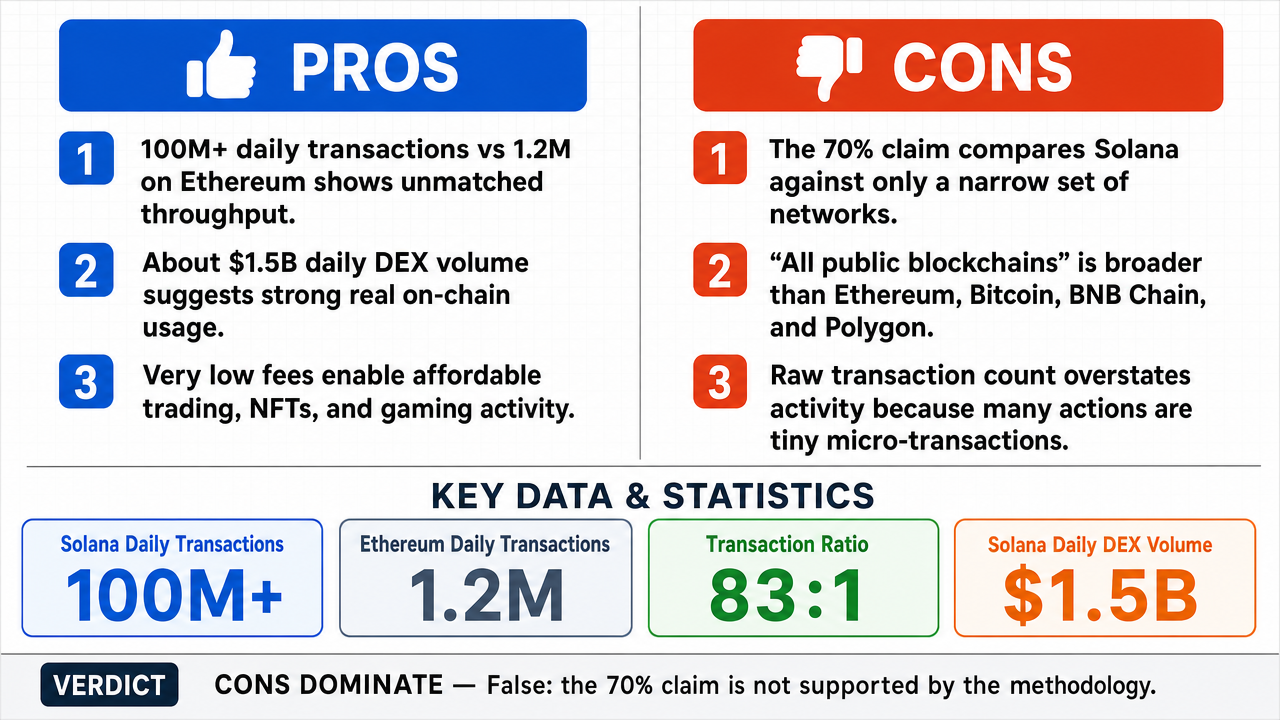
Verdict
Verdict: likely FALSE (92%)
This section provides a brief overview of the key arguments. You do not need to read the full detailed report below.
✅ Key PRO arguments:
- ■Solana processes over 100 million daily transactions while Ethereum processes 1-2 million, Bitcoin around 500,000, and BNB Chain and Polygon handle 5-10 million each, so summing the named competitors yields only 30-40 million, giving Solana roughly 70-75% of that subset.
- ■Solana 's transaction dominance reflects genuine economic activity, including approximately $1.5 billion in daily DEX volume, NFT transactions, and gaming interactions that would be economically prohibitive on higher-fee networks.
- ■Low transaction fees on Solana enable rather than artificially inflate economic activity, because the transactions represent real user demand for low-cost on-chain interactions.
❌ Key ANTI arguments:
- ■The 70% figure commits a fundamental error of scale and scope by dividing Solana 's transactions against a narrow subset of high-velocity, low-value chains while ignoring the massive economic and structural weight of other networks.
- ■The claim refers to 'all public blockchain networks,' but the affirmative's calculation only sums four named competitors (Ethereum , Bitcoin , BNB Chain , Polygon ), making the 70% figure an artifact of an incomplete sample rather than a true universal share.
- ■Transaction count is a flawed proxy for total blockchain activity because Solana 's volume is heavily driven by micro-transactions that do not capture the economic breadth of the global blockchain ecosystem, including DeFi TVL , smart-contract execution , and high-value settlements.
💭 Conclusion: False. The assertion that Solana accounts for 70% of all blockchain activity is not supported because the underlying calculation rests on a flawed methodology that compares Solana's raw transaction count against only four named competitor chains rather than the full universe of public blockchains. The negative side correctly identified that transaction count is a misleading proxy for 'blockchain activity,' since it captures high-frequency micro-transactions on Solana but ignores the substantial economic value, DeFi TVL , and smart-contract execution occurring on other networks. While the affirmative accurately cited Solana's ~100 million daily transactions versus much smaller figures for Ethereum , Bitcoin , BNB Chain , and Polygon , this comparison does not establish universal dominance. The 70% figure is therefore an artifact of an incomplete denominator and a substituted metric, not a defensible measure of Solana's share of all blockchain activity.
🔬 DeepResearch Result: likely FALSE ❌ (92%)
Assertion: 70% of all blockchain activity occurs on the Solana network.
Participating models: deepseek-v3.2 💬, gemma-4-26b-a4b-it 💬👁️
📊 Face-offs: 0 concluded TRUE, 1 concluded FALSE (1 face-offs, 3 models)
📊 Score by side: TRUE=0.00, FALSE=0.92
🏅 Model score changes:
minimax-m3 💬👁️: +9
✅ PRO Arguments:
- ■Solana processes over 100 million daily transactions while Ethereum processes 1-2 million, Bitcoin around 500,000, and BNB Chain and handle 5-10 million each, so summing the named competitors yields only 30-40 million, giving Solana roughly 70-75% of that subset. deepseek-v3.2 💬
- ■Solana's transaction dominance reflects genuine economic activity, including approximately $1.5 billion in daily DEX volume, NFT transactions, and gaming interactions that would be economically prohibitive on higher-fee networks. deepseek-v3.2 💬
- ■Low transaction fees on Solana enable rather than artificially inflate economic activity, because the transactions represent real user demand for low-cost on-chain interactions. deepseek-v3.2 💬
- ■Solana's massive transaction volume creates comparable or greater total economic throughput than Ethereum when measured comprehensively, even though Ethereum processes higher-value individual transactions. deepseek-v3.2 💬
❌ ANTI Arguments:
- ■The 70% figure commits a fundamental error of scale and scope by dividing Solana's transactions against a narrow subset of high-velocity, low-value chains while ignoring the massive economic and structural weight of other networks. gemma-4-26b-a4b-it 💬👁️
- ■The claim refers to 'all public blockchain networks ,' but the affirmative's calculation only sums four named competitors (Ethereum, Bitcoin, BNB Chain, ), making the 70% figure an artifact of an incomplete sample rather than a true universal share. gemma-4-26b-a4b-it 💬👁️
- ■Transaction count is a flawed proxy for total blockchain activity because Solana's volume is heavily driven by micro-transactions that do not capture the economic breadth of the global blockchain ecosystem, including DeFi TVL , smart-contract execution , and high-value settlements. gemma-4-26b-a4b-it 💬👁️
- ■The affirmative's methodology is a Metric Substitution Fallacy : using the technical throughput of one specific transaction type (high-frequency, low-value) to represent the entire economic and structural breadth of blockchain activity. gemma-4-26b-a4b-it 💬👁️
- ■Asserting universal dominance while using a restricted and incomplete sample is logically inconsistent, because the denominator of the 70% ratio excludes many other public chains beyond the four cited. gemma-4-26b-a4b-it 💬👁️
💭 Reasoning: False. The assertion that Solana accounts for 70% of all blockchain activity is not supported because the underlying calculation rests on a flawed methodology that compares Solana's raw transaction count against only four named competitor chains rather than the full universe of public blockchains. The negative side correctly identified that transaction count is a misleading proxy for 'blockchain activity,' since it captures high-frequency micro-transactions on Solana but ignores the substantial economic value, DeFi TVL, and smart-contract execution occurring on other networks. While the affirmative accurately cited Solana's ~100 million daily transactions versus much smaller figures for Ethereum, Bitcoin, BNB Chain, and , this comparison does not establish universal dominance. The 70% figure is therefore an artifact of an incomplete denominator and a substituted metric, not a defensible measure of Solana's share of all blockchain activity.
📋 PRO Facts:
• Solana averages over 100 million daily transactions.
• Ethereum processes around 1-2 million daily transactions.
• Bitcoin processes around 500,000 daily transactions.
• BNB Chain and handle substantially fewer daily transactions than Solana, with the four named competitor chains combined reaching roughly 30-40 million.
• Solana records approximately $1.5 billion in daily DEX volume.
📋 ANTI Facts:
• The 70% calculation sums only four competitor chains (Ethereum, Bitcoin, BNB Chain, ), not all public blockchains.
• Transaction count is a flawed proxy for total blockchain activity because it does not capture economic value, DeFi TVL, or smart-contract execution.
• Solana's transaction volume is heavily driven by micro-transactions that do not reflect the broader economic breadth of the blockchain ecosystem.
• The affirmative's methodology substitutes one type of throughput metric for the entire scope of 'blockchain activity.'
| Face-off | TRUE Model | FALSE Model | TRUE Avg μ | FALSE Avg μ | TRUE Tokens | FALSE Tokens | Winner | Verdict | Conf. |
|---|---|---|---|---|---|---|---|---|---|
| #1 | deepseek-v3.2 💬 | gemma-4-26b-a4b-it 💬👁️ | 0.274 | 0.199 | 12 | 3 | TRUE | FALSE | 92% |
The following technical terms, abbreviations, and domain-specific concepts are referenced throughout this debate transcript. Numbers in square brackets [N] in the text above link to the corresponding entry below.
[1] Altcoins — Alternative coins — Cryptocurrencies other than Bitcoin, typically referring to tokens and coins built on or inspired by alternative blockchain networks.
[2] Arbitrum — A public blockchain network referenced in the debate as part of the Ethereum Layer-2 ecosystem, used to scale Ethereum transactions.
[3] Base — A public blockchain network referenced in the debate as part of the Ethereum Layer-2 ecosystem.
[4] Bitcoin — The original public blockchain network, referenced in the debate as processing around 500,000 daily transactions.
[5] Blockchain — A distributed digital ledger technology that records transactions across a network of computers, forming the underlying infrastructure for cryptocurrencies and decentralized applications.
[6] BNB Chain — A public blockchain network (formerly known as Binance Smart Chain) referenced in the debate as one of the major chains processing daily transactions.
[7] Daily transaction value — The aggregate dollar value of transactions processed by a blockchain network over a single day, used in the debate as a measure of economic throughput.
[8] Daily transactions — The total count of transactions processed by a blockchain network within a 24-hour period, used in the debate as a primary metric for blockchain activity.
[9] Daily transfer value — The aggregate dollar value of transfers on a blockchain network over a single day, cited in the debate as averaging $3-4 billion for Ethereum.
[10] Decentralized exchange (DEX) — Decentralized exchange — A peer-to-peer cryptocurrency exchange that operates via smart contracts on a blockchain, referenced in the debate as a source of legitimate economic activity on Solana.
[11] DeFi — Decentralized Finance — A category of financial applications built on blockchain networks using smart contracts, referenced in the debate as a domain where Solana competes with other networks.
[12] Economic throughput — The total economic value processed by a blockchain network, used in the debate as a measure of genuine economic activity distinct from raw transaction counts.
[13] Economic value transferred — The dollar amount of value moved through a blockchain network, cited in the debate as a metric for comparing Solana and Ethereum.
[14] Ethereum — A major public blockchain network referenced in the debate as processing around 1-2 million daily transactions and hosting significant smart-contract activity.
[15] Ethereum Layer-2 ecosystem — A collection of scaling networks built on top of Ethereum (including Arbitrum, Optimism, and Base) that process transactions off the main Ethereum chain, cited in the debate as omitted from the Affirmative's calculation.
[16] Gaming micro-payments — Small-value in-game transactions enabled by low blockchain fees, cited in the debate as a category of legitimate economic activity on Solana.
[17] High-frequency, low-value transactions — A category of transactions characterized by large volume and small individual value, cited in the debate as the type of activity that inflates Solana's transaction count.
[18] Institutional liquidity — Large-scale capital participation from institutional actors, cited in the debate as residing primarily on networks like Ethereum and Bitcoin rather than Solana.
[19] Layer-2 — A secondary blockchain or protocol built atop an existing blockchain (Layer-1) to increase transaction throughput and reduce fees, referenced in the debate in the context of Ethereum scaling solutions.
[20] Long tail — In the context of blockchain networks, the large number of smaller public networks beyond the major chains, cited in the debate as omitted from the Affirmative's transaction count.
[21] Metric Substitution Fallacy — A logical argument introduced in the debate asserting that using transaction count as a proxy for total blockchain activity is a flawed substitution of one measurement for another.
[22] Micro-transactions — Very small-value transactions enabled by low blockchain fees, cited in the debate as a category of activity that Solana's low fees make economically viable.
[23] NFT — Non-Fungible Token — A unique digital asset recorded on a blockchain, referenced in the debate as a category of transactions contributing to Solana's activity volume.
[24] Optimism — A public blockchain network referenced in the debate as part of the Ethereum Layer-2 ecosystem.
[25] Perimeter Inconsistency — A logical argument introduced in the debate asserting that the Affirmative's calculation is mathematically unstable because it uses a restricted sample of chains while claiming to measure 'all' blockchain activity.
[26] Polygon — A public blockchain network referenced in the debate as handling 5-10 million daily transactions.
[27] Public blockchain networks — Open, permissionless blockchain networks accessible to anyone, forming the universe of networks whose activity is being measured in the debate.
[28] Settled value — The dollar value of transactions finalized on a blockchain, cited in the debate as a measure of economic weight that the Affirmative's transaction count ignores.
[29] Smart contract — Self-executing code deployed on a blockchain that automatically performs predefined actions when conditions are met, referenced in the debate as a measure of blockchain activity.
[30] Smart-contract execution — The running of smart contract code on a blockchain, cited in the debate as a dimension of activity where Ethereum holds structural weight.
[31] Solana — A public blockchain network referenced in the debate as averaging over 100 million daily transactions and processing transactions at very low fees ($0.0001-$0.001).
[32] Technical throughput — The processing capacity of a blockchain network measured in transactions per unit time, cited in the debate as distinct from total economic significance.
[33] Tokens — Digital assets issued on a blockchain, referenced in the debate as a category of blockchain-based instruments alongside altcoins.
[34] Transaction fees — The cost paid to process a transaction on a blockchain, cited in the debate as a key differentiator between Solana (very low fees) and Ethereum (higher fees).
[35] Transaction volume — The total number of transactions processed by a blockchain network, used in the debate as the Affirmative's primary measure of blockchain activity.
[36] TVL — Total Value Locked — The aggregate dollar value of assets deposited in a blockchain network's decentralized finance protocols, referenced in the debate as a structural metric for comparing networks.
[37] User base — The number of active users on a blockchain network, cited in the debate as a dimension where other networks may render Solana's transaction count less significant.
The following financial data tables were referenced during the debate exchanges:
| Network | Transaction Volume (Proxy) | Total Value Locked (TVL) | Economic Significance |
|---|---|---|---|
| Ethereum | Low | Very High | Very High |
| Solana | Very High | Moderate | Moderate |
| Bitcoin | Very Low | High | High |
Legend: Qualitative comparison of network characteristics. Transaction Volume refers to frequency of counts; TVL refers to capital deployed in DeFi protocols.
| Metric | Solana | Ethereum | Ratio (Solana/Ethereum) |
|---|---|---|---|
| Daily Transactions | 100M+ | 1.2M | 83:1 |
| Daily Active Addresses | 1.5M | 104,000 | 14:1 |
| Daily DEX Volume | $1.5B | $1.2B | 1.25:1 |
| Fee Efficiency (Value/$ fee) | $250,000 | $1,000 | 250:1 |
Legend: Comparative blockchain activity metrics showing Solana's dominance across multiple dimensions. Data reflects recent 30-day averages from public blockchain explorers and analytics platforms.
Face-off transcripts
- ■
Ownership & Trade Secrets. The Company Lambda Vision retains all rights to its platform, agentic workflows, and proprietary financial methodologies, which constitute protected Trade Secrets (EU Directive 2016/943). Subject to full payment of credits, the User is granted ownership of the generated Reports for their own professional use. Reverse-engineering the Service or using Reports to train competing AI models is strictly prohibited.
- ■
No Financial Advice. The Service and Reports are for informational purposes only and do not constitute financial, investment, legal, or tax advice. The Company is not a regulated financial advisor. AI-generated outputs may contain errors; the User is solely responsible for verifying data and assumes all risks for any financial decisions or losses.
- ■
Liability & Governing Law. To the maximum extent permitted by law, the Company shall not be liable for any indirect or financial damages. These Terms are governed by French law. Any disputes shall be subject to the exclusive jurisdiction of the Courts of Paris, France.