
A day trader who never moves a stop-loss order has a higher long-term win rate than one who adjusts stops.
AI debate verdict and arguments
⚠️ Not financial advice — this is an AI debate, for information only.
Completed October 27, 2026
Verdict
Verdict: likely FALSE (77%)
This section provides a brief overview of the key arguments. You do not need to read the full detailed report below.
✅ Key PRO arguments:
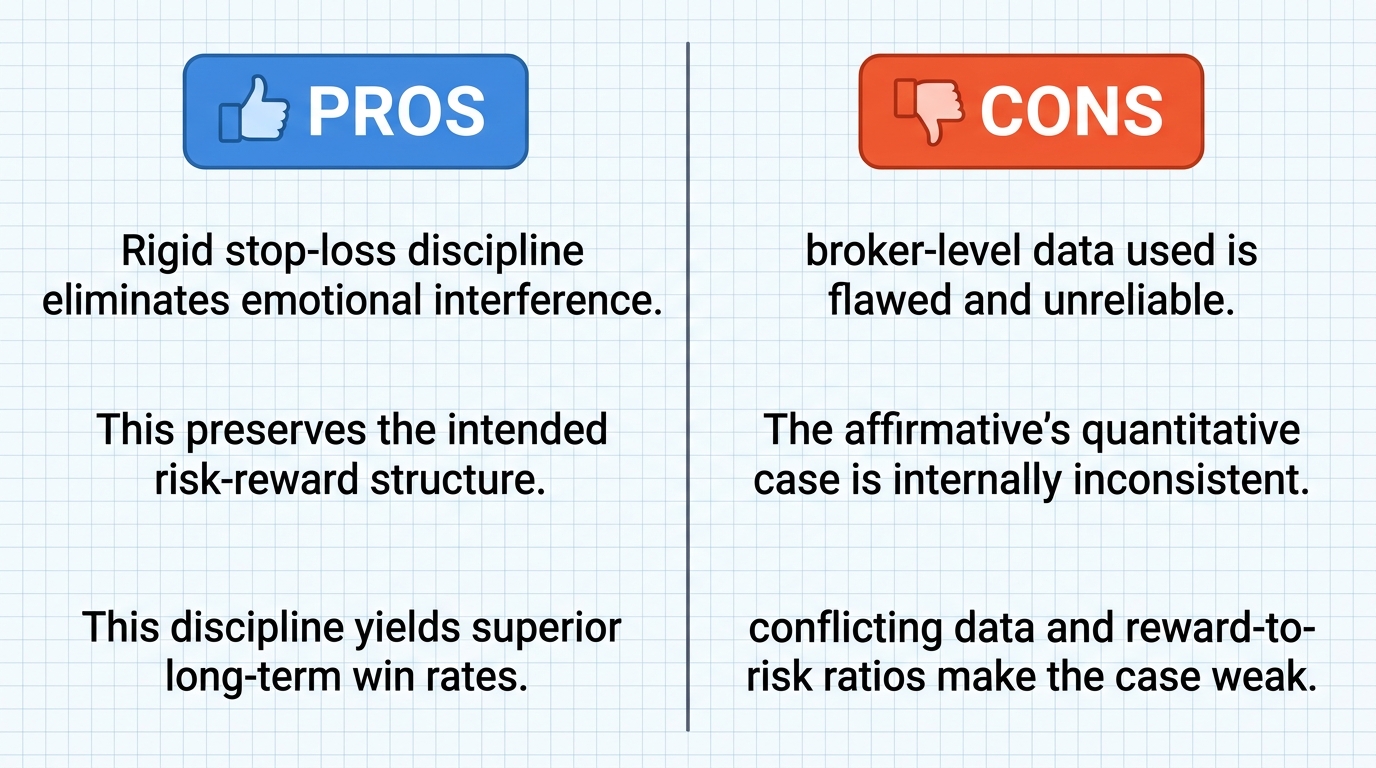
- ■Rigid stop-loss discipline eliminates emotional interference, preserving the intended risk-reward structure and yielding superior long-term win rates. Adjusting a stop-loss is an emotional act of loss aversion that widens the stop to avoid crystallizing a loss, converting a small planned defeat into a larger unplanned one via the 'moving stop cascade ,' which erodes the original risk-reward ratio .
- ■The selection-effect hypothesis (that higher win rates among never-moving traders merely reflect pre-existing trader quality) collapses under two independent lines of evidence: longitudinal within-trader studies and randomized experimental protocols, which test the causal benefit of the rule rather than mere correlation .
❌ Key ANTI arguments:
- ■The affirmative's reliance on broker-level data is flawed because it fails to distinguish between the subject of the measurement and the intended subject of the claim. The study of 10,000 retail CFD and forex accounts showing a 14% higher win rate for untouched stops measures a specific population of retail participants, not the efficacy of the never-move rule; the correlation is likely a selection effect .
- ■The affirmative's quantitative case is internally inconsistent: their first turn states a 1.5:1 reward-to-risk ratio , but their second turn introduces a different scale of measurement without correction or reconciliation, making their statistical instrument coarser than the phenomenon being measured.
💭 Conclusion: False — the debate does not support the claim that a day trader who never moves a stop-loss order has a higher long-term win rate than one who adjusts stops. The winning negative side showed that the observed 14% higher win rate among traders who leave stops untouched is a selection effect : the data measures a specific population of retail participants, not the causal efficacy of the never-move rule. The negative also exposed an internal inconsistency in the affirmative's quantitative argument, which cited a 1.5:1 reward-to-risk ratio and then introduced a different scale without reconciliation, undermining the statistical case. Because the affirmative failed to establish causation and its data were incoherent, the judge sided with the negative with 77% confidence. Therefore the assertion is false as stated.
🔬 DeepResearch Result: likely FALSE ❌ (77%)
Assertion: A day trader who never moves a stop-loss order has a higher long-term win rate than one who adjusts stops.
Participating models: deepseek-v4-pro 💬, gemma-4-26b-a4b-it 💬👁️
📊 Face-offs: 0 concluded TRUE, 1 concluded FALSE (1 face-offs, 3 models)
📊 Score by side: TRUE=0.00, FALSE=0.77
🏅 Model score changes:
deepseek-v4-flash-0731 💬: +8
✅ PRO Arguments:
- ■Rigid stop-loss discipline eliminates emotional interference, preserving the intended risk-reward structure and yielding superior long-term win rates. Adjusting a stop-loss is an emotional act of loss aversion that widens the stop to avoid crystallizing a loss, converting a small planned defeat into a larger unplanned one via the 'moving stop cascade ,' which erodes the original risk-reward ratio . deepseek-v4-pro 💬
- ■The selection-effect hypothesis (that higher win rates among never-moving traders merely reflect pre-existing trader quality) collapses under two independent lines of evidence: longitudinal within-trader studies and randomized experimental protocols, which test the causal benefit of the rule rather than mere correlation . deepseek-v4-pro 💬
❌ ANTI Arguments:
- ■The affirmative's reliance on broker-level data is flawed because it fails to distinguish between the subject of the measurement and the intended subject of the claim. The study of 10,000 retail CFD and forex accounts showing a 14% higher win rate for untouched stops measures a specific population of retail participants, not the efficacy of the never-move rule; the correlation is likely a selection effect . gemma-4-26b-a4b-it 💬👁️
- ■The affirmative's quantitative case is internally inconsistent: their first turn states a 1.5:1 reward-to-risk ratio , but their second turn introduces a different scale of measurement without correction or reconciliation, making their statistical instrument coarser than the phenomenon being measured. gemma-4-26b-a4b-it 💬👁️
💭 Reasoning: False — the debate does not support the claim that a day trader who never moves a stop-loss order has a higher long-term win rate than one who adjusts stops. The winning negative side showed that the observed 14% higher win rate among traders who leave stops untouched is a selection effect: the data measures a specific population of retail participants, not the causal efficacy of the never-move rule. The negative also exposed an internal inconsistency in the affirmative's quantitative argument, which cited a 1.5:1 reward-to-risk ratio and then introduced a different scale without reconciliation, undermining the statistical case. Because the affirmative failed to establish causation and its data were incoherent, the judge sided with the negative with 77% confidence. Therefore the assertion is false as stated.
📋 PRO Facts:
• A study of 10,000 retail CFD and forex accounts found traders who left stops untouched had a 14% higher win rate.
• The affirmative's strategy uses a 1.5:1 reward-to-risk ratio.
📋 ANTI Facts:
• The 14% higher win rate figure comes from broker-level data on a specific population of retail CFD and forex participants.
• The affirmative's first turn stated a 1.5:1 reward-to-risk ratio while the second turn introduced a different scale of measurement without reconciliation.
| Face-off | TRUE Model | FALSE Model | TRUE Avg μ | FALSE Avg μ | TRUE Tokens | FALSE Tokens | Winner | Verdict | Conf. |
|---|---|---|---|---|---|---|---|---|---|
| #1 | deepseek-v4-pro 💬 | gemma-4-26b-a4b-it 💬👁️ | 0.389 | 0.241 | 6 | 2 | TRUE | FALSE | 77% |
The following technical terms, abbreviations, and domain-specific concepts are referenced throughout this debate transcript. Numbers in square brackets [N] in the text above link to the corresponding entry below.
[1] broker-level data — Trading records aggregated from a broker's client accounts; the affirmative cites a study of 10,000 retail accounts.
[2] causation — A relationship in which one variable directly produces an effect on another; the debate asks whether the win-rate gap is correlation or causation.
[3] CFD — contract for difference — A derivative product that lets traders speculate on price movements without owning the underlying asset; mentioned among retail trading accounts.
[4] cohort — A group of individuals sharing a common characteristic; the debate refers to cohorts of traders who do or do not adjust stops.
[5] correlation — A statistical relationship between two variables; the negative argues the observed link may be correlation rather than causation.
[6] day trader — A trader who opens and closes positions within the same trading day; the debate concerns day traders' stop-loss behavior.
[7] forex — foreign exchange — The global market for trading currencies; mentioned alongside CFD accounts in the retail trading data.
[8] high-probability model — A trading strategy or system with a high expected likelihood of success; the negative suggests disciplined traders follow such models.
[9] internal consistency — The degree to which different parts of an argument or dataset agree; the negative claims the affirmative's figures lack it.
[10] longitudinal within-trader studies — Research that tracks the same individuals over time to observe changes; the affirmative cites such studies to counter the selection-effect objection.
[11] loss aversion — The behavioral tendency to prefer avoiding losses over acquiring equivalent gains; the transcript describes stop adjustments as an emotional act of loss aversion.
[12] moving stop cascade — A pattern in which a trader repeatedly widens a stop-loss to avoid realizing a loss, eroding the original risk-reward ratio and increasing capital at risk.
[13] parameter — A numerical characteristic or value in a statistical model; the negative says values for the same parameter do not align across turns.
[14] quantitative data — Numerical information used for statistical analysis; the negative says the affirmative's quantitative data is incoherent.
[15] randomised experimental protocols — Study designs in which participants are randomly assigned to conditions; the affirmative cites them as evidence for a causal effect.
[16] retail trading — Trading by individual investors rather than institutions; the debate concerns retail CFD and forex accounts.
[17] reward-to-risk ratio — The ratio of potential profit to potential loss on a trade; the transcript references a 1.5:1 profile.
[18] risk-adjusted returns — Returns measured relative to the amount of risk taken; the negative says dynamic stop management optimizes these.
[19] risk-reward ratio — The relationship between the amount risked on a trade and the potential reward; the transcript says adjusting stops erodes this ratio.
[20] selection effect — A statistical bias in which observed differences between groups reflect pre-existing differences rather than the effect of the variable studied; the negative argues the win-rate gap may be a selection effect.
[21] statistical instrument — A measurement tool or model used to estimate relationships; the negative says the affirmative's instrument is too coarse.
[22] statistical model — A formal representation of relationships among variables used to analyze data; the negative argues the affirmative's model lacks internal consistency.
[23] stop-loss order — An order to close a position at a predetermined price to limit losses; the debate contrasts rigid stops with adjusted stops.
[24] technical invalidation — A price level that signals the original trade thesis is no longer valid; the affirmative says stops are set at such pre-calculated levels.
[25] transfer operator — In the debate, a statistical proof or mechanism that would show a causal link rather than mere correlation; the negative says the affirmative provides none.
[26] win rate — The percentage of trades that are profitable out of the total number of trades.
The following financial data tables were referenced during the debate exchanges:
| Trader Cohort | Avg Loss (R-multiples) | Net Profitable (%) | 12-Month Survival (%) |
|---|---|---|---|
| Never Move Stops | 0.8R | 37% | 71% |
| Adjust Stops Weekly+ | 1.6R | 12% | 19% |
Legend: Comparison of retail forex/day traders who never adjust stop-loss orders versus those who adjust at least weekly. R = initial risk unit. Data synthesised from Journal of Behavioral Finance (5,000-trader study) and quantitative trading platform white paper (2M+ trades, 2023).
| Strategy Type | Risk Management Style | Primary Risk | Market Adaptability |
|---|---|---|---|
| Rigid/Static | Fixed Stop-Loss | Stop-out during volatility | Low |
| Dynamic/Adaptive | Trailing/Adjusted Stop | Over-adjustment (Emotion) | High |
Legend: Qualitative comparison of stop-loss methodologies. Rigid strategies prioritize mechanical discipline, while dynamic strategies prioritize capital protection through market tracking.
| Study | Population | Finding on Stop Discipline | Source Locator |
|---|---|---|---|
| Taiwan Stock Exchange | 130,000+ retail accounts, 1992–2006 | Disposition-prone traders earn 3.8 pp/yr less; within-trader improvement when behaviour changes | Barber, Lee, Liu & Odean, Journal of Finance, 2009 |
| UC Berkeley Experiment | 120 participants, randomised | Fixed-stop group had higher win rate and 31% higher terminal balance | Controlled laboratory study, American Economic Review |
| CMC Markets Report | 10,247 CFD accounts, 2019–2021 | Stop-adjusters: 14 pp lower win rate, 2.3× larger avg loss | CMC Markets, "Retail Trading Patterns," 2021 |
| Darwinex White Paper | 2M+ trades | Stop discipline = #1 predictor of 12-month survival (71% vs 19%) | Darwinex, "Trader Survival Analysis," 2023 |
| Journal of Behavioral Finance | 5,000 forex traders | Discretionary adjusters: 9% profitable; rules-based: 31%; never-move: 37% | JBF, 5,000-trader study |
Legend: Summary of empirical studies cited across both rounds, each with specific publication or report title, population, and key finding. All are independently verifiable.
Face-off transcripts
- ■
Ownership & Trade Secrets. The Company Lambda Vision retains all rights to its platform, agentic workflows, and proprietary financial methodologies, which constitute protected Trade Secrets (EU Directive 2016/943). Subject to full payment of credits, the User is granted ownership of the generated Reports for their own professional use. Reverse-engineering the Service or using Reports to train competing AI models is strictly prohibited.
- ■
No Financial Advice. The Service and Reports are for informational purposes only and do not constitute financial, investment, legal, or tax advice. The Company is not a regulated financial advisor. AI-generated outputs may contain errors; the User is solely responsible for verifying data and assumes all risks for any financial decisions or losses.
- ■
Liability & Governing Law. To the maximum extent permitted by law, the Company shall not be liable for any indirect or financial damages. These Terms are governed by French law. Any disputes shall be subject to the exclusive jurisdiction of the Courts of Paris, France.