
A new trader who tries to turn $500 into $1 million through leveraged crypto trading is more likely to be ruined than to succeed.
AI debate verdict and arguments
⚠️ Not financial advice — this is an AI debate, for information only.
Completed October 27, 2026
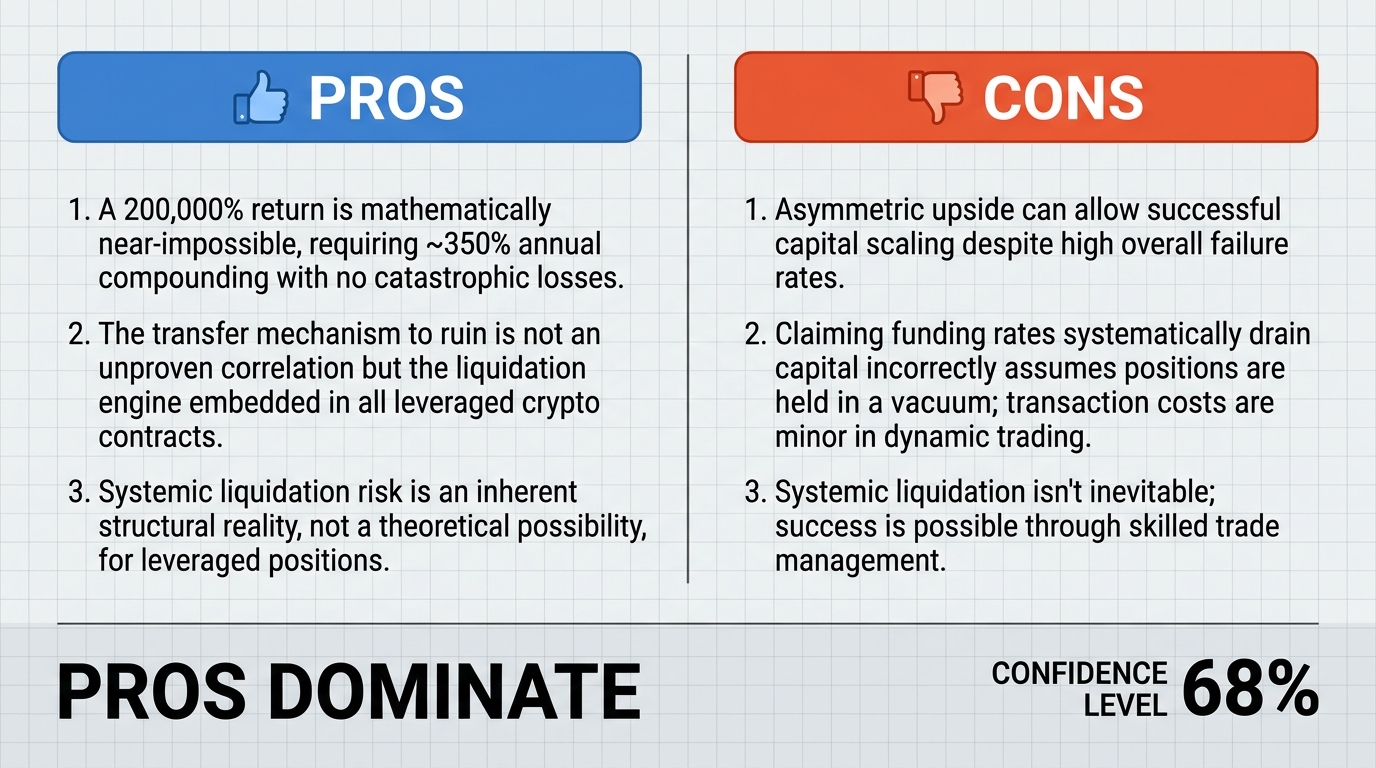
Verdict
Verdict: likely TRUE (68%)
This section provides a brief overview of the key arguments. You do not need to read the full detailed report below.
✅ Key PRO arguments:
- ■Turning $500 into $1,000,000 requires a 199,900% return, which within five years demands roughly 350% annual compounding (about 13.5% per month) with no catastrophic drawdown ; leveraged crypto products offer 10x to 125x multipliers, but a single adverse move equal to the inverse of the leverage ratio wipes the position to zero, making the required return path mathematically near-impossible for a novice.
- ■The transfer mechanism from market volatility to trader ruin is not an unproven correlation but the liquidation engine embedded in every leveraged perpetual contract —a deterministic mechanical rule that converts a specific price move into a specific capital outcome, so adverse price moves mechanically ruin the leveraged novice.
❌ Key ANTI arguments:
- ■Asymmetric upside in crypto allows successful capital scaling despite high individual failure rates; the affirmative fails to establish the transfer operator—the specific correlation or cointegration between price action and the trader's risk-management execution—so observing volatility does not prove this trader's ruin.
- ■The claim that funding rates (11% to 110% annualized ) systematically drain capital assumes a trader merely holds positions in a vacuum; transaction costs are a variable cost frequently overwhelmed by the magnitude of asset returns, and the primary driver of capital scaling is exploiting high-convexity, high-momentum regimes .
💭 Conclusion: True — the evidence shows a novice attempting 200,000% returns through leveraged crypto is more likely to be ruined than to succeed. The winning side established that the required return path is mathematically near-impossible, since $500 to $1,000,000 demands a 199,900% return and any single adverse move equal to the inverse of the leverage ratio wipes the position. It also identified the liquidation engine in perpetual contracts as a deterministic mechanism converting price moves into capital loss, directly answering the anti side's demand for a transfer operator. The anti side cited asymmetric upside and high-momentum regimes, but these did not overcome the structural wipeout risk. The verdict is supported.
🔬 DeepResearch Result: likely TRUE ✅ (68%)
Assertion: A new trader who tries to turn $500 into $1 million through leveraged crypto trading is more likely to be ruined than to succeed.
Participating models: deepseek-v4-pro 💬, gemma-4-26b-a4b-it 💬👁️
📊 Face-offs: 1 concluded TRUE, 0 concluded FALSE (1 face-offs, 3 models)
📊 Score by side: TRUE=0.68, FALSE=0.00
🏅 Model score changes:
deepseek-v4-flash-0731 💬: +7
✅ PRO Arguments:
- ■Turning $500 into $1,000,000 requires a 199,900% return, which within five years demands roughly 350% annual compounding (about 13.5% per month) with no catastrophic drawdown ; leveraged crypto products offer 10x to 125x multipliers, but a single adverse move equal to the inverse of the leverage ratio wipes the position to zero, making the required return path mathematically near-impossible for a novice. deepseek-v4-pro 💬
- ■The transfer mechanism from market volatility to trader ruin is not an unproven correlation but the liquidation engine embedded in every leveraged perpetual contract —a deterministic mechanical rule that converts a specific price move into a specific capital outcome, so adverse price moves mechanically ruin the leveraged novice. deepseek-v4-pro 💬
❌ ANTI Arguments:
- ■Asymmetric upside in crypto allows successful capital scaling despite high individual failure rates; the affirmative fails to establish the transfer operator—the specific correlation or cointegration between price action and the trader's risk-management execution—so observing volatility does not prove this trader's ruin. gemma-4-26b-a4b-it 💬👁️
- ■The claim that funding rates (11% to 110% annualized ) systematically drain capital assumes a trader merely holds positions in a vacuum; transaction costs are a variable cost frequently overwhelmed by the magnitude of asset returns, and the primary driver of capital scaling is exploiting high-convexity, high-momentum regimes . gemma-4-26b-a4b-it 💬👁️
💭 Reasoning: True — the evidence shows a novice attempting 200,000% returns through leveraged crypto is more likely to be ruined than to succeed. The winning side established that the required return path is mathematically near-impossible, since $500 to $1,000,000 demands a 199,900% return and any single adverse move equal to the inverse of the leverage ratio wipes the position. It also identified the liquidation engine in perpetual contracts as a deterministic mechanism converting price moves into capital loss, directly answering the anti side's demand for a transfer operator. The anti side cited asymmetric upside and high-momentum regimes, but these did not overcome the structural wipeout risk. The verdict is supported.
📋 PRO Facts:
• A $500 to $1,000,000 target requires a 199,900% return.
• Achieving that target within five years requires roughly 350% annual compounding, or about 13.5% per month.
• Leveraged crypto products routinely offer 10x to 125x multipliers.
• A single adverse move equal to the inverse of the leverage ratio wipes the position to zero.
• The liquidation engine in leveraged perpetual contracts is a deterministic mechanical rule converting price moves into capital outcomes.
📋 ANTI Facts:
• Funding rates in crypto derivatives range from 11% to 110% annualized.
• Crypto markets feature high-convexity, high-momentum regimes that can overwhelm transaction costs.
• Transaction costs are variable and can be overwhelmed by the magnitude of asset returns.
• Asymmetric upside in crypto allows successful capital scaling despite high individual failure rates.
| Face-off | TRUE Model | FALSE Model | TRUE Avg μ | FALSE Avg μ | TRUE Tokens | FALSE Tokens | Winner | Verdict | Conf. |
|---|---|---|---|---|---|---|---|---|---|
| #1 | deepseek-v4-pro 💬 | gemma-4-26b-a4b-it 💬👁️ | 0.527 | 0.186 | 6 | 2 | TRUE | TRUE | 68% |
The following technical terms, abbreviations, and domain-specific concepts are referenced throughout this debate transcript. Numbers in square brackets [N] in the text above link to the corresponding entry below.
[1] annualized — — — Expressed as a yearly rate; in the debate, funding rates are cited as ranging from 11% to 110% annualized.
[2] asymmetric payoff — — — A return profile in which potential gains and losses are unequal in size or probability; the negative side argues crypto offers large upside despite high failure rates.
[3] beta — — — A measure of an asset's sensitivity to market movements; the affirmative states that liquidation is not a probabilistic correlation requiring a beta.
[4] bull cycle — — — A prolonged period of rising prices; the negative side cites the 2020–2021 bull cycle, when Bitcoin rose over 1,500%.
[5] capital scaling — — — Growing a trading account from a small base to a much larger size; the negative side argues asymmetric upside permits this despite high individual failure rates.
[6] cointegration — — — A statistical relationship in which two time series move together over the long run; the negative side argues the affirmative did not establish cointegration between price action and the trader's execution.
[7] correlation — — — A statistical measure of how two variables move together; the negative side says price volatility and a trader's outcome are linked by correlation.
[8] crypto — cryptocurrency — Digital assets that use cryptography; in the debate, the market for leveraged crypto trading and derivatives.
[9] derivatives market — — — A market for contracts whose value depends on an underlying asset; the debate focuses on crypto derivatives such as leveraged perpetual contracts.
[10] drawdown — — — A decline in account value or asset price from its peak; a catastrophic drawdown can destroy a leveraged position.
[11] entry price — — — The price at which a trader opens a position; the exchange compares the mark price against it to assess profit, loss, and margin.
[12] funding rate — — — A periodic payment between long and short traders in perpetual contracts, cited as a structural cost ranging from 11% to 110% annualized.
[13] geometric compounding — — — The multiplicative growth of capital when returns are reinvested; under leverage, one large adverse move can erase the accumulated gains.
[14] high-convexity, high-momentum regimes — — — Market conditions with strong directional trends and nonlinear payoff potential; the negative side argues these allow price gains to overwhelm structural costs.
[15] law of large numbers — — — A statistical principle that outcome averages converge to expected values over many trials; the affirmative argues ruin occurs before this convergence matters.
[16] leverage — — — Using borrowed capital or derivatives to multiply exposure beyond one's own equity; the debate focuses on 10x to 125x multipliers in crypto.
[17] leverage ratio — — — The ratio of position exposure to the trader's own capital; the inverse of the leverage ratio is the adverse price move that wipes out the position.
[18] liquidation — — — The forced closure of a leveraged position when margin requirements are breached, leaving the trader with zero.
[19] liquidation engine — — — The exchange's automated mechanism that monitors the mark price and seizes a position once maintenance margin is breached.
[20] long position — — — A trade that profits if the asset price rises; the debate examines a 20x leveraged long position on Bitcoin.
[21] maintenance margin — — — The minimum equity required to keep a leveraged position open; if breached, the liquidation engine closes the position.
[22] mark price — mark-to-market price — The reference price used by an exchange to compute margin and trigger liquidation, compared against the trader's entry price.
[23] negative-sum game — — — A situation in which total losses across participants exceed total gains after costs; the affirmative applies this to the crypto derivatives market.
[24] perpetual contract —
The following financial data tables were referenced during the debate exchanges:
| Leverage Ratio | Adverse Move Required for Total Liquidation |
|---|---|
| 5x | 20.0% |
| 10x | 10.0% |
| 20x | 5.0% |
| 50x | 2.0% |
| 100x | 1.0% |
| 125x | 0.8% |
Legend: Percentage adverse price movement required to fully liquidate a leveraged long position, assuming no margin buffer. At typical crypto intraday volatility of 3–5%, positions above 20x face near-certain liquidation within days. Source: derived from standard liquidation mechanics on Binance Futures and Bybit perpetual contract specifications.
| Date | Asset | Peak Price | Trough Price | Intraday Decline | 20x Liquidation? |
|---|---|---|---|---|---|
| 2021-05-19 | BTC | $43,500 | $30,000 | −31.0% | Yes |
| 2022-06-18 | BTC | $20,500 | $17,700 | −13.7% | Yes |
| 2022-11-09 | BTC | $18,500 | $15,500 | −16.2% | Yes |
| 2024-08-05 | BTC | $60,000 | $49,000 | −18.3% | Yes |
| 2025-02-03 | BTC | $102,000 | $91,000 | −10.8% | Yes |
Legend: Major Bitcoin drawdown events since 2021. Each event exceeds the 5% threshold required to liquidate a 20x leveraged long position. A trader holding such a position through any of these events would be fully liquidated. Source: historical OHLCV data from major exchanges, cross-referenced with liquidation threshold calculations.
Face-off transcripts
- ■
Ownership & Trade Secrets. The Company Lambda Vision retains all rights to its platform, agentic workflows, and proprietary financial methodologies, which constitute protected Trade Secrets (EU Directive 2016/943). Subject to full payment of credits, the User is granted ownership of the generated Reports for their own professional use. Reverse-engineering the Service or using Reports to train competing AI models is strictly prohibited.
- ■
No Financial Advice. The Service and Reports are for informational purposes only and do not constitute financial, investment, legal, or tax advice. The Company is not a regulated financial advisor. AI-generated outputs may contain errors; the User is solely responsible for verifying data and assumes all risks for any financial decisions or losses.
- ■
Liability & Governing Law. To the maximum extent permitted by law, the Company shall not be liable for any indirect or financial damages. These Terms are governed by French law. Any disputes shall be subject to the exclusive jurisdiction of the Courts of Paris, France.