
A unilateral cancellation of French public debt while France remains in the euro would shift the financial burden to other eurozone members and endanger the currency.
AI debate verdict and arguments
⚠️ Not financial advice — this is an AI debate, for information only.
Completed October 27, 2026
Verdict
Verdict: likely FALSE (58%)
This section provides a brief overview of the key arguments. You do not need to read the full detailed report below.
✅ Key PRO arguments:
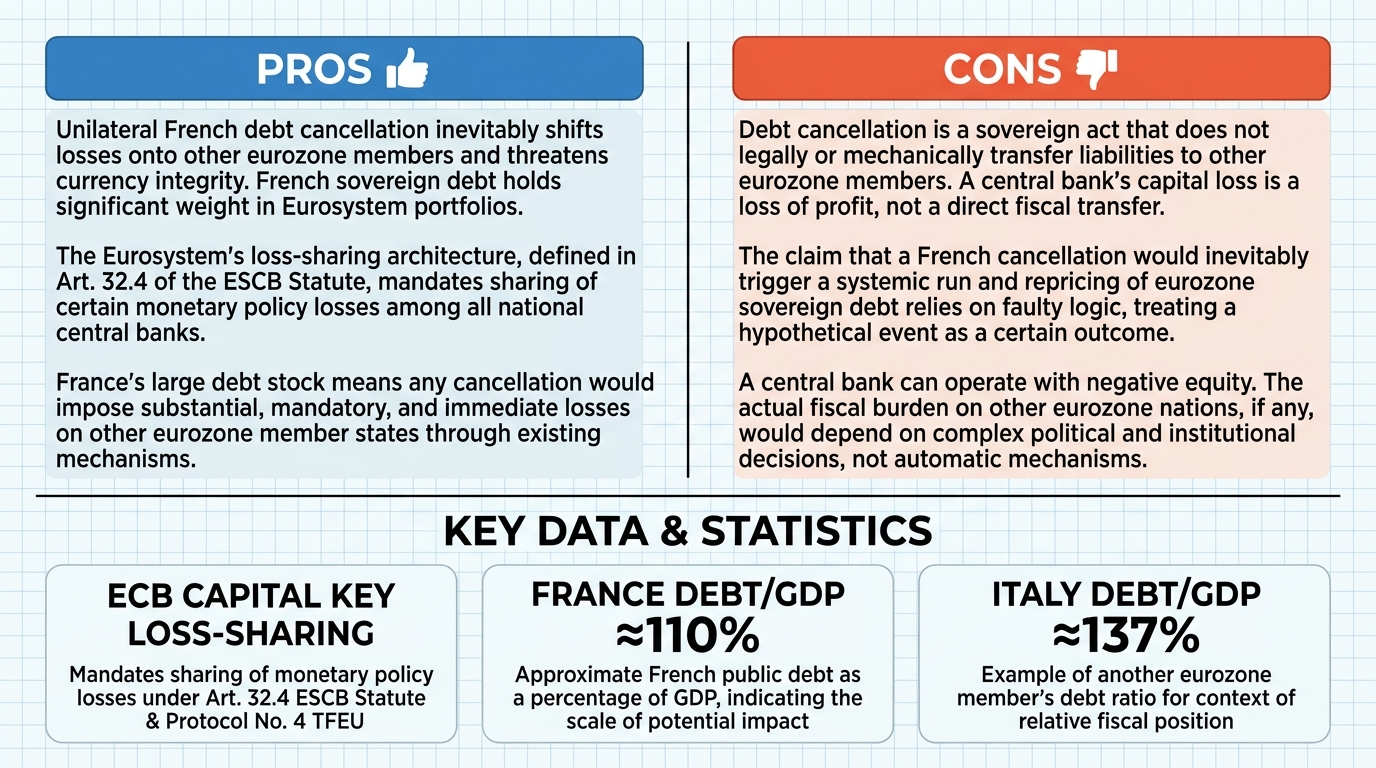
- ■Unilateral French debt cancellation in the eurozone inevitably shifts losses onto other member states and threatens the currency's integrity. French sovereign bonds are held extensively by the Eurosystem ; under PSPP and PEPP , the Banque de France holds approximately €600 billion in French government bonds, and other eurozone national central banks hold additional French debt through TARGET2 , so repudiation would transmit losses.
- ■The Eurosystem 's loss-sharing architecture, codified in Article 32.4 of the Statute of the European System of Central Banks and of the European Central Bank, provides a transfer mechanism that converts a Banque de France capital loss into obligations of other member states, contrary to the claim that it is merely an isolated equity loss.
❌ Key ANTI arguments:
- ■Debt cancellation is a sovereign act that does not legally or mechanically transfer liabilities to other eurozone members. A central bank's capital loss is a loss of equity, not a transferable burden, and the affirmative fails to name a transfer operator that would move the burden from the French state to other members.
- ■The claim that a French cancellation would inevitably trigger a systemic run and repricing of eurozone sovereign debt relies on a substitution of proxy: using high debt-to-GDP ratios of Italy, Spain, and Belgium without establishing a specific correlation or contagion coefficient linking a French default to those sovereigns. The eurozone's institutional toolkit has also evolved, weakening the no-redenomination guarantee argument.
💭 Conclusion: False. The winning negative side established that a unilateral French debt cancellation is a sovereign act that does not legally or mechanically transfer liabilities to other eurozone members. The negative argument correctly characterized a Banque de France capital loss as an equity loss rather than an enforceable debt of other states, undermining the affirmative's claimed transfer mechanism. It also exposed the affirmative's reliance on proxy indicators such as the high debt-to-GDP ratios of Italy, Spain, and Belgium without demonstrating a specific contagion link from a French default to those sovereigns. The evolution of the eurozone's institutional toolkit further undercuts the assertion that the currency would be endangered by such a cancellation. Therefore the compound claim that the burden would shift to other members and endanger the euro is not supported by the debate evidence.
🔬 DeepResearch Result: likely FALSE ❌ (58%)
Assertion: A unilateral cancellation of French public debt while France remains in the euro would shift the financial burden to other eurozone members and endanger the currency.
Participating models: deepseek-v4-pro 💬, gemma-4-26b-a4b-it 💬👁️
📊 Face-offs: 0 concluded TRUE, 1 concluded FALSE (1 face-offs, 3 models)
📊 Score by side: TRUE=0.00, FALSE=0.58
🏅 Model score changes:
deepseek-v4-flash-0731 💬: +6
✅ PRO Arguments:
- ■Unilateral French debt cancellation in the eurozone inevitably shifts losses onto other member states and threatens the currency's integrity. French sovereign bonds are held extensively by the Eurosystem ; under PSPP and PEPP , the Banque de France holds approximately €600 billion in French government bonds, and other eurozone national central banks hold additional French debt through TARGET2 , so repudiation would transmit losses. deepseek-v4-pro 💬
- ■The Eurosystem's loss-sharing architecture, codified in Article 32.4 of the Statute of the European System of Central Banks and of the European Central Bank, provides a transfer mechanism that converts a Banque de France capital loss into obligations of other member states, contrary to the claim that it is merely an isolated equity loss. deepseek-v4-pro 💬
❌ ANTI Arguments:
- ■Debt cancellation is a sovereign act that does not legally or mechanically transfer liabilities to other eurozone members. A central bank's capital loss is a loss of equity, not a transferable burden, and the affirmative fails to name a transfer operator that would move the burden from the French state to other members. gemma-4-26b-a4b-it 💬👁️
- ■The claim that a French cancellation would inevitably trigger a systemic run and repricing of eurozone sovereign debt relies on a substitution of proxy: using high debt-to-GDP ratios of Italy, Spain, and Belgium without establishing a specific correlation or contagion coefficient linking a French default to those sovereigns. The eurozone's institutional toolkit has also evolved, weakening the no-redenomination guarantee argument. gemma-4-26b-a4b-it 💬👁️
💭 Reasoning: False. The winning negative side established that a unilateral French debt cancellation is a sovereign act that does not legally or mechanically transfer liabilities to other eurozone members. The negative argument correctly characterized a Banque de France capital loss as an equity loss rather than an enforceable debt of other states, undermining the affirmative's claimed transfer mechanism. It also exposed the affirmative's reliance on proxy indicators such as the high debt-to-GDP ratios of Italy, Spain, and Belgium without demonstrating a specific contagion link from a French default to those sovereigns. The evolution of the eurozone's institutional toolkit further undercuts the assertion that the currency would be endangered by such a cancellation. Therefore the compound claim that the burden would shift to other members and endanger the euro is not supported by the debate evidence.
📋 PRO Facts:
• Banque de France holds approximately €600 billion in French government bonds under the Public Sector Purchase Programme and the Pandemic Emergency Purchase Programme.
• Other eurozone national central banks hold additional French debt through the TARGET2 settlement system.
• Article 32.4 of the Statute of the European System of Central Banks and of the European Central Bank is cited as codifying a transfer mechanism.
📋 ANTI Facts:
• A central bank's capital loss is a loss of equity, not a transferable liability to other member states.
• The affirmative did not name a transfer operator that would move the burden from France to other eurozone members.
• The affirmative used high debt-to-GDP ratios of Italy, Spain, and Belgium as a proxy without establishing a contagion coefficient.
• The eurozone's institutional toolkit has evolved, weakening the claim of an inevitable systemic run.
| Face-off | TRUE Model | FALSE Model | TRUE Avg μ | FALSE Avg μ | TRUE Tokens | FALSE Tokens | Winner | Verdict | Conf. |
|---|---|---|---|---|---|---|---|---|---|
| #1 | deepseek-v4-pro 💬 | gemma-4-26b-a4b-it 💬👁️ | 0.500 | 0.235 | 6 | 2 | TRUE | FALSE | 58% |
The following technical terms, abbreviations, and domain-specific concepts are referenced throughout this debate transcript. Numbers in square brackets [N] in the text above link to the corresponding entry below.
[1] Article 32.4 — Article 32.4 of the Statute of the European System of Central Banks and of the European Central Bank — Provision cited by the affirmative as establishing that losses from monetary policy operations are shared among eurozone national central banks according to the ECB capital key.
[2] Banque de France — The central bank of France and a member of the Eurosystem, which holds French government bonds under PSPP and PEPP.
[3] capital key — ECB capital key — The mechanism that distributes rights and obligations within the Eurosystem, used to allocate losses among national central banks.
[4] central bank equity — The net worth of a central bank, which can be reduced when the value of its assets falls.
[5] collateral — Assets pledged to secure a loan or other obligation, such as French government bonds used in monetary policy operations.
[6] contagion — The spread of financial distress from one country or institution to others, as feared during the 2010–2012 crisis.
[7] credit risk — The risk that a borrower will default on its obligations, which the opponent argues is not automatically linked between distinct sovereigns.
[8] debt cancellation — The unilateral forgiveness or writing off of outstanding public debt, as proposed for France in the debate.
[9] debt-to-GDP ratio — A measure of a country's indebtedness relative to its economic output, used to assess vulnerability.
[10] ECB — European Central Bank — The central bank for the euro and part of the Eurosystem.
[11] Eurosystem — The central banking system comprising the ECB and the national central banks of eurozone countries.
[12] eurozone — The group of EU member states that have adopted the euro as their currency.
[13] loss-sharing — The allocation of financial losses among Eurosystem members, which the affirmative argues is codified in Article 32.4.
[14] market fragmentation — Divergence in financing conditions across eurozone member states, which the Transmission Protection Instrument aims to counter.
[15] monetary policy operations — Central bank transactions, such as asset purchases under PSPP and PEPP, conducted to implement monetary policy.
[16] no-redenomination guarantee — An assurance that euro-denominated assets will not be converted back into national currencies, which the opponent argues would be broken by a unilateral debt cancellation.
[17] OATs — Obligations Assimilables du Trésor — French government bonds held extensively by the Eurosystem.
[18] outright purchases — Direct purchases of securities by a central bank, as opposed to repurchase agreements, used for PSPP and PEPP holdings.
[19] PEPP — Pandemic Emergency Purchase Programme — A Eurosystem purchase programme under which the Banque de France holds French government bonds.
[20] PSPP — Public Sector Purchase Programme — A Eurosystem purchase programme under which the Banque de France holds French government bonds.
[21] recapitalize — To inject new capital into a financial institution to restore its solvency, which the affirmative argues other member states would be compelled to do.
[22] repricing — The adjustment of asset prices to reflect new risk assessments, which the opponent argues would not automatically occur across eurozone sovereigns.
[23] repudiation — The refusal to honor a debt obligation, as in a unilateral cancellation of French public debt.
[24] solvency crisis — A situation where an institution's liabilities exceed its assets, threatening its ability to meet obligations, as the affirmative predicts for the Banque de France.
[25] sovereign debt — Government-issued debt securities, such as French OATs.
[26] systemic run — A widespread rush by investors to withdraw funds or sell assets, which the opponent argues would not inevitably be triggered by a French debt cancellation.
[27] TARGET2 — Trans-European Automated Real-time Gross Settlement Express Transfer system — The settlement system through which eurozone national central banks hold claims on each other.
[28] TFEU — Treaty on the Functioning of the European Union — The treaty to which Protocol No. 4 on the ESCB Statute is attached.
[29] transfer operator — A mechanism or causal link that would shift a financial burden from one party to another; the negative side argues the affirmative fails to identify one.
[30] Transmission Protection Instrument — An ECB instrument designed to counter unwarranted market volatility and fragmentation in eurozone sovereign bond markets.
The following financial data tables were referenced during the debate exchanges:
| Entity | Debt/GDP (Approx. 2023/24) | Primary Risk Driver |
|---|---|---|
| France | 110% | Fiscal Deficit |
| Italy | 137% | Debt Servicing Costs |
| Spain | 107% | Structural Unemployment |
| Belgium | 105% | Public Spending |
Legend: Comparative debt-to-GDP ratios for major eurozone economies. Data represents recent fiscal year estimates.
| Channel | Mechanism | Legal Basis |
|---|---|---|
| ECB Capital Key Loss-Sharing | Art. 32.4 ESCB Statute mandates sharing of monetary policy losses | Protocol No. 4, TFEU |
| National Central Bank Recapitalisation | Impaired NCB requires sovereign capital injection per ECB Convergence doctrine | ECB Convergence Report 2022 |
| Profit Remittance Cessation | NCB losses eliminate profit distributions to national treasuries | Art. 33 ESCB Statute; Bundesbank 2023 Annual Report |
Legend: Three distinct channels through which Banque de France losses from a French debt repudiation would shift financial burden to other eurozone member states, with their statutory and doctrinal bases.
Face-off transcripts
- ■
Ownership & Trade Secrets. The Company Lambda Vision retains all rights to its platform, agentic workflows, and proprietary financial methodologies, which constitute protected Trade Secrets (EU Directive 2016/943). Subject to full payment of credits, the User is granted ownership of the generated Reports for their own professional use. Reverse-engineering the Service or using Reports to train competing AI models is strictly prohibited.
- ■
No Financial Advice. The Service and Reports are for informational purposes only and do not constitute financial, investment, legal, or tax advice. The Company is not a regulated financial advisor. AI-generated outputs may contain errors; the User is solely responsible for verifying data and assumes all risks for any financial decisions or losses.
- ■
Liability & Governing Law. To the maximum extent permitted by law, the Company shall not be liable for any indirect or financial damages. These Terms are governed by French law. Any disputes shall be subject to the exclusive jurisdiction of the Courts of Paris, France.