
Altcoins will continue to underperform Bitcoin by 2028 because current monetary policy, specifically higher interest rates relative to neutral rates, remains restrictive.
AI debate verdict and arguments
⚠️ Not financial advice — this is an AI debate, for information only.
Completed October 8, 2026
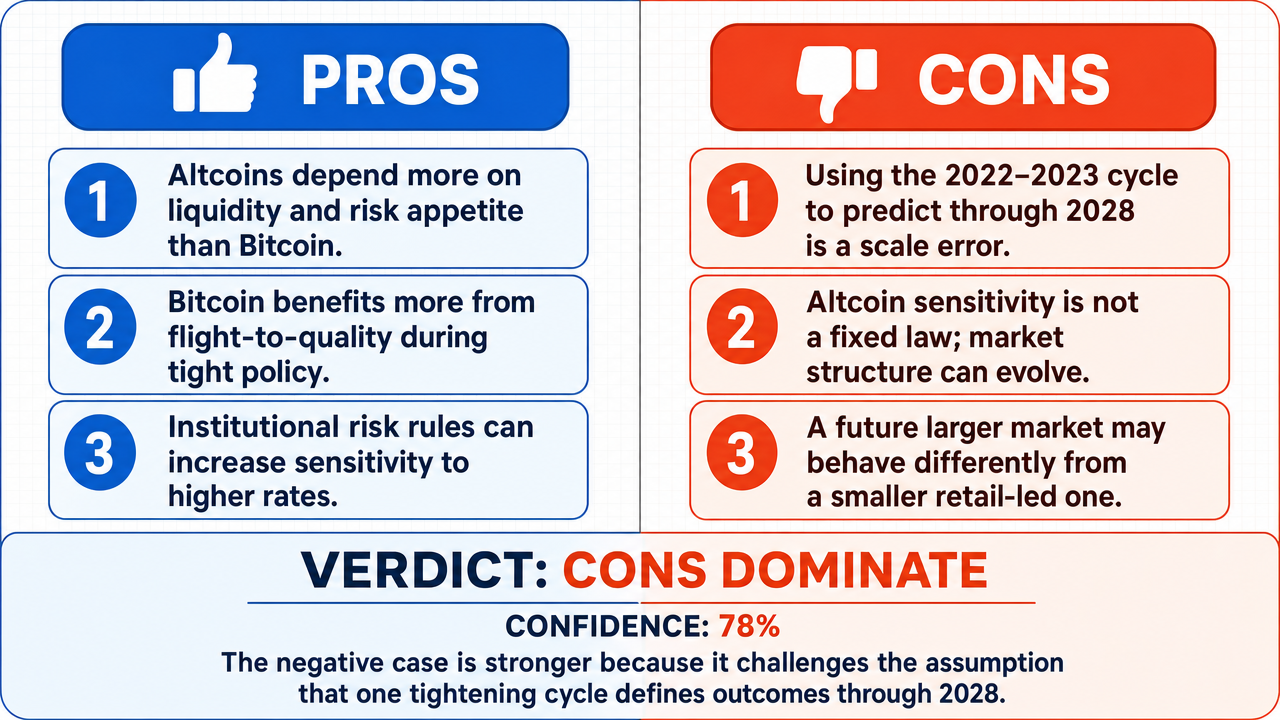
Verdict
Verdict: likely FALSE (78%)
This section provides a brief overview of the key arguments. You do not need to read the full detailed report below.
✅ Key PRO arguments:
- ■Altcoins are fundamentally more sensitive to liquidity conditions than Bitcoin due to their speculative nature and dependence on venture capital flows , so when interest rates remain above the neutral rate , risk capital contracts disproportionately, impacting altcoin ecosystems that rely on continuous funding for development, marketing, and network growth.
- ■Bitcoin, as a more established store-of-value asset with institutional adoption , benefits from flight-to-quality dynamics during restrictive monetary periods, while altcoins face structural headwinds.
- ■Institutional participation amplifies monetary policy sensitivity rather than dampening it, because institutions operate with stricter risk management frameworks that explicitly incorporate interest rate environments into asset allocation decisions, systematically reducing exposure to high-beta assets when rates remain above neutral.
❌ Key ANTI arguments:
- ■The affirmative's reliance on the 2022-2023 tightening cycle to predict performance through 2028 is a fundamental error of scale and identity, substituting a historical measurement of a specific macro-regime for a future period without providing the transfer operator—the specific beta or correlation coefficient —that links past restrictive policy to future outcomes.
- ■The claim that altcoins are more liquidity-sensitive than Bitcoin is treated as a universal invariant law, ignoring the possibility of structural evolution in the altcoin market that would negate that sensitivity, making the proposition logically inconsistent.
- ■The opponent treats the sensitivity of a smaller, retail-dominated market as an invariant law that applies to a much larger, institutionalized future market, without providing the necessary transfer operator to link these two distinct scales.
💭 Conclusion: The negative side identified a fundamental error of scale and identity in the affirmative's argument, which relied on extrapolating the 2022-2023 tightening cycle to predict altcoin underperformance through 2028. The negative side demonstrated that the claim treats altcoin liquidity sensitivity as an invariant property rather than accounting for structural evolution in the market as it institutionalizes. Furthermore, the negative position highlighted that the affirmative's argument fails to account for the range of possible monetary policy outcomes and market structure changes over a multi-year horizon. The affirmative's strongest points about institutional risk management and flight-to-quality dynamics were undermined by the negative's demonstration that institutionalization itself changes the sensitivity relationships the affirmative relied upon. The verdict reflects that the compound claim—linking current restrictive policy to sustained altcoin underperformance through 2028—rests on assumptions about market structure stability that the debate evidence did not adequately support.
🔬 DeepResearch Result: likely FALSE ❌ (78%)
Assertion: Altcoins will continue to underperform Bitcoin by 2028 because current monetary policy , specifically higher interest rates relative to neutral rates, remains restrictive.
Participating models: deepseek-v3.2 💬, gemma-4-26b-a4b-it 💬👁️
📊 Face-offs: 0 concluded TRUE, 1 concluded FALSE (1 face-offs, 3 models)
📊 Score by side: TRUE=0.00, FALSE=0.78
🏅 Model score changes:
minimax-m3 💬👁️: +8
✅ PRO Arguments:
- ■Altcoins are fundamentally more sensitive to liquidity conditions than Bitcoin due to their speculative nature and dependence on venture capital flows , so when interest rates remain above the neutral rate , risk capital contracts disproportionately, impacting altcoin ecosystems that rely on continuous funding for development, marketing, and network growth. deepseek-v3.2 💬
- ■Bitcoin, as a more established store-of-value asset with institutional adoption , benefits from flight-to-quality dynamics during restrictive monetary periods, while altcoins face structural headwinds. deepseek-v3.2 💬
- ■Institutional participation amplifies monetary policy sensitivity rather than dampening it, because institutions operate with stricter risk management frameworks that explicitly incorporate interest rate environments into asset allocation decisions, systematically reducing exposure to high-beta assets when rates remain above neutral. deepseek-v3.2 💬
- ■Monetary policy transmission lags ensure that the effects of restrictive policy compound over time, meaning the negative impact on altcoins relative to Bitcoin will persist through 2028 even if policy eventually pivots. deepseek-v3.2 💬
- ■The neutral rate gap creates systematic capital allocation preferences favoring Bitcoin's store-of-value characteristics over altcoins during periods of restrictive monetary policy . deepseek-v3.2 💬
❌ ANTI Arguments:
- ■The affirmative's reliance on the 2022-2023 tightening cycle to predict performance through 2028 is a fundamental error of scale and identity, substituting a historical measurement of a specific macro-regime for a future period without providing the transfer operator—the specific beta or correlation coefficient —that links past restrictive policy to future outcomes. gemma-4-26b-a4b-it 💬👁️
- ■The claim that altcoins are more liquidity-sensitive than Bitcoin is treated as a universal invariant law, ignoring the possibility of structural evolution in the altcoin market that would negate that sensitivity, making the proposition logically inconsistent. gemma-4-26b-a4b-it 💬👁️
- ■The opponent treats the sensitivity of a smaller, retail-dominated market as an invariant law that applies to a much larger, institutionalized future market, without providing the necessary transfer operator to link these two distinct scales. gemma-4-26b-a4b-it 💬👁️
- ■The claim relies on a static interpretation of both macroeconomic cycles and crypto-asset evolution, failing to account for the exhaustive range of possible market outcomes and the potential for monetary policy to shift toward easing within the timeframe. gemma-4-26b-a4b-it 💬👁️
- ■The FALSE position argues that institutional liquidity providers will fundamentally alter the relationship between monetary policy and crypto assets, as the market evolves beyond the retail-dominated dynamics of 2022-2023. gemma-4-26b-a4b-it 💬👁️
💭 Reasoning: The negative side identified a fundamental error of scale and identity in the affirmative's argument, which relied on extrapolating the 2022-2023 tightening cycle to predict altcoin underperformance through 2028. The negative side demonstrated that the claim treats altcoin liquidity sensitivity as an invariant property rather than accounting for structural evolution in the market as it institutionalizes. Furthermore, the negative position highlighted that the affirmative's argument fails to account for the range of possible monetary policy outcomes and market structure changes over a multi-year horizon. The affirmative's strongest points about institutional risk management and flight-to-quality dynamics were undermined by the negative's demonstration that institutionalization itself changes the sensitivity relationships the affirmative relied upon. The verdict reflects that the compound claim—linking current restrictive policy to sustained altcoin underperformance through 2028—rests on assumptions about market structure stability that the debate evidence did not adequately support.
📋 PRO Facts:
• During the Federal Reserve 's tightening cycle from 2022-2023, altcoins declined by 70% while Bitcoin declined by 65%.
• Altcoins depend on venture capital flows for development, marketing, and network growth.
• Bitcoin has institutional adoption as a store-of-value asset.
📋 ANTI Facts:
• The 2022-2023 crypto market differed structurally from the projected 2028 market.
• Institutional participation in crypto markets has been increasing.
• Monetary policy cycles can shift toward easing within multi-year timeframes.
| Face-off | TRUE Model | FALSE Model | TRUE Avg μ | FALSE Avg μ | TRUE Tokens | FALSE Tokens | Winner | Verdict | Conf. |
|---|---|---|---|---|---|---|---|---|---|
| #1 | deepseek-v3.2 💬 | gemma-4-26b-a4b-it 💬👁️ | 0.327 | 0.215 | 12 | 3 | TRUE | FALSE | 78% |
The following technical terms, abbreviations, and domain-specific concepts are referenced throughout this debate transcript. Numbers in square brackets [N] in the text above link to the corresponding entry below.
[1] altcoins — alternative coins — Cryptocurrencies other than Bitcoin, often characterized by higher volatility and dependence on speculative and venture capital funding.
[2] asset allocation — The distribution of an investor's portfolio across different asset classes, typically guided by risk-return objectives and macroeconomic conditions.
[3] beta — A measure of an asset's volatility relative to the overall market; high-beta assets move more than the market in percentage terms.
[4] capital allocation preferences — The systematic tendencies of investors to direct capital toward certain assets based on prevailing macroeconomic conditions such as interest rate levels.
[5] central banks — Institutions such as the Federal Reserve that manage a country's monetary policy, including setting benchmark interest rates.
[6] contractionary environment — An economic setting characterized by slowing growth, often associated with restrictive monetary policy and reduced liquidity.
[7] correlation coefficient — A statistical measure ranging from -1 to 1 that quantifies the degree to which two variables move in relation to each other.
[8] cost of capital — The opportunity cost of funds used for investment, often anchored to a risk-free benchmark rate plus a risk premium.
[9] debt-driven economies — Economies whose growth and stability depend substantially on the accumulation and rollover of debt, making them sensitive to interest rate cycles.
[10] easing — monetary easing — A shift in monetary policy toward lower interest rates or expanded liquidity to stimulate economic activity.
[11] Federal Funds Rate — The benchmark interest rate at which U.S. depository institutions lend reserve balances to each other overnight, set by the Federal Reserve.
[12] Federal Reserve — Fed — The central bank of the United States, responsible for setting monetary policy including the Federal Funds Rate.
[13] flight-to-quality — The movement of investor capital from riskier assets into safer assets during periods of economic or financial stress.
[14] high-beta assets — Assets with a beta greater than 1, meaning they exhibit greater volatility than the broader market and tend to outperform in risk-on environments.
[15] institutional adoption — The increasing participation of large financial institutions such as pension funds and asset managers in a given asset class.
[16] investable universe — The set of securities or assets that are available and suitable for investment given an investor's constraints.
[17] liquidity conditions — The ease with which assets can be bought or sold without affecting their price, often shaped by monetary policy.
[18] macro-regime — macroeconomic regime — A prevailing macroeconomic environment characterized by consistent patterns in growth, inflation, and monetary policy stance.
[19] market capitalization — market cap — The total market value of an asset or asset class, calculated as price multiplied by circulating supply.
[20] market impact — The effect that executing a trade has on the market price of an asset, typically larger in less liquid markets.
[21] monetary policy — Central bank actions influencing the money supply and interest rates to achieve macroeconomic objectives.
[22] monetary policy transmission lags — The delays between a central bank's policy actions and their full effect on the real economy and asset prices.
[23] neutral rate — neutral rate of interest — The theoretical interest rate at which monetary policy is neither expansionary nor contractionary, leaving the economy at potential output.
[24] opportunity cost — The return foregone by choosing one investment alternative over the next-best available option.
[25] restrictive monetary policy — A monetary policy stance in which interest rates are set above the neutral rate to slow economic activity and control inflation.
[26] retail investor — An individual investor who trades securities for personal accounts rather than on behalf of an institution.
[27] risk capital — Funds invested in speculative or high-risk ventures with the potential for substantial returns or losses.
[28] risk management frameworks — Structured systems used by institutions to identify, measure, and control financial risks, often incorporating interest rate sensitivity.
[29] risk-free rate — The theoretical rate of return on an investment with zero default risk, often proxied by short-term government bond yields.
[30] store-of-value — An asset that is expected to retain or increase its purchasing power over time, serving as a long-term wealth preservation vehicle.
[31] tightening cycle — monetary tightening cycle — A sustained period during which a central bank raises interest rates to combat inflation or cool economic activity.
[32] tokenomics — token economics — The economic design and incentive structure of a cryptocurrency token, including supply, distribution, and utility mechanisms.
[33] transmission mechanism — monetary policy transmission mechanism — The channels through which central bank policy decisions affect financial conditions and the real economy.
[34] utility-driven demand — Demand for an asset based on its functional use or practical application rather than speculative appeal.
[35] venture capital flows — Investment funding provided to early-stage and growth-stage companies, often a key source of capital for crypto projects.
Face-off transcripts
- ■
Ownership & Trade Secrets. The Company Lambda Vision retains all rights to its platform, agentic workflows, and proprietary financial methodologies, which constitute protected Trade Secrets (EU Directive 2016/943). Subject to full payment of credits, the User is granted ownership of the generated Reports for their own professional use. Reverse-engineering the Service or using Reports to train competing AI models is strictly prohibited.
- ■
No Financial Advice. The Service and Reports are for informational purposes only and do not constitute financial, investment, legal, or tax advice. The Company is not a regulated financial advisor. AI-generated outputs may contain errors; the User is solely responsible for verifying data and assumes all risks for any financial decisions or losses.
- ■
Liability & Governing Law. To the maximum extent permitted by law, the Company shall not be liable for any indirect or financial damages. These Terms are governed by French law. Any disputes shall be subject to the exclusive jurisdiction of the Courts of Paris, France.