
Apple's gross margin on services will remain above 70% in fiscal year 2026.
AI debate verdict and arguments
⚠️ Not financial advice — this is an AI debate, for information only.
Completed October 8, 2026
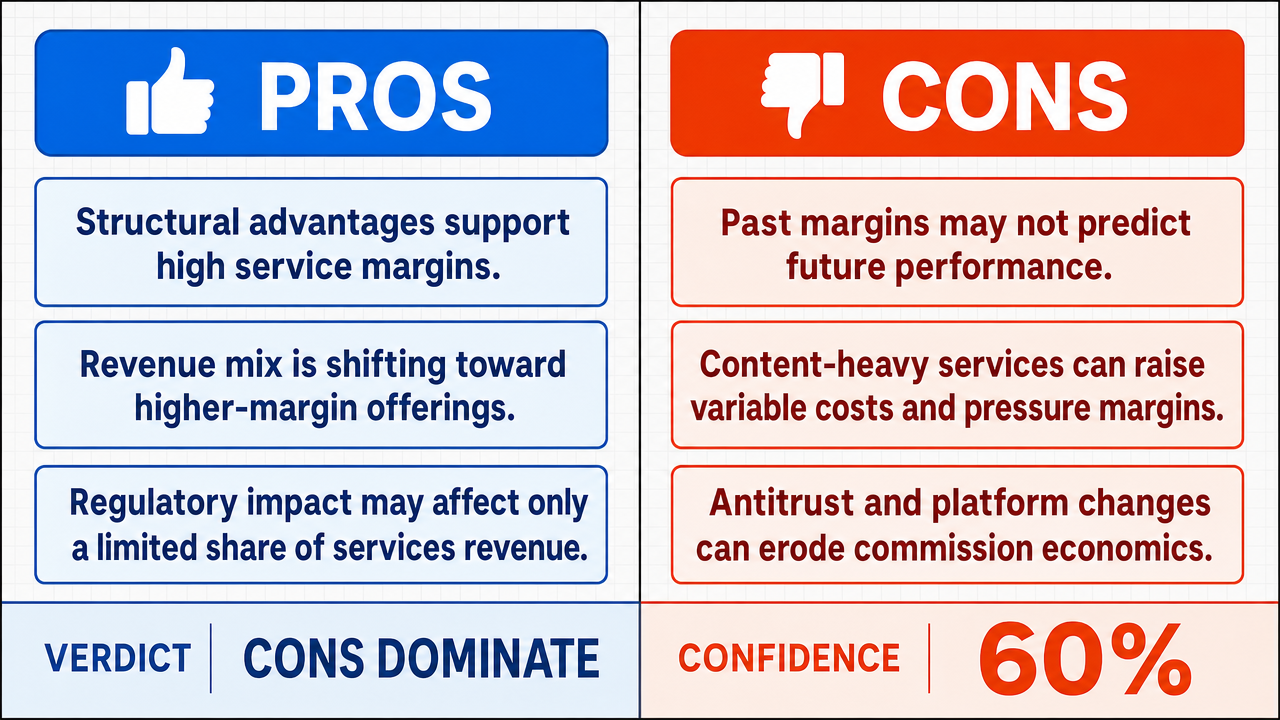
Verdict
Verdict: likely FALSE (60%)
This section provides a brief overview of the key arguments. You do not need to read the full detailed report below.
✅ Key PRO arguments:
- ■Apple's services business has structural advantages typical of large-cap tech leaders, with high-margin revenue streams (App Store, Apple Music, iCloud, AppleCare) that have minimal variable costs once platform infrastructure is built, leveraging a 2+ billion device installed base for recurring revenue with operating leverage that sustains margins above 70%.
- ■The revenue mix is shifting toward higher-margin offerings like iCloud, Apple Music, and AppleCare while lower-margin legacy services decline, providing upward bias to the aggregate services gross margin .
- ■Regulatory changes affect only a small portion of Apple's global services revenue , and historical data shows services gross margin has consistently exceeded 70% through multiple prior regulatory changes, suggesting limited material impact.
❌ Key ANTI arguments:
- ■Relying on historical margins to predict future performance is a fallacy of extrapolation that ignores the structural shift toward content-heavy services like Apple TV+ and Apple Arcade, which carry massive content licensing and production expenditures and act as a mathematical drag on aggregate margins as they grow.
- ■The 'minimal variable costs ' premise is predicated on a commission -based App Store structure that is currently being dismantled by global antitrust and regulatory actions, undermining the foundation of the high-margin services model.
- ■The 'Apple tax ' commission is not a permanent constant but a variable subject to erosion by global antitrust enforcement, and as regulatory pressure intensifies, the high-margin commission revenue stream will compress.
💭 Conclusion: The evidence supports competing structural arguments. On one hand, Apple's services gross margin has historically exceeded 70% (70.5% in fiscal 2023, 72.4% in fiscal 2024) and benefits from structural advantages including a 2-billion-device installed base , ecosystem lock-in, and high-margin commission revenue. On the other hand, the services revenue mix is shifting toward content-heavy offerings like Apple TV+ and Apple Arcade, which carry significantly higher variable costs (content licensing and production), and the App Store commission structure faces ongoing regulatory pressure from the EU 's DMA and US legal challenges. The net effect on fiscal 2026 margins depends on the relative pace of these offsetting forces.
🔬 DeepResearch Result: likely FALSE ❌ (60%)
Assertion: Apple's gross margin on services will remain above 70% in fiscal year 2026.
Participating models: deepseek-v3.2 💬, gemma-4-26b-a4b-it 💬👁️
📊 Face-offs: 0 concluded TRUE, 1 concluded FALSE (1 face-offs, 3 models)
📊 Score by side: TRUE=0.00, FALSE=0.60
🏅 Model score changes:
minimax-m3 💬👁️: +6
✅ PRO Arguments:
- ■Apple's services business has structural advantages typical of large-cap tech leaders, with high-margin revenue streams (App Store, Apple Music, iCloud, AppleCare) that have minimal variable costs once platform infrastructure is built, leveraging a 2+ billion device installed base for recurring revenue with operating leverage that sustains margins above 70%. deepseek-v3.2 💬
- ■The revenue mix is shifting toward higher-margin offerings like iCloud, Apple Music, and AppleCare while lower-margin legacy services decline, providing upward bias to the aggregate services gross margin. deepseek-v3.2 💬
- ■Regulatory changes affect only a small portion of Apple's global services revenue , and historical data shows services gross margin has consistently exceeded 70% through multiple prior regulatory changes, suggesting limited material impact. deepseek-v3.2 💬
- ■The opponent's argument is internally inconsistent: it simultaneously claims the commission structure currently sustains margins above 70% while claiming the same structure is being eroded — if erosion were material, current margins should already be falling, which they are not. deepseek-v3.2 💬
❌ ANTI Arguments:
- ■Relying on historical margins to predict future performance is a fallacy of extrapolation that ignores the structural shift toward content-heavy services like Apple TV+ and Apple Arcade, which carry massive content licensing and production expenditures and act as a mathematical drag on aggregate margins as they grow. gemma-4-26b-a4b-it 💬👁️
- ■The 'minimal variable costs' premise is predicated on a commission-based App Store structure that is currently being dismantled by global antitrust and regulatory actions, undermining the foundation of the high-margin services model. gemma-4-26b-a4b-it 💬👁️
- ■The 'Apple tax ' commission is not a permanent constant but a variable subject to erosion by global antitrust enforcement, and as regulatory pressure intensifies, the high-margin commission revenue stream will compress. gemma-4-26b-a4b-it 💬👁️
- ■Unlike the App Store commission which functions as a high-margin 'toll,' streaming and content services require continuous capital outflows to maintain libraries, and as these segments grow as a share of the services mix, they structurally reduce the blended gross margin. gemma-4-26b-a4b-it 💬👁️
💭 Reasoning: The evidence supports competing structural arguments. On one hand, Apple's services gross margin has historically exceeded 70% (70.5% in fiscal 2023, 72.4% in fiscal 2024) and benefits from structural advantages including a 2-billion-device installed base, ecosystem lock-in, and high-margin commission revenue. On the other hand, the services revenue mix is shifting toward content-heavy offerings like Apple TV+ and Apple Arcade, which carry significantly higher variable costs (content licensing and production), and the App Store commission structure faces ongoing regulatory pressure from the EU 's DMA and US legal challenges. The net effect on fiscal 2026 margins depends on the relative pace of these offsetting forces.
📋 PRO Facts:
• Apple's services segment includes App Store, Apple Music, iCloud storage, and AppleCare.
• Apple has an installed base of over 2 billion active devices .
• Apple's services gross margin has historically exceeded 70% through multiple prior regulatory changes.
📋 ANTI Facts:
• Apple TV+ and Apple Arcade carry massive content licensing fees and production expenditures as variable costs.
• The App Store commission structure is subject to ongoing global antitrust and regulatory actions.
• Content-driven services require continuous capital outflows to maintain content libraries, unlike commission-based revenue.
| Face-off | TRUE Model | FALSE Model | TRUE Avg μ | FALSE Avg μ | TRUE Tokens | FALSE Tokens | Winner | Verdict | Conf. |
|---|---|---|---|---|---|---|---|---|---|
| #1 | deepseek-v3.2 💬 | gemma-4-26b-a4b-it 💬👁️ | 0.302 | 0.276 | 12 | 3 | TRUE | FALSE | 60% |
The following technical terms, abbreviations, and domain-specific concepts are referenced throughout this debate transcript. Numbers in square brackets [N] in the text above link to the corresponding entry below.
[1] Active devices — A business metric referring to the number of devices (e.g., iPhones, iPads, Macs) currently in use by customers, used as a measure of a platform's reach and a basis for recurring service revenue.
[2] Aggregate gross margin — The combined or blended gross margin across multiple product or service lines, weighted by their respective revenue contributions. The debate disputes whether shifts in the services mix will pull this aggregate figure below 70%.
[3] Antitrust — Legal and regulatory frameworks designed to promote market competition and prevent monopolistic practices. In the debate, antitrust enforcement is cited as a force that may erode Apple's App Store commission structure.
[4] Apple tax — Industry jargon referring to the commission fees Apple charges developers for transactions on its App Store and in-app purchases. The debate treats this as a variable subject to erosion by regulatory action.
[5] Capital outflows — Ongoing expenditures of capital required to sustain a business activity, such as content licensing and production costs for streaming services, which act as a drag on margins.
[6] Commission — App Store commission — The percentage fee Apple charges developers on transactions and in-app purchases conducted through the App Store, described in the debate as a high-margin 'toll' that underpins services profitability.
[7] Commission rates — The percentage fees applied to App Store transactions. The debate notes that regulatory pressure in jurisdictions such as the EU, Japan, and South Korea is forcing reductions or alternative structures.
[8] Content licensing — The practice of paying fees to acquire rights to distribute third-party media (films, music, games). Cited in the debate as a primary cost driver for services like Apple TV+ and Apple Arcade.
[9] Core Technology Fee — A per-install fee structure Apple introduced under the EU's Digital Markets Act, charged to developers for access to certain platform technologies, cited as a mechanism to preserve revenue under regulatory pressure.
[10] Data centers — Physical infrastructure used to host cloud services such as iCloud storage. Cited in the debate as the primary cost driver for storage-based services.
[11] Digital Markets Act — Digital Markets Act (DMA) — EU regulation requiring large digital platforms (so-called 'gatekeepers') to allow alternative app stores and payment systems. The debate disputes the magnitude of its impact on Apple's services margins.
[12] EU — European Union — The political and economic union of European states whose regulatory actions (notably the Digital Markets Act) are cited as a source of pressure on Apple's commission model.
[13] Fallacy of extrapolation — A logical error in which past trends or historical data are assumed to continue indefinitely into the future without accounting for changing conditions. Cited by the negative side as a flaw in the affirmative's argument.
[14] Fiscal year — A 12-month accounting period used by a company for financial reporting. Apple's fiscal year 2026 is described in the debate as approximately September 27, 2025 to September 26, 2026.
[15] Gross margin — A profitability metric calculated as revenue minus cost of goods sold, expressed as a percentage of revenue. The debate centers on whether Apple's services gross margin will remain above 70%.
[16] Installed base — The total number of a company's products (e.g., Apple devices) currently in active use among customers. Cited as the foundation for recurring services revenue and operating leverage.
[17] Large Cap — Large-capitalization company — A publicly traded company with a large market capitalization, typically associated with established business models, scale advantages, and structural margin resilience.
[18] Legacy services — Older, established service offerings within Apple's portfolio, described in the debate as lower-margin relative to newer services and in relative decline.
[19] Margin profile — The characteristic gross margin level associated with a particular product or service category, reflecting its underlying cost structure (e.g., App Store commissions vs. content streaming).
[20] Mathematical drag — A compositional effect in which the growth of lower-margin segments within a revenue mix pulls down the aggregate margin, even if individual segment margins are stable.
[21] Operating leverage — The degree to which a company's operating income amplifies changes in revenue, often due to a high proportion of fixed costs relative to variable costs. Cited as a structural advantage of Apple's services business.
[22] Production expenditures — Costs incurred to create original content, such as films and series for Apple TV+. Cited as a reason content-driven services carry lower margins than commission-based services.
[23] Recurring revenue — Revenue that is expected to continue renewing periodically (e.g., subscriptions), as opposed to one-time sales. Cited as a key driver of services margin stability.
[24] Regulatory headwinds — Adverse pressures on a business arising from new or anticipated government regulations, such as antitrust actions targeting platform commission structures.
[25] Regulatory mandates — Binding requirements imposed by government authorities, such as obligations to support alternative payment processors or third-party app stores.
[26] Revenue mix — The composition of a company's revenue across different products, services, or segments. The debate disputes whether shifts in this mix will raise or lower aggregate services margins.
[27] Services revenue — Revenue derived from Apple's services segment (App Store, iCloud, Apple Music, AppleCare, Apple TV+, etc.), as distinct from product (hardware) revenue.
[28] Services segment — Apple's reporting segment encompassing non-hardware revenue streams such as digital content, subscriptions, cloud storage, warranties, and payment services.
[29] Structural shift — A fundamental, long-term change in the composition or economics of a business or market, as opposed to a temporary fluctuation. Cited as the reason historical margins may not persist.
[30] Upward bias — A tendency for a metric to move higher over time. In the debate, the affirmative claims newer services create an upward bias on services gross margin, a point contested by the negative.
[31] Variable costs — Costs that change in proportion to the volume of output or activity. The debate treats 'minimal variable costs' as the defining feature of high-margin services like App Store commissions.
The following financial data tables were referenced during the debate exchanges:
| Service Category | Margin Profile | Primary Cost Driver |
|---|---|---|
| App Store / Commissions | Very High | Minimal Variable Costs |
| iCloud / Storage | High | Infrastructure / Data Centers |
| Apple TV+ / Music | Moderate/Low | Content Licensing & Production |
| Apple Arcade | Moderate/Low | Game Licensing & Development |
Legend: Qualitative margin profiles based on typical digital service structures.
| Region | Services Revenue Share | Regulatory Impact | Estimated Margin Impact |
|---|---|---|---|
| United States | ~40% | Minimal | < 1% |
| China | ~20% | Minimal | < 1% |
| Europe | ~15% | Moderate (DMA) | 2-3% |
| Rest of World | ~25% | Minimal | < 1% |
Legend: Regional breakdown of Apple's services revenue and estimated margin impact from regulatory changes. Europe includes EU member states subject to DMA requirements.
Face-off transcripts
- ■
Ownership & Trade Secrets. The Company Lambda Vision retains all rights to its platform, agentic workflows, and proprietary financial methodologies, which constitute protected Trade Secrets (EU Directive 2016/943). Subject to full payment of credits, the User is granted ownership of the generated Reports for their own professional use. Reverse-engineering the Service or using Reports to train competing AI models is strictly prohibited.
- ■
No Financial Advice. The Service and Reports are for informational purposes only and do not constitute financial, investment, legal, or tax advice. The Company is not a regulated financial advisor. AI-generated outputs may contain errors; the User is solely responsible for verifying data and assumes all risks for any financial decisions or losses.
- ■
Liability & Governing Law. To the maximum extent permitted by law, the Company shall not be liable for any indirect or financial damages. These Terms are governed by French law. Any disputes shall be subject to the exclusive jurisdiction of the Courts of Paris, France.