
Apple's market capitalization will reach $5 trillion by the end of 2027.
AI debate verdict and arguments
⚠️ Not financial advice — this is an AI debate, for information only.
Completed October 8, 2026
Verdict
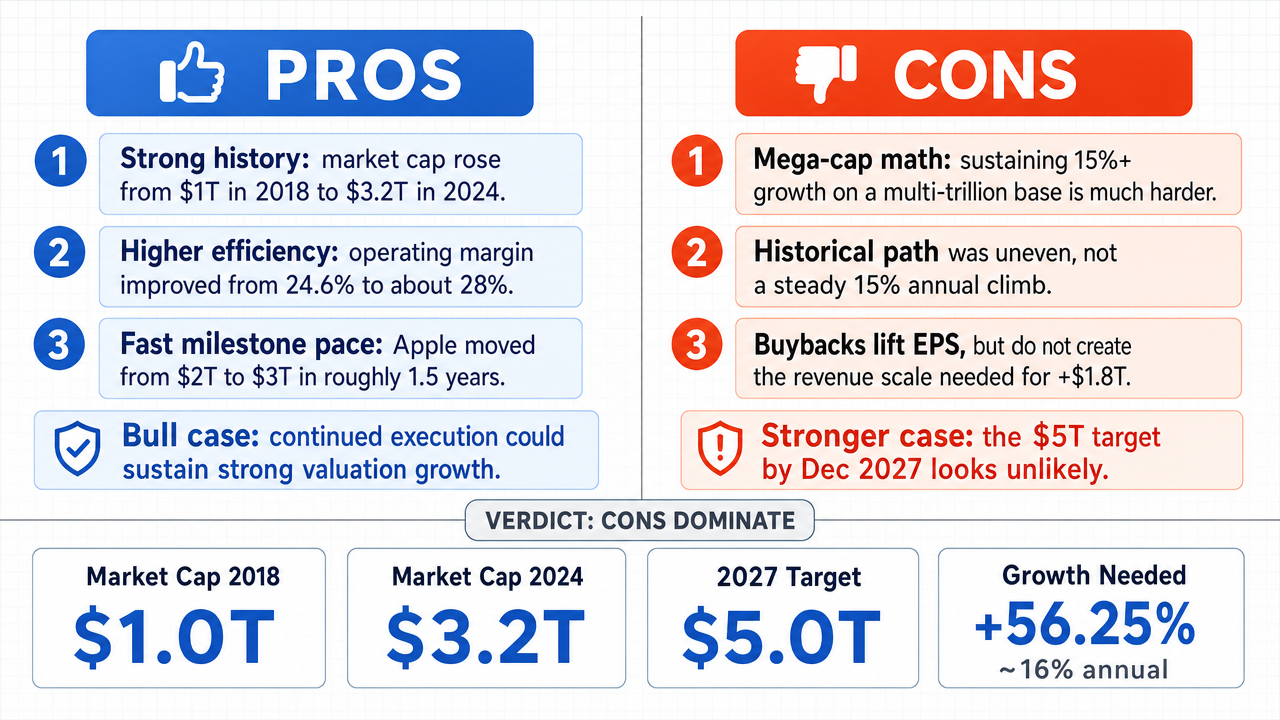
Verdict: likely FALSE (76%)
This section provides a brief overview of the key arguments. You do not need to read the full detailed report below.
✅ Key PRO arguments:
- ■Apple's historical growth from approximately $1 trillion in 2018 to $3.2 trillion today represents a CAGR above 15%, and maintaining even a modest 15% annual growth rate would propel its valuation to $5 trillion by December 2027.
- ■Apple's operating margins have improved from 24.6% in 2018 to approximately 28% in recent periods, demonstrating that the business model becomes more efficient at scale, creating a virtuous cycle supporting continued valuation expansion.
- ■Apple's valuation milestones have occurred in increasingly rapid succession—the company reached $3 trillion in approximately 1.5 years after hitting $2 trillion—demonstrating momentum that outpaces simple historical averages.
❌ Key ANTI arguments:
- ■Diminishing marginal returns at mega-cap scale mean the absolute capital required to sustain a 15% CAGR on a multi-trillion-dollar base is fundamentally different from when Apple was a $1 trillion company, making the historical growth rate an unreliable predictor.
- ■The affirmative's argument is internally inconsistent: it claims a sustained 15% CAGR from 2018 to present, yet the historical record shows Apple experienced significant year-over-year valuation declines, meaning the 15% figure is a geometric average over a volatile period, not a sustainable annual rate.
- ■Share buybacks primarily manipulate earnings per share rather than generating the massive absolute revenue expansion required to add $1.8 trillion in market capitalization , making buyback-driven valuation growth insufficient to reach $5 trillion.
💭 Conclusion: False. The FALSE side presented the more analytically rigorous case by demonstrating that the affirmative's reliance on a historical 15% CAGR is internally inconsistent and fails to account for the diminishing marginal returns inherent in mega-cap valuations. The affirmative's claim that Apple grew at a sustained 15% annual rate from 2018 to present is contradicted by the historical record of significant year-over-year valuation volatility, making the geometric average an unreliable basis for forward projection. The negative side correctly identified that moving from $3.2 trillion to $5 trillion requires an absolute increase of $1.8 trillion, which demands revenue and earnings expansion far beyond what share buybacks alone can deliver. The affirmative's argument about improving operating margins, while factually grounded, does not adequately address the scale-dependent capital and liquidity constraints that fundamentally alter growth dynamics at multi-trillion-dollar market capitalizations. Overall, the negative side's structural critique of the projection methodology was more compelling than the affirmative's extrapolation from historical averages.
🔬 DeepResearch Result: likely FALSE ❌ (76%)
Assertion: Apple's market capitalization will reach $5 trillion by the end of 2027.
Participating models: deepseek-v3.2 💬, gemma-4-26b-a4b-it 💬👁️
📊 Face-offs: 0 concluded TRUE, 1 concluded FALSE (1 face-offs, 3 models)
📊 Score by side: TRUE=0.00, FALSE=0.76
🏅 Model score changes:
minimax-m3 💬👁️: +8
✅ PRO Arguments:
- ■Apple's historical growth from approximately $1 trillion in 2018 to $3.2 trillion today represents a CAGR above 15%, and maintaining even a modest 15% annual growth rate would propel its valuation to $5 trillion by December 2027. deepseek-v3.2 💬
- ■Apple's operating margins have improved from 24.6% in 2018 to approximately 28% in recent periods, demonstrating that the business model becomes more efficient at scale, creating a virtuous cycle supporting continued valuation expansion. deepseek-v3.2 💬
- ■Apple's valuation milestones have occurred in increasingly rapid succession—the company reached $3 trillion in approximately 1.5 years after hitting $2 trillion—demonstrating momentum that outpaces simple historical averages. deepseek-v3.2 💬
- ■Apple's diversified revenue streams across hardware , services, and emerging technologies provide multiple growth engines to sustain valuation momentum toward $5 trillion. deepseek-v3.2 💬
❌ ANTI Arguments:
- ■Diminishing marginal returns at mega-cap scale mean the absolute capital required to sustain a 15% CAGR on a multi-trillion-dollar base is fundamentally different from when Apple was a $1 trillion company, making the historical growth rate an unreliable predictor. gemma-4-26b-a4b-it 💬👁️
- ■The affirmative's argument is internally inconsistent: it claims a sustained 15% CAGR from 2018 to present, yet the historical record shows Apple experienced significant year-over-year valuation declines, meaning the 15% figure is a geometric average over a volatile period, not a sustainable annual rate. gemma-4-26b-a4b-it 💬👁️
- ■Share buybacks primarily manipulate earnings per share rather than generating the massive absolute revenue expansion required to add $1.8 trillion in market capitalization, making buyback-driven valuation growth insufficient to reach $5 trillion. gemma-4-26b-a4b-it 💬👁️
- ■The investable universe and liquidity constraints necessary to sustain a 15% annual increase on a multi-trillion-dollar base are fundamentally different from the market conditions present during Apple's earlier growth phases. gemma-4-26b-a4b-it 💬👁️
💭 Reasoning: False. The FALSE side presented the more analytically rigorous case by demonstrating that the affirmative's reliance on a historical 15% CAGR is internally inconsistent and fails to account for the diminishing marginal returns inherent in mega-cap valuations. The affirmative's claim that Apple grew at a sustained 15% annual rate from 2018 to present is contradicted by the historical record of significant year-over-year valuation volatility, making the geometric average an unreliable basis for forward projection. The negative side correctly identified that moving from $3.2 trillion to $5 trillion requires an absolute increase of $1.8 trillion, which demands revenue and earnings expansion far beyond what share buybacks alone can deliver. The affirmative's argument about improving operating margins, while factually grounded, does not adequately address the scale-dependent capital and liquidity constraints that fundamentally alter growth dynamics at multi-trillion-dollar market capitalizations. Overall, the negative side's structural critique of the projection methodology was more compelling than the affirmative's extrapolation from historical averages.
📋 PRO Facts:
• Apple's market capitalization grew from approximately $1 trillion in 2018 to approximately $3.2 trillion at the time of the debate.
• Apple's operating margins improved from 24.6% in 2018 to approximately 28% in recent periods.
• Apple reached $3 trillion in market capitalization in approximately 1.5 years after hitting $2 trillion.
📋 ANTI Facts:
• Apple's historical market capitalization growth was volatile and did not sustain a steady 15% annual rate throughout the 2018-to-present period.
• Moving from $3.2 trillion to $5 trillion requires an absolute increase of $1.8 trillion in market capitalization.
• Share buybacks primarily affect earnings per share rather than generating the absolute revenue expansion needed for such a large valuation increase.
| Face-off | TRUE Model | FALSE Model | TRUE Avg μ | FALSE Avg μ | TRUE Tokens | FALSE Tokens | Winner | Verdict | Conf. |
|---|---|---|---|---|---|---|---|---|---|
| #1 | deepseek-v3.2 💬 | gemma-4-26b-a4b-it 💬👁️ | 0.415 | 0.189 | 12 | 3 | TRUE | FALSE | 76% |
The following technical terms, abbreviations, and domain-specific concepts are referenced throughout this debate transcript. Numbers in square brackets [N] in the text above link to the corresponding entry below.
[1] Accretive capital returns — Capital return actions (such as buybacks or dividends) that increase per-share financial metrics, referenced as enabled by Apple's operating cash flow.
[2] AI — Artificial Intelligence — A field of computer science focused on creating systems capable of performing tasks that typically require human intelligence, referenced in the debate as a potential growth driver for Apple.
[3] AR — Augmented Reality — A technology that overlays digital content onto the real world, cited in the debate as an emerging sector whose near-term commercial maturity is disputed.
[4] CAGR — Compound Annual Growth Rate — The mean annual growth rate of an investment or metric over a specified period longer than one year, assuming profits are reinvested at the end of each year. The debate disputes whether Apple's historical ~15% CAGR is a reliable predictor of future growth.
[5] Capital returns — Distributions of value to shareholders, typically through share buybacks or dividends, discussed as a use of Apple's cash generation.
[6] Diminishing marginal returns — An economic principle stating that as a company grows in scale, each additional unit of growth requires disproportionately more resources. The negative side argues this applies to mega-cap valuation expansion.
[7] Double-digit rates — Growth rates of 10% or more, used in the debate to describe the pace of Apple's services revenue growth.
[8] Earnings per share — EPS — A profitability metric calculated as net income divided by the number of outstanding shares, which share buybacks can increase by reducing the share count.
[9] Ecosystem development — Investment in integrated products and services that reinforce customer loyalty and cross-selling, cited as a virtuous-cycle benefit of Apple's scale.
[10] Emerging technologies — New and developing technology sectors such as AI and AR, referenced as potential future growth engines for Apple.
[11] Fiscal year — A 12-month accounting period used by a company for financial reporting, referenced when discussing Apple's most recent operating cash flow figure.
[12] Geometric average — A mean calculated by multiplying a series of numbers and taking the nth root, used here to describe the CAGR over a volatile period. The negative side argues this smooths over actual year-to-year volatility.
[13] Hardware — Physical electronic devices such as iPhones and Macs, identified as one of Apple's diversified revenue streams.
[14] Investable universe — The total pool of available capital in financial markets that could theoretically be allocated to a given security, cited as a constraint on sustaining growth at mega-cap scale.
[15] Large Cap — Large capitalization — A classification for publicly traded companies with a large market capitalization, typically above $10 billion, used as a debate facet category.
[16] Liquidity — The ease with which an asset can be bought or sold without significantly affecting its price, cited as a constraint on sustaining rapid valuation growth at mega-cap scale.
[17] Market capitalization — The total market value of a company's outstanding shares, calculated by multiplying the share price by the number of shares outstanding. The central metric of the debate's $5 trillion prediction.
[18] Mega-cap — Mega-capitalization — A classification for extremely large publicly traded companies, typically with market capitalizations exceeding $200 billion, used to describe Apple's current scale.
[19] Operating cash flow — The cash generated by a company's normal business operations, cited as exceeding $100 billion in Apple's most recent fiscal year.
[20] Operating margin — A profitability ratio calculated as operating income divided by revenue, expressed as a percentage. The affirmative cites Apple's expansion from 24.6% to approximately 28%.
[21] Profit margin — A profitability metric measuring the percentage of revenue that remains as profit after expenses, cited among Apple's robust fundamental metrics.
[22] Revenue growth — The percentage increase in a company's total sales over a specified period, cited as a fundamental metric supporting Apple's valuation trajectory.
[23] Services revenue — Income generated from non-hardware offerings such as App Store, subscriptions, and cloud services, cited as a high-growth and increasingly profitable segment.
[24] Share buyback — A corporate action in which a company repurchases its own outstanding shares from the market, reducing share count and potentially increasing earnings per share.
[25] Share count — The total number of a company's outstanding shares, which share buybacks reduce in order to increase per-share metrics.
[26] Strategic reinvestment — The deployment of generated cash back into the business for growth initiatives, cited alongside capital returns as a use of Apple's operating cash flow.
[27] USD — United States Dollar — The official currency of the United States, used as the denomination for the $5 trillion market capitalization target.
[28] Valuation — The current market price or estimated worth of a company, used throughout the debate in reference to Apple's market capitalization milestones.
[29] Year-over-year — YoY — A comparison or measurement comparing a metric in one period to the same period in the previous year, cited in reference to Apple's market value decline between 2022 and 2023.
The following financial data tables were referenced during the debate exchanges:
| Metric | 2018 | 2020 | 2022 | 2024 | CAGR |
|---|---|---|---|---|---|
| Market Cap ($B) | $1,000 | $2,000 | $2,400 | $3,200 | 26% |
| Revenue ($B) | $266 | $274 | $394 | $383 | 9.5% |
| Services Revenue ($B) | $37 | $54 | $78 | $85 | 23% |
| Operating Cash Flow ($B) | $77 | $104 | $122 | $110 | 9.3% |
Legend: Apple's financial and market cap growth trajectory from 2018-2024. All figures in USD billions. CAGR calculated over the 6-year period. Sources: Company financial reports and market data.
| Metric | 2024 (Est) | 2027 Target | Required Growth |
|---|---|---|---|
| Market Cap ($B) | $3,200 | $5,000 | +56.25% |
| Annual Growth Req. | - | - | ~16.0% |
Legend: Required growth trajectory for Apple to reach the $5 trillion milestone by end of 2027. Values in USD billions.
| Growth Period | Starting Cap ($B) | Ending Cap ($B) | Years | Annual Growth |
|---|---|---|---|---|
| $1T → $2T | $1,000 | $2,000 | ~2.5 | ~32% |
| $2T → $3T | $2,000 | $3,000 | ~1.5 | ~33% |
| $3T → $3.2T | $3,000 | $3,200 | ~1.0 | ~6.7% |
| Required: $3.2T → $5T | $3,200 | $5,000 | 3.0 | ~16% |
Legend: Apple's actual market cap acceleration versus required growth to reach $5 trillion by December 2027. All figures in USD billions. Source: Market data and company milestones.
Face-off transcripts
- ■
Ownership & Trade Secrets. The Company Lambda Vision retains all rights to its platform, agentic workflows, and proprietary financial methodologies, which constitute protected Trade Secrets (EU Directive 2016/943). Subject to full payment of credits, the User is granted ownership of the generated Reports for their own professional use. Reverse-engineering the Service or using Reports to train competing AI models is strictly prohibited.
- ■
No Financial Advice. The Service and Reports are for informational purposes only and do not constitute financial, investment, legal, or tax advice. The Company is not a regulated financial advisor. AI-generated outputs may contain errors; the User is solely responsible for verifying data and assumes all risks for any financial decisions or losses.
- ■
Liability & Governing Law. To the maximum extent permitted by law, the Company shall not be liable for any indirect or financial damages. These Terms are governed by French law. Any disputes shall be subject to the exclusive jurisdiction of the Courts of Paris, France.