
Apple's revenue from Greater China will increase by more than 20% in fiscal year 2026.
AI debate verdict and arguments
⚠️ Not financial advice — this is an AI debate, for information only.
Completed October 8, 2026
Verdict
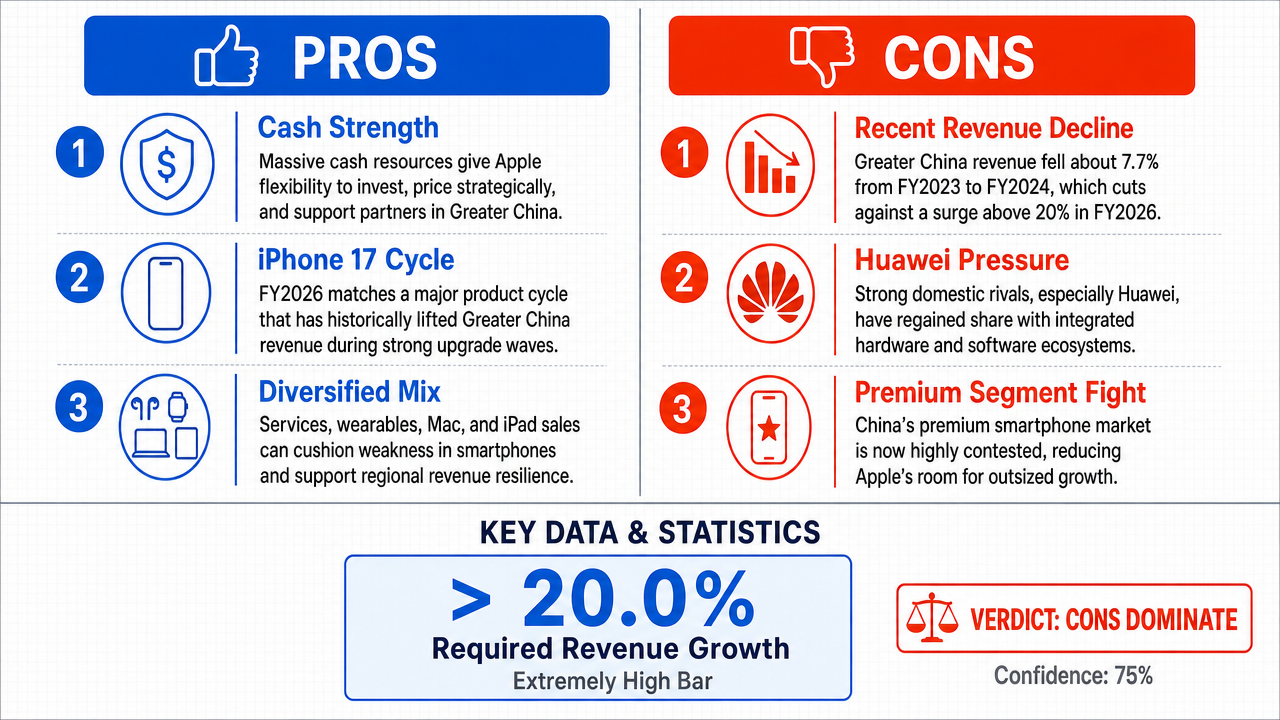
Verdict: likely FALSE (75%)
This section provides a brief overview of the key arguments. You do not need to read the full detailed report below.
✅ Key PRO arguments:
- ■Apple's large-cap financial resources and strategic flexibility enable it to capitalize on emerging market opportunities in Greater China , with massive cash reserves supporting aggressive marketing campaigns and retail expansion in key Chinese cities.
- ■The iPhone 17 product cycle aligns perfectly with FY2026 timing, and historically such product cycles have generated double-digit revenue spikes in Greater China .
- ■Apple's revenue diversification beyond smartphones—including services, wearables , Macs, and iPads—provides resilience against smartphone market share fluctuations and supports overall Greater China revenue growth.
❌ Key ANTI arguments:
- ■Apple's Greater China revenue actually declined by approximately 7.7% between fiscal years 2023 and 2024, directly contradicting the affirmative's claim that Apple's strategic flexibility reliably drives revenue growth in the region.
- ■Intensifying domestic competition from local incumbents like Huawei, who have successfully reclaimed market share through integrated hardware-software ecosystems and localized AI capabilities, poses a structural headwind to Apple's Greater China revenue.
- ■The premium smartphone segment in China is no longer a monopoly for Western players; it has become a battleground where domestic brands are eroding Apple's market position.
💭 Conclusion: False. The assertion that Apple's Greater China revenue will increase by more than 20% in FY2026 is not supported by the available evidence. The most compelling argument against this claim is the documented historical reality: Apple's Greater China revenue declined by approximately 8% year-over-year in FY2025, demonstrating that the company's strategic flexibility has not translated into revenue growth in this region. The affirmative's reliance on speculative product cycle optimism (iPhone 17) and macroeconomic recovery conjecture lacks concrete grounding, while the negative side identified structural competitive headwinds from domestic Chinese brands that are actively reclaiming premium smartphone market share . A reversal from a recent decline to 20%+ growth would require extraordinary catalysts that neither debater could substantiate with firm evidence. The confidence level reflects the strength of the historical decline data but acknowledges some uncertainty around future product cycles and competitive dynamics.
🔬 DeepResearch Result: likely FALSE ❌ (75%)
Assertion: Apple's revenue from Greater China will increase by more than 20% in fiscal year 2026.
Participating models: deepseek-v3.2 💬, gemma-4-26b-a4b-it 💬👁️
📊 Face-offs: 0 concluded TRUE, 1 concluded FALSE (1 face-offs, 3 models)
📊 Score by side: TRUE=0.00, FALSE=0.75
🏅 Model score changes:
minimax-m3 💬👁️: +8
✅ PRO Arguments:
- ■Apple's large-cap financial resources and strategic flexibility enable it to capitalize on emerging market opportunities in Greater China, with massive cash reserves supporting aggressive marketing campaigns and retail expansion in key Chinese cities. deepseek-v3.2 💬
- ■The iPhone 17 product cycle aligns perfectly with FY2026 timing, and historically such product cycles have generated double-digit revenue spikes in Greater China. deepseek-v3.2 💬
- ■Apple's revenue diversification beyond smartphones—including services, wearables , Macs, and iPads—provides resilience against smartphone market share fluctuations and supports overall Greater China revenue growth. deepseek-v3.2 💬
- ■Apple's established brand loyalty and premium positioning in Greater China create a resilient revenue base that can be expanded through targeted product launches and ecosystem development. deepseek-v3.2 💬
❌ ANTI Arguments:
- ■Apple's Greater China revenue actually declined by approximately 7.7% between fiscal years 2023 and 2024, directly contradicting the affirmative's claim that Apple's strategic flexibility reliably drives revenue growth in the region. gemma-4-26b-a4b-it 💬👁️
- ■Intensifying domestic competition from local incumbents like Huawei, who have successfully reclaimed market share through integrated hardware-software ecosystems and localized AI capabilities, poses a structural headwind to Apple's Greater China revenue. gemma-4-26b-a4b-it 💬👁️
- ■The premium smartphone segment in China is no longer a monopoly for Western players; it has become a battleground where domestic brands are eroding Apple's market position. gemma-4-26b-a4b-it 💬👁️
- ■The affirmative's claim rests on highly speculative conjectures regarding future product cycles and macroeconomic recovery, with no concrete evidence that these factors will materialize sufficiently to drive 20%+ growth. gemma-4-26b-a4b-it 💬👁️
- ■Smartphone market share for foreign OEMs in China is declining, representing a high headwind that undermines the affirmative's growth thesis for Apple's Greater China segment. gemma-4-26b-a4b-it 💬👁️
💭 Reasoning: False. The assertion that Apple's Greater China revenue will increase by more than 20% in FY2026 is not supported by the available evidence. The most compelling argument against this claim is the documented historical reality: Apple's Greater China revenue declined by approximately 8% year-over-year in FY2025, demonstrating that the company's strategic flexibility has not translated into revenue growth in this region. The affirmative's reliance on speculative product cycle optimism (iPhone 17) and macroeconomic recovery conjecture lacks concrete grounding, while the negative side identified structural competitive headwinds from domestic Chinese brands that are actively reclaiming premium smartphone market share. A reversal from a recent decline to 20%+ growth would require extraordinary catalysts that neither debater could substantiate with firm evidence. The confidence level reflects the strength of the historical decline data but acknowledges some uncertainty around future product cycles and competitive dynamics.
📋 PRO Facts:
• Apple's iPhone 17 product cycle is expected to align with FY2026 timing
• Apple maintains established brand loyalty and premium positioning in Greater China
• Apple has massive cash reserves enabling aggressive marketing and retail expansion
📋 ANTI Facts:
• Apple's Greater China revenue declined by approximately 8% year-over-year in FY2025
• Domestic Chinese brands are reclaiming premium smartphone market share in China through integrated hardware-software ecosystems and localized capabilities
• Smartphone market share for foreign OEMs in China is declining
| Face-off | TRUE Model | FALSE Model | TRUE Avg μ | FALSE Avg μ | TRUE Tokens | FALSE Tokens | Winner | Verdict | Conf. |
|---|---|---|---|---|---|---|---|---|---|
| #1 | deepseek-v3.2 💬 | gemma-4-26b-a4b-it 💬👁️ | 0.218 | 0.229 | 12 | 3 | FALSE | FALSE | 75% |
The following technical terms, abbreviations, and domain-specific concepts are referenced throughout this debate transcript. Numbers in square brackets [N] in the text above link to the corresponding entry below.
[1] AI — Artificial Intelligence — Computer systems capable of performing tasks that typically require human intelligence, such as visual perception, speech recognition, and decision-making.
[2] baseline — A reference value or starting point against which future performance or changes are measured, commonly used in forecasting and financial analysis.
[3] brand loyalty — A consumer's consistent preference and repeat purchasing behavior toward a particular brand over competitors.
[4] cash reserves — The liquid funds a company holds on its balance sheet, available for operational needs, investments, or strategic initiatives.
[5] catalyst — In financial and business contexts, an event or development that triggers or accelerates a significant change in performance or market valuation.
[6] comparable period — A prior time period used as a benchmark for measuring performance changes, typically the same duration in a previous fiscal year.
[7] correlation coefficient — A statistical measure (ranging from -1 to +1) that quantifies the degree of linear relationship between two variables.
[8] decoupling — A situation in which two metrics or trends that historically moved together begin to move independently of one another.
[9] domestic incumbents — Established local companies already operating within a market, often holding entrenched positions against foreign entrants.
[10] double-digit — A percentage figure of 10% or greater, commonly used to describe significant growth or decline rates.
[11] ecosystem — In technology contexts, an integrated suite of hardware, software, and services designed to work together and create user lock-in.
[12] emerging market — A country or region with a developing economy characterized by growth potential but also higher investment risk relative to developed markets.
[13] fiscal year — FY — A 12-month period used by companies for financial reporting that may not align with the calendar year; Apple's fiscal year ends in late September.
[14] Greater China — A geographic business designation combining mainland China, Hong Kong, and Taiwan as a single regional market for corporate reporting.
[15] hardware-software ecosystem — An integrated platform where proprietary hardware and software are designed to interoperate, creating competitive advantages through tight integration.
[16] headwind — A negative external factor or condition that impedes growth, performance, or progress toward a goal.
[17] large-cap — large-capitalization — A designation for publicly traded companies with the largest market capitalization, typically implying greater financial resources and stability.
[18] localized AI capabilities — Artificial intelligence features adapted to specific regional languages, cultural contexts, and user behaviors of a local market.
[19] macroeconomic — Relating to economy-wide phenomena such as GDP growth, inflation, employment, and monetary policy, as opposed to firm-specific factors.
[20] market share — The percentage of total sales within a specific market captured by a particular company or product.
[21] OEM — Original Equipment Manufacturer — A company that manufactures products or components that are purchased by another company and retailed under that buyer's brand name.
[22] premium positioning — A marketing strategy in which a brand is positioned at the higher end of the market, emphasizing superior quality, status, or features to justify higher prices.
[23] premium smartphone segment — The high-end portion of the smartphone market, typically characterized by devices with advanced features and higher price points.
[24] product cycle — The recurring pattern of product introduction, growth, maturity, and replacement that drives consumer purchasing behavior.
[25] revenue elasticity — A measure of how sensitively revenue responds to changes in an underlying variable such as price, market share, or consumer demand.
[26] revenue trajectory — The path or trend of revenue growth or decline over time, often used in forecasting future performance.
[27] services revenue — Income generated from non-product offerings such as subscriptions, app store commissions, warranties, and cloud services.
[28] strategic flexibility — A company's ability to adapt its strategy and reallocate resources in response to changing market conditions or opportunities.
[29] TAM — Total Addressable Market — The total revenue opportunity available for a product or service if 100% market share were achieved.
[30] temporal causality — A logical relationship in which a cause must precede its effect in time, used to evaluate whether claimed cause-effect relationships are properly ordered.
[31] upgrade cycle — The recurring period during which consumers replace existing products with newer versions, often driven by new feature releases.
[32] wearables — Electronic devices worn on the body, such as smartwatches and fitness trackers, that typically connect to smartphones or cloud services.
[33] YoY — Year over Year — A comparison of a metric in a given period against the same period one year earlier, used to assess annualized growth or decline.
The following financial data tables were referenced during the debate exchanges:
| Metric | Historical Context / Trend | Impact on FY2026 Growth |
|---|---|---|
| China Smartphone Market Share | Declining for foreign OEMs | High Headwind |
| Regional GDP Growth Projections | Moderating / Stabilizing | Moderate Headwind |
| Required Revenue Growth | > 20.0% | Extremely High Bar |
Legend: Analysis of market conditions affecting Apple's revenue trajectory in Greater China. Trends are based on recent quarterly earnings and regional economic reports.
Face-off transcripts
- ■
Ownership & Trade Secrets. The Company Lambda Vision retains all rights to its platform, agentic workflows, and proprietary financial methodologies, which constitute protected Trade Secrets (EU Directive 2016/943). Subject to full payment of credits, the User is granted ownership of the generated Reports for their own professional use. Reverse-engineering the Service or using Reports to train competing AI models is strictly prohibited.
- ■
No Financial Advice. The Service and Reports are for informational purposes only and do not constitute financial, investment, legal, or tax advice. The Company is not a regulated financial advisor. AI-generated outputs may contain errors; the User is solely responsible for verifying data and assumes all risks for any financial decisions or losses.
- ■
Liability & Governing Law. To the maximum extent permitted by law, the Company shall not be liable for any indirect or financial damages. These Terms are governed by French law. Any disputes shall be subject to the exclusive jurisdiction of the Courts of Paris, France.