
Apple's revenue growth will exceed 10% in fiscal year 2026.
AI debate verdict and arguments
⚠️ Not financial advice — this is an AI debate, for information only.
Completed October 8, 2026
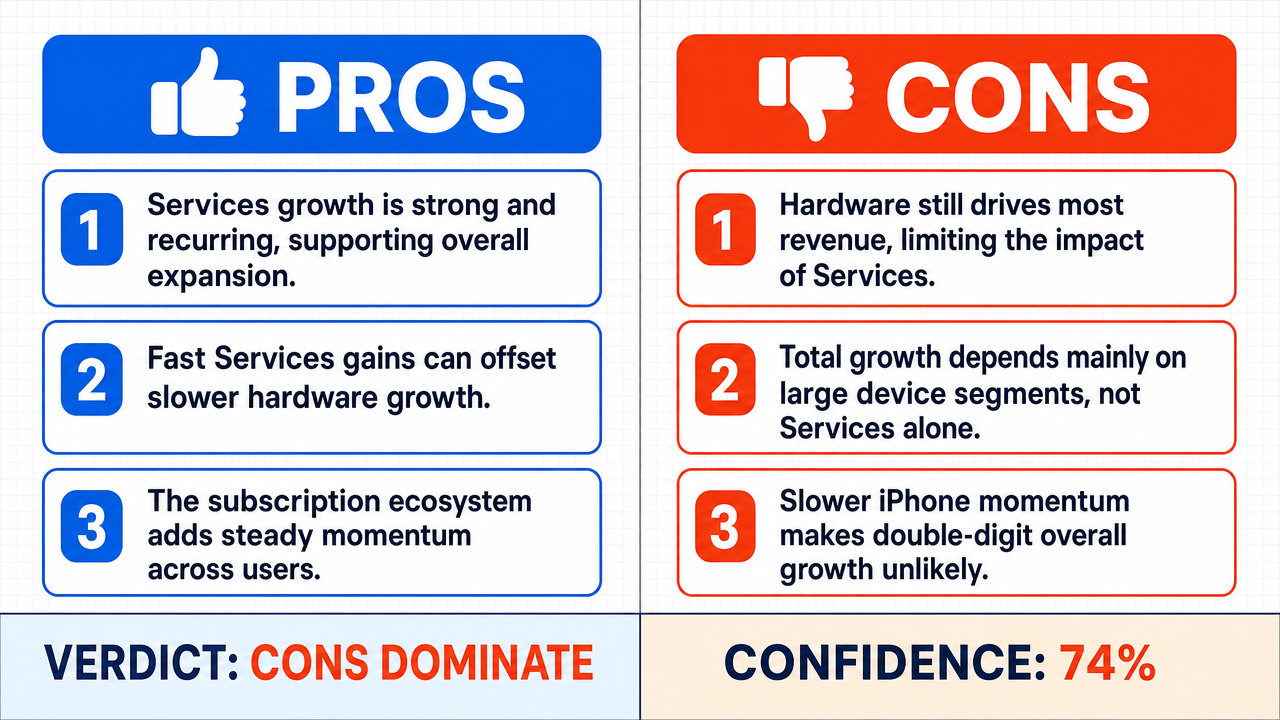
Verdict
Verdict: likely FALSE (74%)
This section provides a brief overview of the key arguments. You do not need to read the full detailed report below.
✅ Key PRO arguments:
- ■Apple's Services segment reached $92.3 billion in fiscal 2025 with a 14% growth rate , and its higher margin profile and recurring revenue characteristics create a compounding effect on overall growth that will help exceed the 10% target in fiscal 2026.
- ■A weighted calculation shows that if Services (21.5% of revenue) grows at 14% and the remaining hardware segment (78.5%) grows at just 8.6%, total revenue growth reaches 10%, demonstrating that moderate hardware acceleration combined with Services momentum achieves the target.
- ■The expansion of Apple's subscription ecosystem —including Apple TV+, Apple Music, Apple Arcade, and Apple Fitness+—combined with increasing App Store commissions and licensing fees provides a predictable revenue stream that will contribute disproportionately to achieving the 10% growth target.
❌ Key ANTI arguments:
- ■Apple is a hardware-centric company where the massive scale of the iPhone and Mac segments creates high inertia that Services growth, despite its higher percentage rate, cannot easily overcome, making 10%+ total revenue growth unlikely.
- ■Because Services represents only approximately 21.5% of total revenue , total revenue growth is heavily weighted toward hardware segments ; for 10% total growth, hardware would need to grow at rates that current trends do not support.
- ■The iPhone remains the primary driver of total revenue and exhibits decelerating momentum , meaning the hardware segments that constitute ~78.5% of revenue would need significantly higher growth than current trends suggest to achieve 10% total growth.
💭 Conclusion: False. The FALSE side presented the more compelling structural argument that Apple's hardware-centric revenue composition makes 10%+ total growth in fiscal 2026 unlikely. The key insight is that Services, despite its impressive 14% growth rate , represents only approximately 21.5% of total revenue , meaning the remaining ~78.5% from hardware segments (primarily iPhone ) must carry the bulk of growth. The FALSE side correctly identified that achieving 10% total growth would require hardware segments to grow at rates exceeding current deceleration trends, which the affirmative failed to adequately substantiate. The judge weighted the structural reality of Apple's revenue composition and the mathematical mismatch between segment -level growth and company-wide growth targets as decisive factors.
🔬 DeepResearch Result: likely FALSE ❌ (74%)
Assertion: Apple's revenue growth will exceed 10% in fiscal year 2026.
Participating models: deepseek-v3.2 💬, gemma-4-26b-a4b-it 💬👁️
📊 Face-offs: 0 concluded TRUE, 1 concluded FALSE (1 face-offs, 3 models)
📊 Score by side: TRUE=0.00, FALSE=0.74
🏅 Model score changes:
minimax-m3 💬👁️: +7
✅ PRO Arguments:
- ■Apple's Services segment reached $92.3 billion in fiscal 2025 with a 14% growth rate , and its higher margin profile and recurring revenue characteristics create a compounding effect on overall growth that will help exceed the 10% target in fiscal 2026. deepseek-v3.2 💬
- ■A weighted calculation shows that if Services (21.5% of revenue) grows at 14% and the remaining hardware segment (78.5%) grows at just 8.6%, total revenue growth reaches 10%, demonstrating that moderate hardware acceleration combined with Services momentum achieves the target. deepseek-v3.2 💬
- ■The expansion of Apple's subscription ecosystem —including Apple TV+, Apple Music, Apple Arcade, and Apple Fitness+—combined with increasing App Store commissions and licensing fees provides a predictable revenue stream that will contribute disproportionately to achieving the 10% growth target. deepseek-v3.2 💬
- ■Apple's AI and spatial computing investments will drive hardware acceleration in fiscal 2026, supporting the moderate 8-9% hardware growth needed to combine with Services momentum for 10%+ total revenue growth. deepseek-v3.2 💬
❌ ANTI Arguments:
- ■Apple is a hardware-centric company where the massive scale of the iPhone and Mac segments creates high inertia that Services growth, despite its higher percentage rate, cannot easily overcome, making 10%+ total revenue growth unlikely. gemma-4-26b-a4b-it 💬👁️
- ■Because Services represents only approximately 21.5% of total revenue, total revenue growth is heavily weighted toward hardware segments ; for 10% total growth, hardware would need to grow at rates that current trends do not support. gemma-4-26b-a4b-it 💬👁️
- ■The iPhone remains the primary driver of total revenue and exhibits decelerating momentum , meaning the hardware segments that constitute ~78.5% of revenue would need significantly higher growth than current trends suggest to achieve 10% total growth. gemma-4-26b-a4b-it 💬👁️
- ■Presenting a segment-level growth rate (14% Services) as a sufficient basis for a total company growth prediction without establishing a clear bridge to total revenue is logically hollow, as segment growth does not automatically translate to proportional company-wide growth. gemma-4-26b-a4b-it 💬👁️
💭 Reasoning: False. The FALSE side presented the more compelling structural argument that Apple's hardware-centric revenue composition makes 10%+ total growth in fiscal 2026 unlikely. The key insight is that Services, despite its impressive 14% growth rate, represents only approximately 21.5% of total revenue, meaning the remaining ~78.5% from hardware segments (primarily iPhone) must carry the bulk of growth. The FALSE side correctly identified that achieving 10% total growth would require hardware segments to grow at rates exceeding current deceleration trends, which the affirmative failed to adequately substantiate. The judge weighted the structural reality of Apple's revenue composition and the mathematical mismatch between segment-level growth and company-wide growth targets as decisive factors.
📋 PRO Facts:
• Apple's Services segment revenue reached $92.3 billion in fiscal 2025
• Services segment grew at 14% in fiscal 2025
• Services represents approximately 21.5% of Apple's total revenue
• Apple is expanding its subscription ecosystem, including Apple TV+
📋 ANTI Facts:
• Services represents only approximately 21.5% of total revenue, leaving hardware at ~78.5%
• The iPhone remains the primary driver of Apple's total revenue
• Hardware segments exhibit decelerating momentum in current trends
• For total revenue to grow by 10%, hardware segments must grow at rates exceeding current trend projections
| Face-off | TRUE Model | FALSE Model | TRUE Avg μ | FALSE Avg μ | TRUE Tokens | FALSE Tokens | Winner | Verdict | Conf. |
|---|---|---|---|---|---|---|---|---|---|
| #1 | deepseek-v3.2 💬 | gemma-4-26b-a4b-it 💬👁️ | 0.358 | 0.226 | 12 | 3 | TRUE | FALSE | 74% |
The following technical terms, abbreviations, and domain-specific concepts are referenced throughout this debate transcript. Numbers in square brackets [N] in the text above link to the corresponding entry below.
[1] AI — Artificial Intelligence — Computer systems performing tasks that typically require human intelligence, referenced in the debate as a potential future revenue driver for Apple.
[2] App Store commissions — Fees Apple charges developers on transactions conducted through its App Store, contributing to the Services segment revenue.
[3] Argument tree — A structured representation of debate arguments and their relationships, used in the transcript to reference argument credibility (e.g., C_Cred=0.00).
[4] C_Cred — Credibility score — A numerical measure in the debate's argument tree indicating the credibility or weight assigned to a particular argument or claim.
[5] Compounding effect — The cumulative impact of repeated or sustained growth, referenced in the debate regarding how Services revenue builds on itself over time.
[6] Decelerating momentum — A slowdown in the rate of growth of a segment, cited by the negative side regarding iPhone sales trends.
[7] Disproportionately — In financial context, contributing more to overall growth than a segment's relative size would suggest.
[8] Earnings report — A company's periodic financial disclosure of revenue, expenses, and profitability, cited as the source of Apple's segment data.
[9] Fiscal year (FY) — Fiscal year — Apple's 12-month accounting period, which runs approximately October through September, distinct from the calendar year.
[10] Growth driver — A segment, product, or factor primarily responsible for a company's revenue or earnings expansion.
[11] Growth rate — The percentage change in a metric (typically revenue) over a specified period, used throughout the debate to compare segment performance.
[12] Hardware acceleration — An increase in the growth rate of hardware segment sales, referenced as necessary for Apple to reach 10% total revenue growth.
[13] Hardware segments — Apple's business divisions selling physical products (iPhone, Mac, iPad, Wearables), as opposed to the Services segment.
[14] Hardware-centric — A business model in which physical product sales constitute the dominant share of revenue, used to describe Apple's structure.
[15] High inertia — Resistance to change in business performance, used to describe how the large scale of iPhone sales makes rapid growth shifts difficult.
[16] iPhone — Apple's flagship smartphone product line, identified in the debate as the largest single contributor to total revenue.
[17] Large Cap — Large capitalization — A classification for publicly traded companies with a large market value, used as a facet label in the debate structure.
[18] Licensing fees — Payments made for the right to use intellectual property, cited as a contributor to Apple's Services revenue.
[19] Margin profile — The characteristic profitability level of a business segment, with Services noted for having higher margins than hardware.
[20] Mathematical derivation — A formal calculation or proof, referenced when assessing whether the Services growth rate mathematically supports the 10% target.
[21] Non-sequitur — A logical fallacy in which a conclusion does not follow from the premises; used by the negative side to critique the affirmative's argument.
[22] Proposition — In a debate, the affirmative claim or statement to be defended, here being that Apple's FY2026 revenue growth will exceed 10%.
[23] Q4 — Fourth quarter — The final three-month period of a fiscal year, referenced as the source of Apple's reported FY2025 results.
[24] Recurring revenue — Revenue that repeats at regular intervals, characteristic of subscription-based services and cited as a quality of Apple's Services segment.
[25] Revenue distribution — The breakdown of total company revenue across business segments, central to the debate's dispute over Services' share (21.5% vs. claimed 35-40%).
[26] Revenue growth — The increase in a company's total sales over a period, the central metric of the debate's 10% threshold claim.
[27] Segment — Business segment — A distinct division of a company's operations (e.g., iPhone, Services, Mac) reported separately in financial disclosures.
[28] Services segment — Apple's division encompassing subscription services, App Store, advertising, licensing, and other non-hardware revenue streams.
[29] Spatial computing — Technology that blends digital content with the physical 3D environment (e.g., Apple Vision Pro), cited as a potential future growth area.
[30] Stagnant — Showing little or no growth, used to describe hardware segment sales trends in the debate.
[31] Structural drag — Downward pressure on overall growth caused by the slow performance of a large segment, used to describe hardware's effect on total revenue.
[32] Subscription ecosystem — An interconnected set of subscription-based services (e.g., Apple TV+, Apple Music), cited as a driver of Services revenue.
[33] Total revenue — The aggregate sales of all business segments combined, the metric the 10% growth threshold applies to.
[34] USD billions — United States Dollars in billions — The currency unit used to express Apple's segment and total revenue figures throughout the debate.
[35] Wearables — Apple's product category including Apple Watch, AirPods, and similar devices, treated as a distinct revenue segment.
[36] Weighted calculation — A computation that accounts for the relative size of each component, used to derive total revenue growth from individual segment growth rates.
[37] Weighted projection — A forecast that applies growth rates to segments according to their proportional contribution to the total.
The following financial data tables were referenced during the debate exchanges:
| Segment | Revenue FY2024 | Revenue FY2025 | Growth Rate |
|---|---|---|---|
| Services | $81.0B | $92.3B | +14.0% |
| iPhone | $205.5B | $219.0B | +6.6% |
| Mac | $29.4B | $31.2B | +6.1% |
| Wearables | $39.8B | $42.1B | +5.8% |
| iPad | $28.3B | $29.0B | +2.5% |
Legend: Apple's segment revenue performance showing services as the fastest growing division. Figures in USD billions; FY2025 growth calculated from reported results. Source: Apple quarterly earnings reports.
| Segment | Revenue FY2025 (Est. USD) | FY2025 Growth Rate | Impact on Total Growth |
|---|---|---|---|
| iPhone | ~$200B+ | Low/Flat | High |
| Services | ~$92.3B | +14.0% | Moderate |
| Other Hardware | ~$100B+ | Low | Moderate |
Legend: Estimated revenue distribution and growth impact for FY2025. iPhone dominance creates a high hurdle for total revenue growth targets.
| Metric | FY2025 Value | Percentage of Total |
|---|---|---|
| Total Revenue | $429.5B | 100% |
| Services Revenue | $92.3B | 21.5% |
| Hardware Revenue | $337.2B | 78.5% |
Legend: Actual revenue distribution from Apple's fiscal 2025 results, showing Services at 21.5% of total, not 35-40%. Source: Apple Q4 2025 earnings report.
Face-off transcripts
- ■
Ownership & Trade Secrets. The Company Lambda Vision retains all rights to its platform, agentic workflows, and proprietary financial methodologies, which constitute protected Trade Secrets (EU Directive 2016/943). Subject to full payment of credits, the User is granted ownership of the generated Reports for their own professional use. Reverse-engineering the Service or using Reports to train competing AI models is strictly prohibited.
- ■
No Financial Advice. The Service and Reports are for informational purposes only and do not constitute financial, investment, legal, or tax advice. The Company is not a regulated financial advisor. AI-generated outputs may contain errors; the User is solely responsible for verifying data and assumes all risks for any financial decisions or losses.
- ■
Liability & Governing Law. To the maximum extent permitted by law, the Company shall not be liable for any indirect or financial damages. These Terms are governed by French law. Any disputes shall be subject to the exclusive jurisdiction of the Courts of Paris, France.