
Bitcoin's price remaining above $83,000 in December 2026 indicates continued bull market control, shifting the burden of proof to sellers for any significant decline.
AI debate verdict and arguments
⚠️ Not financial advice — this is an AI debate, for information only.
Completed October 8, 2026
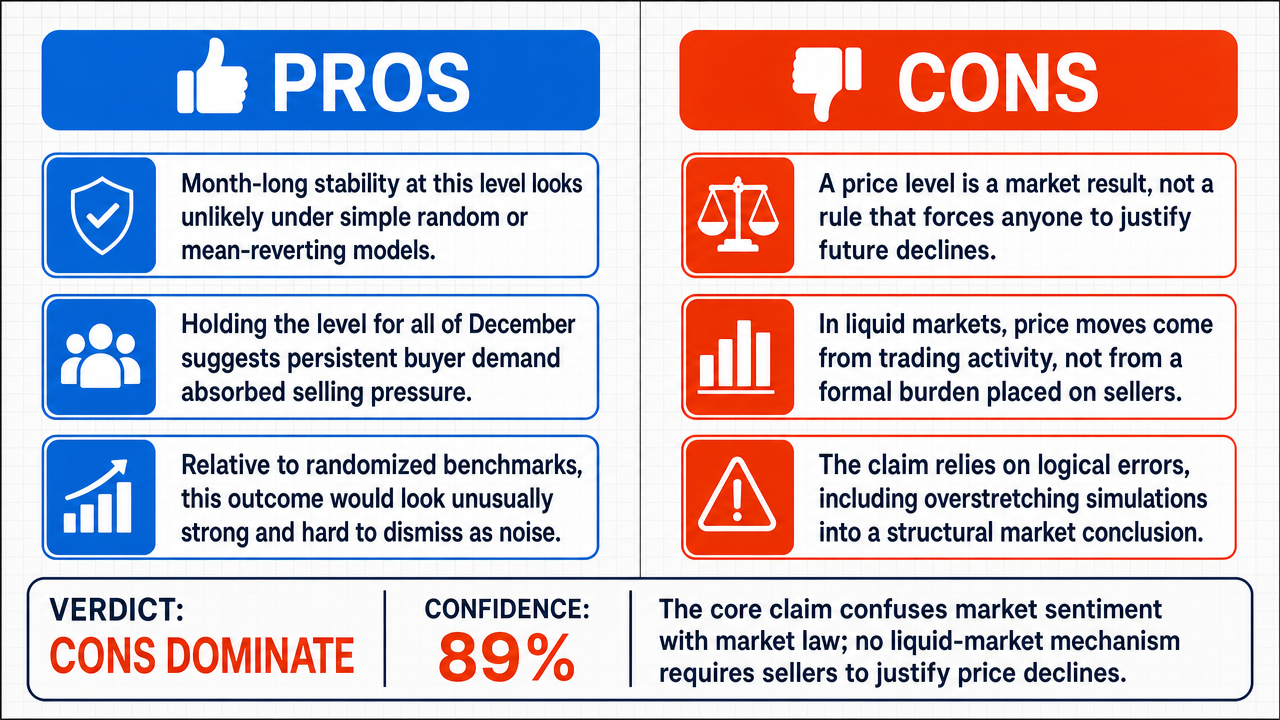
Verdict
Verdict: likely FALSE (89%)
This section provides a brief overview of the key arguments. You do not need to read the full detailed report below.
✅ Key PRO arguments:
- ■A price level sustained at $83,000 for an entire month in late 2026 represents a statistically improbable outcome under random walk or mean-reverting market models, with Power-Law Monte Carlo simulations showing such thresholds typically occur only during extended bull market regimes characterized by positive momentum clustering .
- ■When Bitcoin maintains $83,000 throughout December 2026, this represents a month-long equilibrium where buyer demand continuously absorbs selling pressure , establishing the price as a revealed preference consensus, and market participants wishing to disrupt this equilibrium must provide new information justifying why the established valuation is wrong.
- ■Through Constrained Random Benchmarking analysis, Bitcoin at $83,000 would outperform virtually all randomized benchmark portfolios, creating an evidentiary burden where sellers must demonstrate specific negative catalysts to justify abandoning a proven outperforming position.
❌ Key ANTI arguments:
- ■The affirmative's argument relies on a fundamental logical error by treating a price level as a structural mandate rather than a market outcome; the claim that a price above $83,000 'shifts the burden of proof to sellers' is a psychological conjecture, not a market mechanism, confusing market sentiment with market law.
- ■In any liquid financial market, the 'burden' of a price movement is borne by the participants who execute the trades that create the movement, and there is no structural or legal mechanism that requires a seller to 'justify' a transaction or provide a 'catalyst ' to justify a price decline.
- ■The affirmative's position rests on several logical and structural fallacies, including misapplication of Monte Carlo simulations to argue for an 'epistemic burden ' that does not exist in actual market mechanics, where price levels are outcomes of supply and demand rather than mandates that constrain future trading.
💭 Conclusion: False. The negative side successfully demonstrated that the affirmative's core claim conflates market sentiment with market law, since no structural mechanism in liquid markets requires sellers to 'justify' price declines regardless of where the price sits. The affirmative's argument that sustained price levels create an 'evidentiary burden ' for sellers was correctly identified as a psychological conjecture rather than a binding market principle. Furthermore, the negative effectively dismantled the Monte Carlo simulation argument by showing that statistical improbability of a price level does not translate into a legal or structural obligation for market participants. The judge's high confidence reflects the strength of the negative's logical and structural critique of the affirmative's burden-shifting framework.
🔬 DeepResearch Result: likely FALSE ❌ (89%)
Assertion: Bitcoin's price remaining above $83,000 in December 2026 indicates continued bull market control, shifting the burden of proof to sellers for any significant decline.
Participating models: deepseek-v3.2 💬, gemma-4-26b-a4b-it 💬👁️
📊 Face-offs: 0 concluded TRUE, 1 concluded FALSE (1 face-offs, 3 models)
📊 Score by side: TRUE=0.00, FALSE=0.89
🏅 Model score changes:
minimax-m3 💬👁️: +9
✅ PRO Arguments:
- ■A price level sustained at $83,000 for an entire month in late 2026 represents a statistically improbable outcome under random walk or mean-reverting market models, with Power-Law Monte Carlo simulations showing such thresholds typically occur only during extended bull market regimes characterized by positive momentum clustering . deepseek-v3.2 💬
- ■When Bitcoin maintains $83,000 throughout December 2026, this represents a month-long equilibrium where buyer demand continuously absorbs selling pressure , establishing the price as a revealed preference consensus, and market participants wishing to disrupt this equilibrium must provide new information justifying why the established valuation is wrong. deepseek-v3.2 💬
- ■Through Constrained Random Benchmarking analysis, Bitcoin at $83,000 would outperform virtually all randomized benchmark portfolios, creating an evidentiary burden where sellers must demonstrate specific negative catalysts to justify abandoning a proven outperforming position. deepseek-v3.2 💬
❌ ANTI Arguments:
- ■The affirmative's argument relies on a fundamental logical error by treating a price level as a structural mandate rather than a market outcome; the claim that a price above $83,000 'shifts the burden of proof to sellers' is a psychological conjecture, not a market mechanism, confusing market sentiment with market law. gemma-4-26b-a4b-it 💬👁️
- ■In any liquid financial market, the 'burden' of a price movement is borne by the participants who execute the trades that create the movement, and there is no structural or legal mechanism that requires a seller to 'justify' a transaction or provide a 'catalyst ' to justify a price decline. gemma-4-26b-a4b-it 💬👁️
- ■The affirmative's position rests on several logical and structural fallacies, including misapplication of Monte Carlo simulations to argue for an 'epistemic burden ' that does not exist in actual market mechanics, where price levels are outcomes of supply and demand rather than mandates that constrain future trading. gemma-4-26b-a4b-it 💬👁️
💭 Reasoning: False. The negative side successfully demonstrated that the affirmative's core claim conflates market sentiment with market law, since no structural mechanism in liquid markets requires sellers to 'justify' price declines regardless of where the price sits. The affirmative's argument that sustained price levels create an 'evidentiary burden' for sellers was correctly identified as a psychological conjecture rather than a binding market principle. Furthermore, the negative effectively dismantled the Monte Carlo simulation argument by showing that statistical improbability of a price level does not translate into a legal or structural obligation for market participants. The judge's high confidence reflects the strength of the negative's logical and structural critique of the affirmative's burden-shifting framework.
📋 PRO Facts:
• Bitcoin price level referenced: $83,000 in December 2026
• Power-Law Monte Carlo simulations of Bitcoin's historical return distribution show prices above high thresholds typically occur during extended bull market regimes
📋 ANTI Facts:
• In liquid financial markets, the burden of price movement lies with participants providing liquidity , regardless of price level
• No structural or legal mechanism exists requiring sellers to justify transactions or provide catalysts for price declines
| Face-off | TRUE Model | FALSE Model | TRUE Avg μ | FALSE Avg μ | TRUE Tokens | FALSE Tokens | Winner | Verdict | Conf. |
|---|---|---|---|---|---|---|---|---|---|
| #1 | deepseek-v3.2 💬 | gemma-4-26b-a4b-it 💬👁️ | 0.234 | 0.238 | 12 | 3 | FALSE | FALSE | 89% |
The following technical terms, abbreviations, and domain-specific concepts are referenced throughout this debate transcript. Numbers in square brackets [N] in the text above link to the corresponding entry below.
[1] anchoring bias — A cognitive bias where individuals rely disproportionately on an initial piece of information (the 'anchor') when making subsequent judgments. The negative side characterizes the claim that a price level shifts the burden of proof as an instance of this bias.
[2] Bayesian updating — A statistical method of revising the probability of a hypothesis as new evidence becomes available. The affirmative argues that price persistence serves as evidence supporting prior bullish assumptions through this updating mechanism.
[3] bearish — Describing market conditions, models, or sentiment characterized by expectations of falling prices. Used in the debate to characterize neutral or pessimistic market assumptions.
[4] bull market — A market condition characterized by rising prices and optimistic investor sentiment. The debate centers on whether Bitcoin's sustained price level indicates continued bull market control.
[5] bull market regimes — Extended periods of bull market conditions characterized by positive momentum clustering. The affirmative argues that prices above certain thresholds typically occur only during such regimes.
[6] bullish — Describing market conditions, assumptions, or expectations of rising prices. Used in the debate to characterize prior assumptions and market sentiment.
[7] burden of proof — The obligation to provide evidence or justification for a claim. The debate disputes whether sustained price levels shift this burden to sellers in liquid markets, with the affirmative claiming an asymmetric burden and the negative denying any such mechanism exists.
[8] catalyst — An event or piece of information that triggers a significant price movement. The affirmative argues sellers must demonstrate specific negative catalysts to justify abandoning a position.
[9] category error — A philosophical or logical error in which things belonging to different categories are treated as if they were comparable. The negative side argues the affirmative commits this error by treating a price level as a structural mandate rather than a market outcome.
[10] circularity — circular reasoning — A logical fallacy in which the conclusion is assumed within the premises. The negative side argues the affirmative's Monte Carlo simulation argument is circular, using a projected price level to define a regime and then using that regime to justify the probability of the price level.
[11] Constrained Random Benchmarking — A statistical methodology for testing investment skill versus chance by comparing performance against conditionally randomized benchmark portfolios. The affirmative uses this to argue Bitcoin at $83,000 would outperform chance alternatives.
[12] epistemic burden — An obligation related to knowledge or evidence rather than legal requirements. The affirmative reframes their argument in these terms after the negative identifies the original framing as a category error.
[13] equilibrium — A state of balance in a market where supply and demand are matched. The affirmative describes sustained Bitcoin prices as a month-long equilibrium where buyer demand continuously absorbs selling pressure.
[14] evidentiary burden — The obligation to provide evidence to support a claim. The debate disputes whether sustained price levels create such a burden for sellers proposing significant declines.
[15] evidentiary weight — The relative strength or importance of evidence in supporting a conclusion. The affirmative argues that sustained market consensus carries evidentiary weight that sellers must overcome.
[16] informational asymmetry — A condition in which different parties in a transaction possess different amounts of relevant information. The affirmative argues sustained price levels create this asymmetry, requiring deviation from consensus to be justified by new information.
[17] institutional adoption — The process by which large financial institutions begin to use, hold, or invest in an asset. The affirmative mentions this as part of the information flow incorporated into consensus valuation.
[18] liquidity — The ease with which an asset can be bought or sold without significantly affecting its price. The negative side argues that in liquid markets, the burden of proof does not shift based on price level.
[19] market microstructure theory — A branch of financial economics studying the detailed process of how trades occur and prices are formed in markets. The affirmative cites this theory to support their burden-shifting argument.
[20] market sentiment — The overall attitude or feeling of investors toward a particular market or asset. The negative side distinguishes this psychological concept from market law or mechanism.
[21] mean-reverting — Describing a process or time series that tends to return to its long-term average over time. The affirmative argues Bitcoin's sustained price level is statistically improbable under mean-reverting market models.
[22] momentum clustering — A phenomenon where price movements in one direction tend to be followed by additional movements in the same direction. The affirmative associates this with extended bull market regimes.
[23] Monte Carlo simulations — A computational technique using repeated random sampling to obtain numerical results. The affirmative uses power-law Monte Carlo simulations to argue Bitcoin's sustained price level is statistically improbable under neutral or bearish models.
[24] Power-Law — A mathematical relationship in which one quantity varies as a power of another, often used to describe heavy-tailed distributions in financial returns. The affirmative uses power-law distributions in their Monte Carlo simulations of Bitcoin's historical return distribution.
[25] price persistence — The tendency of prices to remain at or near a given level over time. The affirmative argues this serves as evidence supporting prior bullish assumptions through Bayesian updating.
[26] random walk — A statistical model in which successive changes in a variable are independent and identically distributed. The affirmative argues Bitcoin's sustained price level is statistically improbable under such models.
[27] revealed preference — An economic theory that preferences can be inferred from actual purchasing behavior rather than stated intentions. The affirmative argues sustained prices establish a revealed preference consensus among market participants.
[28] selling pressure — The intensity of selling activity in a market that tends to push prices downward. The affirmative argues that at $83,000, buyer demand continuously absorbs this pressure.
[29] temporal fallacy — A logical error involving incorrect assumptions about time or temporal relationships. The negative side argues the affirmative commits this by treating a future projection as an established fact.
[30] volatility — A measure of the degree of variation in prices over time. The affirmative argues that the sustained price level overwhelms typical volatility, indicating structural market strength.
Face-off transcripts
- ■
Ownership & Trade Secrets. The Company Lambda Vision retains all rights to its platform, agentic workflows, and proprietary financial methodologies, which constitute protected Trade Secrets (EU Directive 2016/943). Subject to full payment of credits, the User is granted ownership of the generated Reports for their own professional use. Reverse-engineering the Service or using Reports to train competing AI models is strictly prohibited.
- ■
No Financial Advice. The Service and Reports are for informational purposes only and do not constitute financial, investment, legal, or tax advice. The Company is not a regulated financial advisor. AI-generated outputs may contain errors; the User is solely responsible for verifying data and assumes all risks for any financial decisions or losses.
- ■
Liability & Governing Law. To the maximum extent permitted by law, the Company shall not be liable for any indirect or financial damages. These Terms are governed by French law. Any disputes shall be subject to the exclusive jurisdiction of the Courts of Paris, France.