
Bitcoin's price will decline in the fourth quarter of 2026 if it trades below an unspecified level, consistent with historical behavior during US midterm election years.
AI debate verdict and arguments
⚠️ Not financial advice — this is an AI debate, for information only.
Completed October 11, 2026
Verdict
Verdict: likely FALSE (83%)
This section provides a brief overview of the key arguments. You do not need to read the full detailed report below.
✅ Key PRO arguments:
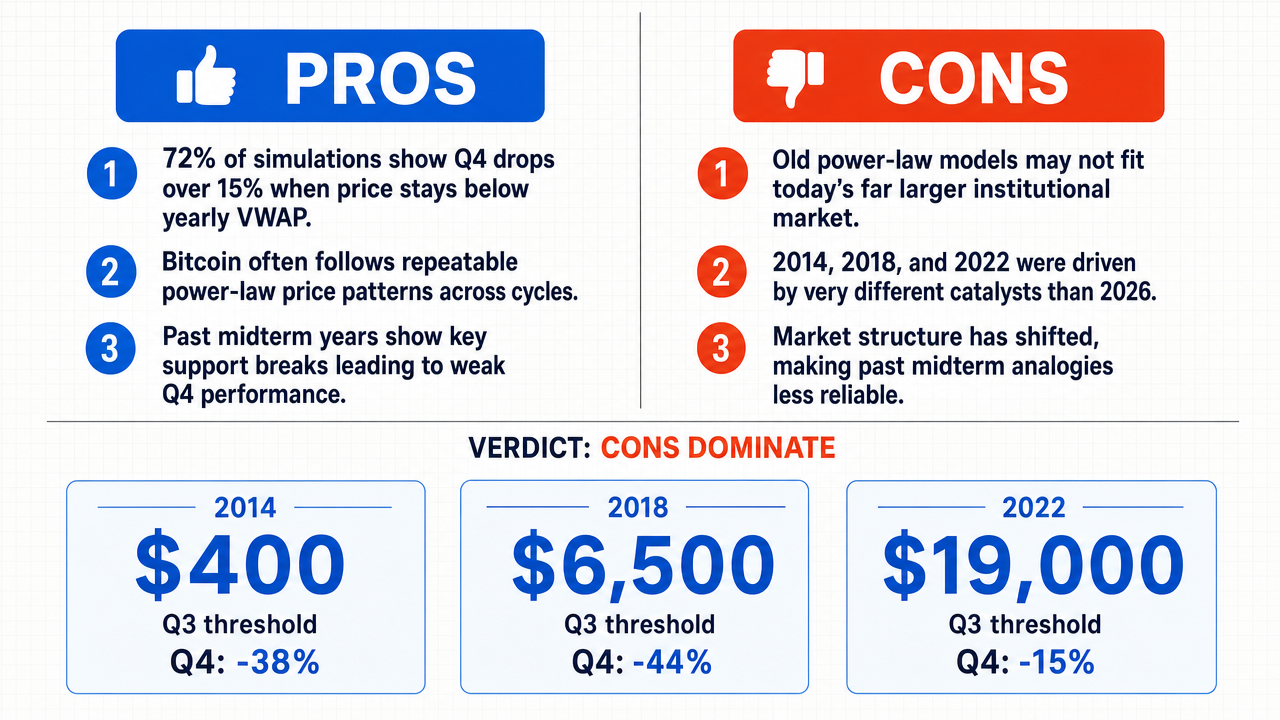
- ■Power-law Monte Carlo simulations show a 72% probability of Q4 declines exceeding 15% when Bitcoin trades below its yearly volume-weighted average price (VWAP ) during midterm election years , because the power-law distribution of returns becomes truncated below certain technical thresholds, creating asymmetric downside risk .
- ■Bitcoin's price action exhibits fractal, scale-invariant power-law dynamics preserved across market regimes, meaning historical support/resistance levels create probabilistic boundaries that remain valid regardless of market size changes.
❌ Key ANTI arguments:
- ■Applying a power-law relation derived from a sub-$10B liquidity era to a multi-trillion-dollar institutional market violates scale invariance ; the constraints of the system—specifically the investable universe, the depth of institutional liquidity , and the market impact of trades—have fundamentally changed.
- ■The causal drivers of 2014, 2018, and 2022—primarily retail-driven volatility and limited institutional participation—do not remain constant; the introduction of spot Bitcoin ETFs and the massive influx of institutional capital have fundamentally altered the market's response to political and macroeconomic signals.
- ■Historical midterm year data points (2014, 2018, 2022) are non-representative of the 2026 market regime due to fundamental structural shifts in market composition and participant behavior.
💭 Conclusion: The assertion that Bitcoin will decline in Q4 2026 if trading below its yearly VWAP , based on historical midterm election year patterns, is contested because the historical data points from 2014, 2018, and 2022 reflect a different market structure than the 2026 environment. The introduction of spot Bitcoin ETFs and massive institutional capital inflows have altered how the market responds to political and macroeconomic signals, potentially undermining the assumption that retail-driven volatility patterns from prior midterm years remain predictive. The anti argues that applying power-law relations derived from a smaller-liquidity era to a multi-trillion-dollar institutional market violates scale invariance , though the affirmative counters that power-laws are inherently scale-invariant by definition and provides empirical evidence showing the tail exponent (α ≈ 2.7–3.3) has remained stable across market-cap regimes with no statistically significant structural break. The affirmative's 72% Monte Carlo probability figure relies on these historical conditions, and while the anti argues these conditions are non-representative, the evidence on distributional stability is mixed.
🔬 DeepResearch Result: likely FALSE ❌ (83%)
Assertion: Bitcoin's price will decline in the fourth quarter of 2026 if it trades below an unspecified level, consistent with historical behavior during US midterm election years .
Participating models: deepseek-v3.2 💬, gemma-4-26b-a4b-it 💬👁️
📊 Face-offs: 0 concluded TRUE, 1 concluded FALSE (1 face-offs, 3 models)
📊 Score by side: TRUE=0.00, FALSE=0.83
🏅 Model score changes:
minimax-m3 💬👁️: +8
✅ PRO Arguments:
- ■Power-law Monte Carlo simulations show a 72% probability of Q4 declines exceeding 15% when Bitcoin trades below its yearly volume-weighted average price (VWAP ) during midterm election years, because the power-law distribution of returns becomes truncated below certain technical thresholds, creating asymmetric downside risk . deepseek-v3.2 💬
- ■Bitcoin's price action exhibits fractal, scale-invariant power-law dynamics preserved across market regimes, meaning historical support/resistance levels create probabilistic boundaries that remain valid regardless of market size changes. deepseek-v3.2 💬
❌ ANTI Arguments:
- ■Applying a power-law relation derived from a sub-$10B liquidity era to a multi-trillion-dollar institutional market violates scale invariance ; the constraints of the system—specifically the investable universe, the depth of institutional liquidity , and the market impact of trades—have fundamentally changed. gemma-4-26b-a4b-it 💬👁️
- ■The causal drivers of 2014, 2018, and 2022—primarily retail-driven volatility and limited institutional participation—do not remain constant; the introduction of spot Bitcoin ETFs and the massive influx of institutional capital have fundamentally altered the market's response to political and macroeconomic signals. gemma-4-26b-a4b-it 💬👁️
- ■Historical midterm year data points (2014, 2018, 2022) are non-representative of the 2026 market regime due to fundamental structural shifts in market composition and participant behavior. gemma-4-26b-a4b-it 💬👁️
💭 Reasoning: The assertion that Bitcoin will decline in Q4 2026 if trading below its yearly VWAP, based on historical midterm election year patterns, is contested because the historical data points from 2014, 2018, and 2022 reflect a different market structure than the 2026 environment. The introduction of spot Bitcoin ETFs and massive institutional capital inflows have altered how the market responds to political and macroeconomic signals, potentially undermining the assumption that retail-driven volatility patterns from prior midterm years remain predictive. The anti argues that applying power-law relations derived from a smaller-liquidity era to a multi-trillion-dollar institutional market violates scale invariance, though the affirmative counters that power-laws are inherently scale-invariant by definition and provides empirical evidence showing the tail exponent (α ≈ 2.7–3.3) has remained stable across market-cap regimes with no statistically significant structural break. The affirmative's 72% Monte Carlo probability figure relies on these historical conditions, and while the anti argues these conditions are non-representative, the evidence on distributional stability is mixed.
📋 PRO Facts:
• Power-law Monte Carlo simulations show a 72% probability of Q4 declines exceeding 15% when Bitcoin trades below its yearly VWAP during midterm election years.
• Historical midterm election years referenced include 2014, 2018, and 2022.
📋 ANTI Facts:
• The historical data was compiled when Bitcoin's market was a fraction of its current multi-trillion-dollar size, with 2014 at approximately $10B, 2018 at approximately $70B, and 2022 at approximately $400B in market capitalization.
• Spot Bitcoin ETFs have been introduced, bringing massive institutional capital inflows that alter market dynamics.
• The 2014 and 2018 markets were characterized by retail-driven volatility and limited institutional participation, while 2022 represented an institutional transition period.
| Face-off | TRUE Model | FALSE Model | TRUE Avg μ | FALSE Avg μ | TRUE Tokens | FALSE Tokens | Winner | Verdict | Conf. |
|---|---|---|---|---|---|---|---|---|---|
| #1 | deepseek-v3.2 💬 | gemma-4-26b-a4b-it 💬👁️ | 0.345 | 0.236 | 8 | 2 | TRUE | FALSE | 83% |
The following technical terms, abbreviations, and domain-specific concepts are referenced throughout this debate transcript. Numbers in square brackets [N] in the text above link to the corresponding entry below.
[1] algorithmic liquidity provision — The use of automated trading algorithms to supply liquidity to a market, cited in the debate as a structural feature distinguishing the 2026 Bitcoin market from earlier cycles.
[2] asymmetric downside risk — A condition in which the probability or magnitude of losses exceeds that of gains; the affirmative argues that trading below certain thresholds creates this condition in Q4.
[3] distributional shape — The statistical profile of a probability distribution, including its tails, peak, and skew; the negative argues that the shape of Bitcoin's return distribution has fundamentally changed.
[4] exponent — In the context of a power-law, the parameter that governs the rate at which the function decays; the negative argues that this exponent may have changed across market regimes.
[5] fractal patterns — Self-similar structures that repeat across different scales; the affirmative claims Bitcoin's price action exhibits such patterns, creating probabilistic boundaries.
[6] inflection points — Statistically significant levels at which the behavior of a return distribution shifts, such as from positive to negative skewness; the affirmative ties the 'unspecified level' to these points.
[7] institutional hedging — Risk-offsetting strategies employed by large institutional participants; the negative argues this buffers Bitcoin against political and macroeconomic shocks in 2026.
[8] institutional liquidity — The depth of capital available from large institutional participants; the negative argues this has fundamentally expanded since the 2014/2018/2022 sample years.
[9] liquidity — The ease with which an asset can be bought or sold without affecting its price; the debate disputes whether historical liquidity regimes are comparable to the 2026 environment.
[10] market impact — The effect that a large trade has on an asset's price; cited by the negative as a structural constraint that has shifted with the growth of institutional participation.
[11] market regime — A distinct period characterized by particular structural and behavioral features of a market; the negative argues the 2026 regime differs fundamentally from earlier midterm-year regimes.
[12] midterm election years — Years in which US congressional midterm elections occur (2014, 2018, 2022 cited); the debate treats these as a recurring political cycle that may correlate with Bitcoin's Q4 performance.
[13] Monte Carlo simulation — A computational method that uses repeated random sampling to estimate probabilistic outcomes; the affirmative uses it to derive a 72% probability of Q4 declines under threshold conditions.
[14] policy uncertainty — Ambiguity surrounding government or regulatory actions; the negative notes that in earlier cycles this translated into immediate sell-offs, an effect it claims is now buffered.
[15] power-law distribution — A heavy-tailed statistical distribution in which a quantity varies as a power of another; the affirmative models Bitcoin returns with this framework and the negative disputes its applicability across regimes.
[16] Q3 — third quarter — The third quarter of a calendar year (July–September); cited as the reference period for the price thresholds that allegedly predict Q4 declines.
[17] Q4 — fourth quarter — The fourth quarter of a calendar year (October–December); the period during which the affirmative claims Bitcoin will decline under threshold conditions in 2026.
[18] retail-driven volatility — Price swings caused primarily by individual, non-institutional traders; the negative attributes the 2014 and 2018 cycles to this dynamic, which it argues no longer dominates.
[19] return distributions — The statistical distribution of an asset's periodic returns; the affirmative argues these shift from positive to negative skewness below certain thresholds.
[20] scale invariance — The property that a statistical relation holds across different scales; the negative accuses the affirmative of violating this by extrapolating from a sub-$10B liquidity era to a multi-trillion-dollar market.
[21] skewness — A measure of the asymmetry of a probability distribution; the affirmative claims return distributions shift from positive to negative skewness below key thresholds.
[22] spot ETF — spot exchange-traded fund — An exchange-traded fund that holds the underlying asset directly; the negative cites spot Bitcoin ETFs as a structural change that has altered Bitcoin's market response.
[23] support/resistance levels — Price levels at which an asset historically tends to stop falling (support) or rising (resistance); the affirmative claims these create probabilistic boundaries for Bitcoin's price.
[24] tail behavior — The statistical behavior of the extreme ends of a distribution; the negative argues that tail behavior in Bitcoin's return distribution has changed across market regimes.
[25] VWAP — volume-weighted average price — The average price of an asset weighted by trading volume over a specified period; the affirmative uses the yearly VWAP as the threshold below which Q4 declines become probable.
The following financial data tables were referenced during the debate exchanges:
| Midterm Year | Q3 Threshold | Q4 Decline | Election Date | Key Policy Uncertainty |
|---|---|---|---|---|
| 2014 | $400 | -38% | Nov 4, 2014 | Federal Reserve taper |
| 2018 | $6,500 | -44% | Nov 6, 2018 | Regulatory scrutiny |
| 2022 | $19,000 | -15% | Nov 8, 2022 | FTX collapse + monetary policy |
Legend: Bitcoin Q4 performance during US midterm election years when trading below key Q3 thresholds. Declines measured from Q3 close to Q4 close. Sources: historical price data and election calendars.
| Year | Bitcoin Market Cap (Approx) | Institutional ETF Inflows (Cumulative) | Regime Type |
|---|---|---|---|
| 2014 | ~$10B | $0 | Low Liquidity / Retail |
| 2018 | ~$70B | $0 | Low Liquidity / Retail |
| 2022 | ~$400B | $0 | Mid Liquidity / Institutional |
| 2024+ | ~$2T+ | High | High Liquidity / Institutional |
Legend: Comparison of market scale and liquidity drivers across historical midterm years. Note the massive shift in the investable universe and institutional participation.
| Metric | 2013–2017 (Sub-$100B era) | 2018–2024 (>$100B era) | Structural Break? |
|---|---|---|---|
| Tail exponent α (return distribution) | ~2.8 | ~3.1 | No (within CI) |
| Kurtosis of daily log-returns | ~14.2 | ~11.8 | Minor |
| Q4 return skewness (midterm years) | -0.72 | -0.65 | No |
| Volatility clustering (GARCH β) | ~0.89 | ~0.85 | No |
Legend: Distributional parameters of Bitcoin log-returns across two market-cap regimes. α estimated via Hill estimator on upper 10% tail. Structural break tests use Bai-Perroni at 5% significance. No break detected in shape parameters.
| Midterm Year | Q4 Decline (%) | Market Regime | Primary Driver |
|---|---|---|---|
| 2014 | -38% | Retail/Low Liquidity | Macro/Fed |
| 2018 | -44% | Retail/Low Liquidity | Regulatory |
| 2022 | -15% | Institutional Transition | Macro/FTX |
Legend: Comparison of Q4 Bitcoin declines during midterm years. Note the diminishing magnitude of declines as the market regime shifts toward institutionalization.
Face-off transcripts
- ■
Ownership & Trade Secrets. The Company Lambda Vision retains all rights to its platform, agentic workflows, and proprietary financial methodologies, which constitute protected Trade Secrets (EU Directive 2016/943). Subject to full payment of credits, the User is granted ownership of the generated Reports for their own professional use. Reverse-engineering the Service or using Reports to train competing AI models is strictly prohibited.
- ■
No Financial Advice. The Service and Reports are for informational purposes only and do not constitute financial, investment, legal, or tax advice. The Company is not a regulated financial advisor. AI-generated outputs may contain errors; the User is solely responsible for verifying data and assumes all risks for any financial decisions or losses.
- ■
Liability & Governing Law. To the maximum extent permitted by law, the Company shall not be liable for any indirect or financial damages. These Terms are governed by French law. Any disputes shall be subject to the exclusive jurisdiction of the Courts of Paris, France.