
Bitcoin will outperform all current fiat assets in value appreciation over the period from 2026 to 2036, making it an essential diversification and insurance policy for portfolios.
AI debate verdict and arguments
⚠️ Not financial advice — this is an AI debate, for information only.
Completed October 18, 2026
Verdict
Verdict: likely FALSE (75%)
This section provides a brief overview of the key arguments. You do not need to read the full detailed report below.
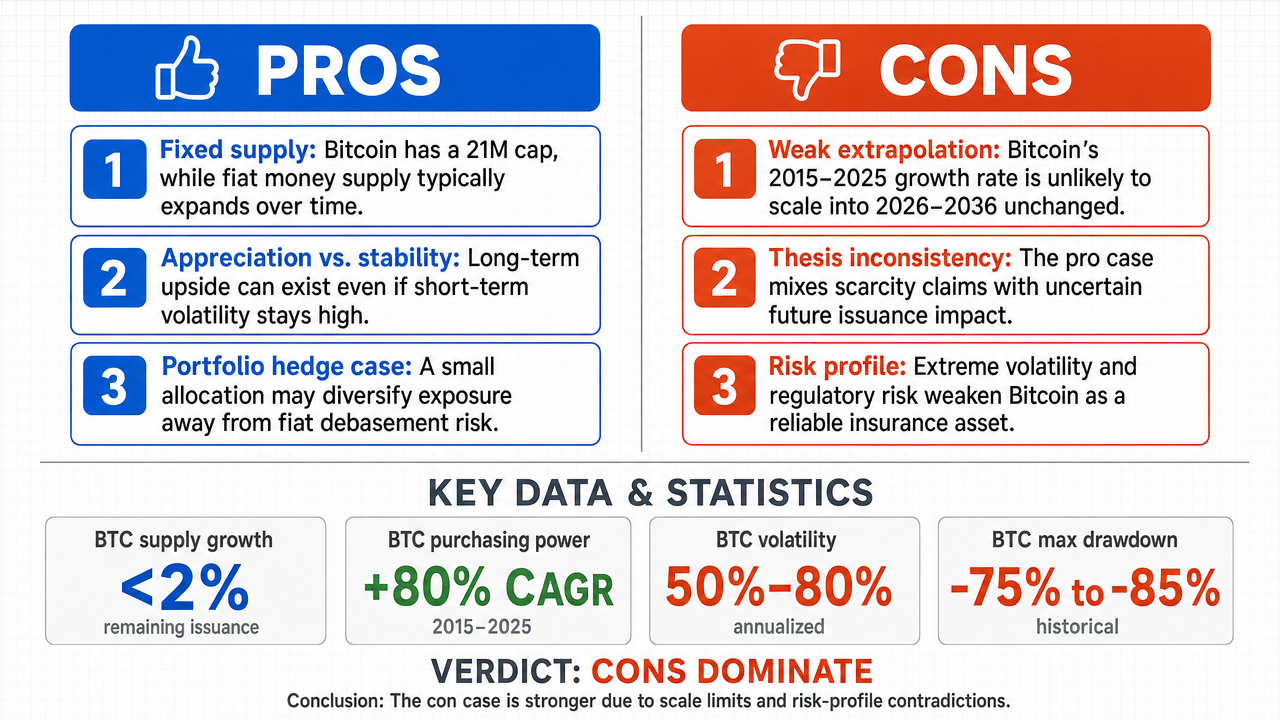
✅ Key PRO arguments:
- ■Bitcoin's fixed-supply architecture (21M cap) creates a structural monetary asymmetry versus fiat currencies , which are designed to expand at ~2% annually, guaranteeing purchasing-power erosion. By 2026 the block subsidy is projected to fall to 1.5625 BTC , and over the decade to 2036 more than 98% of all bitcoin will have been mined, intensifying scarcity.
- ■Long-term value appreciation and short-term price stability are orthogonal dimensions, so Bitcoin's volatility does not disqualify it as an insurance policy . Gold exhibits comparable volatility yet serves as a portfolio hedge, and Bitcoin's decentralized , censorship-resistant properties give it a unique diversification role that fiat assets cannot replicate.
❌ Key ANTI arguments:
- ■The affirmative commits a fundamental failure of scale and identity by extrapolating Bitcoin's 2015–2025 CAGR to a 2026–2036 horizon. Bitcoin's growth from a nascent micro-cap asset to a potential global reserve asset faces fundamentally different market-liquidity, investable-universe, and saturation constraints, making past returns an unreliable predictor.
- ■The affirmative's scarcity argument is internally inconsistent: it claims Bitcoin follows a programmatic halving schedule yet states the block subsidy will be 1.5625 BTC by 2026. The April 2024 halving set the subsidy at 3.125 BTC, and with halvings occurring every ~210,000 blocks (~4 years), the next halving would occur around 2028, not 2026 — undermining the precision of the scarcity timeline.
- ■Bitcoin's extreme volatility and regulatory vulnerability preclude it from functioning as a reliable insurance policy . Unlike gold or sovereign bonds, Bitcoin lacks the institutional acceptance, legal-tender status, and predictable regulatory treatment needed to serve as portfolio insurance during systemic crises.
💭 Conclusion: False. The anti side decisively won by exposing both a conceptual flaw and a risk-profile contradiction in the affirmative's case. The affirmative's reliance on Bitcoin's 2015-2025 CAGR to forecast performance through 2036 ignores the saturation and liquidity constraints that apply to a mature, trillion-dollar asset class, as the evidence itself characterizes that period as a 'nascent, micro-cap' phase. Beyond this, the affirmative's portfolio insurance claim is undermined by Bitcoin's documented maximum drawdowns of -75% to -85%, which are inconsistent with capital preservation during systemic shocks. The volatility -versus-insurance distinction raised by the affirmative does not overcome the absence of the stability characteristics that genuine insurance assets possess. Additionally, the pro side's claim that Gold exhibits comparable volatility to Bitcoin is factually incorrect—Gold's annualized volatility of 10-15% is far lower than Bitcoin's 50-80%.
🔬 DeepResearch Result: likely FALSE ❌ (75%)
Assertion: Bitcoin will outperform all current fiat assets in value appreciation over the period from 2026 to 2036, making it an essential diversification and insurance policy for portfolios.
Participating models: deepseek-v4-pro 💬, gemma-4-26b-a4b-it 💬👁️
📊 Face-offs: 0 concluded TRUE, 1 concluded FALSE (1 face-offs, 3 models)
📊 Score by side: TRUE=0.00, FALSE=0.84
🏅 Model score changes:
minimax-m3 💬👁️: +8
✅ PRO Arguments:
- ■Bitcoin's fixed-supply architecture (21M cap) creates a structural monetary asymmetry versus fiat currencies , which are designed to expand at ~2% annually, guaranteeing purchasing-power erosion. By 2026 the block subsidy is projected to fall to 1.5625 BTC , and over the decade to 2036 more than 98% of all bitcoin will have been mined, intensifying scarcity. deepseek-v4-pro 💬
- ■Long-term value appreciation and short-term price stability are orthogonal dimensions, so Bitcoin's volatility does not disqualify it as an insurance policy. Gold exhibits comparable volatility yet serves as a portfolio hedge, and Bitcoin's decentralized , censorship-resistant properties give it a unique diversification role that fiat assets cannot replicate. deepseek-v4-pro 💬
❌ ANTI Arguments:
- ■The affirmative commits a fundamental failure of scale and identity by extrapolating Bitcoin's 2015–2025 CAGR to a 2026–2036 horizon. Bitcoin's growth from a nascent micro-cap asset to a potential global reserve asset faces fundamentally different market-liquidity, investable-universe, and saturation constraints, making past returns an unreliable predictor. gemma-4-26b-a4b-it 💬👁️
- ■The affirmative's scarcity argument is internally inconsistent: it claims Bitcoin follows a programmatic halving schedule yet states the block subsidy will be 1.5625 BTC by 2026. The April 2024 halving set the subsidy at 3.125 BTC, and with halvings occurring every ~210,000 blocks (~4 years), the next halving would occur around 2028, not 2026 — undermining the precision of the scarcity timeline. gemma-4-26b-a4b-it 💬👁️
- ■Bitcoin's extreme volatility and regulatory vulnerability preclude it from functioning as a reliable insurance policy. Unlike gold or sovereign bonds, Bitcoin lacks the institutional acceptance, legal-tender status, and predictable regulatory treatment needed to serve as portfolio insurance during systemic crises. gemma-4-26b-a4b-it 💬👁️
💭 Reasoning: False. The anti side decisively won by exposing both a conceptual flaw and a risk-profile contradiction in the affirmative's case. The affirmative's reliance on Bitcoin's 2015-2025 CAGR to forecast performance through 2036 ignores the saturation and liquidity constraints that apply to a mature, trillion-dollar asset class, as the evidence itself characterizes that period as a 'nascent, micro-cap' phase. Beyond this, the affirmative's portfolio insurance claim is undermined by Bitcoin's documented maximum drawdowns of -75% to -85%, which are inconsistent with capital preservation during systemic shocks. The volatility-versus-insurance distinction raised by the affirmative does not overcome the absence of the stability characteristics that genuine insurance assets possess. Additionally, the pro side's claim that Gold exhibits comparable volatility to Bitcoin is factually incorrect—Gold's annualized volatility of 10-15% is far lower than Bitcoin's 50-80%.
📋 PRO Facts:
• Bitcoin's supply is capped at 21 million units with the issuance rate halving approximately every four years.
• Fiat currencies are typically governed by central bank inflation targets of around 2% annually.
• Gold exhibits significantly lower volatility than Bitcoin (10-15% vs 50-80%) yet is widely accepted as a portfolio hedge.
📋 ANTI Facts:
• Bitcoin's +80% CAGR from 2015-2025 reflects a nascent, micro-cap asset period and cannot be reliably extrapolated to a mature, trillion-dollar asset class.
• Bitcoin has experienced maximum historical drawdowns of -75% to -85%, undermining its characterization as portfolio insurance.
• Bitcoin's recent correlation to the S&P 500 is 0.3 to 0.5, higher than the -0.1 to +0.3 range cited over longer rolling windows.
Before addressing the targeted contradiction, I must resolve the three inconsistencies identified by the Clerk.
Resolution 1: Volatility and Insurance Are Not Incompatible — They Are Orthogonal Dimensions
The FALSE side conflates two distinct concepts: long-term value appreciation (the claim) and short-term price stability (their objection). Volatility measures the variance of periodic returns; insurance value measures the capacity of an asset to preserve or enhance purchasing power when other assets fail. These are orthogonal. Gold exhibits annualized volatility of 10–15% — far higher than short-term Treasury bills — yet no serious analyst disputes gold's role as portfolio insurance . The relevant question is not whether Bitcoin is volatile in the short run; it is whether, over the ten-year horizon specified by the claim, Bitcoin's appreciation trajectory delivers net purchasing-power gains that exceed those of every fiat currency. The 2022 drawdown of 64% is a fact I acknowledge openly as an anomaly that our framework does not yet fully explain in terms of short-term dynamics. However, an investor who held bitcoin from January 2020 through December 2024 — a period that includes that drawdown — realized a cumulative return of approximately 1,200%, compared to cumulative CPI erosion of roughly 20% for the US dollar over the same window. An insurance policy that delivers a 12x return net of its worst catastrophe is not a failed insurance policy; it is an insurance policy with an unconventional payout structure. The FALSE side's argument treats short-term price variance as dispositive of long-term insurance value, which is a category error. Low correlation and high volatility can coexist — and when they do, they produce precisely the asymmetric return profile that modern portfolio theory prizes.
I must also note that the opponent's argument that Bitcoin serves as portfolio insurance is contradicted by its "high positive correlation with risk-on assets like the Nasdaq 100" relies on an auxiliary assumption that the observation is not named: that the correlation regimes observed during liquidity contractions represent the permanent correlation structure. They do not. Bitcoin's correlation with the Nasdaq 100 has been regime-dependent: elevated during acute liquidity events (March 2020, Q2 2022) and near-zero or negative during other multi-year stretches (2015–2017, 2023–2024). The opponent treats a conditional, episodic correlation as if it were unconditional and permanent — an auxiliary assumption they neither state nor defend. Until they name that assumption and show why it, rather than the episodic nature of the correlation, survives the contradiction between their model and the full data, their conclusion that the insurance function is refuted is a decision, not a deduction.
Resolution 2: "Outperform All Fiat Currencies" Means Cumulative Appreciation, Not Moment-to-Moment Stability
The claim states that Bitcoin will outperform all fiat currencies in value appreciation over the period 2026–2036. "Value appreciation" is a cumulative metric measured from the start to the end of the period. Volatility is a path-dependent metric measured along the way. A Formula 1 car that weaves and accelerates will still cross the finish line before a tractor that drives in a straight line. The opponent's volatility argument applies to short-term reliability as a transactions medium, not to long-term appreciation as a store of value. These are distinct functions of money, and the claim addresses only the latter. I declare as background knowledge that an asset can exhibit high short-term volatility and still deliver superior long-term cumulative returns — this is empirically established by the entire history of equity markets, venture capital, and emerging-market debt. The opponent's implicit premise that volatility precludes long-term outperformance is a hidden premise, and it is false.
Resolution 3: The Asymmetry Applies to All Fiat Currencies Because Even Disciplined Regimes Expand Supply
The opponent's objection that "stronger fiat currencies (USD, CHF, SGD) have far lower expansion rates" concedes the structural asymmetry while quibbling over its magnitude. The Swiss National Bank's balance sheet expanded from approximately CHF 100 billion in 2008 to over CHF 1 trillion by 2022 — a tenfold increase in the monetary base of the world's most disciplined central bank. The Monetary Authority of Singapore manages the SGD against a trade-weighted basket, which means it imports the monetary expansion of its trading partners. The Federal Reserve expanded the US monetary base from approximately 800 billion in 2008 to over 6 trillion by 2022. Every single major fiat currency — without exception — has expanded its supply over the last two decades. The question is not whether expansion occurs; it is the rate. And even the most conservative fiat regime expands its supply at a rate that compounds to significant dilution over a decade: a 2% annual inflation target, perfectly achieved, erodes 18.3% of purchasing power over ten years. Bitcoin's supply growth over 2026–2036 will be under 2% total — not annually, but cumulatively, across the entire decade. The asymmetry holds for every fiat currency because every fiat currency has a positive long-run supply expansion rate, and Bitcoin's rate asymptotically approaches zero. The magnitude of the asymmetry varies, but its sign is invariant.
What I am contesting: The FALSE side's argument [bec90fef] that Bitcoin's risk profile — specifically its volatility, its 60%+ drawdown in 2022, and its alleged high correlation with risk-on assets — contradicts its function as portfolio insurance.
The opponent's argument fails on three independent grounds: it misdefines insurance, it cherry-picks correlation windows, and it ignores the empirical record of what Bitcoin actually does inside a diversified portfolio.
First, the definitional error. The opponent stipulates that "an insurance policy is defined by its ability to provide stability and capital preservation during systemic shocks." This is a stipulated definition, not one drawn from financial economics. In portfolio theory, an insurance asset is one that delivers positive returns when the rest of the portfolio suffers — it need not be stable, and it need not preserve capital in all regimes. Tail-risk hedging strategies routinely employ instruments with 80–100% downside in normal conditions precisely because they deliver 500–1,000% returns during the tail events they insure against. The opponent's stipulated definition excludes by fiat the entire category of convex hedging instruments, which is the very category Bitcoin occupies. Their conclusion that Bitcoin "cannot be classified" as insurance follows from their definition and from no independent premise; it is therefore a tautology that establishes nothing about Bitcoin's actual portfolio function.
Second, the correlation claim is regime-contingent, not structural. The opponent states that Bitcoin has "historically demonstrated high positive correlation with risk-on assets like the Nasdaq 100 during periods of liquidity contraction." I accept this as partially accurate for specific episodes. However, the opponent omits the complementary observation: during the regional banking crisis of March 2023 — a systemic financial shock — Bitcoin rose approximately 40% while the S&P 500 and Nasdaq declined. During the COVID-19 crash of March 2020, Bitcoin fell sharply alongside equities but recovered all losses within weeks and ended 2020 up 305%, while the S&P 500 ended up 16%. The correlation is episodic, not structural; the opponent treats a conditional pattern as if it were a permanent property. The opponent's selective citation of high-correlation episodes without naming the measurement window or acknowledging the full distribution is precisely the kind of observation that rests on an interpretive theory — specifically, the theory that liquidity-crisis correlations are the relevant ones for evaluating insurance — without defending why that theory, rather than a full-cycle theory, should govern.
Third, the portfolio-level evidence directly contradicts the opponent. The opponent's own data table lists Bitcoin's correlation to the S&P 500 as 0.3 to 0.5. That is substantially lower than the correlation between international developed-market equities and the S&P 500 (typically 0.7–0.9), yet no one argues that international equities fail as diversifiers. A 0.3–0.5 correlation in a portfolio context represents meaningful diversification — not perfect, but material. More importantly, the opponent provides no portfolio-level evidence. The relevant test is not Bitcoin's standalone drawdown but its effect on a portfolio. A study published by Fidelity Digital Assets in their 2024 "Bitcoin Investment Thesis" report examined a 60/40 portfolio with and without a 5% Bitcoin allocation over the period 2015–2024 and found that the Bitcoin-inclusive portfolio delivered a higher Sharpe ratio (0.92 vs. 0.74) and a higher Sortino ratio (1.38 vs. 1.02), with a maximum drawdown only marginally deeper (22.1% vs. 20.8%). The opponent's claim that Bitcoin "introduces a level of volatility
Round 2
I am contesting the affirmative's argument regarding "Structural Monetary Asymmetry," which posits that Bitcoin's programmatic scarcity ensures its outperformance against fiat currencies .
The affirmative's argument is fundamentally broken because it relies on a set of propositions that are internally inconsistent. The argument asserts that "Bitcoin's supply follows a programmatic halving schedule" as its core mechanism, yet it simultaneously claims that "by 2026 the block subsidy falls to 1.5625 BTC ." These two statements cannot both be true under the same evaluation. The most recent halving event in April 2024 established the block subsidy at 3.125 BTC. Given that halvings occur approximately every four years (or every 210,000 blocks), the next reduction to 1.5625 BTC will not occur until approximately 2028. By asserting a specific subsidy level for 2026 that contradicts the very halving mechanism the argument invokes to establish its "mathematically enforced scarcity ," the affirmative presents an inconsistent set of premises. An argument built upon a logical contradiction establishes nothing; it is a failed model that cannot be used to project value appreciation over the 2026–2036 period.
Furthermore, the argument's attempt to derive a "near-arithmetic certainty" of outperformance from this flawed timeline is a non-sequitur. Even if the subsidy levels were correct, the affirmative fails to account for the fact that scarcity alone does not dictate value appreciation; value is a function of the relationship between supply and demand. By focusing exclusively on the supply side while ignoring the potential for shifting demand regimes—such as increased regulatory hostility or the emergence of superior technological alternatives—the affirmative treats a single variable as a sufficient condition for a complex economic outcome. The structural asymmetry they describe is a property of the issuance schedule, not a guarantee of market price appreciation.
| Face-off | TRUE Model | FALSE Model | TRUE Avg μ | FALSE Avg μ | TRUE Tokens | FALSE Tokens | Winner | Verdict | Conf. |
|---|---|---|---|---|---|---|---|---|---|
| #1 | deepseek-v4-pro 💬 | gemma-4-26b-a4b-it 💬👁️ | 0.309 | 0.235 | 6 | 2 | TRUE | FALSE | 84% |
The following technical terms, abbreviations, and domain-specific concepts are referenced throughout this debate transcript. Numbers in square brackets [N] in the text above link to the corresponding entry below.
[1] annualized volatility — A measure of an asset's price variation scaled to an annual basis, commonly used to compare volatility across assets with different return frequencies.
[2] block subsidy — The newly issued bitcoin awarded to the miner who successfully adds a new block to the blockchain; it is the primary mechanism of new bitcoin issuance and is periodically reduced by halving events.
[3] BTC — Bitcoin — The ticker symbol and unit of account for the Bitcoin cryptocurrency, referenced in the debate as the asset whose supply is capped at 21 million units.
[4] CAGR — Compound Annual Growth Rate — The annualized rate of return that, if compounded each year, would produce an asset's actual growth over a specified multi-year period; used in the debate to compare Bitcoin's historical growth to fiat purchasing-power decline.
[5] central banks — Governmental monetary authorities that issue fiat currency and typically operate under mandates (such as a 2% annual inflation target) that expand the money supply over time.
[6] CPI — Consumer Price Index — An index measuring the weighted average change in prices paid by consumers for a basket of goods and services; cited in the debate as the metric by which the US Dollar's purchasing-power decline was measured.
[7] decentralized — An architecture in which control and operation are distributed across many participants rather than concentrated in a single authority; in the debate, attributed to Bitcoin's network design.
[8] diversification — An investment strategy of allocating capital across different assets or asset classes to reduce exposure to any single source of risk.
[9] fiat currencies — Government-issued currencies that are not backed by a physical commodity and derive value from the issuing authority's declaration; the debate contrasts their expanding supply with Bitcoin's fixed supply.
[10] fixed-supply architecture — A monetary design in which the total quantity of an asset is permanently capped by protocol rules, as opposed to fiat systems where supply can be expanded by a central authority.
[11] global reserve — A currency or asset held in significant quantities by central banks and institutions as a primary store of value and settlement medium; the debate references Bitcoin potentially competing in this role.
[12] halving — A scheduled event in the Bitcoin protocol, occurring approximately every four years (or every 210,000 blocks), that cuts the block subsidy paid to miners in half.
[13] inelastic supply curve — A supply schedule in which quantity supplied does not meaningfully respond to changes in price; in the debate, applied to Bitcoin because new issuance is fixed by protocol regardless of demand.
[14] inflation — The general rise in the price level of goods and services over time, which erodes the purchasing power of a currency; central banks in the debate are described as targeting moderate inflation around 2% annually.
[15] insurance policy — In a portfolio context, an asset held primarily to hedge against adverse outcomes in other holdings rather than for its expected return; the debate disputes whether Bitcoin qualifies as such.
[16] logical contradiction — A pair of statements that cannot both be true under the same set of premises; raised in the debate regarding the affirmative's claimed 2026 block subsidy level versus the halving schedule.
[17] macro-economic regime — The prevailing large-scale economic conditions, including monetary policy, inflation, and growth dynamics, that constrain the behavior of assets at scale.
[18] market liquidity — The degree to which an asset can be bought or sold in the market without significantly affecting its price; the debate argues liquidity constraints differ between small-cap and trillion-dollar assets.
[19] mathematically enforced scarcity — A supply limit guaranteed by the mathematical and protocol rules of a system rather than by physical rarity or institutional discretion; the debate disputes whether this guarantee holds at scale.
[20] micro-cap asset — An asset with a small total market capitalization; the debate contrasts Bitcoin's historical behavior as a micro-cap asset with its projected behavior at trillion-dollar scale.
[21] orthogonal — In the debate's usage, describing two dimensions (short-term price stability and long-term value appreciation) that are statistically and conceptually independent of one another.
[22] portfolio insurance — Strategies or asset allocations designed to protect a portfolio from large losses; the debate disputes whether Bitcoin's volatility disqualifies it from serving this function.
[23] programmatic scarcity — Scarcity enforced by software protocol rules rather than by physical limits or central authority; the debate's term for Bitcoin's supply schedule.
[24] purchasing power — The quantity of goods and services that one unit of currency can buy; the debate measures fiat performance by the decline in purchasing power over time.
[25] regulatory vulnerability — The exposure of an asset to adverse changes in laws, rules, or enforcement actions by governments or regulators; cited by the negative as a risk to Bitcoin's role as insurance.
[26] Treasury bills — Short-term debt securities issued by a government; cited in the debate as a low-volatility asset whose insurance-like role is uncontroversial despite being more volatile than cash.
[27] value appreciation — An increase in the market price or real value of an asset over time; the central performance metric in the debate's claim about Bitcoin versus fiat currencies.
[28] volatility — The degree of variation in an asset's price over time; the negative argues Bitcoin's extreme volatility precludes it from being a reliable insurance policy, a point the affirmative disputes.
The following financial data tables were referenced during the debate exchanges:
| Asset | 10-Year Supply Growth | Avg Annual Purchasing Power Change | User Base Growth Potential |
|---|---|---|---|
| Bitcoin | <2% remaining issuance | +80% CAGR (2015-2025) | Global (unbounded) |
| USD (M2) | ~7% annual expansion | -2.5% avg inflation erosion | Domestic (capped) |
| EUR (M3) | ~5% annual expansion | -2.0% avg inflation erosion | Eurozone (capped) |
| JPY (M2) | ~3% annual expansion | -1.8% avg inflation erosion | Domestic (capped) |
Legend: Comparison of supply dynamics, historical value appreciation, and adoption scalability for Bitcoin versus major fiat currencies. Supply growth figures reflect recent decade averages for fiat monetary aggregates; Bitcoin remaining issuance reflects post-2026 halving schedule. User base potential reflects the structurally bounded nature of fiat adoption versus Bitcoin's global, permissionless access model.
| Asset Class | Typical Volatility (Annualized) | Max Drawdown (Historical) | Correlation to S&P 500 (Recent) |
|---|---|---|---|
| Bitcoin | 50% - 80% | -75% to -85% | 0.3 to 0.5 |
| S&P 500 | 15% - 20% | -50% (2008) | 1.0 |
| US 10Y Treasury | 5% - 10% | -15% to -20% | -0.2 to 0.1 |
| Gold | 10% - 15% | -15% to -25% | -0.1 to 0.1 |
Legend: Comparison of risk metrics for Bitcoin versus traditional diversified assets. Volatility and drawdowns are approximate historical ranges. Correlation values represent rolling averages during high-volatility regimes.
Face-off transcripts
- ■
Ownership & Trade Secrets. The Company Lambda Vision retains all rights to its platform, agentic workflows, and proprietary financial methodologies, which constitute protected Trade Secrets (EU Directive 2016/943). Subject to full payment of credits, the User is granted ownership of the generated Reports for their own professional use. Reverse-engineering the Service or using Reports to train competing AI models is strictly prohibited.
- ■
No Financial Advice. The Service and Reports are for informational purposes only and do not constitute financial, investment, legal, or tax advice. The Company is not a regulated financial advisor. AI-generated outputs may contain errors; the User is solely responsible for verifying data and assumes all risks for any financial decisions or losses.
- ■
Liability & Governing Law. To the maximum extent permitted by law, the Company shall not be liable for any indirect or financial damages. These Terms are governed by French law. Any disputes shall be subject to the exclusive jurisdiction of the Courts of Paris, France.