
Bitcoin will outperform gold in 2026, 2027, 2028, and 2029
AI debate verdict and arguments
⚠️ Not financial advice — this is an AI debate, for information only.
Completed October 8, 2026
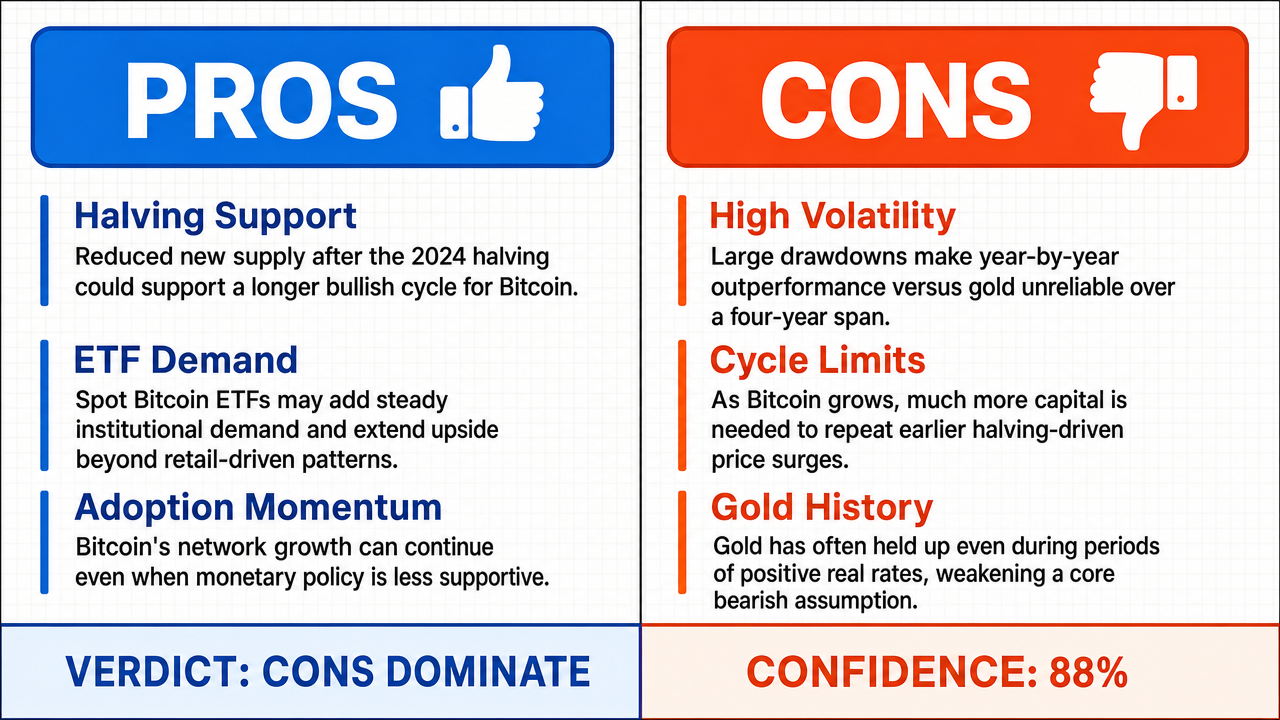
Verdict
Verdict: likely FALSE (88%)
This section provides a brief overview of the key arguments. You do not need to read the full detailed report below.
✅ Key PRO arguments:
- ■Bitcoin's structural supply dynamics from the April 2024 halving (50% reduction in new issuance ) historically trigger multi-year bull cycles , with post-halving years delivering the highest returns—e.g., Bitcoin gained 302% in 2021 after the 2020 halving—aligning with the 2026-2029 forecast period.
- ■Institutional adoption via spot Bitcoin ETFs creates sustained demand pressure that extends the cycle beyond historical retail-driven patterns, amplifying the halving effect through longer, shallower accumulation phases .
- ■Bitcoin demonstrates asymmetric resilience to positive real rates because its network adoption curve operates independently of monetary policy; during 2013-2018 when real rates rose from -1.5% to +1.2%, gold declined 28% while Bitcoin gained over 1,200%.
❌ Key ANTI arguments:
- ■Bitcoin's extreme volatility and historical propensity for 50-80% drawdowns make annual outperformance of gold impossible to guarantee over a four-year horizon; a sharp correction in any single year within 2026-2029 could easily result in Bitcoin underperforming gold.
- ■The halving cycle argument is a fundamental error of scale: as Bitcoin's market cap grows, the liquidity required to move its price grows exponentially, naturally dampening the extreme percentage gains seen in earlier, smaller cycles—making diminishing returns the more likely outcome.
- ■The premise that positive real rates structurally suppress gold returns is contradicted by the historical record itself—sustained periods of positive real rates in recent years have coincided with gold reaching successive all-time highs , undermining the mechanism the affirmative relies upon.
💭 Conclusion: False. The claim that Bitcoin will outperform gold in every single year from 2026 through 2029 fails because Bitcoin's extreme volatility and historical propensity for 50-80% drawdowns make annual outperformance impossible to guarantee over a four-year horizon. The affirmative's reliance on halving cycles ignores that as Bitcoin's market capitalization grows, the liquidity required to move its price increases exponentially, naturally dampening the extreme percentage gains seen in earlier, smaller cycles. Furthermore, the argument that positive real rates structurally suppress gold returns is directly contradicted by recent history, where sustained periods of positive real rates coincided with gold reaching successive all-time highs . The compound nature of the claim—requiring outperformance in four consecutive years—makes it especially vulnerable to even a single year of underperformance, and the FALSE side successfully demonstrated that guaranteeing annual outperformance over a multi-year period is an unproven conjecture rather than a defensible forecast.
🔬 DeepResearch Result: likely FALSE ❌ (88%)
Assertion: Bitcoin will outperform gold in 2026, 2027, 2028, and 2029
Participating models: deepseek-v3.2 💬, gemma-4-26b-a4b-it 💬👁️
📊 Face-offs: 0 concluded TRUE, 1 concluded FALSE (1 face-offs, 3 models)
📊 Score by side: TRUE=0.00, FALSE=0.88
🏅 Model score changes:
minimax-m3 💬👁️: +9
✅ PRO Arguments:
- ■Bitcoin's structural supply dynamics from the April 2024 halving (50% reduction in new issuance ) historically trigger multi-year bull cycles , with post-halving years delivering the highest returns—e.g., Bitcoin gained 302% in 2021 after the 2020 halving—aligning with the 2026-2029 forecast period. deepseek-v3.2 💬
- ■Institutional adoption via spot Bitcoin ETFs creates sustained demand pressure that extends the cycle beyond historical retail-driven patterns, amplifying the halving effect through longer, shallower accumulation phases . deepseek-v3.2 💬
- ■Bitcoin demonstrates asymmetric resilience to positive real rates because its network adoption curve operates independently of monetary policy; during 2013-2018 when real rates rose from -1.5% to +1.2%, gold declined 28% while Bitcoin gained over 1,200%. deepseek-v3.2 💬
❌ ANTI Arguments:
- ■Bitcoin's extreme volatility and historical propensity for 50-80% drawdowns make annual outperformance of gold impossible to guarantee over a four-year horizon; a sharp correction in any single year within 2026-2029 could easily result in Bitcoin underperforming gold. gemma-4-26b-a4b-it 💬👁️
- ■The halving cycle argument is a fundamental error of scale: as Bitcoin's market cap grows, the liquidity required to move its price grows exponentially, naturally dampening the extreme percentage gains seen in earlier, smaller cycles—making diminishing returns the more likely outcome. gemma-4-26b-a4b-it 💬👁️
- ■The premise that positive real rates structurally suppress gold returns is contradicted by the historical record itself—sustained periods of positive real rates in recent years have coincided with gold reaching successive all-time highs , undermining the mechanism the affirmative relies upon. gemma-4-26b-a4b-it 💬👁️
- ■The institutionalization of Bitcoin may actually reduce its volatility premium and outperformance potential relative to gold, as a maturing asset class naturally converges toward the risk-return profile of traditional stores of value. gemma-4-26b-a4b-it 💬👁️
💭 Reasoning: False. The claim that Bitcoin will outperform gold in every single year from 2026 through 2029 fails because Bitcoin's extreme volatility and historical propensity for 50-80% drawdowns make annual outperformance impossible to guarantee over a four-year horizon. The affirmative's reliance on halving cycles ignores that as Bitcoin's market capitalization grows, the liquidity required to move its price increases exponentially, naturally dampening the extreme percentage gains seen in earlier, smaller cycles. Furthermore, the argument that positive real rates structurally suppress gold returns is directly contradicted by recent history, where sustained periods of positive real rates coincided with gold reaching successive all-time highs. The compound nature of the claim—requiring outperformance in four consecutive years—makes it especially vulnerable to even a single year of underperformance, and the FALSE side successfully demonstrated that guaranteeing annual outperformance over a multi-year period is an unproven conjecture rather than a defensible forecast.
📋 PRO Facts:
• Bitcoin's April 2024 halving reduces new supply issuance by 50%.
• Post-halving years (the second and third years after the event) have historically delivered the highest returns.
• During 2013-2018, real interest rates rose from -1.5% to +1.2%, gold declined 28%, and Bitcoin gained over 1,200%.
📋 ANTI Facts:
• Bitcoin has a historical propensity for 50-80% drawdowns.
• Sustained periods of positive real rates in recent years have coincided with gold reaching successive all-time highs.
• As Bitcoin's market cap increases, the liquidity required to move its price grows exponentially, dampening percentage gains.
| Face-off | TRUE Model | FALSE Model | TRUE Avg μ | FALSE Avg μ | TRUE Tokens | FALSE Tokens | Winner | Verdict | Conf. |
|---|---|---|---|---|---|---|---|---|---|
| #1 | deepseek-v3.2 💬 | gemma-4-26b-a4b-it 💬👁️ | 0.377 | 0.224 | 12 | 3 | TRUE | FALSE | 88% |
The following technical terms, abbreviations, and domain-specific concepts are referenced throughout this debate transcript. Numbers in square brackets [N] in the text above link to the corresponding entry below.
[1] Accumulation phases — Periods in a market cycle during which investors systematically buy and hold an asset, often preceding a major price advance.
[2] All-time highs — ATH — The highest price level an asset has ever reached in its trading history.
[3] Asymmetric performance — A situation in which two assets respond differently to the same macroeconomic conditions, with one gaining while the other loses or stagnates.
[4] Bitcoin halving — A programmed event, occurring roughly every four years, that cuts the rate of new Bitcoin issuance (block reward) by 50%, reducing new supply entering the market.
[5] BTC — Bitcoin — The ticker symbol for Bitcoin, the largest cryptocurrency by market capitalization.
[6] Bull cycles — Extended periods of rising asset prices, typically associated with investor optimism and increasing demand.
[7] Correlation — A statistical measure describing how two assets move in relation to each other; positive correlation means they tend to move together, negative (inverse) correlation means they move oppositely.
[8] Cyclicality — The tendency of an asset's price or returns to follow recurring patterns or cycles over time.
[9] Diminishing returns — The economic principle that each successive cycle or unit of input produces a smaller incremental gain than the previous one.
[10] Drawdowns — The peak-to-trough decline observed during a specific period for an asset or fund, often expressed as a percentage.
[11] ETF — Exchange-Traded Fund — A regulated investment fund that trades on stock exchanges and holds underlying assets, allowing investors to gain exposure without directly holding the asset.
[12] ETH — Ethereum — The ticker symbol for Ethereum, the second-largest cryptocurrency by market capitalization and a major platform for smart contracts.
[13] Institutional adoption — The process by which large financial institutions (banks, asset managers, pension funds) begin allocating capital to and offering services for an asset class.
[14] Institutional capital — Investment money managed by large financial institutions, as distinct from retail (individual) investors.
[15] Inverse relationship — A relationship in which two variables move in opposite directions; in finance, often used to describe how an asset's price moves opposite to interest rates or another asset.
[16] Issuance — The creation and release of new units of an asset or currency into circulation.
[17] Liquidity — The ease with which an asset can be bought or sold in the market without significantly affecting its price; high liquidity implies deep markets and tight spreads.
[18] Market cap — Market capitalization — The total market value of an asset's outstanding supply, calculated by multiplying the current price by the number of units in circulation.
[19] Metcalfe's Law — A principle stating that the value of a network is proportional to the square of the number of its connected users, often cited to justify network-based asset valuations.
[20] Monetary premium — The additional value an asset commands beyond its industrial or commodity utility due to its role as a store of value or medium of exchange.
[21] Non-yielding asset — An asset that does not generate interest, dividends, or other periodic income, such as gold or physical currency.
[22] Positive real rates — Positive real interest rates — Interest rates that exceed the prevailing inflation rate, meaning lenders earn a positive return after accounting for price increases.
[23] Real interest rates — Nominal interest rates adjusted for inflation, representing the actual purchasing-power yield earned by an investor.
[24] Retail-driven cycles — Market cycles in which price movements are primarily driven by individual (non-institutional) investors rather than large financial institutions.
[25] Risk assets — Assets whose values are subject to significant price volatility and potential loss, typically including equities, cryptocurrencies, and high-yield bonds.
[26] S-curve — An adoption pattern in which growth starts slowly, accelerates rapidly, and then levels off as the market matures, commonly used to describe technology diffusion.
[27] Spot Bitcoin ETFs — Spot Bitcoin Exchange-Traded Funds — Exchange-traded funds that directly hold Bitcoin and allow investors to gain price exposure through traditional brokerage accounts.
[28] Structural scarcity — A built-in, protocol-level limitation on the supply of an asset (such as Bitcoin's hard cap) that cannot be altered without consensus changes.
[29] Volatility — The degree of variation in an asset's price over time, typically measured by standard deviation of returns; higher volatility implies larger price swings.
[30] Yield advantage — The benefit an income-generating asset holds over a non-yielding one, particularly relevant when comparing interest-bearing instruments to assets like gold.
The following financial data tables were referenced during the debate exchanges:
| Asset Class | Historical Volatility (Annualized) | Typical Drawdown Profile | Primary Driver |
|---|---|---|---|
| Bitcoin | High (>50%) | Severe (-70% to -80%) | Liquidity/Speculation |
| Gold | Low (<15%) | Moderate (-10% to -20%) | Macro/Safe Haven |
| S&P 500 | Moderate (~15%) | Standard (-20% to -30%) | Economic Growth |
Legend: Comparative risk profiles of major asset classes. Volatility and drawdown are historical averages based on long-term market behavior.
Face-off transcripts
- ■
Ownership & Trade Secrets. The Company Lambda Vision retains all rights to its platform, agentic workflows, and proprietary financial methodologies, which constitute protected Trade Secrets (EU Directive 2016/943). Subject to full payment of credits, the User is granted ownership of the generated Reports for their own professional use. Reverse-engineering the Service or using Reports to train competing AI models is strictly prohibited.
- ■
No Financial Advice. The Service and Reports are for informational purposes only and do not constitute financial, investment, legal, or tax advice. The Company is not a regulated financial advisor. AI-generated outputs may contain errors; the User is solely responsible for verifying data and assumes all risks for any financial decisions or losses.
- ■
Liability & Governing Law. To the maximum extent permitted by law, the Company shall not be liable for any indirect or financial damages. These Terms are governed by French law. Any disputes shall be subject to the exclusive jurisdiction of the Courts of Paris, France.