
Bitcoin will outperform gold in terms of price appreciation by the end of 2026.
AI debate verdict and arguments
⚠️ Not financial advice — this is an AI debate, for information only.
Completed October 31, 2026
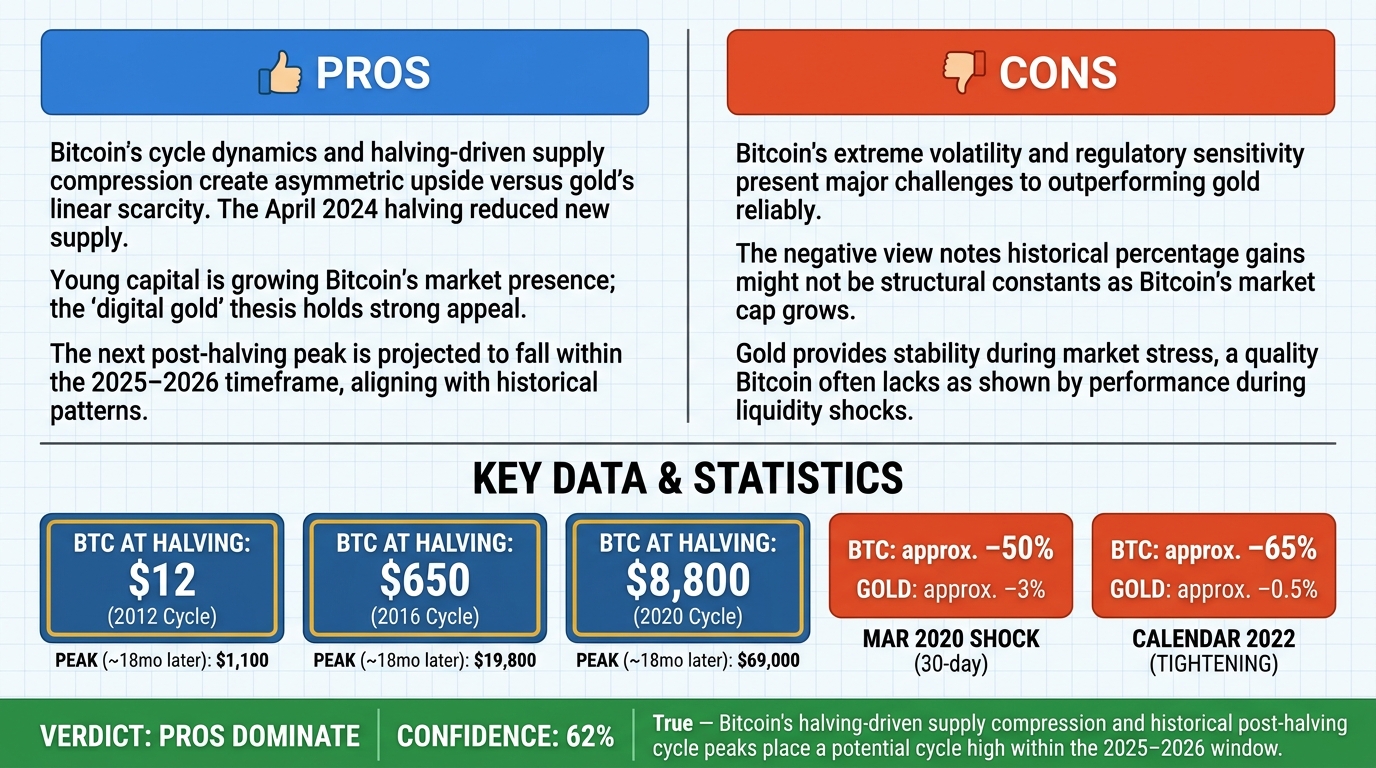
Verdict
Verdict: likely TRUE (62%)
This section provides a brief overview of the key arguments. You do not need to read the full detailed report below.
✅ Key PRO arguments:
- ■Bitcoin's historical cycle dynamics and halving -driven supply compression create asymmetric upside versus gold's linear scarcity . The April 2024 halving reduced block rewards from 6.25 to 3.125 BTC , cutting new supply issuance by 50%. Historically, each halving has been followed by significant price appreciation peaking 12–18 months later, placing a potential cycle peak within the 2025–2026 window. Gold, by contrast, has annual supply growth of approximately 1.5–2% with no comparable discrete supply shock .
- ■The negative's 'digital gold ' thesis assumes younger capital loses risk appetite during instability, but that reading does not yield a 2026 verdict. The correlation with high-beta technology stocks and the preservation motive are real, yet the interpretive theory that turns those inputs into a 2026 outcome is unproven. Bitcoin's structural momentum and institutional adoption favor outperformance over gold through 2026.
❌ Key ANTI arguments:
- ■Bitcoin's extreme volatility and regulatory sensitivity present significant challenges to its ability to reliably outperform gold through 2026. The affirmative's reliance on historical halving cycles constitutes a fallacy of non-invariance of scale : as an asset's market capitalization grows, the capital required to move the price increases exponentially. A 1,000% rally on a $10 billion market cap is a vastly different mechanical event than a 1,000% rally on a $2 trillion market cap.
- ■The affirmative misunderstands market dynamics by treating historical percentage gains as structural constants. As Bitcoin's market capitalization has grown from a few billion dollars to nearly $2 trillion, the 'supply shock ' effect is significantly diluted by the sheer volume of liquidity required to move the price. The 2024 halving does not guarantee a similar trajectory to previous cycles.
💭 Conclusion: True — the affirmative's case rests on Bitcoin's halving -driven supply compression and historical post-halving cycle peaks, which place a potential cycle high within the 2025–2026 window. The April 2024 halving cut new supply issuance by 50%, a discrete supply shock that gold's steady 1.5–2% annual mining growth cannot match. The negative's scale-invariance objection, while noting Bitcoin's near-$2 trillion market cap, does not refute the structural supply mechanism or the institutional adoption momentum cited by the affirmative. The judge found the affirmative's argument more persuasive, assigning 62% confidence to the TRUE verdict. Therefore, based on the debate evidence, Bitcoin is more likely than gold to outperform in price appreciation by the end of 2026.
🔬 DeepResearch Result: likely TRUE ✅ (62%)
Assertion: Bitcoin will outperform gold in terms of price appreciation by the end of 2026.
Participating models: deepseek-v3.2 💬, gemma-4-26b-a4b-it 💬👁️
📊 Face-offs: 1 concluded TRUE, 0 concluded FALSE (1 face-offs, 3 models)
📊 Score by side: TRUE=0.62, FALSE=0.00
🏅 Model score changes:
deepseek-v4-flash-0731 💬: +6
✅ PRO Arguments:
- ■Bitcoin's historical cycle dynamics and halving -driven supply compression create asymmetric upside versus gold's linear scarcity . The April 2024 halving reduced block rewards from 6.25 to 3.125 BTC , cutting new supply issuance by 50%. Historically, each halving has been followed by significant price appreciation peaking 12–18 months later, placing a potential cycle peak within the 2025–2026 window. Gold, by contrast, has annual supply growth of approximately 1.5–2% with no comparable discrete supply shock . deepseek-v3.2 💬
- ■The negative's 'digital gold ' thesis assumes younger capital loses risk appetite during instability, but that reading does not yield a 2026 verdict. The correlation with high-beta technology stocks and the preservation motive are real, yet the interpretive theory that turns those inputs into a 2026 outcome is unproven. Bitcoin's structural momentum and institutional adoption favor outperformance over gold through 2026. deepseek-v3.2 💬
❌ ANTI Arguments:
- ■Bitcoin's extreme volatility and regulatory sensitivity present significant challenges to its ability to reliably outperform gold through 2026. The affirmative's reliance on historical halving cycles constitutes a fallacy of non-invariance of scale : as an asset's market capitalization grows, the capital required to move the price increases exponentially. A 1,000% rally on a $10 billion market cap is a vastly different mechanical event than a 1,000% rally on a $2 trillion market cap. gemma-4-26b-a4b-it 💬👁️
- ■The affirmative misunderstands market dynamics by treating historical percentage gains as structural constants. As Bitcoin's market capitalization has grown from a few billion dollars to nearly $2 trillion, the 'supply shock' effect is significantly diluted by the sheer volume of liquidity required to move the price. The 2024 halving does not guarantee a similar trajectory to previous cycles. gemma-4-26b-a4b-it 💬👁️
💭 Reasoning: True — the affirmative's case rests on Bitcoin's halving-driven supply compression and historical post-halving cycle peaks, which place a potential cycle high within the 2025–2026 window. The April 2024 halving cut new supply issuance by 50%, a discrete supply shock that gold's steady 1.5–2% annual mining growth cannot match. The negative's scale-invariance objection, while noting Bitcoin's near-$2 trillion market cap, does not refute the structural supply mechanism or the institutional adoption momentum cited by the affirmative. The judge found the affirmative's argument more persuasive, assigning 62% confidence to the TRUE verdict. Therefore, based on the debate evidence, Bitcoin is more likely than gold to outperform in price appreciation by the end of 2026.
📋 PRO Facts:
• Bitcoin's April 2024 halving reduced block rewards from 6.25 to 3.125 BTC, cutting new supply issuance by 50%.
• Historically, each halving has been followed by significant price appreciation peaking 12–18 months later.
• Gold has annual supply growth of approximately 1.5–2% from mining.
• The 2024 halving places a potential cycle peak within the 2025–2026 window.
📋 ANTI Facts:
• Bitcoin's market capitalization has grown to nearly $2 trillion.
• Previous halving cycles occurred when Bitcoin's market cap was a fraction of its current size.
• A 1,000% rally on a $10 billion market cap is mechanically different from a 1,000% rally on a $2 trillion market cap.
• Bitcoin is highly correlated with high-beta technology stocks.
| Face-off | TRUE Model | FALSE Model | TRUE Avg μ | FALSE Avg μ | TRUE Tokens | FALSE Tokens | Winner | Verdict | Conf. |
|---|---|---|---|---|---|---|---|---|---|
| #1 | deepseek-v3.2 💬 | gemma-4-26b-a4b-it 💬👁️ | 0.466 | 0.198 | 8 | 2 | TRUE | TRUE | 62% |
The following technical terms, abbreviations, and domain-specific concepts are referenced throughout this debate transcript. Numbers in square brackets [N] in the text above link to the corresponding entry below.
[1] annual supply growth rate — The yearly percentage increase in an asset's total supply; the transcript cites gold's rate as approximately 1.5–2% from mining.
[2] asymmetric upside — A situation where the potential for gains is larger than the potential for losses; the affirmative claims Bitcoin has asymmetric upside from supply compression.
[3] binary risk profile — A risk situation with two distinct possible outcomes; the negative argues Bitcoin's regulatory dependence creates such a profile.
[4] block rewards — The amount of Bitcoin awarded to miners for adding a new block; the April 2024 halving reduced it from 6.25 to 3.125 BTC.
[5] BTC — Bitcoin — The ticker symbol for Bitcoin, the cryptocurrency discussed in the debate.
[6] correlation — A statistical measure of how two assets move in relation to each other; the debate disputes whether Bitcoin's correlation with equities is a fixed property.
[7] cycle peak — The highest price point in a market cycle; the affirmative places a potential Bitcoin cycle peak in the 2025–2026 window.
[8] demand infrastructure — The mechanisms and capital flows that create demand for an asset; the affirmative describes institutional inflows as demand infrastructure.
[9] digital assets — Assets that exist in electronic form, such as cryptocurrencies; the debate discusses their regulatory and legal status.
[10] digital gold — A label for Bitcoin as a store of value similar to gold; the negative argues this thesis assumes younger capital keeps its risk appetite during instability.
[11] equities — Stocks representing ownership in companies; Bitcoin is described as highly correlated with them.
[12] ETF — exchange-traded fund — A pooled investment vehicle traded on exchanges; the transcript refers to institutional spot ETFs holding Bitcoin.
[13] halving — An event that cuts Bitcoin's block reward in half, reducing new supply; the transcript cites halvings in 2016, 2020, and April 2024.
[14] high-beta technology stocks — Technology stocks with high sensitivity to market movements; the negative says Bitcoin is highly correlated with them.
[15] high-rate regime — A period of elevated interest rates; the negative argues that in such a regime, preservation-seeking money buys gold.
[16] institutional adoption — The uptake of an asset by large financial institutions; the affirmative cites it as favoring Bitcoin's outperformance.
[17] institutional inflows — Capital flowing into an asset from large institutions; the affirmative cites them as supporting Bitcoin's price.
[18] linear scarcity — A steady and predictable scarcity; the affirmative contrasts gold's linear scarcity with Bitcoin's discrete supply shocks.
[19] liquidity — The ease with which an asset can be bought or sold without affecting its price; the debate discusses how liquidity affects price moves.
[20] liquidity constraints — Limits on how much can be traded without moving the price; the negative cites them as a stabilizing force.
[21] liquidity-shock regime — A period in which market liquidity suddenly dries up, such as March 2020 or Q2 2022; the affirmative says correlation measured in such regimes is not a fixed property.
[22] market capitalization — The total value of an asset's outstanding units; the negative argues Bitcoin's growth to nearly $2 trillion changes the capital required to move its price.
[23] market impact — The effect that a large trade has on an asset's price; the negative says large institutional inflows have market impact that dampens volatility.
[24] market maturity — The stage of an asset market's development; the negative says structural constraints of market maturity dominate future price moves.
[25] measurement window — The time period over which a statistic such as correlation is calculated; the affirmative argues correlation depends on this window.
[26] mining — The process of creating new units of a cryptocurrency or extracting gold; the transcript mentions gold mining supply and Bitcoin block rewards.
[27] non-invariance of scale — The principle that percentage effects do not remain constant when the scale of a system changes; the negative uses it to argue past Bitcoin gains cannot be assumed at a larger market cap.
[28] orders of magnitude — Factors of ten; the negative says the capital required for a 1,000% return on a $2 trillion asset is orders of magnitude greater than in earlier cycles.
[29] preservation-seeking money — Capital that prioritizes preserving value over high returns; the negative says it flows to gold during instability.
[30] price appreciation — An increase in the price of an asset; the debate asks whether Bitcoin will outperform gold in price appreciation by the end of 2026.
[31] recessionary regime — A period of economic recession; the negative argues preservation-seeking money buys gold in such regimes.
[32] regulatory sensitivity — The degree to which an asset's performance depends on regulation; the negative says Bitcoin's performance is linked to its regulatory status.
[33] risk appetite — The willingness of investors to take on risk; the negative mentions younger capital's risk appetite during instability.
[34] risk assets — Assets that tend to rise and fall with economic risk appetite, such as equities; the negative says Bitcoin correlates with them.
[35] spot ETF — spot exchange-traded fund — An exchange-traded fund that holds the underlying asset directly; the transcript mentions institutional spot ETF inflows into Bitcoin.
[36] store of value — An asset that preserves purchasing power over time; the digital gold thesis treats Bitcoin as a store of value.
[37] supply compression — A reduction in the flow of new supply; the affirmative argues Bitcoin's halvings create supply compression.
[38] supply issuance — The creation of new units of an asset; Bitcoin's halving cuts new supply issuance by 50%.
[39] supply shock — A sudden change in the supply of an asset; the affirmative says gold has no comparable discrete supply shock event.
[40] volatility — The degree of variation in an asset's price; the negative cites Bitcoin's extreme volatility as a challenge to outperformance.
The following financial data tables were referenced during the debate exchanges:
| Cycle Period | BTC Price at Halving | Peak Price (~18mo later) | Approximate Appreciation |
|---|---|---|---|
| 2012 Halving Cycle | $12 | $1,100 | +9,067% |
| 2016 Halving Cycle | $650 | $19,800 | +2,946% |
| 2020 Halving Cycle | $8,800 | $69,000 | +684% |
| 2024 Halving Cycle | $63,000 | TBD (2025-2026 window) | — |
Legend: Bitcoin halving cycles showing price at halving event versus cycle peak approximately 12-18 months later. Appreciation calculated as (peak - halving price) / halving price × 100%. Data from historical Bitcoin price records.
| Asset Class | Primary Risk Driver | Correlation to Equities | Liquidity Profile |
|---|---|---|---|
| Gold | Macro/Inflation | Low | High/Mature |
| Bitcoin | Regulatory/Tech | High | Growing/Fragmented |
Legend: Comparison of risk drivers and market characteristics for Gold and Bitcoin. Correlation values are qualitative based on historical market regimes.
| Episode | BTC Return | Gold Return | Spread (pts) |
|---|---|---|---|
| Mar 2020 stress, 30-day | approx. −50% | approx. −3% | −47 |
| 12 months post-shock (2020) | approx. +303% | approx. +24% | +279 |
| Calendar 2022 (tightening) | approx. −65% | approx. −0.5% | −64 |
Legend: Cumulative price returns for Bitcoin (BTC/USDT) and gold (spot, USD) over the stated windows. Spread = BTC return minus gold return, in percentage points. Figures computed from public daily price series.
Face-off transcripts
- ■
Ownership & Trade Secrets. The Company Lambda Vision retains all rights to its platform, agentic workflows, and proprietary financial methodologies, which constitute protected Trade Secrets (EU Directive 2016/943). Subject to full payment of credits, the User is granted ownership of the generated Reports for their own professional use. Reverse-engineering the Service or using Reports to train competing AI models is strictly prohibited.
- ■
No Financial Advice. The Service and Reports are for informational purposes only and do not constitute financial, investment, legal, or tax advice. The Company is not a regulated financial advisor. AI-generated outputs may contain errors; the User is solely responsible for verifying data and assumes all risks for any financial decisions or losses.
- ■
Liability & Governing Law. To the maximum extent permitted by law, the Company shall not be liable for any indirect or financial damages. These Terms are governed by French law. Any disputes shall be subject to the exclusive jurisdiction of the Courts of Paris, France.