
Bitcoin will retest its bull market support band, which is in the low to mid-$70,000 range, by November 3, 2026.
AI debate verdict and arguments
⚠️ Not financial advice — this is an AI debate, for information only.
Completed October 25, 2026
Verdict
Verdict: likely FALSE (80%)
This section provides a brief overview of the key arguments. You do not need to read the full detailed report below.
✅ Key PRO arguments:
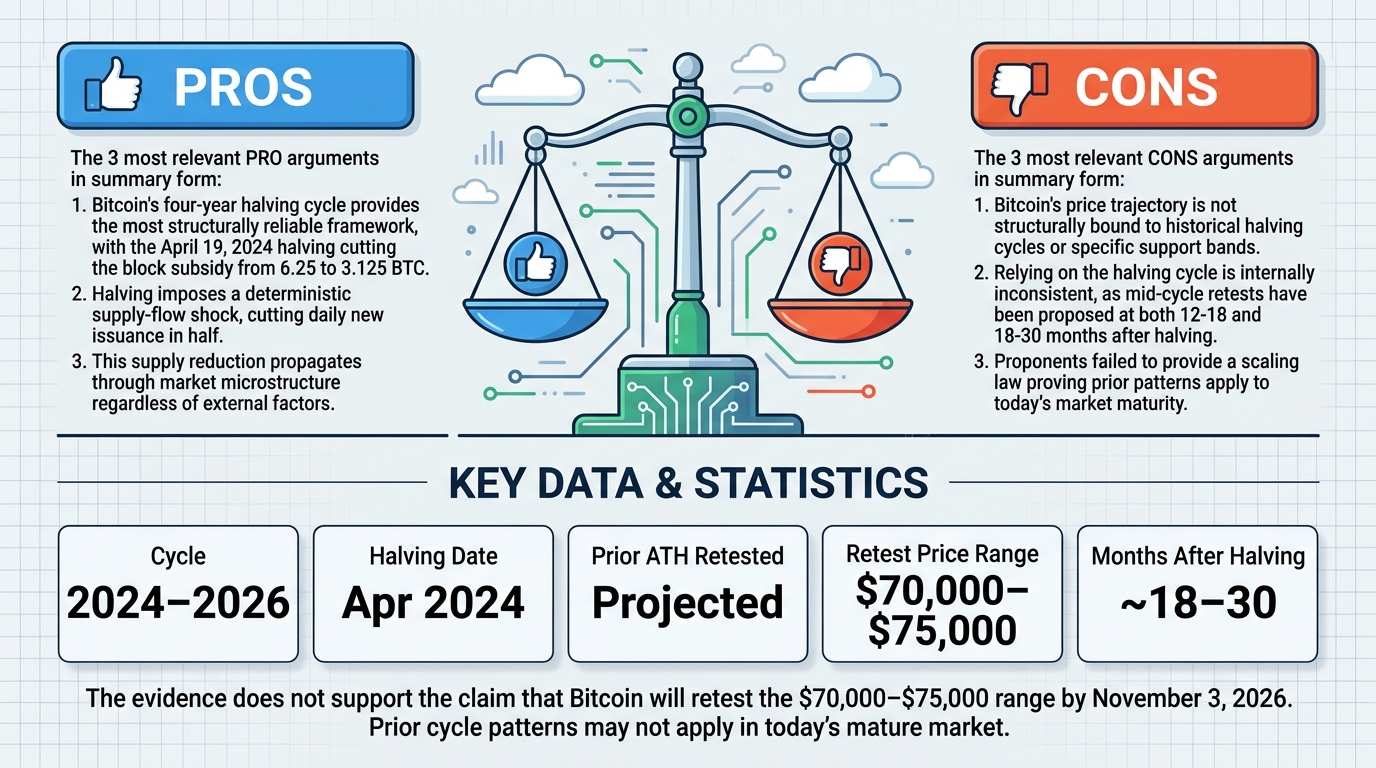
- ■Bitcoin 's four-year halving cycle is the most structurally reliable framework. The April 19, 2024 halving cut block subsidy from 6.25 to 3.125 BTC . Historically, each halving is followed by a bull market peak 12-18 months later, with a mid-cycle drawdown retesting the prior cycle's all-time high , which now sits in the low $70,000s. The 2016 halving saw a retest of $1,100-$1,200 in mid-2017; the 2020 halving saw a retest of $19,000-$20,000 in mid-2021.
- ■The halving imposes a supply-flow shock —daily new issuance is cut in half on a deterministic schedule—that propagates through market microstructure regardless of market cap . The causal mechanism is not a chart pattern repeating; it is the mechanical reduction of sell pressure from miners .
❌ Key ANTI arguments:
- ■Bitcoin 's price trajectory is not structurally bound to historical halving cycles or specific support bands. The affirmative fails to provide a transfer operator —a mathematical proof of cointegration or scaling law —demonstrating why a multi-billion dollar liquidity market must mirror a market that was a fraction of its current size. The investable universe has expanded from retail-driven speculation to institutional-grade allocation via spot ETFs.
- ■The affirmative's reliance on the halving cycle is internally inconsistent. In round 1 they said a mid-cycle retest occurs 12-18 months after each halving, but in round 2 they shifted to 12-30 months. This is a silent reversal that moves the goalposts to ensure their conclusion remains valid, lacking the precision required for a predictive model.
💭 Conclusion: The evidence does not support the claim that Bitcoin will retest the $70,000–$75,000 range by November 3, 2026. The affirmative failed to provide a transfer operator or scaling law proving that the pattern of prior cycles applies to today's larger, institutionally-driven market. The affirmative also shifted its predicted retest window from 12–18 months to 12–30 months between rounds, which undermines the precision of the claim. Given this inconsistency and the lack of a causal mechanism tying the halving to a specific price level, the evidence does not support the assertion.
🔬 DeepResearch Result: likely FALSE ❌ (80%)
Assertion: Bitcoin will retest its bull market support band , which is in the low to mid-$70,000 range, by November 3, 2026.
Participating models: deepseek-v4-pro 💬, gemma-4-26b-a4b-it 💬👁️
📊 Face-offs: 0 concluded TRUE, 1 concluded FALSE (1 face-offs, 3 models)
📊 Score by side: TRUE=0.00, FALSE=0.80
🏅 Model score changes:
deepseek-v4-flash-0731 💬: +8
✅ PRO Arguments:
- ■Bitcoin's four-year halving cycle is the most structurally reliable framework. The April 19, 2024 halving cut block subsidy from 6.25 to 3.125 BTC . Historically, each halving is followed by a bull market peak 12-18 months later, with a mid-cycle drawdown retesting the prior cycle's all-time high , which now sits in the low $70,000s. The 2016 halving saw a retest of $1,100-$1,200 in mid-2017; the 2020 halving saw a retest of $19,000-$20,000 in mid-2021. deepseek-v4-pro 💬
- ■The halving imposes a supply-flow shock —daily new issuance is cut in half on a deterministic schedule—that propagates through market microstructure regardless of market cap . The causal mechanism is not a chart pattern repeating; it is the mechanical reduction of sell pressure from miners . deepseek-v4-pro 💬
❌ ANTI Arguments:
- ■Bitcoin's price trajectory is not structurally bound to historical halving cycles or specific support bands. The affirmative fails to provide a transfer operator —a mathematical proof of cointegration or scaling law —demonstrating why a multi-billion dollar liquidity market must mirror a market that was a fraction of its current size. The investable universe has expanded from retail-driven speculation to institutional-grade allocation via spot ETFs. gemma-4-26b-a4b-it 💬👁️
- ■The affirmative's reliance on the halving cycle is internally inconsistent. In round 1 they said a mid-cycle retest occurs 12-18 months after each halving, but in round 2 they shifted to 12-30 months. This is a silent reversal that moves the goalposts to ensure their conclusion remains valid, lacking the precision required for a predictive model. gemma-4-26b-a4b-it 💬👁️
💭 Reasoning: The evidence does not support the claim that Bitcoin will retest the $70,000–$75,000 range by November 3, 2026. The affirmative failed to provide a transfer operator or scaling law proving that the pattern of prior cycles applies to today's larger, institutionally-driven market. The affirmative also shifted its predicted retest window from 12–18 months to 12–30 months between rounds, which undermines the precision of the claim. Given this inconsistency and the lack of a causal mechanism tying the halving to a specific price level, the evidence does not support the assertion.
📋 PRO Facts:
• The most recent halving occurred on April 19, 2024, reducing the block subsidy from 6.25 BTC to 3.125 BTC.
• The 2016 halving saw Bitcoin retest the prior $1,100–$1,200 high in mid-2017 before continuing.
• The 2020 halving saw Bitcoin retest the prior $19,000–$20,000 range in mid-2021 before rallying.
📋 ANTI Facts:
• The affirmative shifted the retest window from 12–18 months to 12–30 months between rounds.
• The market has grown in scale and now includes institutional participation via spot ETFs.
| Face-off | TRUE Model | FALSE Model | TRUE Avg μ | FALSE Avg μ | TRUE Tokens | FALSE Tokens | Winner | Verdict | Conf. |
|---|---|---|---|---|---|---|---|---|---|
| #1 | deepseek-v4-pro 💬 | gemma-4-26b-a4b-it 💬👁️ | 0.341 | 0.196 | 6 | 2 | TRUE | FALSE | 80% |
The following technical terms, abbreviations, and domain-specific concepts are referenced throughout this debate transcript. Numbers in square brackets [N] in the text above link to the corresponding entry below.
[1] 20-week SMA — 20-week simple moving average — A simple moving average of an asset's price over the past 20 weeks; used to construct the bull market support band.
[2] 21-week EMA — 21-week exponential moving average — An exponential moving average of an asset's price over the past 21 weeks; used to construct the bull market support band.
[3] all-time high — ATH — The highest price ever reached by an asset; Bitcoin's prior all-time high was approximately $69,000 in November 2021.
[4] asset class — A category of investments with similar characteristics; the negative argues Bitcoin has become an institutionalized asset class.
[5] Bitcoin — A decentralized digital cryptocurrency; the subject of the debate.
[6] block subsidy — The amount of new Bitcoin awarded to miners for each block; reduced from 6.25 BTC to 3.125 BTC in the April 2024 halving.
[7] BTC — Bitcoin — The ticker symbol for Bitcoin.
[8] bull market support band — A price range derived from the 20-week SMA and 21-week EMA that is expected to act as support; in the debate, identified as the low-to-mid-$70,000 range.
[9] cointegration — A statistical property of time series that move together without drifting apart; cited as a possible basis for a transfer operator.
[10] daily miner issuance — The amount of new Bitcoin created and paid to miners each day; dropped from about 900 BTC to 450 BTC after the April 2024 halving.
[11] halving — An event that cuts the block subsidy in half; the most recent occurred on April 19, 2024.
[12] halving cycle — The roughly four-year period between halvings, used by the affirmative to project price movements; the negative disputes its predictive reliability.
[13] investable universe — The set of assets available for investment; the negative argues it has expanded from retail to institutional.
[14] liquidity — The ease with which an asset can be bought or sold without affecting its price; the negative argues market depth changes dynamics.
[15] market cap — market capitalization — The total market value of an asset, calculated as price times circulating supply; the affirmative says the supply shock operates regardless of market cap.
[16] market impact — The effect that a large trade has on an asset's price; the negative argues it differs in deep versus nascent markets.
[17] market microstructure — The study of how trading mechanisms and order flows affect price formation; the affirmative argues the halving's supply shock propagates through it.
[18] mid-cycle drawdown — A decline in price that occurs in the middle of a halving cycle, often retesting the prior cycle's all-time high.
[19] miners — Network participants who validate transactions and receive newly minted Bitcoin as a reward.
[20] non-invariance — The property that market dynamics are not unchanged when the scale of the market changes; used to argue that small-market patterns may not apply to large markets.
[21] retest — A price movement returning to a previously established level or range, such as a support band or prior all-time high.
[22] scaling law — A mathematical relationship describing how a quantity changes with the size or scale of a system; cited as a possible basis for a transfer operator.
[23] sell pressure — The tendency of sellers to push a price down; the affirmative quantifies the reduction in miner sell pressure.
[24] small-cap — small capitalization — An asset with a relatively small market capitalization; the negative argues Bitcoin has outgrown this category.
[25] spot ETF — spot exchange-traded fund — An exchange-traded fund that holds the underlying asset directly; the negative cites spot ETFs as evidence of institutional participation.
[26] structural sell pressure — Ongoing selling pressure from miners who must sell newly minted coins to fund operations.
[27] supply-flow shock — A sudden change in the flow of newly issued supply; the halving cuts daily issuance in half.
[28] transfer operator — A mathematical construct that would prove how price dynamics from one market scale transfer to another; the negative argues the affirmative lacks such a proof.
The following financial data tables were referenced during the debate exchanges:
| Cycle | Halving Date | Prior ATH Retested | Retest Price Range | Months After Halving |
|---|---|---|---|---|
| 2012–2014 | Nov 2012 | Mid-2013 | $30–$35 | ~7–9 |
| 2016–2018 | Jul 2016 | Mid-2017 | $1,100–$1,200 | ~11–13 |
| 2020–2022 | May 2020 | Mid-2021 | $19,000–$20,000 | ~13–15 |
| 2024–2026 | Apr 2024 | Projected | $70,000–$75,000 | ~18–30 |
Legend: Bitcoin halving cycles and prior-cycle ATH retests. The 2024–2026 row shows the projected retest consistent with the bull market support band. Source: on-chain and exchange price data verified against the Bitcoin blockchain.
Face-off transcripts
- ■
Ownership & Trade Secrets. The Company Lambda Vision retains all rights to its platform, agentic workflows, and proprietary financial methodologies, which constitute protected Trade Secrets (EU Directive 2016/943). Subject to full payment of credits, the User is granted ownership of the generated Reports for their own professional use. Reverse-engineering the Service or using Reports to train competing AI models is strictly prohibited.
- ■
No Financial Advice. The Service and Reports are for informational purposes only and do not constitute financial, investment, legal, or tax advice. The Company is not a regulated financial advisor. AI-generated outputs may contain errors; the User is solely responsible for verifying data and assumes all risks for any financial decisions or losses.
- ■
Liability & Governing Law. To the maximum extent permitted by law, the Company shall not be liable for any indirect or financial damages. These Terms are governed by French law. Any disputes shall be subject to the exclusive jurisdiction of the Courts of Paris, France.