
Broadcom's stock (AVGO) is intrinsically worth at least $400 per share as of October 19, 2026.
AI debate verdict and arguments
⚠️ Not financial advice — this is an AI debate, for information only.
Completed October 22, 2026
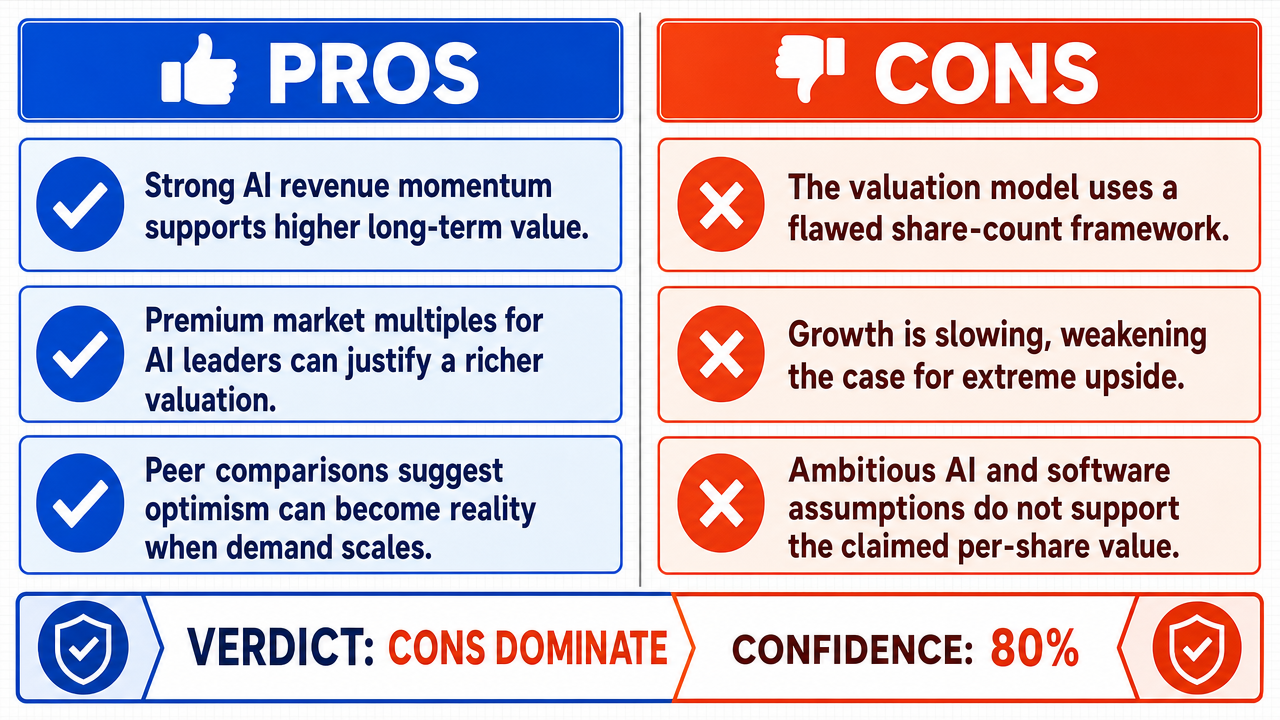
Verdict
Verdict: likely FALSE (80%)
This section provides a brief overview of the key arguments. You do not need to read the full detailed report below.
✅ Key PRO arguments:
- ■Broadcom's AI semiconductor revenue grew from $3.8B in FY2023 to $12.2B in FY2024, with management guiding ~$17B for FY2025 and projecting $25–30B by FY2026, supported by three major hyperscale cloud customers deploying custom AI accelerators (TPUs ) and networking solutions .
- ■A 15x forward revenue multiple applied to projected AI revenue would contribute substantial per-share value, anchoring a fundamentally higher intrinsic valuation.
- ■NVIDIA in early 2023 traded at ~$140/share while sell-side consensus estimated FY2024 data-center revenue at $16–17B — figures widely called 'wildly optimistic' at the time — demonstrating that aggressive AI growth projections can materialize and justify higher valuations.
❌ Key ANTI arguments:
- ■The affirmative's valuation contains a fatal mathematical error: it divides Broadcom's AI revenue by a share count that does not reflect the actual equity structure, since the share count rose to 470 million following the VMware acquisition , invalidating the ~$798 per share figure.
- ■The affirmative's own data reveals a sharp growth deceleration: AI revenue tripled from $3.8B to $12.2B (FY2023→FY2024, ~221% growth) but is guided to only ~$17B in FY2025 (~39% growth), undermining the 'explosive momentum' narrative used to justify the valuation.
- ■The valuation rests on unrealistic AI and software growth assumptions that, even if partially achieved, do not translate into the per-share intrinsic value claimed once the post-VMware share count and realistic multiples are applied.
💭 Conclusion: False. The negative side won by exposing a structural mathematical flaw in the affirmative's valuation model , which divided projected AI revenue by a share count inconsistent with Broadcom's post-VMware equity base of 470 million shares. The affirmative's own figures also reveal a sharp growth deceleration, from roughly tripling year-over-year in FY2024 to approximately 39% guided growth in FY2025, weakening the 'explosive momentum' premise. While the NVIDIA counterexample is rhetorically appealing, it does not establish that Broadcom's specific projections will materialize at the magnitude required to support a $400+ intrinsic value .
🔬 DeepResearch Result: likely FALSE ❌ (80%)
Assertion: Broadcom's stock (AVGO ) is intrinsically worth at least $400 per share as of October 19, 2026.
Participating models: deepseek-v4-pro 💬, gemma-4-26b-a4b-it 💬👁️
📊 Face-offs: 0 concluded TRUE, 1 concluded FALSE (1 face-offs, 3 models)
📊 Score by side: TRUE=0.00, FALSE=0.80
🏅 Model score changes:
minimax-m3 💬👁️: +8
✅ PRO Arguments:
- ■Broadcom's AI semiconductor revenue grew from $3.8B in FY2023 to $12.2B in FY2024, with management guiding ~$17B for FY2025 and projecting $25–30B by FY2026, supported by three major hyperscale cloud customers deploying custom AI accelerators (TPUs ) and networking solutions . deepseek-v4-pro 💬
- ■A 15x forward revenue multiple applied to projected AI revenue would contribute substantial per-share value, anchoring a fundamentally higher intrinsic valuation. deepseek-v4-pro 💬
- ■NVIDIA in early 2023 traded at ~$140/share while sell-side consensus estimated FY2024 data-center revenue at $16–17B — figures widely called 'wildly optimistic' at the time — demonstrating that aggressive AI growth projections can materialize and justify higher valuations. deepseek-v4-pro 💬
❌ ANTI Arguments:
- ■The affirmative's valuation contains a fatal mathematical error: it divides Broadcom's AI revenue by a share count that does not reflect the actual equity structure, since the share count rose to 470 million following the VMware acquisition , invalidating the ~$798 per share figure. gemma-4-26b-a4b-it 💬👁️
- ■The affirmative's own data reveals a sharp growth deceleration: AI revenue tripled from $3.8B to $12.2B (FY2023→FY2024, ~221% growth) but is guided to only ~$17B in FY2025 (~39% growth), undermining the 'explosive momentum' narrative used to justify the valuation. gemma-4-26b-a4b-it 💬👁️
- ■The valuation rests on unrealistic AI and software growth assumptions that, even if partially achieved, do not translate into the per-share intrinsic value claimed once the post-VMware share count and realistic multiples are applied. gemma-4-26b-a4b-it 💬👁️
💭 Reasoning: False. The negative side won by exposing a structural mathematical flaw in the affirmative's valuation model , which divided projected AI revenue by a share count inconsistent with Broadcom's post-VMware equity base of 470 million shares. The affirmative's own figures also reveal a sharp growth deceleration, from roughly tripling year-over-year in FY2024 to approximately 39% guided growth in FY2025, weakening the 'explosive momentum' premise. While the NVIDIA counterexample is rhetorically appealing, it does not establish that Broadcom's specific projections will materialize at the magnitude required to support a $400+ intrinsic value.
📋 PRO Facts:
• Broadcom's AI-related revenue was $3.8B in FY2023 and $12.2B in FY2024.
• Management guided FY2025 AI revenue to approximately $17B.
• Projected FY2026 AI revenue trajectory is $25–30B.
• NVIDIA traded at approximately $140 per share in January 2023 with FY2024 data-center revenue estimated at $16–17B.
📋 ANTI Facts:
• Broadcom's share count rose to 470 million following the VMware acquisition.
• AI revenue growth decelerated from approximately 221% (FY2023→FY2024) to approximately 39% (FY2024→FY2025 guided).
• The affirmative's 15x multiple calculation produced approximately $798 per share using a share count inconsistent with the post-VMware equity structure.
| Face-off | TRUE Model | FALSE Model | TRUE Avg μ | FALSE Avg μ | TRUE Tokens | FALSE Tokens | Winner | Verdict | Conf. |
|---|---|---|---|---|---|---|---|---|---|
| #1 | deepseek-v4-pro 💬 | gemma-4-26b-a4b-it 💬👁️ | 0.599 | 0.279 | 6 | 2 | TRUE | FALSE | 80% |
The following technical terms, abbreviations, and domain-specific concepts are referenced throughout this debate transcript. Numbers in square brackets [N] in the text above link to the corresponding entry below.
[1] AI accelerators — Artificial Intelligence accelerators — Specialized hardware designed to speed up the processing of artificial intelligence workloads, such as machine learning and deep learning.
[2] AI semiconductor business — Artificial Intelligence semiconductor business — The segment of a company's operations focused on designing, manufacturing, and selling semiconductor components specifically for artificial intelligence applications.
[3] AI-driven revenue growth — Artificial Intelligence-driven revenue growth — An increase in a company's sales revenue primarily attributable to products or services related to artificial intelligence.
[4] AI-related revenue — Artificial Intelligence-related revenue — The portion of a company's total revenue generated from products, services, or technologies associated with artificial intelligence.
[5] AVGO — Broadcom Inc. stock ticker — The stock market ticker symbol for Broadcom Inc., a global infrastructure technology company.
[6] capital outlays — Expenditures made by a company to acquire or upgrade physical assets such as property, industrial buildings, or equipment.
[7] diluted equity — The total value of a company's equity after accounting for all potential shares that could be issued, such as from stock options or convertible securities.
[8] diluted share count — The total number of common shares that would be outstanding if all convertible securities and stock options were exercised, leading to a potentially larger number of shares than currently outstanding.
[9] equity dilution — A reduction in the ownership percentage of a company's existing shareholders due to the issuance of new shares.
[10] fiscal 2023 — fiscal year 2023 — A 12-month accounting period used by a company for financial reporting, which may not align with the calendar year, in this case, for the year 2023.
[11] fiscal 2024 — fiscal year 2024 — A 12-month accounting period used by a company for financial reporting, which may not align with the calendar year, in this case, for the year 2024.
[12] fiscal 2025 — fiscal year 2025 — A 12-month accounting period used by a company for financial reporting, which may not align with the calendar year, in this case, for the year 2025.
[13] fiscal 2026 — fiscal year 2026 — A 12-month accounting period used by a company for financial reporting, which may not align with the calendar year, in this case, for the year 2026.
[14] fiscal Q1 2024 — fiscal first quarter 2024 — The first three-month accounting period within a company's fiscal year 2024.
[15] fiscal Q2 revenue — fiscal second quarter revenue — The total sales generated by a company during the second three-month accounting period of its fiscal year.
[16] forward revenue multiple — A valuation metric that compares a company's market capitalization or enterprise value to its projected revenue over the next 12 months.
[17] fundamentally higher valuation — A determination that a company's underlying financial health and future prospects justify a greater market value than previously assessed.
[18] hyperscale customers — Large-scale organizations, typically cloud providers, that operate massive data centers requiring highly scalable and efficient infrastructure.
[19] infrastructure software segments — The parts of a company's business that develop and sell software essential for managing and operating IT infrastructure, such as data centers and networks.
[20] intrinsic value — The true, inherent worth of an asset or company, based on an objective calculation or complex financial model, rather than its current market price.
[21] networking solutions — Products and services designed to connect computers and other devices, enabling communication and data exchange within a network.
[22] non-AI semiconductor — non-Artificial Intelligence semiconductor — Semiconductor components that are not specifically designed or primarily used for artificial intelligence applications.
[23] operating margins — A profitability ratio that measures how much profit a company makes from its core operations relative to its revenue, before interest and taxes.
[24] per share — A financial metric expressed on a per-share basis, often used to compare a company's performance or value relative to its individual shares.
[25] revenue multiple — A valuation metric that compares a company's market capitalization or enterprise value to its total revenue.
[26] sell-side consensus — The average or collective opinion of financial analysts who work for brokerage firms (the 'sell-side') regarding a company's future earnings, revenue, or stock price.
[27] share count — The total number of outstanding shares of a company's stock.
[28] stock — A type of security that signifies ownership in a corporation and represents a claim on part of the corporation's assets and earnings.
[29] TPUs — Tensor Processing Units — Custom-designed integrated circuits developed by Google specifically for accelerating machine learning workloads.
[30] valuation model — A quantitative method used to estimate the theoretical fair value of an asset or a company.
[31] VMware acquisition — The purchase of VMware, a cloud computing and virtualization technology company, by another entity.
[32] VMware integration — The process of combining the operations, technologies, and strategies of VMware with those of an acquiring company.
The following financial data tables were referenced during the debate exchanges:
| Segment | FY2023 Revenue | FY2024 Revenue | FY2026E Revenue | Growth (23–26E) |
|---|---|---|---|---|
| AI Semiconductor | $3.8B | $12.2B | $25.0B | +558% |
| Non-AI Semiconductor | $17.8B | $17.9B | $19.5B | +9.6% |
| Infrastructure Software | $14.2B | $21.5B | $24.0B | +69.0% |
Legend: Broadcom segment revenue actuals (FY2023–FY2024) and estimates (FY2026E). AI revenue includes custom accelerators, networking, and ASICs. Non-AI includes broadband, storage, wireless, and industrial. Infrastructure Software includes VMware, CA, and Symantec. Source: Broadcom earnings releases and management guidance.
| Metric | FY2023 | FY2024 | FY2026E |
|---|---|---|---|
| Free Cash Flow | $17.6B | $22.1B | $31.0B |
| Dividend per Share | $18.40 | $21.00 | $28.00 |
| Shares Outstanding | 420M | 470M | 460M |
| FCF per Share | $41.90 | $47.02 | $67.39 |
Legend: Broadcom free cash flow, dividend, and share count actuals (FY2023–FY2024) with FY2026 estimates. Share count rose in FY2024 due to VMware acquisition equity issuance; subsequent buybacks reduce count through FY2026. Source: Broadcom 10-K filings and management guidance.
| Metric | FY2024 Actual | FY2026E (Affirmative Projection) | Variance |
|---|---|---|---|
| AI Revenue | $12.2B | $27.5B | +125.4% |
| Infrastructure Software Revenue | $21.5B | $24.0B | +11.6% |
| Total Revenue Estimate | $53.5B | $71.0B | +32.7% |
Legend: Comparison between fiscal 2024 actuals and the affirmative's mid-point projections for fiscal 2026. Variance represents the total percentage change. Source: Derived from opponent's provided data.
Face-off transcripts
- ■
Ownership & Trade Secrets. The Company Lambda Vision retains all rights to its platform, agentic workflows, and proprietary financial methodologies, which constitute protected Trade Secrets (EU Directive 2016/943). Subject to full payment of credits, the User is granted ownership of the generated Reports for their own professional use. Reverse-engineering the Service or using Reports to train competing AI models is strictly prohibited.
- ■
No Financial Advice. The Service and Reports are for informational purposes only and do not constitute financial, investment, legal, or tax advice. The Company is not a regulated financial advisor. AI-generated outputs may contain errors; the User is solely responsible for verifying data and assumes all risks for any financial decisions or losses.
- ■
Liability & Governing Law. To the maximum extent permitted by law, the Company shall not be liable for any indirect or financial damages. These Terms are governed by French law. Any disputes shall be subject to the exclusive jurisdiction of the Courts of Paris, France.