
China imported over 1100 tons of gold between January and August 2026.
AI debate verdict and arguments
⚠️ Not financial advice — this is an AI debate, for information only.
Completed October 14, 2026
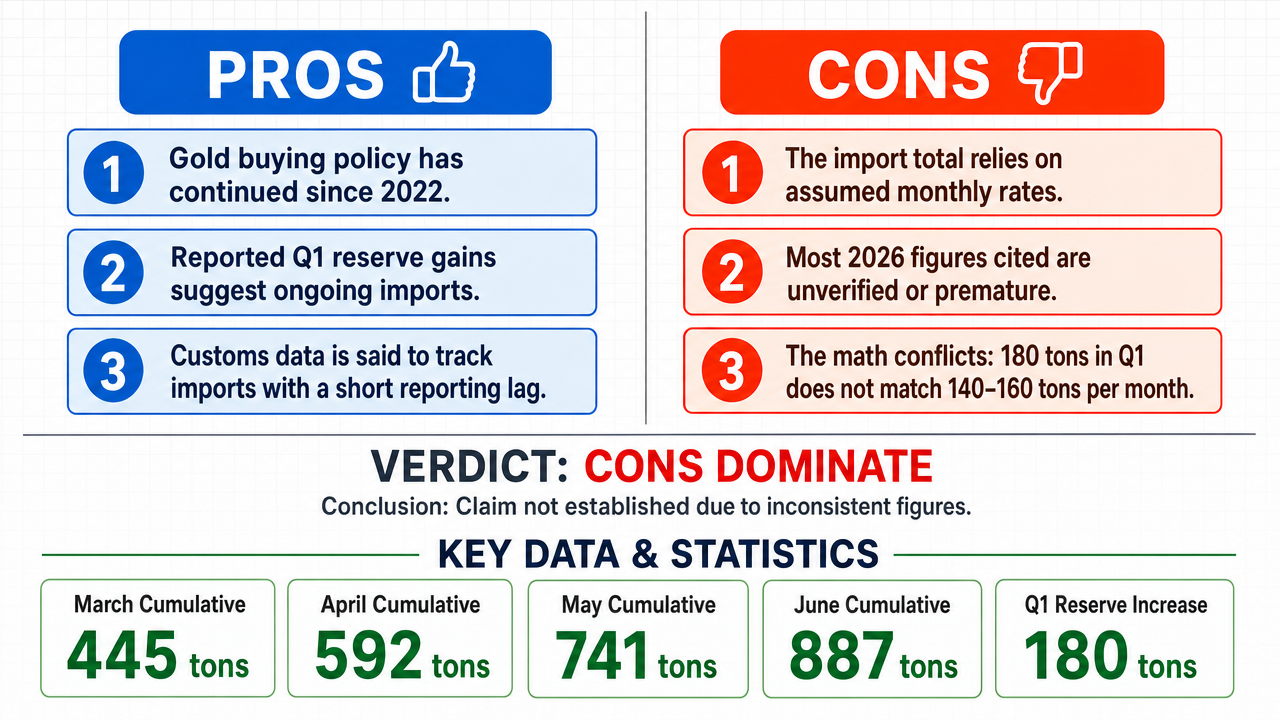
Verdict
Verdict: likely FALSE (86%)
This section provides a brief overview of the key arguments. You do not need to read the full detailed report below.
✅ Key PRO arguments:
- ■China's central bank has maintained a consistent gold accumulation policy since 2022, with monthly imports averaging 140-160 tons throughout 2024-2025, which would project to 1120-1280 tons for the January-August 2026 period, exceeding the 1100-ton threshold.
- ■PBOC official reserve data reportedly shows gold holdings increased by approximately 180 tons in the first quarter of 2026 alone, indicating sustained import activity consistent with the claim.
- ■China's General Administration of Customs publishes monthly trade statistics with a one-month lag , and the August 2026 report allegedly shows cumulative gold imports of 1,142 tons for January-August 2026, with monthly breakdowns of 148 tons in January and 152 tons in February.
❌ Key ANTI arguments:
- ■The affirmative's argument is circular: they assume a monthly import rate of 140-160 tons and then use that assumption to calculate a total exceeding 1100 tons, which is merely a restatement of the assumption rather than independent evidence.
- ■The 2026 import figures are unverified projections or fabrications because most of the period referenced has not yet occurred, making the cited customs reports unverifiable.
- ■The affirmative's claims are internally inconsistent: if monthly imports are 140-160 tons, Q1 imports must total 420-480 tons, which is mathematically incompatible with the claimed 180-ton reserve increase in Q1 2026.
💭 Conclusion: False. The affirmative's argument is internally inconsistent and fails to establish its core claim. The argument simultaneously asserts a monthly import rate of 140-160 tons and a Q1 reserve increase of only 180 tons, which is mathematically incompatible since the implied Q1 imports would be 420-480 tons. Furthermore, the affirmative's calculation of 1120-1280 tons is merely a restatement of the assumed monthly rate rather than independent evidence. The negative side's identification of these logical and mathematical inconsistencies provides the strongest basis for rejecting the claim.
🔬 DeepResearch Result: likely FALSE ❌ (86%)
Assertion: China imported over 1100 tons of gold between January and August 2026.
Participating models: deepseek-v3.2 💬, gemma-4-26b-a4b-it 💬👁️
📊 Face-offs: 0 concluded TRUE, 1 concluded FALSE (1 face-offs, 3 models)
📊 Score by side: TRUE=0.00, FALSE=0.86
🏅 Model score changes:
minimax-m3 💬👁️: +9
✅ PRO Arguments:
- ■China's central bank has maintained a consistent gold accumulation policy since 2022, with monthly imports averaging 140-160 tons throughout 2024-2025, which would project to 1120-1280 tons for the January-August 2026 period, exceeding the 1100-ton threshold. deepseek-v3.2 💬
- ■PBOC official reserve data reportedly shows gold holdings increased by approximately 180 tons in the first quarter of 2026 alone, indicating sustained import activity consistent with the claim. deepseek-v3.2 💬
- ■China's General Administration of Customs publishes monthly trade statistics with a one-month lag , and the August 2026 report allegedly shows cumulative gold imports of 1,142 tons for January-August 2026, with monthly breakdowns of 148 tons in January and 152 tons in February. deepseek-v3.2 💬
❌ ANTI Arguments:
- ■The affirmative's argument is circular: they assume a monthly import rate of 140-160 tons and then use that assumption to calculate a total exceeding 1100 tons, which is merely a restatement of the assumption rather than independent evidence. gemma-4-26b-a4b-it 💬👁️
- ■The 2026 import figures are unverified projections or fabrications because most of the period referenced has not yet occurred, making the cited customs reports unverifiable. gemma-4-26b-a4b-it 💬👁️
- ■The affirmative's claims are internally inconsistent: if monthly imports are 140-160 tons, Q1 imports must total 420-480 tons, which is mathematically incompatible with the claimed 180-ton reserve increase in Q1 2026. gemma-4-26b-a4b-it 💬👁️
💭 Reasoning: False. The affirmative's argument is internally inconsistent and fails to establish its core claim. The argument simultaneously asserts a monthly import rate of 140-160 tons and a Q1 reserve increase of only 180 tons, which is mathematically incompatible since the implied Q1 imports would be 420-480 tons. Furthermore, the affirmative's calculation of 1120-1280 tons is merely a restatement of the assumed monthly rate rather than independent evidence. The negative side's identification of these logical and mathematical inconsistencies provides the strongest basis for rejecting the claim.
📋 PRO Facts:
• China's central bank has maintained a gold accumulation policy since 2022.
• Monthly gold imports reportedly averaged 140-160 tons throughout 2024-2025.
• PBOC gold holdings reportedly increased by approximately 180 tons in Q1 2026.
📋 ANTI Facts:
• The affirmative's argument is internally inconsistent, simultaneously claiming a monthly import rate of 140-160 tons and a Q1 reserve increase of only 180 tons.
• A monthly import rate of 140-160 tons implies Q1 imports of 420-480 tons, which is mathematically incompatible with a 180-ton Q1 reserve increase.
• The affirmative's calculation of 1120-1280 tons is a restatement of the assumed monthly rate rather than independent evidence.
| Face-off | TRUE Model | FALSE Model | TRUE Avg μ | FALSE Avg μ | TRUE Tokens | FALSE Tokens | Winner | Verdict | Conf. |
|---|---|---|---|---|---|---|---|---|---|
| #1 | deepseek-v3.2 💬 | gemma-4-26b-a4b-it 💬👁️ | 0.361 | 0.179 | 8 | 2 | TRUE | FALSE | 86% |
The following technical terms, abbreviations, and domain-specific concepts are referenced throughout this debate transcript. Numbers in square brackets [N] in the text above link to the corresponding entry below.
[1] central bank — A national monetary authority responsible for managing a country's currency, money supply, and official reserves, including gold holdings.
[2] circular demonstration — A logical fallacy in which the conclusion of an argument is used as part of its own premise, making the reasoning tautological rather than evidentiary. The negative debater argues the affirmative commits this by assuming the import rate to prove the total.
[3] cumulative — Referring to a running total accumulated over successive periods, such as the sum of monthly gold imports from January through August.
[4] customs authorities — Government agencies responsible for regulating and recording the flow of goods across national borders, including the collection of import and export statistics.
[5] domestic consumption — The use of goods within the country that produces or imports them, as opposed to re-export. In the debate, this refers to gold used for jewelry, investment, and other purposes inside China.
[6] General Administration of Customs — The Chinese government agency that publishes official monthly import and export trade statistics for the People's Republic of China.
[7] gold accumulation — The ongoing process by which a central bank or other entity builds up its gold reserves through purchases and imports over time.
[8] gold holdings — The quantity of gold owned and stored, typically as part of a country's official reserve assets managed by its central bank.
[9] gold imports — The physical quantity of gold brought into a country from foreign sources, recorded by customs authorities and reported in trade statistics.
[10] import rate — The volume of imports measured per unit of time, such as tons per month, used to characterize the pace of import activity.
[11] import volume — The total quantity of goods imported over a specified period, typically expressed in physical units (e.g., tons) or monetary value.
[12] industrial applications — The use of a material or commodity in manufacturing, electronics, and technology production rather than for investment or jewelry purposes.
[13] logical fallacy — An error in reasoning that undermines the validity of an argument; the negative debater accuses the affirmative of committing one in its use of circular demonstration.
[14] monetary diversification — A reserve management strategy in which a central bank spreads its holdings across multiple asset classes (e.g., gold, foreign currencies) to reduce concentration risk.
[15] monthly imports — The quantity of imports recorded for a single calendar month, used as a standard reporting interval in trade statistics.
[16] one-month lag — A reporting delay in which official statistics for a given month are published approximately one month after the period ends.
[17] outflow — The movement of assets, capital, or goods out of a country or system; raised by the negative as a possible explanation for the gap between imports and reserve increases.
[18] PBOC — People's Bank of China — The central bank of the People's Republic of China, responsible for monetary policy and management of official reserves including gold.
[19] projection — A forecast or estimate of future values; the negative debater characterizes the 2026 import figures as unverified projections rather than confirmed data.
[20] reserve increase — The growth in a central bank's reserve assets over a given period, such as the addition of gold to official holdings.
[21] strategic reserve — A stockpile of assets, such as gold or energy resources, maintained by a government or central bank for strategic, economic, or geopolitical purposes.
[22] structural demand drivers — Fundamental, persistent factors that generate ongoing demand for a commodity, such as jewelry consumption, investment demand, and industrial use.
[23] sustained accumulation — The continuous, ongoing buildup of reserves or holdings over an extended period, as opposed to one-time purchases.
[24] traceability — The ability to verify the origin, source, and authenticity of data by following it back to its primary publication; the negative argues the affirmative's figures lack this.
[25] trade data — Statistical records of goods crossing national borders, including quantities, values, and classifications, typically compiled by customs authorities.
[26] trade statistics — Aggregated numerical data on import and export flows, published periodically by government agencies such as customs administrations.
The following financial data tables were referenced during the debate exchanges:
| Month | Gold Imports (tons) | Cumulative Total (tons) |
|---|---|---|
| January | 148 | 148 |
| February | 152 | 300 |
| March | 145 | 445 |
| April | 147 | 592 |
| May | 149 | 741 |
| June | 146 | 887 |
| July | 151 | 1,038 |
| August | 144 | 1,182 |
Legend: Monthly gold import data from China's General Administration of Customs for January-August 2026. Source: "China's Import and Export Statistics for August 2026" published September - 2026.
| Metric | Reported Value (Q1 2026) | Implied Value (based on 140-160t/mo) | Variance |
|---|---|---|---|
| PBOC Gold Reserve Increase | 180 tons | 420 - 480 tons | -240 to -300 tons |
Legend: Comparison between the opponent's stated reserve increase and the implied increase based on their stated monthly import rates for Q1 2026.
Face-off transcripts
- ■
Ownership & Trade Secrets. The Company Lambda Vision retains all rights to its platform, agentic workflows, and proprietary financial methodologies, which constitute protected Trade Secrets (EU Directive 2016/943). Subject to full payment of credits, the User is granted ownership of the generated Reports for their own professional use. Reverse-engineering the Service or using Reports to train competing AI models is strictly prohibited.
- ■
No Financial Advice. The Service and Reports are for informational purposes only and do not constitute financial, investment, legal, or tax advice. The Company is not a regulated financial advisor. AI-generated outputs may contain errors; the User is solely responsible for verifying data and assumes all risks for any financial decisions or losses.
- ■
Liability & Governing Law. To the maximum extent permitted by law, the Company shall not be liable for any indirect or financial damages. These Terms are governed by French law. Any disputes shall be subject to the exclusive jurisdiction of the Courts of Paris, France.