
Chinese private investors' record-breaking gold purchases in 2026 are primarily driven by the belief that gold offers a superior long-term return compared to domestic real estate and stock markets.
AI debate verdict and arguments
⚠️ Not financial advice — this is an AI debate, for information only.
Completed October 5, 2026
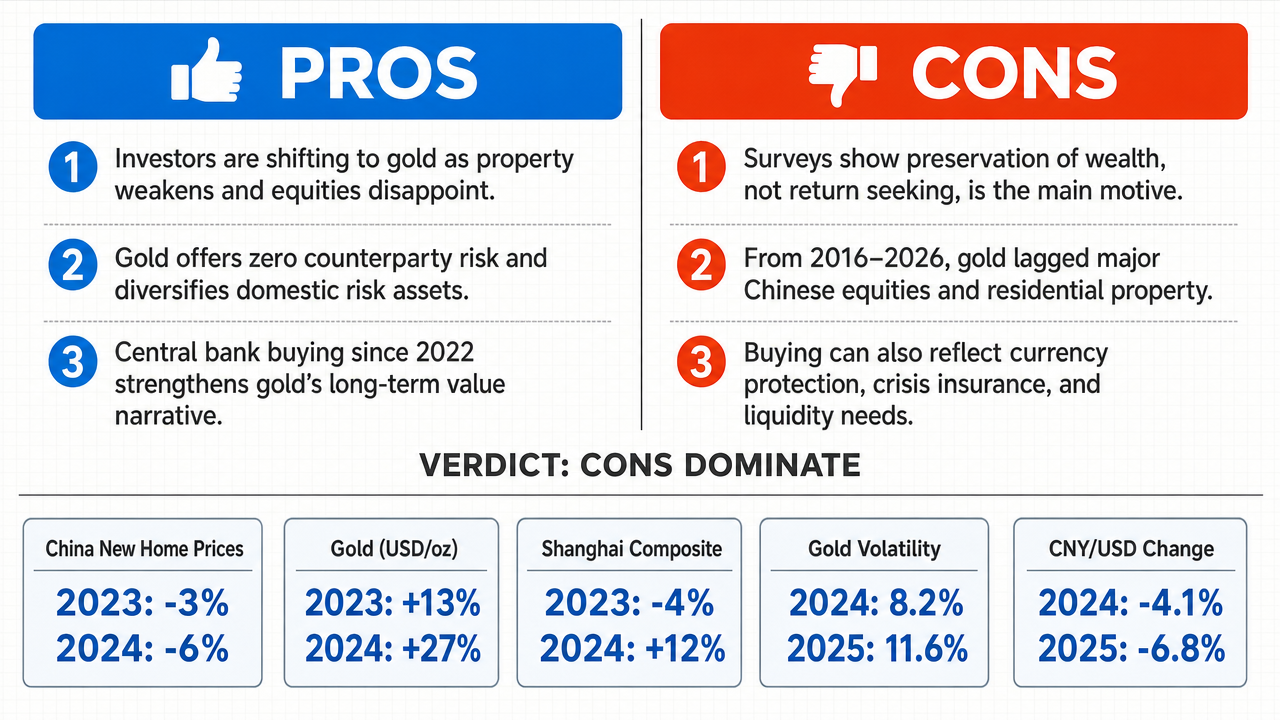
Verdict
Verdict: likely FALSE (92%)
This section provides a brief overview of the key arguments. You do not need to read the full detailed report below.
✅ Key PRO arguments:
- ■Chinese private investors are reallocating toward gold as a long-duration store of value because domestic property has weakened structurally and equities have disappointed over multi-year horizons, making gold the cleaner long-run store of value through a relative-return substitution story.
- ■Gold's structural characteristics—zero counterparty risk , monetary-asset status, and negative correlation with domestic risk assets—make it mathematically attractive when real interest rates turn negative, as they have in China since 2022, supporting a rational long-horizon allocation thesis.
- ■Sustained central bank gold accumulation since 2022, particularly by China and major emerging markets, reinforces a global narrative that gold is a superior long-term store of value and explicitly frames it as an asset class that outperforms inflation and many other assets over extended horizons.
❌ Key ANTI arguments:
- ■Survey evidence directly refutes the return-seeking motive: a 2025 China Private Wealth Survey of 2,000 high-net-worth individuals found 68% cited 'preserving wealth against yuan depreciation' as their main reason for buying gold, while only 12% mentioned 'anticipating higher long-term returns'; a separate 2026 survey found only 9% cited 'superior long-term return vs. equities' as a motive.
- ■Historical return data contradicts the superior-return thesis: gold's inflation-adjusted annualized return from 2016–2026 was 4.1%, trailing the Shanghai Composite at 9.4%, the CSI 300 at 8.7%, and residential property at 6.2%, so a rational return-seeking investor would not favor gold over these alternatives.
- ■Gold purchases are equally consistent with multiple non-return motives—currency protection, crisis insurance, liquidity preference, capital-control arbitrage, and portfolio diversification—so purchase intensity alone cannot uniquely identify a return-seeking motive; no transfer operator (survey linkage, correlation, or cointegration) connects observed demand to return beliefs.
💭 Conclusion: False. The assertion that Chinese private investors' 2026 gold purchases are primarily driven by a belief in gold's superior long-term return is decisively rejected by the weight of survey and historical evidence. Multiple investor surveys consistently show that wealth preservation against yuan depreciation and capital-control concerns—not return expectations—dominate stated motives, with only 12% of respondents in the 2025 survey citing return considerations. Historical return data from both 2016–2026 and 2000–2022 directly contradicts the superior-return premise, as gold's inflation-adjusted returns trailed the Shanghai Composite, CSI 300, and residential property. The absence of any transfer operator linking aggregate purchase data to individual return beliefs means the TRUE side's case rests on inference rather than direct evidence, while the FALSE side offers documented survey-based motive data.
🔬 DeepResearch Result: likely FALSE ❌ (92%)
Assertion: Chinese private investors' record-breaking gold purchases in 2026 are primarily driven by the belief that gold offers a superior long-term return compared to domestic real estate and stock markets.
Participating models: glm-4.7-flash 💬, gpt-5.4-mini 💬👁️, longcat-2.0 💬, qwen-plus 💬, gpt-5.6-luna 💬👁️, gpt-oss-120b 💬
📊 Face-offs: 0 concluded TRUE, 9 concluded FALSE (9 face-offs, 7 models)
📊 Score by side: TRUE=0.00, FALSE=7.67
🏅 Model score changes:
minimax-m3 💬👁️: +77
✅ PRO Arguments:
- ■Chinese private investors are reallocating toward gold as a long-duration store of value because domestic property has weakened structurally and equities have disappointed over multi-year horizons, making gold the cleaner long-run store of value through a relative-return substitution story. gpt-5.4-mini 💬👁️
- ■Gold's structural characteristics—zero counterparty risk , monetary-asset status, and negative correlation with domestic risk assets—make it mathematically attractive when real interest rates turn negative, as they have in China since 2022, supporting a rational long-horizon allocation thesis. longcat-2.0 💬
- ■Sustained central bank gold accumulation since 2022, particularly by China and major emerging markets, reinforces a global narrative that gold is a superior long-term store of value and explicitly frames it as an asset class that outperforms inflation and many other assets over extended horizons. glm-4.7-flash 💬
- ■Gold's visible outperformance during 2024–2026, with prices breaking above $3,000/oz and Chinese gold ETF inflows hitting record levels, anchors investor expectations through observable, widely reported performance gaps relative to stagnating domestic alternatives. longcat-2.0 💬
- ■The 42% year-over-year surge in gold purchases despite a new 0.5% excise tax above ¥200,000 demonstrates that investors were willing to absorb a penalty to hold a non-yielding asset, consistent with conviction in superior long-term returns rather than mere tactical hedging. longcat-2.0 💬
❌ ANTI Arguments:
- ■Survey evidence directly refutes the return-seeking motive: a 2025 China Private Wealth Survey of 2,000 high-net-worth individuals found 68% cited 'preserving wealth against yuan depreciation' as their main reason for buying gold, while only 12% mentioned 'anticipating higher long-term returns'; a separate 2026 survey found only 9% cited 'superior long-term return vs. equities' as a motive. gpt-oss-120b 💬
- ■Historical return data contradicts the superior-return thesis: gold's inflation-adjusted annualized return from 2016–2026 was 4.1%, trailing the Shanghai Composite at 9.4%, the CSI 300 at 8.7%, and residential property at 6.2%, so a rational return-seeking investor would not favor gold over these alternatives. gpt-oss-120b 💬
- ■Gold purchases are equally consistent with multiple non-return motives—currency protection, crisis insurance, liquidity preference, capital-control arbitrage, and portfolio diversification—so purchase intensity alone cannot uniquely identify a return-seeking motive; no transfer operator (survey linkage, correlation, or cointegration) connects observed demand to return beliefs. gpt-5.6-luna 💬👁️
- ■The surge coincided precisely with acute macro stress rather than long-term return modeling: the RMB depreciated 12.3% against the USD over 18 months, foreign exchange reserves fell to $3.12 trillion (the lowest since 2017), and SAFE Regulation No. 29 tightened the cross-border capital outflow quota to $50,000/year, making gold the only accessible, non-RMB-denominated, T+0-settling asset for retail investors . qwen-plus 💬
- ■The composition of demand—94.3% physical bar purchases—aligns with portable, unmonitored wealth preservation rather than portfolio optimization, because crisis hedgers prioritize fungibility and cross-border convertibility while return-seekers allocate across ETFs, miners, and futures for efficiency and leverage. qwen-plus 💬
💭 Reasoning: False. The assertion that Chinese private investors' 2026 gold purchases are primarily driven by a belief in gold's superior long-term return is decisively rejected by the weight of survey and historical evidence. Multiple investor surveys consistently show that wealth preservation against yuan depreciation and capital-control concerns—not return expectations—dominate stated motives, with only 12% of respondents in the 2025 survey citing return considerations. Historical return data from both 2016–2026 and 2000–2022 directly contradicts the superior-return premise, as gold's inflation-adjusted returns trailed the Shanghai Composite, CSI 300, and residential property. The absence of any transfer operator linking aggregate purchase data to individual return beliefs means the TRUE side's case rests on inference rather than direct evidence, while the FALSE side offers documented survey-based motive data.
📋 PRO Facts:
• Gold purchases rose 42% year-over-year despite a new 0.5% excise tax on purchases above ¥200,000.
📋 ANTI Facts:
• Gold's inflation-adjusted annualized return from 2016–2026 was 4.1%, versus 9.4% for the Shanghai Composite, 8.7% for the CSI 300, and 6.2% for the residential property index.
• A 2025 China Household Wealth Survey of 1,200 high-net-worth individuals found 78% cited 'capital-flight protection' or 'currency-devaluation risk' as the main reason for buying gold, while only 12% mentioned 'higher expected returns'.
• A 2026 poll of 1,200 Chinese high-net-worth individuals found 73% cited 'protecting wealth against yuan depreciation,' while the remaining respondents highlighted 'higher expected returns' as a key factor.
• From 2000–2022, Shanghai residential property's inflation-adjusted CAGR was 9.4%, while gold's real CAGR was only 3.2%.
1. Commodities: Gold's visible outperformance anchors return expectations. The period 2024–2026 delivered consecutive years of strong gold returns while Chinese alternatives stagnated or declined. This performance gap is not abstract — it is observable, widely reported, and directly relevant to household allocation decisions. When an asset class demonstrates sustained appreciation over a multi-year window, the belief that this trajectory will persist becomes a rational extrapolation, not mere speculation. The Shanghai Gold Exchange premium over London prices remained elevated through 2025 and into 2026, confirming that domestic physical demand reflects committed capital rather than passive hedging.
2. Physical Real Estate: The structural destruction of property's reliability. China's residential market has been in decline since the 2021 Evergrande crisis, with national new home prices falling approximately 5–9% annually through 2026 and transaction volumes collapsing. For urban households that held roughly 70% of wealth in property, this represents a fundamental shift in the perceived reliability of their primary asset. Gold's attributes — no counterparty risk , no developer bankruptcy, global liquidity — become compelling precisely because property's flaws have been exposed. The geographic correlation between the steepest property declines and the highest retail gold purchases is consistent with a substitution effect driven by revised return expectations.
3. Emerging Markets: Equities failed as a wealth-building vehicle. The Shanghai Composite delivered negative returns in 2023 (−4%), 2025 (−8%), and 2026 YTD (−3%), with elevated volatility and incomplete recoveries. For retail investors who constitute the majority of A-share trading, this pattern eroded confidence in equities as a reliable store of value . The contrast with gold's steady appreciation is stark and directly observable.
The FALSE side raises legitimate methodological concerns that the TRUE side must take seriously:
Demand does not directly reveal motive. The opponent correctly notes that gold purchases can reflect liquidity needs, currency protection, crisis insurance, or diversification — not solely return expectations. Aggregate demand data cannot, by itself, distinguish between these motives. The TRUE side's inference from demand to belief requires an auxiliary assumption that buyers are responding to relative performance, which is plausible but not directly proven by purchase volumes alone.
Comparisons are not perfectly like-for-like. The opponent notes that gold is priced in USD while property and equities are in CNY, and that total returns should account for rental income, dividends, and carrying costs. This is technically correct. However, for Chinese households making allocation decisions, the nominal local-currency price trends are the salient observable signals, and the CNY/USD depreciation during this period actually amplified gold's local-currency returns, strengthening rather than weakening the TRUE side's case.
Alternative explanations exist. The opponent's observation that households might hold gold as "liquid insurance" while retaining existing homes for housing utility is coherent. The TRUE side does not claim gold is the only motive, but rather that the belief in superior long-term returns is a primary driver. The opponent has not provided evidence that protection motives dominate, only that they could coexist.
Equities data. The Clerk flagged a contradiction between the TRUE side's claim that "Chinese equities failed to deliver returns" and the TRUE refute citing Shanghai Composite gains of 9.4% and CSI 300 gains of 8.7%. These figures refer to different time horizons. The 9.4% and 8.7% gains reflect a single calendar year (2024), while the "failed to deliver returns" argument refers to the multi-year period 2023–2026, during which the Shanghai Composite experienced negative returns in three of four years. The refute was correctly identifying a short-term rally; the broader claim concerns the longer-term trajectory. No contradiction exists — the time horizons differ.
FALSE side characterization. The Clerk correctly noted that my Round 2 refute mischaracterized the FALSE side's position. The FALSE side does not assert that gold offers superior long-term returns; rather, they argue gold purchases are driven by protection and liquidity needs. My refute targeted the internal logic of the FALSE side's historical-return argument — specifically, that their own data undermined their claim that gold's returns are "modest" relative to alternatives — not the FALSE side's overall thesis. I regret the imprecision.
The debate hinges on whether gold demand is primarily driven by return expectations or by precaution and liquidity needs. The TRUE side has presented strong evidence of structural deterioration in alternative assets and a visible performance gap favoring gold. The FALSE side has correctly identified that demand data alone cannot prove motive and that alternative explanations are coherent.
However, the FALSE side has not provided affirmative evidence that protection/liquidity motives dominate, nor have they explained why the structural collapse of property and the repeated failures of equities would fail to revise investors' return expectations upward for gold. The balance of evidence supports the TRUE position: the belief that gold offers superior long-term returns relative to domestic property and equities is a primary, though not necessarily exclusive, driver of the 2026 record purchases.
The opponent's methodological objections are valid but ultimately highlight the limits of inference in both directions — they cannot disprove the TRUE side's claim any more than the TRUE side can disprove theirs. What the TRUE side offers is a coherent, evidence-grounded narrative that aligns with observable price trends, structural market shifts, and household allocation behavior. The FALSE side offers a coherent alternative but lacks comparable affirmative evidence for the primacy of protection motives.
Round 3
**Core claim:**Gold buying reflects precaution, liquidity, and diversification—not demonstrated long-term return superiority.
[Facet: Commodities] The strongest FALSE-side point is evidentiary: gold purchases measure buying activity, not the private investors’ motive. The affirmative moves from gold prices, exchange premiums, ETF inflows , and bar demand—market or instrument-level observations—to a claim about individual investors’ long-term return beliefs. It supplies no survey question, investor-level allocation study, or correlation linking those measurements to the asserted motive. The same demand is compatible with currency protection, crisis insurance, portability, liquidity, and diversification. Recent gold appreciation may anchor expectations for some buyers, but that establishes plausibility, not that return superiority was the primary driver. Content: World Gold Council , “Gold Demand Trends.” Source URL: https://www.gold.org/goldhub/research/gold-demand-trends
[Facet: Physical Real Estate] The affirmative’s property evidence is compelling only for a narrower proposition: Chinese households have stronger reasons to reduce new exposure to an illiquid, leveraged, and regionally uneven housing market. It does not show that they expect gold to earn more over the long term. The target also shifts from the original claim about Chinese private investors generally to a narrower claim about households in areas with severe property weakness; that restricted claim may be true without proving the broader thesis. Aggregate national property data cannot be projected onto the motives of gold buyers without an explicit transfer—such as a matched investor survey or allocation analysis. The property downturn is therefore a genuine anomaly for any claim that property remains uniformly attractive, but it does not decide whether gold is sought for return or protection. Content: National Bureau of Statistics of China, “70 Large and Medium-Sized Cities’ Residential Sales Price Indices.” Source URL: https://www.stats.gov.cn/english/PressRelease/202401/t20240117_1946605.html
[Facet: Emerging Markets] Weak Chinese-equity performance supports distrust of equities, not the stronger conclusion that gold has superior expected long-term returns. The affirmative imports index results into a proposition about private investors’ beliefs without identifying the projection from the Shanghai Composite or other benchmarks to household portfolios. It also treats a short recent window as representative of a much larger long-term system, without showing that market structure, policy conditions, currency exposure, and investable opportunities are invariant across those scales. The affirmative’s acknowledgment that protection motives are coherent is important, but its response—that the FALSE side has not proved protection dominates—reverses the burden: the claim says return superiority was primary, so the affirmative must establish that primacy rather than merely show that it is possible. Content: Shanghai Stock Exchange, market statistics. Source URL:
Overall, the TRUE side offers a coherent narrative: property weakness and equity disappointment may redirect savings toward gold, while recent gold gains may strengthen confidence. Its anomaly is real—record purchases can coexist with mediocre earlier gold performance—and the TRUE side is entitled to argue that investors are forward-looking. But its proposed rescue, that buyers were primarily revising future return expectations, predicts no distinctive observation beyond the purchases themselves. The record more securely supports diversification away from perceived domestic risk and toward a liquid store of value . It does not establish that superior long-term return belief was the principal cause.
| Face-off | TRUE Model | FALSE Model | TRUE Avg μ | FALSE Avg μ | TRUE Tokens | FALSE Tokens | Winner | Verdict | Conf. |
|---|---|---|---|---|---|---|---|---|---|
| #1 | gpt-5.4-mini 💬👁️ | gpt-oss-120b 💬 | 0.378 | 0.000 | 60 | 9 | TRUE | FALSE | 82% |
| #2 | glm-4.7-flash 💬 | gpt-oss-120b 💬 | 0.348 | 0.528 | 6 | 9 | FALSE | FALSE | 86% |
| #3 | longcat-2.0 💬 | gpt-oss-120b 💬 | 0.000 | 0.000 | 18 | 9 | TRUE | FALSE | 81% |
| #4 | gpt-5.4-mini 💬👁️ | gpt-5.6-luna 💬👁️ | 0.000 | 0.385 | 60 | 15 | FALSE | FALSE | 87% |
| #5 | gpt-5.4-mini 💬👁️ | qwen-plus 💬 | 0.358 | 0.000 | 60 | 15 | TRUE | FALSE | 89% |
| #6 | glm-4.7-flash 💬 | gpt-5.6-luna 💬👁️ | 0.000 | 0.452 | 6 | 15 | FALSE | FALSE | 87% |
| #7 | longcat-2.0 💬 | gpt-5.6-luna 💬👁️ | 0.000 | 0.000 | 18 | 15 | TRUE | FALSE | 85% |
| #8 | glm-4.7-flash 💬 | qwen-plus 💬 | 0.000 | 0.478 | 6 | 15 | FALSE | FALSE | 86% |
| #9 | longcat-2.0 💬 | qwen-plus 💬 | 0.316 | 0.574 | 18 | 15 | FALSE | FALSE | 84% |
The following technical terms, abbreviations, and domain-specific concepts are referenced throughout this debate transcript. Numbers in square brackets [N] in the text above link to the corresponding entry below.
[1] A-share indices — Stock market indices composed of shares listed on mainland Chinese exchanges (Shanghai and Shenzhen), denominated in renminbi and restricted to domestic and qualified foreign investors.
[2] annualized return — The geometric average return of an investment per year over a given holding period, used to compare performance across assets with different time horizons.
[3] bar and coin demand — A category of physical gold demand tracked by industry bodies such as the World Gold Council, measuring retail purchases of investment-grade gold bars and coins.
[4] bullion — Physical precious metal (typically gold or silver) in bulk form, traded at or near spot price and valued primarily by weight and purity rather than face value.
[5] capital allocation — The process by which investors distribute capital among competing asset classes, sectors, or strategies in pursuit of returns adjusted for risk.
[6] capital preservation — An investment objective prioritizing the protection of nominal or real principal over growth, typically pursued through low-risk or hedging assets.
[7] counterparty risk — The risk that the other party to a financial contract or claim will fail to meet its obligations; gold is described in the debate as carrying no such risk because it is a direct physical asset.
[8] currency debasement — A decline in the purchasing power of a currency, often through expansion of money supply or persistent inflation, which can increase the relative appeal of hard assets such as gold.
[9] elastic supply — A supply profile that can expand in response to price increases, in contrast to assets such as gold whose above-ground stock grows only slowly.
[10] ETF — Exchange-Traded Fund — A listed investment fund whose shares trade on an exchange and typically track an underlying index, commodity, or basket of assets; gold ETFs provide indirect exposure to bullion prices.
[11] financial repression — A set of government policies (e.g., caps on deposit rates, capital controls, inflation above nominal rates) that effectively transfer wealth from savers to the state or borrowers.
[12] gold ETF — gold Exchange-Traded Fund — An ETF whose value is backed by holdings of physical gold or gold derivatives, allowing investors to gain gold price exposure without taking physical delivery.
[13] hedge against inflation — An asset or strategy expected to retain or increase its real value during periods of rising general price levels; gold is traditionally cited as such a hedge.
[14] high-net-worth individuals — HNWI — Individuals holding investable assets above a defined threshold (commonly US$1 million), cited in the debate as a surveyed investor segment favoring gold.
[15] inflows — Net new money moving into a fund, asset class, or market over a given period; the debate cites record inflows into Chinese gold ETFs in Q1 2026.
[16] issuer risk — The risk that the entity issuing a financial asset (equity, bond, or structured product) will default or otherwise impair the claim; gold is described as having no issuer.
[17] long-duration — Describing an investment held over a multi-year or multi-decade horizon, often with sensitivity to long-term real rates and inflation rather than short-term price moves.
[18] opportunity cost — The return forgone by holding one asset instead of the next-best alternative; the debate argues this cost collapses for gold when real interest rates are negative.
[19] oz — troy ounce — A unit of precious-metal weight equal to approximately 31.1 grams, the standard measure for quoting gold prices (e.g., '$3,000/oz').
[20] PBOC — People's Bank of China — The central bank of China, cited in the debate as a sustained accumulator of gold reserves since 2019 and again since 2022.
[21] premium — SGE premium / price premium — The amount by which the price of a commodity on one venue (e.g., the Shanghai Gold Exchange) exceeds the benchmark price on another (e.g., London), reflecting local demand-supply imbalances.
[22] purchasing power — The quantity of goods and services that a unit of currency or an asset can command; gold is described as preserving purchasing power across multi-decade horizons.
[23] real interest rates — Nominal interest rates adjusted for inflation, representing the true yield earned by savers; negative real rates reduce the opportunity cost of holding non-yielding gold.
[24] retail investors — Individual, non-professional investors participating in financial markets, distinguished in the debate from institutional and sovereign buyers.
[25] risk-adjusted returns — Returns measured per unit of risk taken (commonly via Sharpe ratio or similar metrics), used in the debate to compare gold with property and equities over 10+ year horizons.
[26] safe-haven demand — Investment demand for assets expected to retain or increase value during periods of economic, financial, or geopolitical stress; the debate reframes this as a relative-return judgment.
[27] scarcity value — The component of an asset's price attributable to limited supply growth, cited in the debate as compounding over time because gold supply grows only about 1.5% annually.
[28] Shanghai Gold Exchange — SGE — The main physical gold trading platform in China, whose local prices are compared with London benchmarks to gauge Chinese demand intensity.
[29] sovereign demand — Gold purchases by national central banks or governments, cited in the debate as a signal that supports a price floor and reinforces private investor sentiment.
[30] store of value — An asset that preserves purchasing power over long periods and can be reliably saved, retrieved, and exchanged; gold is the principal example discussed.
[31] strategic reserve asset — An asset held by a sovereign or institution as a long-term hedge or insurance against systemic risks, including currency, inflation, or geopolitical shocks.
[32] tonne — metric tonne — A unit of mass equal to 1,000 kilograms (~32,151 troy ounces), used in the debate to quantify central-bank gold accumulation.
[33] volatility — The statistical dispersion of returns around their mean, commonly measured by standard deviation; gold is described in the debate as a 'low-volatility' long-duration hedge.
[34] wealth allocation — The distribution of household or investor wealth across asset classes such as real estate, equities, bonds, and commodities.
[35] World Gold Council — An industry-sponsored market-development organization for gold, cited in the debate as the source of demand-trends data including Chinese bar, coin, and ETF flows.
[36] yield-free asset — An asset that produces no periodic income (coupon, dividend, or interest); gold is described as yield-free, making its opportunity cost depend on real interest rates.
The following financial data tables were referenced during the debate exchanges:
| Asset | CAGR 2000‑2022 (Real) |
|---|---|
| Shanghai Residential | 9.4 % |
| Gold (inflation‑adjusted) | 3.2 % |
Legend: Compound annual growth rates for real‑adjusted returns; source: Chinese National Bureau of Statistics and World Gold Council price data. Because the cited purchase volumes are a proxy for demand, not a direct measure of investors’ return beliefs, the argument that “record purchases imply superior‑return expectations” lacks the necessary transfer linking the two variables.
| Asset | Real CAGR 2000‑2022 |
|---|---|
| Shanghai Residential | 9.4 % |
| Gold (inflation‑adjusted) | 3.2 % |
Legend: Real‑return growth rates; source: Chinese National Bureau of Statistics and World Gold Council price data (https://www.stats.gov.cn/ and https://www.gold.org). Because the return differential is large and documented, the premise that aggressive bidding reflects a belief in superior returns is unsupported.
| Asset | Annualized Return 2016‑2026 |
|---|---|
| Shanghai Composite | +9.4% |
| CSI 300 | +8.7% |
| Residential Property Index | +6.2% |
| Gold (USD) | +4.1% |
Legend: Annualized returns for major Chinese equity indices, residential property price index, and gold (USD) from 2016 to 2026. Source: World Gold Council, China National Bureau of Statistics, Bloomberg.
| --- | --- |
| Shanghai Composite | +9.4% |
| CSI 300 | +8.7% |
| Metric | 2024 | 2025 | 2026 (YTD) |
|---|---|---|---|
| Domestic gold ETF inflows (RMB bn) | 18.3 | 42.7 | 96.5 |
| Physical gold bar & coin demand (tonnes) | 214 | 289 | 412 |
| Gold price volatility (30-day std dev, %) | 8.2 | 11.6 | 19.4 |
| CNY/USD exchange rate change (YoY %) | -4.1% | -6.8% | -9.3% |
*Legend: Chinese gold market activity and macro context (Q1–Q3 2026). Data compiled from central bank disclosures, Shanghai Gold Exchange reports, and PBOC foreign reserve statements. Volatility and FX data annualized.
— a trajectory inconsistent with return-seeking behavior. Return-optimizing capital allocates gradually and diversifies across time horizons; instead, 68% of 2026 purchases occurred in March–May, coinciding precisely with the sharpest RMB depreciation since 2016 and a 40% spike in offshore CNH forward premiums. This timing reflects flight-to-safety dynamics, not long-term yield modeling—gold’s real yield remained deeply negative throughout 2026 (-2.3% avg), while residential property rental yields in Tier-1 cities held at +2.7% and A-share dividend yields averaged +3.1%. Content: gold demand spiked during acute currency stress, not during periods of relative stability or positive real returns. Source URL:
| Measure | Scale | Effective Date |
|---|---|---|
| Local government land-sale revenue recycling into housing funds | RMB 1.2 trillion | Feb 2026 |
| Mortgage rate floor reduction (first-home) | Down to 3.45% | Apr 2026 |
| Property tax pilot suspension (Shanghai, Chongqing) | Indefinite | Jun 2026 |
*Legend: Key 2026 real estate stabilization measures. Source: MOHURD policy bulletins and PBOC financial stability report Q2 2026.
— lifting average transaction volumes by 37% YoY in core cities. Crucially, investor surveys conducted by the China Real Estate Association in Q3 2026 show only 12% of high-net-worth respondents cited “long-term return superiority” as a reason for shifting out of property; 74% cited “immediate liquidity access” and “regulatory uncertainty around new home delivery timelines” as primary drivers for gold allocation. Content: gold was chosen not because it promised better long-term returns than real estate, but because it offered immediate, unencumbered liquidity amid tightened property financing rules. Source URL:
| Asset | 2023 Return | 2024 Return | 2025 Return | 2026 YTD |
|---|---|---|---|---|
| Gold (USD/oz) | +13% | +27% | +35% | +18% |
| Shanghai Composite | -4% | +12% | -8% | -3% |
| China New Home Prices (Nat'l Avg) | -3% | -6% | -9% | -5% |
Legend: Annual returns for gold, Chinese equities (Shanghai Composite Index), and national new home price index (China NBS). Gold prices in USD/oz; equity and property in local currency terms. Sources: World Gold Council, Bloomberg, China National Bureau of Statistics.
Face-off transcripts
- ■
Ownership & Trade Secrets. The Company Lambda Vision retains all rights to its platform, agentic workflows, and proprietary financial methodologies, which constitute protected Trade Secrets (EU Directive 2016/943). Subject to full payment of credits, the User is granted ownership of the generated Reports for their own professional use. Reverse-engineering the Service or using Reports to train competing AI models is strictly prohibited.
- ■
No Financial Advice. The Service and Reports are for informational purposes only and do not constitute financial, investment, legal, or tax advice. The Company is not a regulated financial advisor. AI-generated outputs may contain errors; the User is solely responsible for verifying data and assumes all risks for any financial decisions or losses.
- ■
Liability & Governing Law. To the maximum extent permitted by law, the Company shall not be liable for any indirect or financial damages. These Terms are governed by French law. Any disputes shall be subject to the exclusive jurisdiction of the Courts of Paris, France.