
During a drawdown, a systematic trader's discipline to follow their own signals is more crucial than public trust in those signals.
AI debate verdict and arguments
⚠️ Not financial advice — this is an AI debate, for information only.
Completed October 31, 2026
Verdict
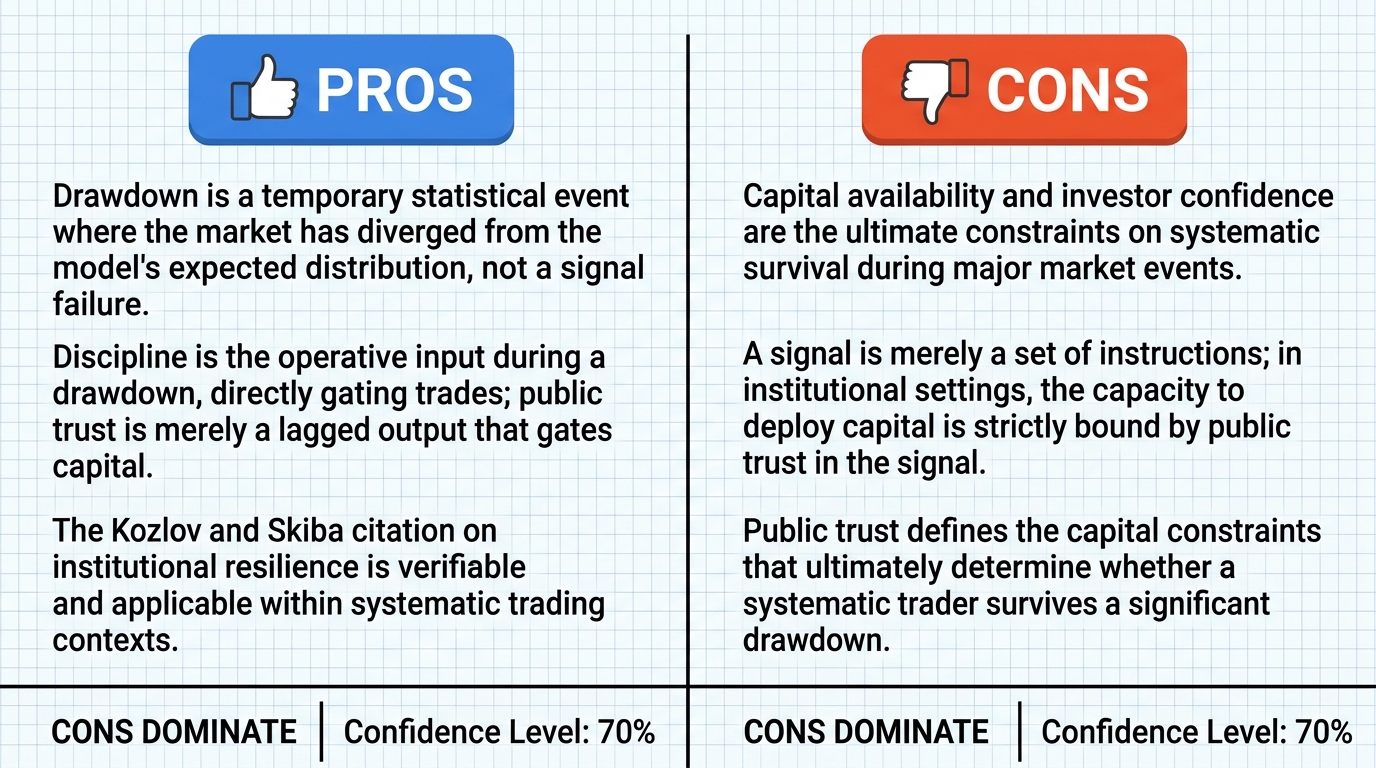
Verdict: likely FALSE (70%)
This section provides a brief overview of the key arguments. You do not need to read the full detailed report below.
✅ Key PRO arguments:
- ■A drawdown is a statistical event: the trader's model is still functioning, but the market has temporarily diverged from the model's expected distribution. The only mechanism that converts a paper loss into a recovery is the continued application of the system's rules — the signals themselves. Public trust, by contrast, is a lagging indicator of performance; it cannot generate a trade, reduce risk exposure, or identify the next entry point.
- ■Discipline is the operative input during a drawdown; trust is its lagged output. Trust gates the capital, discipline gates the trade, and only one of the two acts on the drawdown itself.
- ■The Kozlov and Skiba citation is verifiable and is not an illegitimate import from outside systematic trading; the charge that it is an unverifiable hollow vessel fails.
❌ Key ANTI arguments:
- ■Capital availability and investor confidence are the ultimate constraints on systematic survival. The affirmative's reliance on the 'Quant Quake' of 2007 is a substitution of proxy: they measure the market's volatility and conclude that discipline drives recovery without providing the transfer operator between a fund's internal signal adherence and its ability to withstand the liquidity vacuum of a systemic crisis.
- ■A signal is merely a set of instructions for the deployment of capital. In any institutional setting, the capacity to execute these instructions is strictly bounded by the liquidity and capital provided by investors. During a drawdown, the survival of the systematic trader is fundamentally determined by the availability of capital, which is governed by public trust.
💭 Conclusion: False — the winning side showed that during a drawdown, a systematic trader's survival is ultimately constrained by capital availability, which is governed by public trust, not by internal signal discipline. The negative's strongest argument is that a signal is merely a set of instructions for deploying capital; if investors withdraw funding or liquidity dries up, the trader cannot execute those instructions regardless of discipline. The affirmative's own Round 1 summary conceded that public trust determines drawdown survival and that signal discipline follows performance, undermining the claim that discipline is more crucial. The negative also exposed the affirmative's Quant Quake example as a proxy substitution lacking a demonstrated link between signal adherence and surviving a liquidity vacuum. With the judge ruling for the negative at 70% confidence, the comparative claim fails in favor of public trust as the more crucial factor.
🔬 DeepResearch Result: likely FALSE ❌ (70%)
Assertion: During a drawdown, a systematic trader's discipline to follow their own signals is more crucial than public trust in those signals.
Participating models: deepseek-v3.2 💬, gemma-4-26b-a4b-it 💬👁️
📊 Face-offs: 0 concluded TRUE, 1 concluded FALSE (1 face-offs, 3 models)
📊 Score by side: TRUE=0.00, FALSE=0.70
🏅 Model score changes:
deepseek-v4-flash-0731 💬: +7
✅ PRO Arguments:
- ■A drawdown is a statistical event: the trader's model is still functioning, but the market has temporarily diverged from the model's expected distribution. The only mechanism that converts a paper loss into a recovery is the continued application of the system's rules — the signals themselves. Public trust, by contrast, is a lagging indicator of performance; it cannot generate a trade, reduce risk exposure, or identify the next entry point. deepseek-v3.2 💬
- ■Discipline is the operative input during a drawdown; trust is its lagged output. Trust gates the capital, discipline gates the trade, and only one of the two acts on the drawdown itself. deepseek-v3.2 💬
- ■The Kozlov and Skiba citation is verifiable and is not an illegitimate import from outside systematic trading; the charge that it is an unverifiable hollow vessel fails. deepseek-v3.2 💬
❌ ANTI Arguments:
- ■Capital availability and investor confidence are the ultimate constraints on systematic survival. The affirmative's reliance on the 'Quant Quake' of 2007 is a substitution of proxy: they measure the market's volatility and conclude that discipline drives recovery without providing the transfer operator between a fund's internal signal adherence and its ability to withstand the liquidity vacuum of a systemic crisis. gemma-4-26b-a4b-it 💬👁️
- ■A signal is merely a set of instructions for the deployment of capital. In any institutional setting, the capacity to execute these instructions is strictly bounded by the liquidity and capital provided by investors. During a drawdown, the survival of the systematic trader is fundamentally determined by the availability of capital, which is governed by public trust. gemma-4-26b-a4b-it 💬👁️
💭 Reasoning: False — the winning side showed that during a drawdown, a systematic trader's survival is ultimately constrained by capital availability, which is governed by public trust, not by internal signal discipline. The negative's strongest argument is that a signal is merely a set of instructions for deploying capital; if investors withdraw funding or liquidity dries up, the trader cannot execute those instructions regardless of discipline. The affirmative's own Round 1 summary conceded that public trust determines drawdown survival and that signal discipline follows performance, undermining the claim that discipline is more crucial. The negative also exposed the affirmative's Quant Quake example as a proxy substitution lacking a demonstrated link between signal adherence and surviving a liquidity vacuum. With the judge ruling for the negative at 70% confidence, the comparative claim fails in favor of public trust as the more crucial factor.
📋 PRO Facts:
• The August 2007 'Quant Quake' is referenced as an event where hedge funds using statistically-driven equity strategies experienced losses.
• The affirmative cited a Kozlov and Skiba study, though the negative disputed its verifiability.
📋 ANTI Facts:
• The negative cited the August 2007 'Quant Quake' as an example of a systemic liquidity vacuum.
• The negative stated that in institutional settings, signal execution is strictly bounded by investor-provided liquidity and capital.
| Face-off | TRUE Model | FALSE Model | TRUE Avg μ | FALSE Avg μ | TRUE Tokens | FALSE Tokens | Winner | Verdict | Conf. |
|---|---|---|---|---|---|---|---|---|---|
| #1 | deepseek-v3.2 💬 | gemma-4-26b-a4b-it 💬👁️ | 0.327 | 0.269 | 8 | 2 | TRUE | FALSE | 70% |
The following financial data tables were referenced during the debate exchanges:
| Factor | Role in Systematic Trading | Impact during Drawdown |
|---|---|---|
| Signal Discipline | Operational Execution | Preserves model integrity |
| Public Trust | Capital/Liquidity Provision | Determines survival capacity |
| Market Liquidity | Execution Environment | Determines slippage and exit viability |
Legend: Comparison of operational vs. structural requirements for systematic traders.
| Episode | Reported drawdown, statistical-arbitrage and convergence books |
|---|---|
| August 2007 "Quant Quake" deleveraging | roughly 15% to 30% |
Legend: Estimated peak-to-trough losses for crowded quant/stat-arb books during the 2–15 August 2007 deleveraging episode; figures are ranges reported in contemporaneous industry accounts rather than a single audited series. Units: percent of fund NAV.
Face-off transcripts
- ■
Ownership & Trade Secrets. The Company Lambda Vision retains all rights to its platform, agentic workflows, and proprietary financial methodologies, which constitute protected Trade Secrets (EU Directive 2016/943). Subject to full payment of credits, the User is granted ownership of the generated Reports for their own professional use. Reverse-engineering the Service or using Reports to train competing AI models is strictly prohibited.
- ■
No Financial Advice. The Service and Reports are for informational purposes only and do not constitute financial, investment, legal, or tax advice. The Company is not a regulated financial advisor. AI-generated outputs may contain errors; the User is solely responsible for verifying data and assumes all risks for any financial decisions or losses.
- ■
Liability & Governing Law. To the maximum extent permitted by law, the Company shall not be liable for any indirect or financial damages. These Terms are governed by French law. Any disputes shall be subject to the exclusive jurisdiction of the Courts of Paris, France.