
En France, la TVA est appliquée sur la taxe intérieure de consommation sur les produits énergétiques (TICPE) pour le carburant SP95 E10, ce qui signifie que les consommateurs paient une taxe sur une taxe.
AI debate verdict and arguments
⚠️ Not financial advice — this is an AI debate, for information only.
Completed October 11, 2026
Verdict
Verdict: likely TRUE (61%)
This section provides a brief overview of the key arguments. You do not need to read the full detailed report below.
✅ Key PRO arguments:
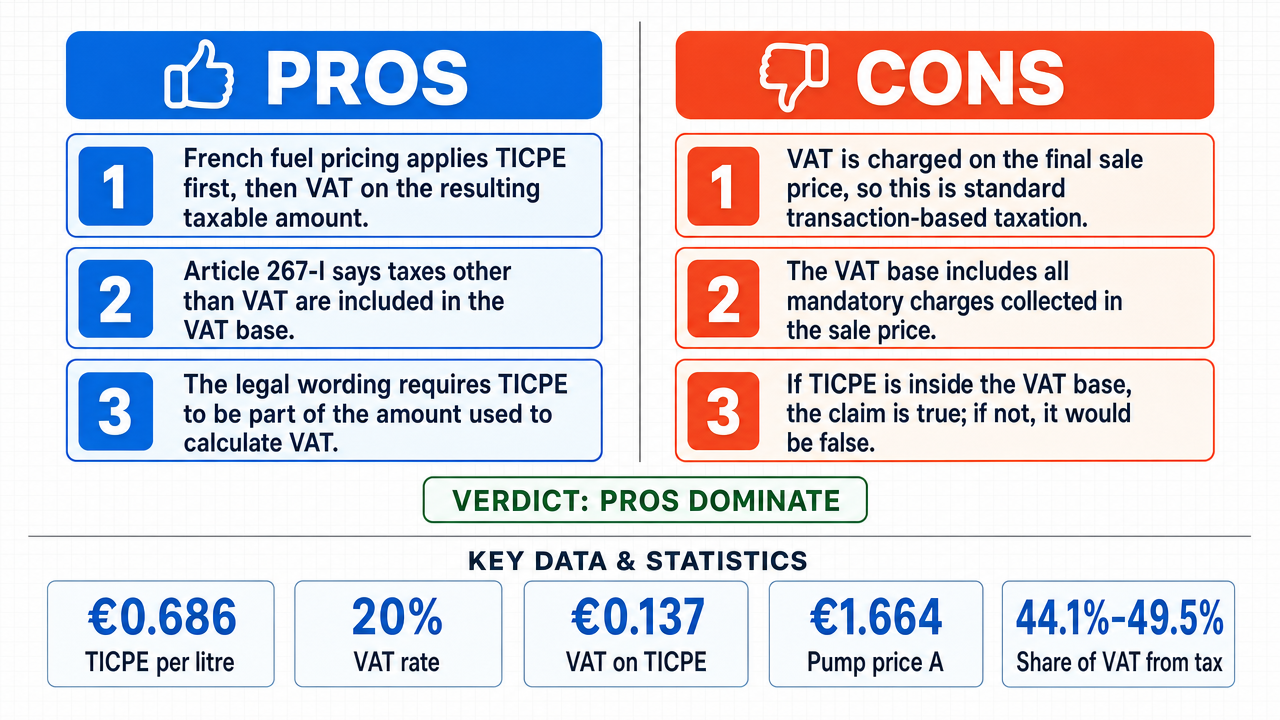
- ■For SP95 E10 in France, the tax framework consists of both the TICPE (excise tax ) and VAT applied sequentially. The TICPE is a specific tax levied per liter of fuel, established by the French fiscal code , which forms part of the base price upon which VAT is calculated, creating a layered taxation approach.
- ■Article 267-I of the Code général des impôts explicitly states that the amount of 'taxes of every kind, excluding VAT itself' is included in the VAT basis of assessment. This is not a doctrinal interpretation but the codified measurement rule, meaning the excise tax is legally inside the VAT base .
- ■The French fiscal code 's operative wording mandates that all duties and levies (including TICPE ) be included in the VAT calculation base, so the excise duty is itself subject to VAT — a textbook tax-on-tax structure.
❌ Key ANTI arguments:
- ■VAT is, by definition, a tax on the final consumption of a good, calculated on the total transaction value at the point of sale. The inclusion of TICPE in the VAT base is not a 'cascading ' error but a standard application of VAT principles, not a tax on a tax.
- ■Under the French General Tax Code, VAT is applied to the total amount received by the seller, which includes all costs, duties, and levies required to bring the product to the consumer. This is a single tax on the total transaction value , not a separate tax levied on another tax.
- ■There are only two possible legal configurations for the VAT base for fuel: either the base excludes the excise tax (which would falsify the claim) or the base includes the excise tax. The opponent's framing of 'tax on tax' is a conceptual misinterpretation of how VAT bases are legally constructed.
💭 Conclusion: The evidence establishes that under Article 267-I of the Code général des impôts , the VAT base for SP95 E10 fuel includes the TICPE excise duty, meaning VAT is mathematically applied to a sum that contains the excise component. The illustrative table demonstrates this concretely: with TICPE at €0.686/litre, the VAT-on-tax component is €0.137/litre in both cases, representing 44.1% to 49.5% of total VAT paid. The anti side argues this is not a 'tax on tax' but rather a single tax on total transaction value , a matter of definitional framing. The legal mechanism is clearly established by statute; whether this constitutes a 'tax on tax' in the colloquial sense remains a matter of interpretation rather than purely legal fact. Both sub-claims are supported: VAT is indeed applied to TICPE, and consumers effectively pay VAT on the excise component.
🔬 DeepResearch Result: likely TRUE ✅ (61%)
Assertion: En France, la TVA est appliquée sur la taxe intérieure de consommation sur les produits énergétiques (TICPE ) pour le carburant SP95 E10 , ce qui signifie que les consommateurs paient une taxe sur une taxe.
Participating models: deepseek-v3.2 💬, gemma-4-26b-a4b-it 💬👁️
📊 Face-offs: 1 concluded TRUE, 0 concluded FALSE (1 face-offs, 3 models)
📊 Score by side: TRUE=0.61, FALSE=0.00
🏅 Model score changes:
minimax-m3 💬👁️: +6
✅ PRO Arguments:
- ■For SP95 E10 in France, the tax framework consists of both the TICPE (excise tax ) and VAT applied sequentially. The TICPE is a specific tax levied per liter of fuel, established by the French fiscal code , which forms part of the base price upon which VAT is calculated, creating a layered taxation approach. deepseek-v3.2 💬
- ■Article 267-I of the Code général des impôts explicitly states that the amount of 'taxes of every kind, excluding VAT itself' is included in the VAT basis of assessment. This is not a doctrinal interpretation but the codified measurement rule, meaning the excise tax is legally inside the VAT base . deepseek-v3.2 💬
- ■The French fiscal code's operative wording mandates that all duties and levies (including TICPE) be included in the VAT calculation base, so the excise duty is itself subject to VAT — a textbook tax-on-tax structure. deepseek-v3.2 💬
❌ ANTI Arguments:
- ■VAT is, by definition, a tax on the final consumption of a good, calculated on the total transaction value at the point of sale. The inclusion of TICPE in the VAT base is not a 'cascading ' error but a standard application of VAT principles, not a tax on a tax. gemma-4-26b-a4b-it 💬👁️
- ■Under the French General Tax Code, VAT is applied to the total amount received by the seller, which includes all costs, duties, and levies required to bring the product to the consumer. This is a single tax on the total transaction value, not a separate tax levied on another tax. gemma-4-26b-a4b-it 💬👁️
- ■There are only two possible legal configurations for the VAT base for fuel: either the base excludes the excise tax (which would falsify the claim) or the base includes the excise tax. The opponent's framing of 'tax on tax' is a conceptual misinterpretation of how VAT bases are legally constructed. gemma-4-26b-a4b-it 💬👁️
💭 Reasoning: The evidence establishes that under Article 267-I of the Code général des impôts, the VAT base for SP95 E10 fuel includes the TICPE excise duty, meaning VAT is mathematically applied to a sum that contains the excise component. The illustrative table demonstrates this concretely: with TICPE at €0.686/litre, the VAT-on-tax component is €0.137/litre in both cases, representing 44.1% to 49.5% of total VAT paid. The anti side argues this is not a 'tax on tax' but rather a single tax on total transaction value, a matter of definitional framing. The legal mechanism is clearly established by statute; whether this constitutes a 'tax on tax' in the colloquial sense remains a matter of interpretation rather than purely legal fact. Both sub-claims are supported: VAT is indeed applied to TICPE, and consumers effectively pay VAT on the excise component.
📋 PRO Facts:
• Article 267-I of the Code général des impôts states that 'taxes of every kind, excluding VAT itself' are included in the VAT basis of assessment.
• TICPE is a specific excise tax levied per liter of fuel in France, updated annually under the French fiscal code.
• The TICPE forms part of the base price upon which VAT is calculated for SP95 E10 fuel.
📋 ANTI Facts:
• VAT is defined as a tax on the final consumption of a good, calculated on the total transaction value at the point of sale.
• The French General Tax Code applies VAT to the total amount received by the seller, including all costs, duties, and levies.
| Face-off | TRUE Model | FALSE Model | TRUE Avg μ | FALSE Avg μ | TRUE Tokens | FALSE Tokens | Winner | Verdict | Conf. |
|---|---|---|---|---|---|---|---|---|---|
| #1 | deepseek-v3.2 💬 | gemma-4-26b-a4b-it 💬👁️ | 0.549 | 0.469 | 8 | 2 | TRUE | TRUE | 61% |
The following technical terms, abbreviations, and domain-specific concepts are referenced throughout this debate transcript. Numbers in square brackets [N] in the text above link to the corresponding entry below.
[1] Article 266 — Article 266 of the Code Général des Impôts — A provision of the French General Tax Code cited in the debate as establishing that the VAT base includes all costs, duties, and levies required to bring a product to the consumer.
[2] Article 267-I — Article 267-I of the Code Général des Impôts — A provision of the French General Tax Code cited in the debate, whose operative wording states that 'taxes of every kind, excluding VAT itself' are included in the VAT basis of assessment.
[3] Article 78(a) — Article 78(a) of Directive 2006/112/EC — A provision of the EU VAT Directive cited in the debate as obliging Member States to include 'taxes, duties, levies and charges, excluding the value added tax itself' in the taxable amount.
[4] cascading — tax cascading — A concept referenced in the debate describing the successive application of taxes on top of one another; the negative side argues that including excise taxes in the VAT base is not a 'cascading' error but a structural requirement of a consumption tax.
[5] Code Général des Impôts — Code Général des Impôts (CGI) — The French General Tax Code, the principal body of French tax law cited throughout the debate as the legal source governing the VAT base and the inclusion of excise taxes within it.
[6] commodities — energy commodities — In the debate, refers to energy products such as gasoline (e.g., SP95 E10) that are subject to specific fiscal regimes combining excise taxes and value-added taxes.
[7] consumption tax — A tax levied on the final consumption of a good, calculated on the total transaction value at the point of sale; the negative side argues VAT is, by definition, such a tax.
[8] Directive 2006/112/EC — Council Directive 2006/112/EC of 28 November 2006 on the common system of value added tax — The EU VAT Directive cited in the debate as the European-level legal basis requiring Member States to include taxes, duties, levies and charges (excluding VAT itself) in the VAT taxable amount.
[9] excise tax — excise tax / excise duties — A specific tax levied per unit (e.g., per liter of fuel), established by the French fiscal code and updated annually; in the debate, refers specifically to the TICPE on energy products.
[10] fiscal code — French fiscal code — The body of French tax legislation under which the TICPE is established and updated annually, forming part of the base price upon which VAT is calculated.
[11] fiscal law — The branch of law governing taxation, referenced in the debate when analyzing whether the inclusion of excise taxes in the VAT base constitutes a 'tax on a tax.'
[12] Member States — EU Member States — Countries of the European Union bound by Directive 2006/112/EC, which obliges them to include certain taxes and levies in the VAT taxable amount.
[13] SP95 E10 — A grade of gasoline (Sans Plomb 95 with up to 10% bioethanol) sold in France, used in the debate as the concrete example of a fuel subject to both TICPE and VAT.
[14] tax base — tax base / VAT base / taxable amount / basis of assessment — The monetary amount on which a tax is calculated; in the debate, the disputed question is whether this base includes the TICPE for fuel products.
[15] tax-on-tax — tax on tax — A concept asserted by the affirmative side to describe the situation where VAT is applied to a price that already contains the TICPE; the negative side disputes this characterization as a conceptual error.
[16] TICPE — Taxe Intérieure de Consommation sur les Produits Énergétiques — The French domestic excise tax on energy products, levied per liter of fuel and included in the retail price of products such as SP95 E10.
[17] transaction value — total transaction value — The total amount received by the seller at the point of sale, which the negative side argues must form the VAT base so that the tax reflects the actual economic value of the transaction.
[18] TVA — Taxe sur la Valeur Ajoutée — The French value-added tax, applied in France at a standard rate on the selling price of goods and services, including fuel.
[19] VAT — Value Added Tax — A general consumption tax applied to the total selling price inclusive of other taxes; in the debate, the affirmative argues it is applied to the TICPE, while the negative argues it is a single tax on the total transaction value.
[20] VAT base — VAT base / taxable amount — The amount on which VAT is calculated; the debate turns on whether French and EU law require this base to include the TICPE for fuel products.
[21] VAT rate — The percentage applied to the VAT base to determine the VAT due; in the debate, the affirmative notes that this rate is applied to a sum containing the TICPE.
The following financial data tables were referenced during the debate exchanges:
| Component of SP95-E10 pump price (€/litre) | Case A: pre-tax €0.70 | Case B: pre-tax €0.87 |
|---|---|---|
| Pre-tax commercial price | €0.700 | €0.870 |
| TICPE (excise duty) | €0.686 | €0.686 |
| Total VAT at 20% | €0.277 | €0.311 |
| Of which: VAT levied on the TICPE | €0.137 | €0.137 |
| Pump price (incl. tax) | €1.664 | €1.868 |
| VAT-on-tax as share of VAT paid | — | 44.1% to 49.5% |
Legend: Two illustrative decompositions of one litre of SP95-E10 in France, in euros per litre, computed from the statutory rule that the VAT base includes the TICPE (Article 267-I CGI; Directive 2006/112/EC Art. 78(a)). VAT = 0.20 × (pre-tax + TICPE); VAT-on-tax = 0.20 × TICPE, hence identical (€0.137) in both cases. Case A share = 0.137/0.277 = 49.5%; Case B share = 0.137/0.311 = 44.1%. Excise taken at ≈ €0.686/litre per the Article 265 CGI rate table; total tax share of pump price = 57.9% (A) and 53.4% (B).
Face-off transcripts
- ■
Ownership & Trade Secrets. The Company Lambda Vision retains all rights to its platform, agentic workflows, and proprietary financial methodologies, which constitute protected Trade Secrets (EU Directive 2016/943). Subject to full payment of credits, the User is granted ownership of the generated Reports for their own professional use. Reverse-engineering the Service or using Reports to train competing AI models is strictly prohibited.
- ■
No Financial Advice. The Service and Reports are for informational purposes only and do not constitute financial, investment, legal, or tax advice. The Company is not a regulated financial advisor. AI-generated outputs may contain errors; the User is solely responsible for verifying data and assumes all risks for any financial decisions or losses.
- ■
Liability & Governing Law. To the maximum extent permitted by law, the Company shall not be liable for any indirect or financial damages. These Terms are governed by French law. Any disputes shall be subject to the exclusive jurisdiction of the Courts of Paris, France.