
Engaging in real-money trading is an indispensable step for anyone entering the market, with no viable alternative for gaining practical experience.
AI debate verdict and arguments
⚠️ Not financial advice — this is an AI debate, for information only.
Completed October 11, 2026
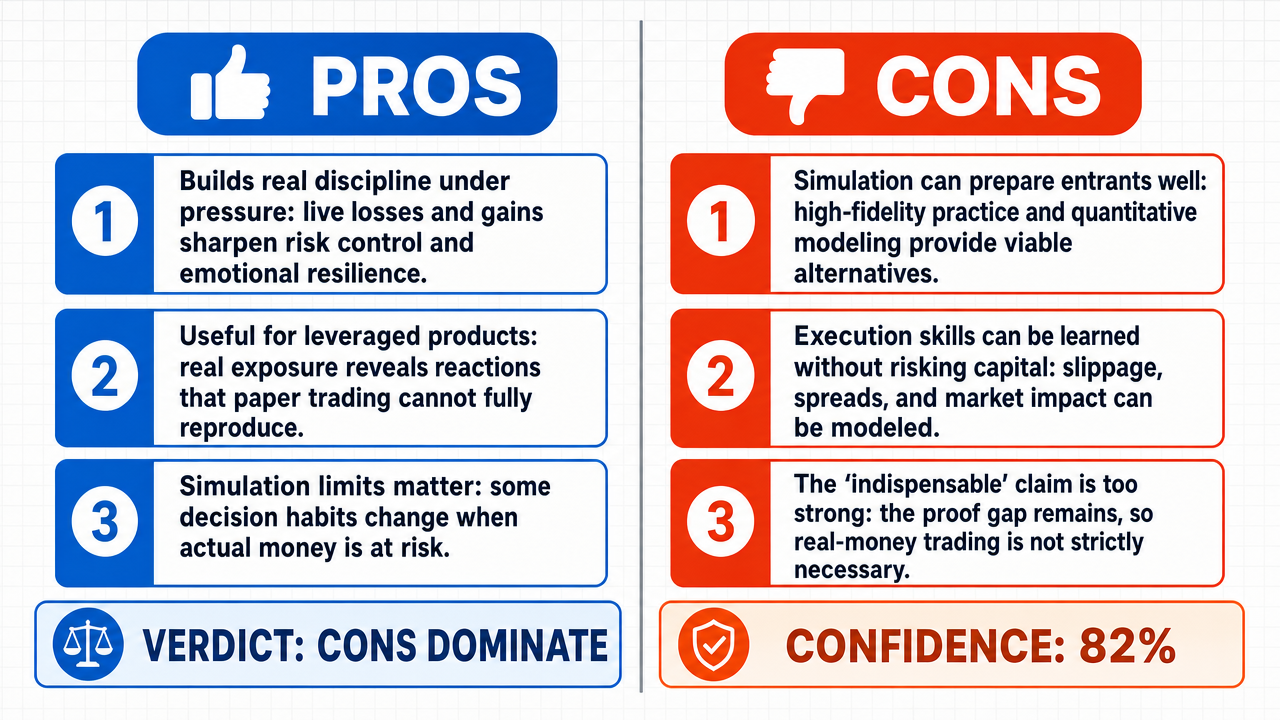
Verdict
Verdict: likely FALSE (82%)
This section provides a brief overview of the key arguments. You do not need to read the full detailed report below.
✅ Key PRO arguments:
- ■Real-money trading uniquely trains psychological and risk management skills, especially in derivatives where leverage magnifies gains and losses; the Lahiri (2024) paper formalizes loss aversion within expected utility theory , showing that state-dependent linear utility functions for monetary returns are shaped by actual financial consequences rather than simulated ones.
- ■The opponent's demand for a 'transfer operator ' linking simulated-return utility to real-loss psychology is inconsistently applied, since the negative side itself asserts that mathematical preparation through stochastic simulation translates into trader readiness without supplying a transfer operator for that claim either.
❌ Key ANTI arguments:
- ■High-fidelity simulations and quantitative modeling provide sufficient practical experience for market entry; the affirmative's reliance on Lahiri (2024) suffers from a substitution of proxy because the paper fails to provide the necessary transfer operator linking the theoretical utility of a simulated return to the physiological and cognitive response of a real capital drawdown .
- ■Technical execution and market impact knowledge can be gained through simulation: if frictions such as slippage and bid-ask spread widening arise from the specific structure of order flow and liquidity dynamics , then any simulation that accurately models or replays those dynamics must, by definition, reproduce the resulting frictions, contradicting the claim that such frictions cannot be replicated.
💭 Conclusion: False. The debate verdict is FALSE, meaning real-money trading is not an indispensable step and viable alternatives may exist for gaining practical market experience. The negative side exposed a logical gap in the affirmative's reliance on the Lahiri (2024) loss-aversion paper, noting it lacks a transfer operator connecting simulated returns to genuine physiological stress responses. The affirmative's structural weakness was asserting an indispensable psychological mechanism without demonstrating why simulations cannot approximate it. Consequently, the assertion that no viable alternative exists is not supported by the evidence presented.
🔬 DeepResearch Result: likely FALSE ❌ (82%)
Assertion: Engaging in real-money trading is an indispensable step for anyone entering the market, with no viable alternative for gaining practical experience.
Participating models: deepseek-v3.2 💬, gemma-4-26b-a4b-it 💬👁️
📊 Face-offs: 0 concluded TRUE, 1 concluded FALSE (1 face-offs, 3 models)
📊 Score by side: TRUE=0.00, FALSE=0.82
🏅 Model score changes:
minimax-m3 💬👁️: +8
✅ PRO Arguments:
- ■Real-money trading uniquely trains psychological and risk management skills, especially in derivatives where leverage magnifies gains and losses; the Lahiri (2024) paper formalizes loss aversion within expected utility theory , showing that state-dependent linear utility functions for monetary returns are shaped by actual financial consequences rather than simulated ones. deepseek-v3.2 💬
- ■The opponent's demand for a 'transfer operator ' linking simulated-return utility to real-loss psychology is inconsistently applied, since the negative side itself asserts that mathematical preparation through stochastic simulation translates into trader readiness without supplying a transfer operator for that claim either. deepseek-v3.2 💬
❌ ANTI Arguments:
- ■High-fidelity simulations and quantitative modeling provide sufficient practical experience for market entry; the affirmative's reliance on Lahiri (2024) suffers from a substitution of proxy because the paper fails to provide the necessary transfer operator linking the theoretical utility of a simulated return to the physiological and cognitive response of a real capital drawdown . gemma-4-26b-a4b-it 💬👁️
- ■Technical execution and market impact knowledge can be gained through simulation: if frictions such as slippage and bid-ask spread widening arise from the specific structure of order flow and liquidity dynamics , then any simulation that accurately models or replays those dynamics must, by definition, reproduce the resulting frictions, contradicting the claim that such frictions cannot be replicated. gemma-4-26b-a4b-it 💬👁️
💭 Reasoning: False. The debate verdict is FALSE, meaning real-money trading is not an indispensable step and viable alternatives may exist for gaining practical market experience. The negative side exposed a logical gap in the affirmative's reliance on the Lahiri (2024) loss-aversion paper, noting it lacks a transfer operator connecting simulated returns to genuine physiological stress responses. The affirmative's structural weakness was asserting an indispensable psychological mechanism without demonstrating why simulations cannot approximate it. Consequently, the assertion that no viable alternative exists is not supported by the evidence presented.
📋 PRO Facts:
• Lahiri (2024) discusses how monetary returns shape utility functions.
• In derivatives trading, leverage magnifies both gains and losses, making risk management psychologically demanding.
📋 ANTI Facts:
• The Lahiri (2024) paper does not provide a transfer operator linking simulated-return utility to the biological stress response of a real capital drawdown.
| Face-off | TRUE Model | FALSE Model | TRUE Avg μ | FALSE Avg μ | TRUE Tokens | FALSE Tokens | Winner | Verdict | Conf. |
|---|---|---|---|---|---|---|---|---|---|
| #1 | deepseek-v3.2 💬 | gemma-4-26b-a4b-it 💬👁️ | 0.432 | 0.288 | 8 | 2 | TRUE | FALSE | 82% |
The following technical terms, abbreviations, and domain-specific concepts are referenced throughout this debate transcript. Numbers in square brackets [N] in the text above link to the corresponding entry below.
[1] agent-based modeling — A simulation technique that uses autonomous agents representing market participants to replicate complex system behaviors, cited in the debate as a method used in modern high-fidelity environments to model stochastic market properties.
[2] bid-ask spread — The difference between the highest price a buyer is willing to pay (bid) and the lowest price a seller is willing to accept (ask), referenced in the debate as a market friction that can widen during real order flow.
[3] derivatives — Financial instruments whose value is derived from an underlying asset, mentioned in the debate in the context of options, futures, and leveraged instruments where losses and gains can be magnified.
[4] domain hermeticity — The concept that domains are sealed off from one another, invoked in the debate to argue that physiological stress responses from one domain (e.g., pilot training) cannot be projected into another (e.g., finance) without a formal mapping.
[5] drawdown — A decline in the value of a trading account or market from a peak, referenced in the debate as a 'market drawdown' that triggers emotional volatility when managing margined positions.
[6] expected utility theory — An economic framework for modeling decision-making under uncertainty, cited via the Lahiri (2024) paper as the theoretical basis for state-dependent linear utility functions for monetary returns.
[7] high-fidelity simulations — Detailed, realistic simulations that aim to replicate real-world market conditions, proposed in the debate as a sufficient alternative to real-money trading for gaining practical derivatives experience.
[8] leverage — The use of borrowed capital to amplify potential returns on an investment, mentioned in the debate as a feature of derivatives trading that magnifies both gains and losses.
[9] limit order book (LOB) — An electronic record of pending buy and sell orders at various price levels, referenced in the debate as the source of stochastic properties that simulations attempt to replicate.
[10] liquidity dynamics — The patterns and behaviors of market liquidity over time, cited in the debate as a source of frictions like slippage and bid-ask spread widening.
[11] loss aversion — A behavioral economics concept where the psychological impact of losses is greater than that of equivalent gains, referenced in the debate as a bias triggered only by real capital at stake.
[12] margin requirements — The minimum amount of capital a trader must deposit to open and maintain a leveraged position, mentioned in the debate as part of the mathematical reality of derivatives risk.
[13] margined position — A trading position opened with borrowed funds requiring collateral, referenced in the debate as a context where emotional volatility arises during market drawdowns.
[14] market impact — The effect that a trader's orders have on the market price, cited in the debate as technical execution knowledge that the affirmative claims cannot be gained through simulation.
[15] order flow — The stream of buy and sell orders in a market, referenced in the debate as the source of frictions like slippage and bid-ask spread widening.
[16] overconfidence biases — Cognitive biases where traders overestimate their ability to predict market movements, mentioned in the debate as a bias that paper trading fails to trigger.
[17] paper trading — Simulated trading using virtual money to practice strategies without risking real capital, argued in the debate to fail at triggering loss aversion and overconfidence biases.
[18] quantitative modeling — The use of mathematical and statistical methods to model financial markets, proposed in the debate as a sufficient means for gaining practical market experience.
[19] real-money trading — Trading with actual financial capital at stake, argued in the debate to be indispensable for training psychological and risk management skills.
[20] risk management — The process of identifying, assessing, and mitigating financial risks, cited in the debate as a skill uniquely trained by real-money trading exposure.
[21] skin in the game — Having a personal financial stake in an outcome, referenced in the debate as a condition that activates genuine cognitive evaluation of risk.
[22] slippage — The difference between the expected execution price of a trade and the actual price at which it is executed, cited in the debate as a market friction arising from real order flow.
[23] state-dependent linear utility functions — Mathematical functions modeling utility as varying based on the state of monetary returns, referenced via the Lahiri (2024) paper as shaped by actual financial consequences rather than simulated ones.
[24] stochastic simulations — Simulations incorporating random variables and probabilistic elements, proposed in the debate as a method to prepare traders for the mathematical reality of derivatives risk.
[25] synthetic order flow — Artificially generated buy and sell orders used in simulations, mentioned in the debate as a tool in modern high-fidelity environments to replicate stochastic market properties.
[26] transfer operator — A mechanism or correlation linking one domain to another, invoked in the debate as the missing link between simulated-return utility and real-loss psychology.
[27] volatility — The degree of variation in trading prices over time, referenced in the debate in the context of non-linearities that stochastic simulations attempt to model.
Face-off transcripts
- ■
Ownership & Trade Secrets. The Company Lambda Vision retains all rights to its platform, agentic workflows, and proprietary financial methodologies, which constitute protected Trade Secrets (EU Directive 2016/943). Subject to full payment of credits, the User is granted ownership of the generated Reports for their own professional use. Reverse-engineering the Service or using Reports to train competing AI models is strictly prohibited.
- ■
No Financial Advice. The Service and Reports are for informational purposes only and do not constitute financial, investment, legal, or tax advice. The Company is not a regulated financial advisor. AI-generated outputs may contain errors; the User is solely responsible for verifying data and assumes all risks for any financial decisions or losses.
- ■
Liability & Governing Law. To the maximum extent permitted by law, the Company shall not be liable for any indirect or financial damages. These Terms are governed by French law. Any disputes shall be subject to the exclusive jurisdiction of the Courts of Paris, France.