
Fujitsu's Monica processor, a 144-core ARM V9 CPU, will provide double the AI inference throughput compared to other leading CPUs in commercial use by the end of 2027.
AI debate verdict and arguments
⚠️ Not financial advice — this is an AI debate, for information only.
Completed October 11, 2026
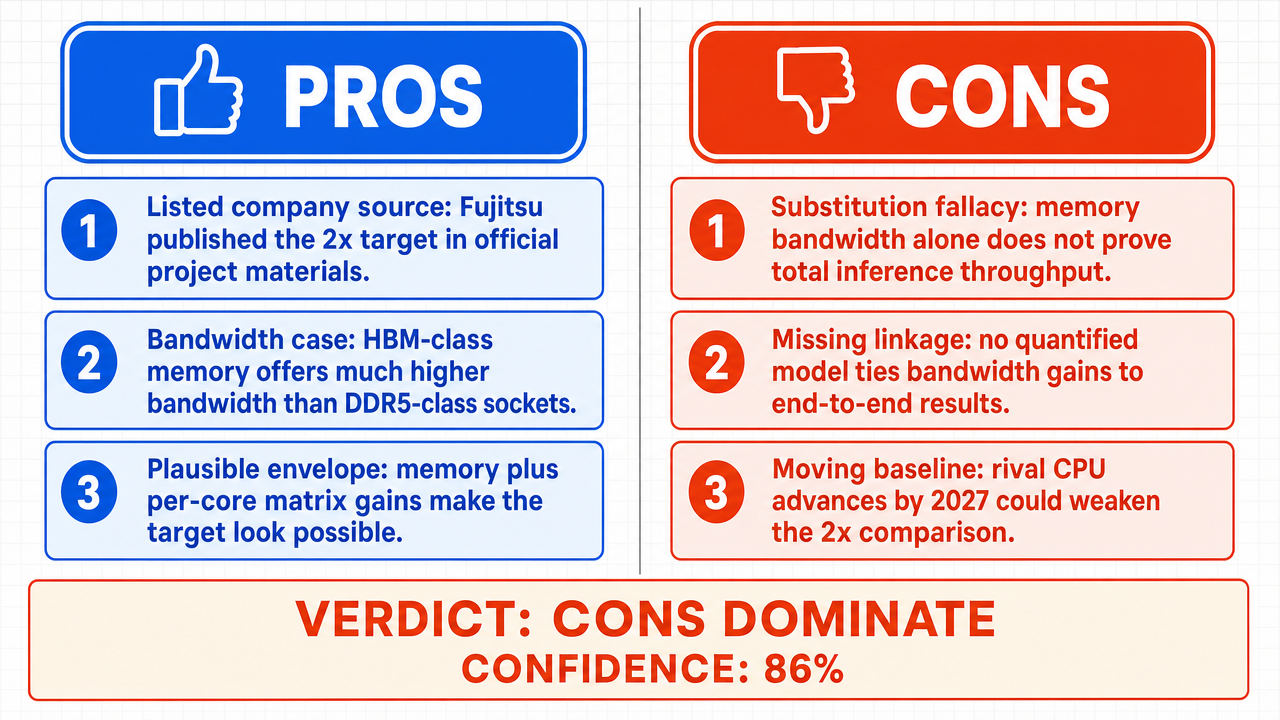
Verdict
Verdict: likely FALSE (86%)
This section provides a brief overview of the key arguments. You do not need to read the full detailed report below.
✅ Key PRO arguments:
- ■The 2x figure originates from Fujitsu Limited (TSE: 6702), a listed large-cap issuer, as a published specification within Japan's state-funded NEXT post-exascale development programme, lending it institutional credibility rather than third-party hype.
- ■MONAKA's HBM -class memory bandwidth is approximately 2.0–2.7× that of DDR5 -class sockets, and this bandwidth ratio is presented as arithmetic support for the 2x aggregate inference throughput target.
- ■The 2x throughput target is described as 'inside the plausible envelope' based on the combined arithmetic of memory bandwidth and per-core matrix throughput scaling.
❌ Key ANTI arguments:
- ■The affirmative commits a substitution fallacy : it measures the potential of a memory subsystem (Entity A, bandwidth) and concludes about total AI inference throughput (Entity B) without providing a proven transfer operator linking the two.
- ■No specific quantified correlation or coefficient of scaling is supplied that relates memory bandwidth to end-to-end inference throughput , so the bandwidth ratio cannot legitimately be used to derive a 2x aggregate outcome.
- ■Architectural and competitive shifts in the broader CPU market by end-2027 could erode or invalidate the comparison baseline against which MONAKA's 2x claim is measured.
💭 Conclusion: False. The affirmative's case rests on a bandwidth-to-throughput inference that the negative correctly identified as a substitution fallacy : a memory subsystem measurement (HBM -class ≥1 TB/s vs DDR5 ~0.5–0.9 TB/s) is used to conclude about aggregate AI inference throughput without any demonstrated transfer operator or quantified scaling coefficient. Because no such operator was provided, the arithmetic 'plausibility' argument collapses into an unsupported leap. Additionally, the negative raised a structural concern about competitive evolution by end-2027, noting that the comparison baseline of 'other leading CPUs in commercial use' is not static and could itself advance in inference-relevant capabilities, undermining the 2x differential. The affirmative's strongest counter — that the figure is an official Fujitsu roadmap specification — establishes intent rather than demonstrated outcome, and does not bridge the logical gap identified by the negative. On balance, the negative's identification of the missing transfer function and the dynamic competitive baseline constitutes the decisive weakness in the compound claim.
🔬 DeepResearch Result: likely FALSE ❌ (86%)
Assertion: Fujitsu's Monica processor, a 144-core ARM V9 CPU , will provide double the AI inference throughput compared to other leading CPUs in commercial use by the end of 2027.
Participating models: deepseek-v3.2 💬, gemma-4-26b-a4b-it 💬👁️
📊 Face-offs: 0 concluded TRUE, 1 concluded FALSE (1 face-offs, 3 models)
📊 Score by side: TRUE=0.00, FALSE=0.86
🏅 Model score changes:
minimax-m3 💬👁️: +9
✅ PRO Arguments:
- ■The 2x figure originates from Fujitsu Limited (TSE: 6702), a listed large-cap issuer, as a published specification within Japan's state-funded NEXT post-exascale development programme, lending it institutional credibility rather than third-party hype. deepseek-v3.2 💬
- ■MONAKA's HBM -class memory bandwidth is approximately 2.0–2.7× that of DDR5 -class sockets, and this bandwidth ratio is presented as arithmetic support for the 2x aggregate inference throughput target. deepseek-v3.2 💬
- ■The 2x throughput target is described as 'inside the plausible envelope' based on the combined arithmetic of memory bandwidth and per-core matrix throughput scaling. deepseek-v3.2 💬
❌ ANTI Arguments:
- ■The affirmative commits a substitution fallacy : it measures the potential of a memory subsystem (Entity A, bandwidth) and concludes about total AI inference throughput (Entity B) without providing a proven transfer operator linking the two. gemma-4-26b-a4b-it 💬👁️
- ■No specific quantified correlation or coefficient of scaling is supplied that relates memory bandwidth to end-to-end inference throughput, so the bandwidth ratio cannot legitimately be used to derive a 2x aggregate outcome. gemma-4-26b-a4b-it 💬👁️
- ■Architectural and competitive shifts in the broader CPU market by end-2027 could erode or invalidate the comparison baseline against which MONAKA's 2x claim is measured. gemma-4-26b-a4b-it 💬👁️
- ■The affirmative's argument treats competitor evolution as static, ignoring that leading CPUs in commercial use by end-2027 will themselves advance in inference-relevant features, making the 2x differential harder to sustain. gemma-4-26b-a4b-it 💬👁️
💭 Reasoning: False. The affirmative's case rests on a bandwidth-to-throughput inference that the negative correctly identified as a substitution fallacy: a memory subsystem measurement (HBM-class ≥1 TB/s vs DDR5 ~0.5–0.9 TB/s) is used to conclude about aggregate AI inference throughput without any demonstrated transfer operator or quantified scaling coefficient. Because no such operator was provided, the arithmetic 'plausibility' argument collapses into an unsupported leap. Additionally, the negative raised a structural concern about competitive evolution by end-2027, noting that the comparison baseline of 'other leading CPUs in commercial use' is not static and could itself advance in inference-relevant capabilities, undermining the 2x differential. The affirmative's strongest counter — that the figure is an official Fujitsu roadmap specification — establishes intent rather than demonstrated outcome, and does not bridge the logical gap identified by the negative. On balance, the negative's identification of the missing transfer function and the dynamic competitive baseline constitutes the decisive weakness in the compound claim.
📋 PRO Facts:
• Fujitsu Limited is listed on the Tokyo Stock Exchange under code 6702.
• MONAKA is described as a 144-core Armv9 server CPU.
• MONAKA's HBM-class on-package memory bandwidth is stated as ≥1 TB/s, compared to ~0.5–0.9 TB/s for multi-channel DDR5 sockets.
• The 2x throughput target is presented as part of Japan's NEXT post-exascale development programme.
📋 ANTI Facts:
• No quantified transfer operator or scaling coefficient linking memory bandwidth to end-to-end AI inference throughput was provided by the affirmative.
• The comparison baseline ('other leading CPUs in commercial use by end-2027') is dynamic and not held constant in the affirmative's analysis.
• Memory bandwidth and total inference throughput are distinct entities (Entity A vs Entity B) that require a demonstrated correlation to be linked.
| Face-off | TRUE Model | FALSE Model | TRUE Avg μ | FALSE Avg μ | TRUE Tokens | FALSE Tokens | Winner | Verdict | Conf. |
|---|---|---|---|---|---|---|---|---|---|
| #1 | deepseek-v3.2 💬 | gemma-4-26b-a4b-it 💬👁️ | 0.492 | 0.248 | 8 | 2 | TRUE | FALSE | 86% |
The following technical terms, abbreviations, and domain-specific concepts are referenced throughout this debate transcript. Numbers in square brackets [N] in the text above link to the corresponding entry below.
[1] AI inference — Artificial Intelligence inference — The process of running a trained AI model to produce outputs (predictions or generations) from new input data, as distinct from the training phase. In the debate, 'AI inference throughput' refers to how much inference work a CPU can complete per unit time.
[2] Armv9 — ARM architecture version 9 — The ninth generation of the ARM instruction set architecture used in the MONAKA processor, described in the debate as featuring SVE2-class vector/matrix capability.
[3] binding constraint — The factor that limits performance most severely in a given workload. The affirmative argues that memory bandwidth is the binding constraint for the commercial CPU inference workloads at issue.
[4] compute-to-bandwidth ratio — The relationship between a processor's compute capacity and the rate at which data can be moved to and from memory. The negative argues that non-linearities in this ratio undermine simple bandwidth-to-throughput extrapolations.
[5] cores — processing cores — Independent processing units within a CPU. MONAKA is described as having 144 cores.
[6] CPU — Central Processing Unit — The general-purpose processor that executes instructions in a computer. The debate concerns CPU-based AI inference throughput, as opposed to accelerator-based inference.
[7] DDR — Double Data Rate memory — A class of commodity system memory. The affirmative contrasts MONAKA's high-bandwidth memory subsystem with 'commodity DDR' used in typical server sockets.
[8] DDR5 — Double Data Rate 5 memory — The fifth generation of Double Data Rate synchronous DRAM, used as a baseline in the negative's bandwidth comparison against MONAKA's HBM-class memory.
[9] decoding — decoding (in AI inference) — The phase of inference in which a model generates output tokens sequentially. The negative notes that bandwidth is a primary constraint specifically for decoding workloads.
[10] end-to-end inference — The complete inference pipeline from input to final output, as opposed to isolated component measurements. The negative argues that bandwidth ratios do not directly determine end-to-end inference throughput.
[11] exascale — exascale computing — Computing performance on the order of one exaFLOPS (10^18 floating-point operations per second). The debate references Japan's 'NEXT post-exascale development effort' as the state-funded programme under which MONAKA is being developed.
[12] HBM — High Bandwidth Memory — A stacked-DRAM memory technology offering substantially higher bandwidth than conventional DDR. The affirmative cites MONAKA's HBM-class bandwidth as roughly 2.0–2.7× that of DDR5-class sockets.
[13] large-cap — large-capitalization — A designation for publicly listed companies with the largest market capitalizations. The affirmative argues that Fujitsu's status as a large-cap issuer (TSE: 6702) gives its roadmap guidance greater evidential weight than an unlisted start-up's announcement.
[14] leading indicator — A metric that tends to move before and predict the metric of interest. The affirmative characterizes memory bandwidth as a 'strong leading indicator' of inference throughput for bandwidth-bound workloads.
[15] market-disclosure discipline — The regulatory and reporting obligations imposed on publicly listed issuers. The affirmative argues that Fujitsu's roadmap disclosures are subject to this discipline, lending them credibility.
[16] memory bandwidth — The rate at which data can be transferred between a processor and its memory, typically measured in bytes or gigabytes per second. Central to both sides' arguments about MONAKA's projected throughput.
[17] memory subsystem — The collection of memory-related components (DRAM, controllers, interconnects) that supply data to a processor. The affirmative highlights MONAKA's high-bandwidth memory subsystem as a key design choice.
[18] multi-tenant — multi-tenant environment — A computing environment in which multiple independent users or workloads share the same hardware. The negative argues that real-world multi-tenant conditions complicate the bandwidth-to-throughput relationship.
[19] NEXT — NEXT post-exascale development effort — Japan's state-funded programme for computing development beyond the exascale level, cited in the debate as the programme under which MONAKA's specifications were published.
[20] non-linearities — Deviations from a proportional (linear) relationship between two variables. The negative argues that the compute-to-bandwidth ratio exhibits non-linearities that prevent simple bandwidth ratios from translating into throughput ratios.
[21] per package — Measured at the level of a single CPU package (socket), rather than per core or per system. The affirmative defines '2x AI inference throughput' as measured per package.
[22] per-core matrix throughput — The rate at which a single processing core can execute matrix operations, relevant to AI inference. The negative contests the 'plausible envelope' of the 2x target based on arithmetic of memory bandwidth and per-core matrix throughput.
[23] post-exascale — post-exascale computing — Computing performance targets beyond the exascale threshold. Japan's NEXT programme is described as a 'post-exascale development effort.'
[24] roadmap guidance — Forward-looking statements by a company about planned product specifications and delivery dates. The affirmative treats Fujitsu's published MONAKA specifications as roadmap guidance from a large-cap issuer with a delivery track record.
[25] shipping CPU — A CPU that is commercially available and being delivered to customers, as opposed to one that is announced or in development. The affirmative defines the 2x comparison as against 'the best shipping CPU of the same period.'
[26] substitution fallacy — fallacy of substitution of entities — A logical error in which a property measured for one entity is transferred to a different entity without justification. The negative accuses the affirmative of substituting a memory-subsystem measurement for a processor-throughput conclusion.
[27] SVE2 — Scalable Vector Extension version 2 — An ARM instruction-set extension providing scalable SIMD vector and matrix operations. The affirmative cites MONAKA's 'SVE2-class vector/matrix capability' as part of its disclosed specification.
[28] throughput — The rate at which work is completed per unit of time. In the debate, 'AI inference throughput' refers to the volume of inference work a CPU can perform, measured per package on commercial-style workloads.
[29] transfer operator — A quantified relationship or coefficient that maps a measurement of one variable (e.g., memory bandwidth) onto a measurement of another (e.g., end-to-end inference throughput). The negative argues the affirmative fails to supply such an operator.
[30] vector/matrix capability — vector and matrix processing capability — Hardware support for SIMD-style vector operations and matrix arithmetic, which are central to AI inference performance. MONAKA is described as having SVE2-class vector/matrix capability.
The following financial data tables were referenced during the debate exchanges:
| Processor (vendor) | Cores (announced max) |
|---|---|
| NVIDIA Grace | 72 |
| Fujitsu MONAKA | 144 |
| Intel Xeon 6 | 128 |
| AMD EPYC 9005 | 128 |
| Ampere One | 192 |
Legend: Maximum announced core counts per CPU package for leading commercially available server processors versus Fujitsu's MONAKA (144-core Armv9 design target). Units: cores per package. Source: vendor product disclosures and public architecture announcements (2024–2026 window).
| Attribute | Leading shipping CPUs (peer set) | Fujitsu MONAKA target |
|---|---|---|
| Memory attach | Multi-channel DDR5 per socket (~0.5–0.9 TB/s) | HBM-class on-package (≥1 TB/s) |
| Vector/matrix ISA | Armv8/v9 SVE, x86 AMX-class units | Armv9 SVE2 + AI/matrix-oriented datapath |
| Design intent | General-purpose compute | AI inference + HPC, exascale node CPU |
| Integration | CPU socket + discrete accelerators | CPU package co-designed with accelerator fabric |
Legend: Architecture-level comparison of the binding constraint on bandwidth-bound LLM inference. Bandwidth figures are declared background ranges for 8–12-channel DDR5 sockets versus HBM3-class stacks (a single 1024-bit HBM3 stack is of order 0.8 TB/s, so two stacks exceed 1.5 TB/s). Not measured benchmarks; specification classes only.
Face-off transcripts
- ■
Ownership & Trade Secrets. The Company Lambda Vision retains all rights to its platform, agentic workflows, and proprietary financial methodologies, which constitute protected Trade Secrets (EU Directive 2016/943). Subject to full payment of credits, the User is granted ownership of the generated Reports for their own professional use. Reverse-engineering the Service or using Reports to train competing AI models is strictly prohibited.
- ■
No Financial Advice. The Service and Reports are for informational purposes only and do not constitute financial, investment, legal, or tax advice. The Company is not a regulated financial advisor. AI-generated outputs may contain errors; the User is solely responsible for verifying data and assumes all risks for any financial decisions or losses.
- ■
Liability & Governing Law. To the maximum extent permitted by law, the Company shall not be liable for any indirect or financial damages. These Terms are governed by French law. Any disputes shall be subject to the exclusive jurisdiction of the Courts of Paris, France.