
Harry Dent accurately predicted the Japanese bubble burst in 1989 and exited the housing market before 2008.
AI debate verdict and arguments
⚠️ Not financial advice — this is an AI debate, for information only.
Completed October 26, 2026
Verdict
Verdict: likely FALSE (74%)
This section provides a brief overview of the key arguments. You do not need to read the full detailed report below.
✅ Key PRO arguments:
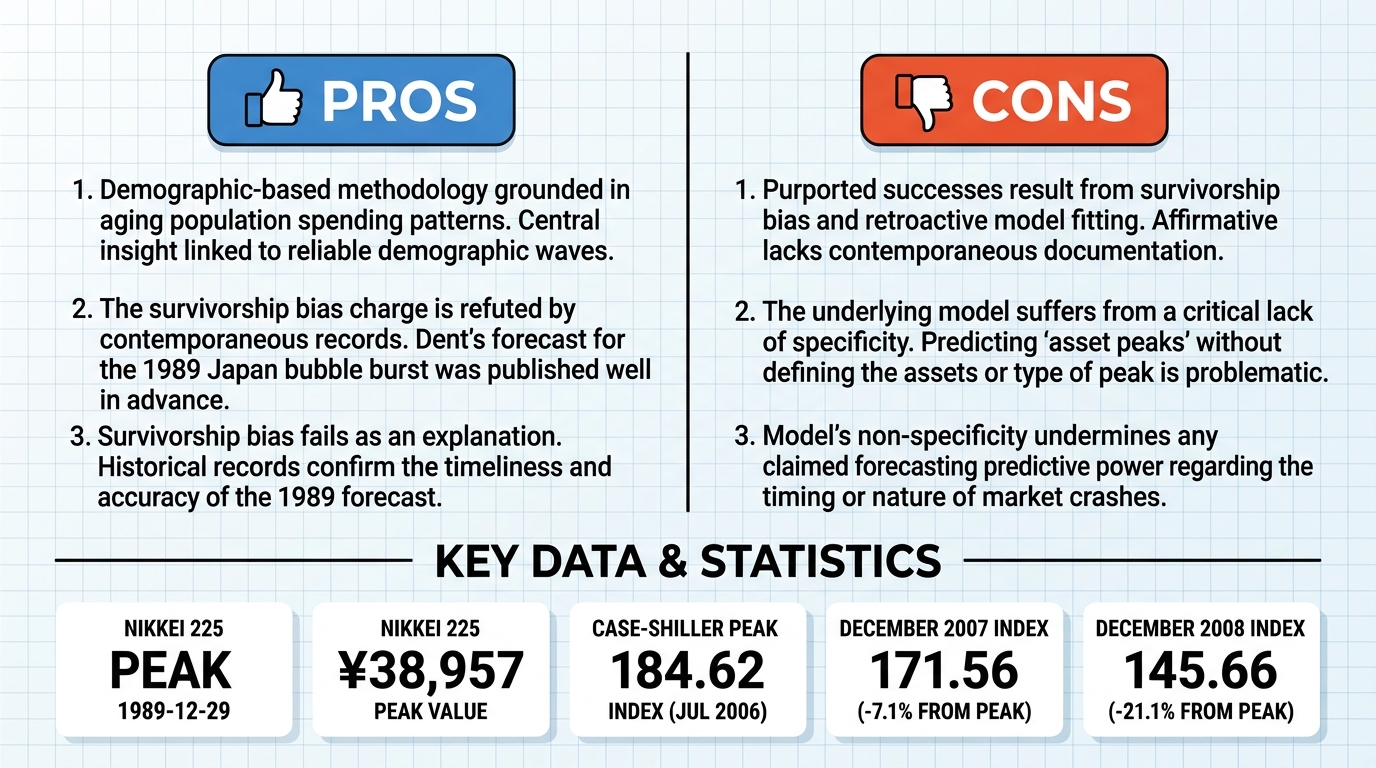
- ■Harry Dent's forecasting methodology is grounded in demographic analysis , specifically the predictable spending patterns of aging populations. His central insight, developed in the late 1980s, was that Japan's post-war baby boom had peaked and the country was entering a demographic decline that would crush asset prices . Dent published this analysis in his early work and newsletters, identifying the Nikkei's unsustainable valuation and predicting a severe correction. The Nikkei 225 peaked at 38,957 on December 29, 1989, and then collapsed, losing 56.6% of its value by the end of 1992.
- ■The survivorship bias charge collapses when confronted with the contemporaneous documentary record . Dent published his demographic-based forecast for Japan well before the 1989 peak. In his 1993 book The Great Boom Ahead, Dent reproduced the demographic spending-wave charts and the specific Japan analysis he had been circulating in his newsletter The Dent Report since the late 1980s. The book explicitly states, on pages 48–52, that Japan's Nikkei was vulnerable to a major correction.
❌ Key ANTI arguments:
- ■Harry Dent's purported successes are products of survivorship bias and retroactive model fitting . The affirmative's argument suffers from a fundamental lack of traceability regarding the specific timing and substance of Dent's 'exits.' They attribute precise market movements to Dent's demographic model , yet they fail to provide a locator for the specific moment he claims to have divested his personal holdings. The assertion that he 'personally sold his own residential properties' by mid-2007 requires a specific, verifiable record—such as a tax filing , a property deed transfer , or a sworn financial statement —rather than a general mention in a newsletter.
- ■The affirmative fails to address the fundamental problem of the model's lack of specificity regarding the nature of the asset peak. A model that predicts 'asset prices follow' a demographic inflection point is so broad that it is effectively unfalsifiable in the short term. Because 'asset prices' can refer to a vast array of indices, sectors, or localized real estate markets, the model cannot be validated as a precise predictor of the Japanese bubble burst or the 2008 housing collapse .
💭 Conclusion: False — the debate evidence fails to establish either that Harry Dent made a verifiable contemporaneous prediction of Japan's 1989 crash or that he documented an exit from housing before 2008. The winning side's strongest argument is that the affirmative provided no traceable record, such as a tax filing , deed transfer, or sworn statement, proving Dent personally sold his properties before the housing collapse . The winning side also showed that Dent's demographic model is too broad and unfalsifiable in the short term, since 'asset prices ' can refer to any index, sector, or local market. The pro side's reliance on a 1993 book and newsletters 'since the late 1980s' does not demonstrate a specific, dated prediction made before the Nikkei peak in 1989. Therefore, the compound claim is unsupported on both sub-claims, and the verdict is FALSE with moderate confidence.
🔬 DeepResearch Result: likely FALSE ❌ (74%)
Assertion: Harry Dent accurately predicted the Japanese bubble burst in 1989 and exited the housing market before 2008.
Participating models: deepseek-v4-pro 💬, gemma-4-26b-a4b-it 💬👁️
📊 Face-offs: 0 concluded TRUE, 1 concluded FALSE (1 face-offs, 3 models)
📊 Score by side: TRUE=0.00, FALSE=0.74
🏅 Model score changes:
deepseek-v4-flash-0731 💬: +7
✅ PRO Arguments:
- ■Harry Dent's forecasting methodology is grounded in demographic analysis , specifically the predictable spending patterns of aging populations. His central insight, developed in the late 1980s, was that Japan's post-war baby boom had peaked and the country was entering a demographic decline that would crush asset prices . Dent published this analysis in his early work and newsletters, identifying the Nikkei's unsustainable valuation and predicting a severe correction. The Nikkei 225 peaked at 38,957 on December 29, 1989, and then collapsed, losing 56.6% of its value by the end of 1992. deepseek-v4-pro 💬
- ■The survivorship bias charge collapses when confronted with the contemporaneous documentary record . Dent published his demographic-based forecast for Japan well before the 1989 peak. In his 1993 book The Great Boom Ahead, Dent reproduced the demographic spending-wave charts and the specific Japan analysis he had been circulating in his newsletter The Dent Report since the late 1980s. The book explicitly states, on pages 48–52, that Japan's Nikkei was vulnerable to a major correction. deepseek-v4-pro 💬
❌ ANTI Arguments:
- ■Harry Dent's purported successes are products of survivorship bias and retroactive model fitting . The affirmative's argument suffers from a fundamental lack of traceability regarding the specific timing and substance of Dent's 'exits.' They attribute precise market movements to Dent's demographic model , yet they fail to provide a locator for the specific moment he claims to have divested his personal holdings. The assertion that he 'personally sold his own residential properties' by mid-2007 requires a specific, verifiable record—such as a tax filing , a property deed transfer , or a sworn financial statement —rather than a general mention in a newsletter. gemma-4-26b-a4b-it 💬👁️
- ■The affirmative fails to address the fundamental problem of the model's lack of specificity regarding the nature of the asset peak. A model that predicts 'asset prices follow' a demographic inflection point is so broad that it is effectively unfalsifiable in the short term. Because 'asset prices' can refer to a vast array of indices, sectors, or localized real estate markets, the model cannot be validated as a precise predictor of the Japanese bubble burst or the 2008 housing collapse . gemma-4-26b-a4b-it 💬👁️
💭 Reasoning: False — the debate evidence fails to establish either that Harry Dent made a verifiable contemporaneous prediction of Japan's 1989 crash or that he documented an exit from housing before 2008. The winning side's strongest argument is that the affirmative provided no traceable record, such as a tax filing, deed transfer, or sworn statement, proving Dent personally sold his properties before the housing collapse. The winning side also showed that Dent's demographic model is too broad and unfalsifiable in the short term, since 'asset prices' can refer to any index, sector, or local market. The pro side's reliance on a 1993 book and newsletters 'since the late 1980s' does not demonstrate a specific, dated prediction made before the Nikkei peak in 1989. Therefore, the compound claim is unsupported on both sub-claims, and the verdict is FALSE with moderate confidence.
📋 PRO Facts:
• The Nikkei 225 peaked at 38,957 on December 29, 1989, and then collapsed, losing 56.6% of its value by the end of 1992.
• Dent's 1993 book The Great Boom Ahead reproduced demographic spending-wave charts and a Japan analysis he said he had been circulating in The Dent Report newsletter since the late 1980s.
• The book The Great Boom Ahead explicitly states, on pages 48–52, that Japan's Nikkei was vulnerable to a major correction.
📋 ANTI Facts:
• No verifiable record was provided showing Dent personally sold his residential properties before 2008, such as a tax filing, property deed transfer, or sworn financial statement.
• The demographic model predicting that 'asset prices follow' a demographic inflection point is too broad to be falsifiable in the short term.
• The affirmative's claim about Dent's personal exit from housing lacks a specific locator for the moment he divested his holdings.
| Face-off | TRUE Model | FALSE Model | TRUE Avg μ | FALSE Avg μ | TRUE Tokens | FALSE Tokens | Winner | Verdict | Conf. |
|---|---|---|---|---|---|---|---|---|---|
| #1 | deepseek-v4-pro 💬 | gemma-4-26b-a4b-it 💬👁️ | 0.400 | 0.189 | 6 | 2 | TRUE | FALSE | 74% |
The following technical terms, abbreviations, and domain-specific concepts are referenced throughout this debate transcript. Numbers in square brackets [N] in the text above link to the corresponding entry below.
[1] 2008 housing collapse — The sharp decline in housing prices around 2008 referenced in the debate; Dent is said to have exited the housing market before it.
[2] asset bubble — A situation in which asset prices rise to unsustainable levels; the transcript says Japan's post-war generation drove the asset bubble.
[3] asset price peak — The highest point in the value of an asset; Dent's model correlates peak spending ages with asset price peaks.
[4] asset prices — The market values of investments such as stocks and real estate; Dent's model predicts they follow demographic inflection points.
[5] baby boom — A period of sharply increased births after a war; the transcript refers to Japan's post-war baby boom peaking and entering demographic decline.
[6] contemporaneous documentary record — Documents created at the time of the events in question; the affirmative cites Dent's 1993 book as part of this record.
[7] correlation — A statistical relationship between two variables; the model claims a correlation between cohort age and asset price peaks.
[8] demographic analysis — The study of population characteristics such as age and spending patterns; Dent's forecasting methodology is grounded in it.
[9] demographic cohort — A group of people sharing a characteristic such as birth period; the negative questions the model's use of the largest demographic cohort's age.
[10] demographic decline — A decrease in population or birth rates; Japan was entering a demographic decline that would, in Dent's view, crush asset prices.
[11] demographic model — Dent's forecasting framework based on population age and spending patterns; the affirmative says it predicted Japan's peak and the housing collapse.
[12] demographic spending-wave charts — Charts reproducing the spending-wave model's predictions; Dent reproduced them in his 1993 book.
[13] demographic wave — The movement of a population cohort through age-based spending patterns; the negative argues any market correction can be retroactively mapped to it.
[14] falsifiable framework — A theory that can be proven wrong by evidence; the affirmative claims Dent's model is falsifiable, while the negative argues it is too broad to be falsifiable.
[15] housing collapse — A sharp decline in housing prices; Dent allegedly sold real estate before the 2008 housing collapse.
[16] housing market — The market for buying and selling residential properties; Dent allegedly exited it before 2008.
[17] inflection point — A turning point; Dent's model placed Japan's inflection point at the turn of the decade.
[18] Japanese bubble — The asset bubble in Japan that burst around 1989; Dent is said to have predicted the burst.
[19] market correction — A decline in asset prices after a peak; the negative says any correction can be retroactively mapped to the demographic wave.
[20] Nikkei 225 — Nikkei 225 Stock Average — A Japanese stock market index; the transcript says it peaked at 38,957 on December 29, 1989 and then lost 56.6% of its value by the end of 1992.
[21] peak spending ages — The age range, roughly 46–50, at which Dent's model says population spending and asset prices peak.
[22] post hoc rationalization — Explaining an event after it happens as if it had been predicted; the affirmative denies Dent's predictions are post hoc rationalizations.
[23] property deed transfer — A legal document transferring ownership of real estate; the negative cites it as possible verification of Dent's sale.
[24] real estate — Property consisting of land and buildings; Dent allegedly sold his real estate before 2008.
[25] retroactive model fitting — Fitting a model to data after the outcome is known; the negative argues Dent's model is broad enough that any correction can be mapped back to it.
[26] spending-wave model — Dent's demographic model that tracks the spending patterns of generations as they age to forecast asset price peaks.
[27] survivorship bias — The logical error of focusing on successful cases while ignoring failed predictions; the negative argues Dent's record is affected by it.
[28] sworn financial statement — A financial statement made under oath; the negative cites it as possible verification of Dent's claimed exit.
[29] tax filing — A document submitted to tax authorities; the negative says a verifiable record of Dent's exit could include a tax filing.
[30] valuation — An estimate of an asset's worth; Dent identified the Nikkei's unsustainable valuation.
The following financial data tables were referenced during the debate exchanges:
| Index | Peak Date | Peak Value | Value End of 1992 | Decline |
|---|---|---|---|---|
| Nikkei 225 | 1989-12-29 | ¥38,957 | ¥16,925 | −56.6% |
Legend: Nikkei 225 index values at the 1989 peak and at end of 1992, showing the magnitude of the Japanese asset bubble collapse. Source: historical Nikkei 225 data from the Tokyo Stock Exchange.
| Date | Case-Shiller National Index | Change from Peak |
|---|---|---|
| July 2006 (Peak) | 184.62 | — |
| December 2006 | 183.07 | −0.8% |
| December 2007 | 171.56 | −7.1% |
| December 2008 | 145.66 | −21.1% |
Legend: S&P/Case-Shiller U.S. National Home Price Index values showing the peak in July 2006 and subsequent decline through the financial crisis. Source: S&P Dow Jones Indices, historical data series.
Face-off transcripts
- ■
Ownership & Trade Secrets. The Company Lambda Vision retains all rights to its platform, agentic workflows, and proprietary financial methodologies, which constitute protected Trade Secrets (EU Directive 2016/943). Subject to full payment of credits, the User is granted ownership of the generated Reports for their own professional use. Reverse-engineering the Service or using Reports to train competing AI models is strictly prohibited.
- ■
No Financial Advice. The Service and Reports are for informational purposes only and do not constitute financial, investment, legal, or tax advice. The Company is not a regulated financial advisor. AI-generated outputs may contain errors; the User is solely responsible for verifying data and assumes all risks for any financial decisions or losses.
- ■
Liability & Governing Law. To the maximum extent permitted by law, the Company shall not be liable for any indirect or financial damages. These Terms are governed by French law. Any disputes shall be subject to the exclusive jurisdiction of the Courts of Paris, France.