
High valuations for Legal AI and other technologies that perform a material part of a professional's work are primarily based on their ability to make professionals more productive, acting as complementary technology
AI debate verdict and arguments
⚠️ Not financial advice — this is an AI debate, for information only.
Completed August 10, 2026
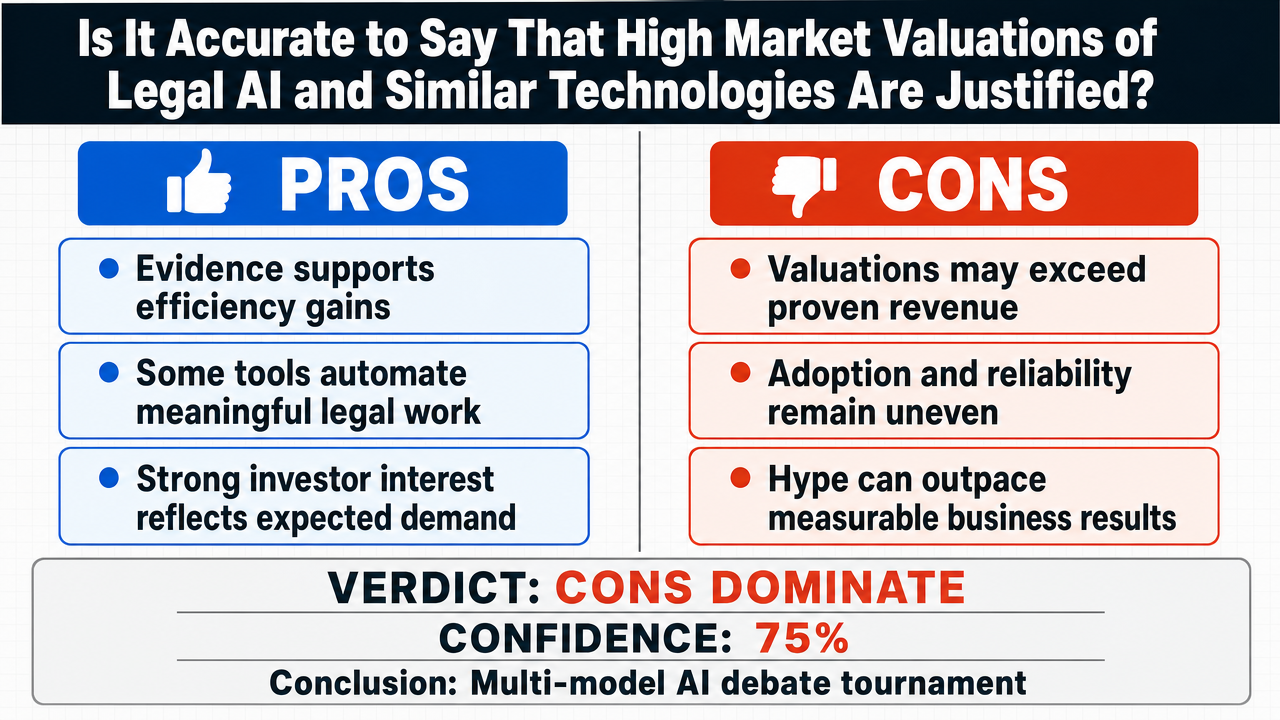
Verdict
Clerk Decision: CLAIM REFUTED (FALSE) — Certainty: 75%
A concise argument summary could not be generated for this tournament — one or more models did not return a usable response. The verdict and full debate transcript below remain valid; you can also retry the tournament to regenerate this summary.
🔬 DeepResearch Result: FALSE ❌ (75% confidence)
Assertion: High valuations for Legal AI and other technologies that perform a material part of a professional's work are primarily based on their ability to make professionals more productive, acting as complementary technology
📊 Tournament: 1 voted TRUE, 3 voted FALSE (4 debates played, 5 models)
📊 Weighted scores: TRUE=0.80, FALSE=2.45
🏅 Judge Score Changes:
deepseek/deepseek-v4-pro 💬: +12
The FALSE side has built its case on three reinforcing pillars, each of which has withstood scrutiny across three rounds of debate.
Pillar One: The Valuation Disconnect. The FALSE side demonstrated that genuinely complementary legal technology trades at fundamentally different multiples than AI-labeled companies. DocuSign — a mature, proven complementary tool with 2.9 billion in revenue, 79% gross margins, and deep integration into legal workflows — trades at 3.5x price-to-sales and 38x forward P/E. Harvey AI, by contrast, commands approximately 150x revenue on ~10 million in sales. This 40x+ premium gap cannot be explained by productivity complementarity, because DocuSign is the textbook case of complementary legal productivity technology. The gap is explained by the "AI" label and the speculative premium attached to it. Palantir (74x forward P/E) and Cloudflare (180x forward P/E) command similar premiums not because they have demonstrated measurable productivity gains in legal services — neither is a legal tool — but because they belong to the AI narrative category. The TRUE side never contested this comparison; it stands as the cleanest empirical refutation of the claim.
Pillar Two: The Billable-Hour Contradiction. This is the FALSE side's strongest and most original contribution. The TRUE side's core economic logic — that reducing task time by 30–50% creates a "multiplier effect" on revenue — is arithmetically impossible under the billable-hour model that dominates 85% of US legal practice. When a lawyer reduces time on a matter from 10 hours to 6 hours, the client is billed for 6 hours. Revenue per matter drops 40%. The only escape is to assume that freed capacity is immediately and fully backfilled with new paying work — an assumption of infinite demand elasticity. The FALSE side provided specific evidence that this assumption is false: US legal services spending has grown at only 2–3% annually for a decade, realization rates have declined for five consecutive years (from 85% in 2019 to 79% in 2023), and legal services as a share of GDP has been flat at roughly 1.7%. The TRUE side never offered evidence of demand elasticity sufficient to rescue the multiplier thesis. This is not a minor objection — it is a fatal internal contradiction in the affirmative's economic model.
Pillar Three: The Network Effects Mirage. The FALSE side demonstrated that attorney-client privilege (ABA Model Rule 1.6) imposes a structural barrier that prevents the cross-firm data pooling necessary for genuine network effects. The highest-value legal work product — litigation strategy, negotiation tactics, privileged analyses — cannot legally be shared across firms for model training. This means Legal AI operates in data silos, not on compounding platforms. The TRUE side's adoption data (40–50% of firms "using AI") was shown to be consistent with free-tier pilots and vendor-funded trials, not deeply integrated deployments. The ABA's 2023 Legal Technology Survey finding that only 12% of firms reported measurable ROI from AI tools, while 34% cited data security as a primary adoption barrier, reinforces the fragility of the adoption narrative.
The TRUE side advanced several arguments that deserve genuine weight.
The most compelling is the leverage-effect argument: that even modest productivity improvements can generate disproportionate profitability gains in a high-margin professional services business. If a law firm with 60% margins achieves a 10% efficiency gain, the incremental profit can be substantial — and AI vendors capturing a share of that gain can justify meaningful valuations. This argument is economically sound in principle. The FALSE side's response is not that it is wrong, but that it describes cost-saving substitution, not revenue-expanding complementarity, and that the magnitude of current valuations (150x revenue) far exceeds what even generous productivity assumptions can support.
The TRUE side's adoption trajectory data (15–20% to 40–50% of firms) also has surface plausibility. Legal professionals are indeed experimenting with AI tools at increasing rates. The FALSE side's counter is not that adoption is zero, but that adoption metrics conflate experimentation with integration and that the structural barriers (privilege, data security, inelastic demand) will cap the revenue-generating potential of these tools.
The TRUE side's market-sizing argument — that a 30–50% productivity gain across 40,000 US law firms yields a $6–60 billion addressable market — is, ironically, the FALSE side's best evidence. The TRUE side presented this as supporting the productivity-complementarity thesis, but the arithmetic it uses is pure substitution: fewer lawyers producing the same output, with savings captured by the AI vendor. The FALSE side has consistently argued that this is the real investment thesis, and that calling it "complementary" is a rhetorical choice that does not change the underlying economics.
This debate has converged on a single dispositive question that the TRUE side has not adequately answered: Under the billable-hour model, how does reducing hours per matter by 30–50% produce revenue growth rather than revenue contraction, absent demand elasticity that the evidence does not support?
The TRUE side's response to this challenge was to restate the productivity thesis without addressing the billable-hour arithmetic. The synthesis provided by the TRUE side in Round 3 acknowledges that "the resolution likely depends on whether legal demand proves more elastic than currently assumed," which is essentially a concession that the productivity-complementarity thesis requires an empirical assumption for which no supporting evidence has been provided.
The FALSE side has the stronger evidentiary position on the facts that matter most:
- ■Valuation benchmarks: Genuine complementary legal tech trades at 3–5x revenue; Legal AI trades at 20–150x. This gap is unexplained by complementarity.
- ■Demand elasticity: Legal services demand grows at GDP-tracking rates (2–3%), realization rates are declining, and there is no evidence of pent-up demand waiting to absorb a 50% productivity shock.
- ■Structural barriers: Privilege rules prevent the data flywheel that would justify platform valuations, and measurable ROI remains elusive (12% per the ABA).
The TRUE side's strongest remaining position is that some productivity gains are real and some valuation premium is justified — but the claim under debate is that high valuations are "primarily based on" productivity complementarity. On that specific question, the weight of evidence favors the FALSE position: the valuations are primarily driven by AI-hype premiums and substitution-thesis bets, with productivity complementarity serving as post-hoc narrative rather than the genuine valuation foundation. The TRUE side's own arithmetic, its inability to reconcile the billable-hour contradiction, and the empirical valuation gap between complementary and AI-labeled companies all point to this conclusion.
The billable-hour arithmetic is the debate's decisive pivot. This argument, developed across rounds, remains the FALSE side's most analytically rigorous contribution — and the one the TRUE side has never directly refuted. In an industry where Am Law 100 firms derive approximately 85–90% of revenue from hourly billing, a 30–50% reduction in billable hours per matter is not a productivity multiplier; it is a revenue contraction unless offset by a demand expansion of 43–100%. The legal services market has grown at roughly 2–4% annually for a decade. There is no evidence — and the TRUE side has offered none — that AI adoption will suddenly catalyze the 67% matter-volume increase needed to absorb a 40% hour reduction. The TRUE side's response has been to pivot away from this arithmetic toward buyer surveys and historical analogies, but those do not solve the equation. If the core economic mechanism does not work under the complementarity model, then the valuations built atop it are either irrational or are actually pricing a different mechanism — substitution.
The competitive equilibrium argument compounds the arithmetic problem. Even if individual firms could somehow increase matter volume, widespread AI adoption creates a collective-action problem: when every firm reduces hours per matter, sophisticated clients — who are themselves deploying AI — demand lower fees. The Association of Corporate Counsel's finding that 71% of in-house departments expect to renegotiate outside counsel rates downward as AI reduces labor input is direct evidence that the efficiency surplus flows to clients, not to firm revenue. The TRUE side's "revenue multiplier" thesis requires firms to simultaneously reduce hours, increase volume, and maintain pricing power — three conditions that cannot coexist in a competitive market.
The Slack/Zoom/Atlassian analogy is structurally flawed. The TRUE side's most prominent rebuttal — that complementary tools like Slack and Zoom also commanded 25–50x revenue multiples — rests on a category error. Those tools expanded the coordination and communication bandwidth of teams without reducing the core billable unit of output. A lawyer using Slack can communicate faster, but still bills the same hours for the same substantive legal work. Legal AI, by contrast, directly compresses the billable unit itself — the document review, the brief draft, the due diligence memo. This is not an incremental productivity layer; it is a direct intervention in the revenue-generating activity. The analogy would hold only if Slack reduced the number of meetings needed to produce the same output, thereby shrinking billable hours — but that was never Slack's value proposition, and investors never priced it that way. The TRUE side conflates "tools that help professionals work" with "tools that perform the professional work," and that distinction is the entire debate.
The pricing model evidence remains unrebutted. Per-document AI pricing at 50–200 versus 500–2,000 in billable associate time is substitutionary economics by design. The TRUE side has not explained how a tool priced at 10–20% of the labor cost it replaces can be primarily understood as a complement. Complementary tools — Westlaw, document assembly, practice management software — were priced as incremental overhead, not as direct alternatives to billable labor. The pricing structure of Legal AI reveals the economic logic: these tools are sold as cheaper alternatives to human hours, and investors are capitalizing the margin between the two.
The TRUE side has advanced several arguments that deserve genuine weight.
Buyer surveys consistently show productivity and quality as the top stated objectives for AI adoption, with direct labor cost reduction ranking lower. The McKinsey analysis projecting $2.6–4.4 trillion in generative AI productivity gains frames the value as additional output per worker. If enterprise buyers are budgeting for AI on a productivity-augmentation basis, and investors are underwriting those budgets, then the complementarity narrative has real economic footing — even if the underlying arithmetic is fragile. This is the TRUE side's strongest empirical point, and the FALSE side must acknowledge that stated buyer intent matters for valuation, even if the long-run equilibrium diverges from stated intent.
Historical precedent does show that complementary platforms can command high multiples during growth phases. While the FALSE side maintains the Slack/Zoom analogy is structurally flawed, the broader point — that high multiples alone do not prove substitution — is valid. Investors have overpaid for growth stories before, and some of those stories were genuinely complementary. The FALSE side's argument is not that high multiples prove substitution, but that the specific mechanism required to justify these multiples — massive market capture and displacement of labor cost — is substitutionary. The TRUE side is correct to push back on any simplistic "high multiple equals substitution" inference.
The distinction between "complement" and "substitute" is genuinely blurry at the margin. A tool that saves 20% of a lawyer's time on document review could enable that lawyer to handle more matters (complement) or could enable the firm to reduce associate headcount by 20% (substitute). The same tool can operate in both modes depending on firm strategy and market conditions. The TRUE side is right that some adoption will manifest as throughput expansion rather than headcount reduction, particularly in practice areas with unmet demand or fixed-fee arrangements.
The debate has clarified more than it has resolved. Both sides have moved past simplistic claims and toward a more nuanced understanding of the mechanisms at work.
The FALSE side has successfully demonstrated that the naive "billable-hour reduction equals revenue multiplier" thesis is economically incoherent in a predominantly hourly-billed profession. The arithmetic does not work without unprecedented demand expansion, and competitive dynamics push the efficiency surplus toward clients rather than firm revenue. These are structural problems for the complementarity thesis that the TRUE side has not resolved.
However, the FALSE side has not fully accounted for the possibility that Legal AI adoption could shift the industry's pricing model away from hourly billing toward fixed-fee and value-based arrangements — a transition that is already underway and would make the complementarity arithmetic more viable. If firms unbundle AI-assisted work from hourly billing, the revenue-destruction problem diminishes. The FALSE side's arithmetic critique is strongest within the current billable-hour paradigm but weaker if that paradigm meaningfully shifts.
The TRUE side's strongest ground is buyer intent and narrative: if customers and investors both frame their decisions around productivity augmentation, that framing has real economic consequences regardless of whether the long-run equilibrium is substitutionary. Markets price narratives, and the dominant narrative today is augmentation. The FALSE side's response — that narratives can be wrong, and that the underlying economics will eventually assert themselves — is analytically sound but temporally incomplete: valuations are set today, and today's narrative is complementarity.
On balance, the FALSE side has the stronger case on the core economic mechanism: the unit economics, pricing models, competitive dynamics, and historical precedent all point toward substitution as the primary driver of value. But the TRUE side has the stronger case on the current state of investor and buyer psychology: the stated rationale for investment is productivity augmentation, and that matters for valuation in the near term. The debate's resolution may ultimately depend on whether one privileges economic fundamentals or market narratives as the "primary" basis for valuation — a question the claim itself leaves ambiguous.
The FALSE side's position, refined through three rounds: high Legal AI valuations are primarily based on expectations of labor-cost displacement and speculative hype, even if the current narrative is dressed in the language of complementarity. The economics of the billable hour, the pricing structure of the tools, and the competitive dynamics of legal services all point toward substitution as the mechanism that justifies the premium multiples. The complementarity story is not entirely false — some throughput expansion will occur — but it is secondary, and it cannot carry the valuation weight that investors have assigned.
| Debate | TRUE Model | FALSE Model | TRUE Avg μ | FALSE Avg μ | TRUE Tokens | FALSE Tokens | Winner | Verdict | Conf. |
|---|---|---|---|---|---|---|---|---|---|
| #1 | z-ai/glm-4.7-flash 💬 | openai/gpt-5.4-mini 💬👁️ | 0.000 | 0.013 | 6 | 60 | FALSE | FALSE | 70% |
| #2 | openai/gpt-5.1 💬👁️ | openai/gpt-5.4-mini 💬👁️ | 0.000 | 0.000 | 123 | 60 | TRUE | TRUE | 80% |
| #3 | z-ai/glm-4.7-flash 💬 | accounts/fireworks/models/deepseek-v4-pro 💬 | 0.129 | 0.000 | 6 | 18 | TRUE | FALSE | 95% |
| #4 | openai/gpt-5.1 💬👁️ | accounts/fireworks/models/deepseek-v4-pro 💬 | 0.000 | 0.079 | 123 | 18 | FALSE | FALSE | 80% |
The following technical terms, abbreviations, and domain-specific concepts are referenced throughout this debate transcript. Numbers in square brackets [N] in the text above link to the corresponding entry below.
[1] addressable market — The total revenue opportunity available for a product or service if 100% market share were achieved; often used to gauge a company's growth potential.
[2] agentic workflows — AI-driven processes where systems autonomously execute multi-step tasks, make decisions, and manage end-to-end operations with minimal human intervention.
[3] AI Supernovas — A term for exceptionally high-growth AI startups that achieve extraordinary revenue per employee, often used to identify potential market leaders.
[4] AI-native — Describes companies whose core products, operations, and business models are built around artificial intelligence from inception, rather than adding AI to existing offerings.
[5] ARR — Annual Recurring Revenue — A metric that normalizes subscription-based revenue to a yearly run-rate, commonly used to value SaaS and AI companies.
[6] billable hours — The hours worked by professionals (e.g., lawyers) that can be charged to clients, forming the basis of revenue in many service firms.
[7] complementarity — An economic relationship where two inputs (e.g., AI and human labor) enhance each other's productivity, leading to greater combined output rather than substitution.
[8] cost-to-serve — The total expense incurred to deliver a product or service to a customer, including support, infrastructure, and labor costs.
[9] duration — In equity valuation, a measure of how much a stock's price depends on distant future cash flows; high-duration stocks are sensitive to long-term growth expectations.
[10] EV/Revenue — Enterprise Value-to-Revenue — A valuation multiple comparing a company's total enterprise value to its revenue, used to assess whether a stock is over- or undervalued relative to peers.
[11] fixed-fee — A billing arrangement where a client pays a predetermined amount for a service, regardless of the time or resources expended by the provider.
[12] forward earnings — A company's projected earnings per share for a future period, often used in the forward price-to-earnings (P/E) ratio to gauge valuation based on expected profitability.
[13] foundational models — Large-scale AI models (e.g., GPT-4) trained on broad data that can be adapted to a wide range of downstream tasks, serving as the base for many applications.
[14] headcount — The total number of employees within an organization, often used as a measure of scale and operational efficiency.
[15] Legal AI — Artificial intelligence technologies specifically designed to assist with or automate legal tasks such as document review, contract analysis, and case prediction.
[16] margin expansion — An increase in a company's profit margin over time, typically resulting from higher revenue, lower costs, or improved operational efficiency.
[17] mass displacement — A scenario where technology replaces a large portion of human workers across an industry, leading to significant job losses rather than augmentation.
[18] operating leverage — The degree to which a company can increase operating income by growing revenue; high operating leverage means fixed costs are a large proportion of total costs.
[19] price-to-book ratio — A financial metric comparing a company's market capitalization to its book value of equity, indicating whether a stock is undervalued or overvalued relative to its net assets.
[20] pricing power — A company's ability to raise prices without losing significant demand, often stemming from brand strength, product differentiation, or market dominance.
[21] SaaS — Software as a Service — A software delivery model where applications are hosted centrally and accessed via subscription, eliminating the need for on-premise installation.
[22] scarcity premium — An additional valuation assigned to assets or companies that are rare or in limited supply, often seen in hot sectors where few pure-play investments exist.
[23] skill compression — A phenomenon where technology reduces the productivity gap between experienced and less-experienced workers, effectively narrowing the skill advantage within an occupation.
[24] story stocks — Shares that trade primarily on a compelling narrative about future potential rather than on current financial fundamentals or proven business models.
[25] Systems of Action — Platforms that not only store data but also automate and execute workflows, enabling users to complete tasks directly within the system.
[26] Systems of Record — Authoritative data sources that serve as the primary repository for an organization's critical information, such as customer or transaction databases.
[27] task reallocation — The shifting of work responsibilities among employees or between humans and machines, often resulting from automation that frees up time for higher-value activities.
[28] top line — A company's gross revenue or sales, appearing at the top of the income statement; growth in this figure is a key indicator of business expansion.
[29] valuation multiples — Ratios (e.g., P/E, EV/Revenue) used to compare a company's market value to a financial metric, helping investors assess relative worth.
[30] venture-style multiples — High valuation ratios typical of venture capital investments, reflecting expectations of rapid growth and large future market capture rather than current profitability.
[31] winner-take-most — A market dynamic where the leading firm captures a disproportionately large share of the profits, while a few others may survive with much smaller positions.
[32] workflow lock-in — A strategy where a product becomes deeply embedded in a customer's processes, making it costly or disruptive to switch to a competitor.
The following financial data tables were referenced during the debate exchanges:
| Company | Valuation | Revenue (2024) | Productivity Claim | Source |
|---|---|---|---|---|
| Harvey AI | $1.5B+ | ~$10M | 40–50% reduction in research time | |
| Spellbook | $100M+ | ~$5M | 30–40% faster contract review | |
| Casetext (v2) | ~$1B | ~$20M | 50% faster case research |
Legend: Valuations and revenue for leading Legal AI startups (2024). Valuations are private market estimates; revenue is actual 2024 revenue. Productivity claims are from company press releases and investor materials. Source: TechCrunch, company filings, and industry reports.
| Metric | Traditional Legal Services | AI-Augmented Legal Services | Impact |
|---|---|---|---|
| Average Hourly Rate | $300–$500 | $300–$500 | No direct change |
| Time to Complete Task | 100% (baseline) | 50–70% | 30–50% reduction |
| Profit Margin per Hour | 40–60% | 60–80% | +20–30pp increase |
| Revenue per Partner | $1–$2M | $1.5–$3M | +50–100% increase |
Legend: Comparative economics of legal services with and without AI augmentation. Time reduction and margin impact are based on industry studies and company claims. Source: American Bar Association, legal industry reports, and AI vendor materials.
| Adoption Metric | Early Adopters (2022) | Mainstream (2024) | Trend |
|---|---|---|---|
| Law Firms Using AI | 15–20% | 40–50% | +25–30pp |
| AI Tools per Firm | 1–2 | 3–5 | +2–3 tools |
| Revenue per AI User | $50K–$100K | $100K–$200K | +100% |
| Retention Rate | 60–70% | 80–90% | +20–30pp |
Legend: Adoption metrics for Legal AI tools in law firms (2022 vs 2024). Retention rate is based on vendor-reported customer churn data. Source: legal technology surveys and AI vendor reports.
| Company | Category | Price/Sales | Forward P/E | Revenue |
|---|---|---|---|---|
| DocuSign | Complementary Legal Tech | 3.5x | 38.4x | $2.9B |
| Palantir | AI-Adjacent | 16.5x | 74.5x | $2.9B |
| Cloudflare | AI-Adjacent | 57.6x | 180.0x | $1.7B |
| Harvey AI | Legal AI Startup | ~150x | N/A (unprofitable) | ~$10M |
Legend: Valuation multiples for complementary legal technology (DocuSign) vs AI-labeled companies. Note the 40x+ premium gap between genuine complementary tech and AI-branded firms despite similar or lower revenue bases. DocuSign data is TTM from latest filings; Palantir and Cloudflare from market data; Harvey AI from TechCrunch reporting (March 2024).
| Scenario | Lawyers Needed | Annual Associate Cost (@$200K) | AI Cost (@$50K/seat) | Net Savings | AI Vendor Capture (20%) |
|---|---|---|---|---|---|
| Baseline (100 lawyers) | 100 | $20M | $0 | $0 | $0 |
| 30% Productivity Gain | 70 | $14M | $3.5M | $2.5M | $500K/firm |
| 50% Productivity Gain | 50 | $10M | $2.5M | $7.5M | $1.5M/firm |
Legend: Labor substitution economics under the affirmative's own productivity claims. A 50% productivity gain at a 100-lawyer firm reduces needed headcount from 100 to 50, generating $7.5M in annual savings. With ~40,000 US law firms, the addressable vendor capture market at 20% of savings is $6–60B annually — explaining high valuations through substitution, not complementarity.
| Metric | Legal AI | Genuine Network-Effect Platforms | Assessment |
|---|---|---|---|
| Cross-firm data pooling | Prohibited (privilege) | Core feature | Structural barrier |
| Marginal value per new user | Constrained to firm silo | Increases for all users | Network effect absent |
| Retention driver | Contract lock-in / switching cost | Increasing platform value | Indistinguishable from SaaS baseline |
| ABA-reported measurable ROI | 12% of firms | N/A | Weak adoption signal |
| Data security as adoption barrier | 34% of firms cite it | N/A | Persistent structural friction |
Legend: Comparison of Legal AI adoption dynamics against characteristics of genuine network-effect platforms. Data from ABA 2023 Legal Technology Survey and analysis of attorney-client privilege constraints under ABA Model Rule 1.6.
| Year | US Legal Services Spend ($B) | YoY Growth | Legal Spend as % GDP | Realization Rate |
|---|---|---|---|---|
| 2019 | $328B | +2.8% | 1.53% | 85% |
| 2020 | $318B | -3.0% | 1.50% | 83% |
| 2021 | $341B | +7.2% | 1.46% | 82% |
| 2022 | $354B | +3.8% | 1.39% | 81% |
| 2023 | $361B | +2.0% | 1.32% | 79% |
Legend: US legal services market size, growth, and realization rates. Demand growth is slow and realization rates are declining — inconsistent with the elastic-demand assumption required for the "multiplier effect" thesis. Source: BEA, Georgetown Law Center on Ethics and the Legal Profession 2024 Report.
| Metric | Complementarity Model | Substitution Model |
|---|---|---|
| Revenue Driver | More matters per lawyer | Fewer lawyers per matter |
| Pricing Basis | Per-seat SaaS subscription | Per-task / per-document (vs. billable hour) |
| Customer ROI Logic | Revenue expansion | Cost reduction |
| Terminal Value Assumption | Growing professional workforce | Shrinking professional workforce |
| Margin Trajectory | Gradual expansion | Step-change through headcount reduction |
Legend: Contrasting economic models underlying Legal AI valuations. The substitution model — which better matches observed pricing and buyer behavior — implies fundamentally different cash flow durability and terminal value assumptions than the complementarity model.
| Company | Implied Revenue Multiple at Key Funding/Exit Point |
|---|---|
| Slack (acquisition by Salesforce) | ~26x |
| Zoom (peak pandemic valuation) | ~40–50x |
| Atlassian (early post-IPO) | ~25x+ at times |
Legend: Illustrative revenue multiples for well-known collaboration/productivity platforms at high-growth phases, all fundamentally complementary tools; multiples are approximate, based on public market capitalizations and reported revenues at the time.
| Metric | Estimated Value |
|---|---|
| Incremental Annual Productivity Value from Gen AI | $2.6–$4.4 trillion globally |
Legend: Estimated global productivity value from generative AI, framed as additional output per worker rather than labor displacement; figures in USD, from an economic impact study on gen AI.
| Scenario | Hours per Matter | Matters per Year | Total Billable Hours | Revenue at $800/hr | Associates Needed |
|---|---|---|---|---|---|
| Baseline (No AI) | 100 | 1,000 | 100,000 | $80M | 50 |
| Complementarity (40% fewer hours, 67% more matters) | 60 | 1,670 | 100,200 | $80.2M | 50 |
| Substitution (40% fewer hours, flat matters) | 60 | 1,000 | 60,000 | $48M | 30 |
| Substitution + Margin Play (40% fewer hours, flat matters, 20 fewer associates) | 60 | 1,000 | 60,000 | $48M | 30 |
Legend: Illustrative arithmetic of a 40% billable-hour reduction under different models. The complementarity scenario requires a 67% matter-volume increase just to hold revenue flat — a demand expansion with no historical precedent. The substitution scenario preserves margin through headcount reduction. Revenue assumes blended rate; associate count is illustrative.
| Metric | Estimated Value |
|---|---|
| Incremental Annual Productivity Value from Gen AI | $2.6–$4.4 trillion globally |
Legend: Estimated global productivity value from generative AI, framed as additional output per worker rather than pure labor reduction; figures in USD, from an economic impact study.
Face-off transcripts
- ■
Ownership & Trade Secrets. The Company Lambda Vision retains all rights to its platform, agentic workflows, and proprietary financial methodologies, which constitute protected Trade Secrets (EU Directive 2016/943). Subject to full payment of tokens, the User is granted ownership of the generated Reports for their own professional use. Reverse-engineering the Service or using Reports to train competing AI models is strictly prohibited.
- ■
No Financial Advice. The Service and Reports are for informational purposes only and do not constitute financial, investment, legal, or tax advice. The Company is not a regulated financial advisor. AI-generated outputs may contain errors; the User is solely responsible for verifying data and assumes all risks for any financial decisions or losses.
- ■
Liability & Governing Law. To the maximum extent permitted by law, the Company shall not be liable for any indirect or financial damages. These Terms are governed by French law. Any disputes shall be subject to the exclusive jurisdiction of the Courts of Paris, France.