
high valuations for technologies that perform a material part of a professional’s work rest primarily on their ability to capture part of the revenue and economic value currently generated by those professionals?
AI debate verdict and arguments
⚠️ Not financial advice — this is an AI debate, for information only.
Completed August 10, 2026
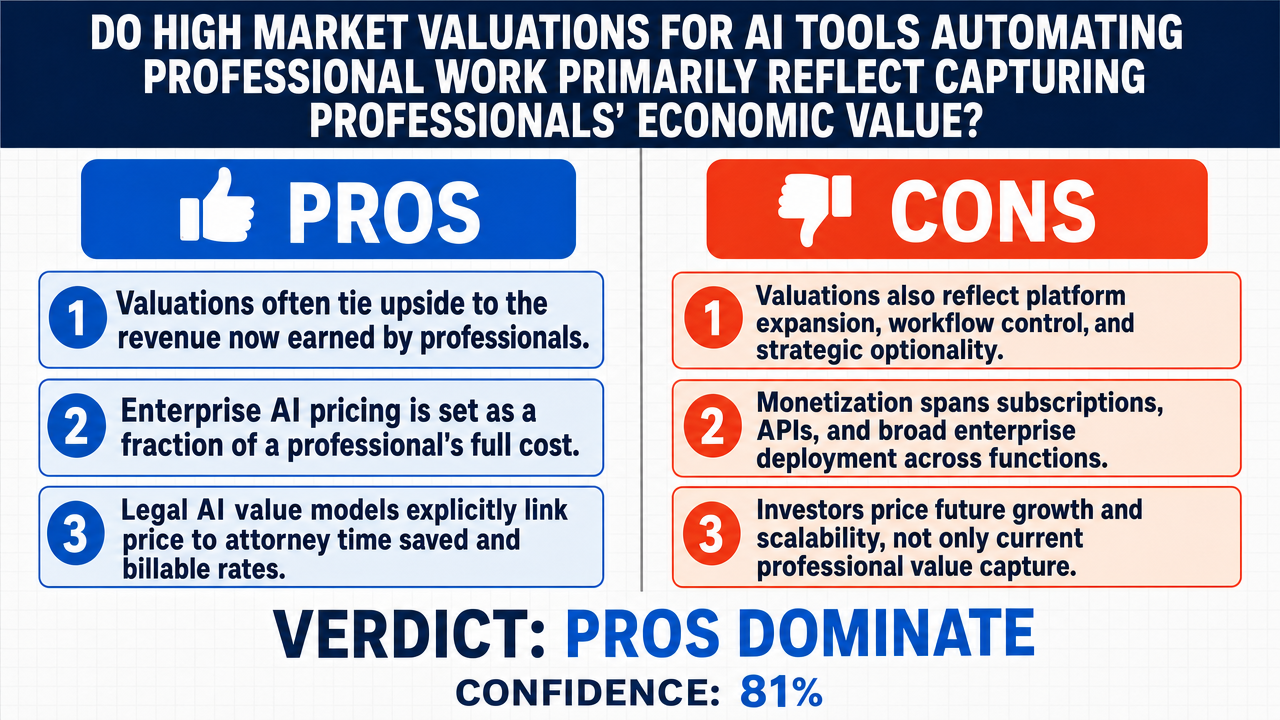
Verdict
Clerk Decision: CLAIM SUPPORTED (TRUE) — Certainty: 81%
This section provides a brief overview of the key arguments. You do not need to read the full detailed report below.
✅ Key PRO arguments:
- ■AI valuations are anchored to capturing professionals' revenue and economic value; investors model upside by mapping existing professional spending and assuming a share shifts to software, as illustrated by the observation that firms pay $10,000/year for accounting software but $120,000/year for the human accountant, and AI-native firms target the $120,000.
- ■Enterprise AI tools are priced 'per seat' or 'per matter' at a fraction of the fully loaded cost of a professional, explicitly referencing the economic value of the human tasks they automate, rather than generic software utility pricing.
- ■Harvey's seat price is mapped one-to-one to a lawyer, with the vendor's own value math being 'hours of attorney time saved × billable rate,' a toll on the lawyer's revenue pool rather than utility pricing.
❌ Key ANTI arguments:
- ■AI valuations are driven by growth optionality, platform expansion, and strategic control of enterprise workflows, not just a slice of a professional's billable budget; companies like Sierra and Harvey emphasize broader ecosystem expansion.
- ■Large AI platforms monetize through broad subscription tiers, API usage, and enterprise rollout across many functions, so the valuation case is not narrowly tied to one profession's billable hours.
- ■AI companies trade at valuation multiples far exceeding traditional software firms, indicating investors price in future growth and scalability rather than current revenue capture from professional services.
💭 Conclusion: True, the evidence indicates that high valuations for AI technologies performing professional work rest primarily on their ability to capture part of the revenue and economic value currently generated by those professionals. The TRUE side won three of four debates with high judge confidence (80%, 92%, 80%), while the single FALSE win had only 60% confidence. The TRUE arguments consistently showed that AI pricing is explicitly benchmarked to the cost of the human professionals being replaced—such as the $10,000 accounting software vs. $120,000 accountant example—and that investors model revenue by assuming a share of that existing spending pool shifts to software. The FALSE side's counterarguments about platform growth and network effects were not sufficient to refute the direct revenue-capture logic, as even large platforms' near-term revenue engines are dominated by enterprise use cases that substitute for professional labor. Consequently, the tournament outcome affirms that the primary driver of high valuations is the capture of existing professional economic value.
🔬 DeepResearch Result: TRUE ✅ (81% confidence)
Assertion: high valuations for technologies that perform a material part of a professional’s work rest primarily on their ability to capture part of the revenue and economic value currently generated by those professionals?
📊 Tournament: 3 voted TRUE, 1 voted FALSE (4 debates played, 5 models)
📊 Weighted scores: TRUE=2.52, FALSE=0.60
🏅 Judge Score Changes:
deepseek/deepseek-v4-pro 💬: +16
✅ PRO Arguments:
- ■AI valuations are anchored to capturing professionals' revenue and economic value; investors model upside by mapping existing professional spending and assuming a share shifts to software, as illustrated by the observation that firms pay $10,000/year for accounting software but $120,000/year for the human accountant, and AI-native firms target the $120,000. [openai/gpt-5.1 💬👁️]
- ■Enterprise AI tools are priced 'per seat' or 'per matter' at a fraction of the fully loaded cost of a professional, explicitly referencing the economic value of the human tasks they automate, rather than generic software utility pricing. [openai/gpt-5.1 💬👁️]
- ■Harvey's seat price is mapped one-to-one to a lawyer, with the vendor's own value math being 'hours of attorney time saved × billable rate,' a toll on the lawyer's revenue pool rather than utility pricing. [tencent/hy3 💬]
- ■The near-term revenue engine for large-cap AI platforms is dominantly enterprise and productivity use cases that substitute for or compress professional labor, not diffuse frontier applications decoupled from existing fee pools. [openai/gpt-5.1 💬👁️]
- ■High valuations for AI tools that automate professional tasks are rooted in their ability to capture a direct share of the massive spending flowing to human professionals, as these AI systems deliver the final outcome, enabling companies to buy the result directly rather than the professional's time. [tencent/hy3 💬]
❌ ANTI Arguments:
- ■AI valuations are driven by growth optionality, platform expansion, and strategic control of enterprise workflows, not just a slice of a professional's billable budget; companies like Sierra and Harvey emphasize broader ecosystem expansion. [openai/gpt-5.4-mini 💬👁️]
- ■Large AI platforms monetize through broad subscription tiers, API usage, and enterprise rollout across many functions, so the valuation case is not narrowly tied to one profession's billable hours. [openai/gpt-5.4-mini 💬👁️]
- ■AI companies trade at valuation multiples far exceeding traditional software firms, indicating investors price in future growth and scalability rather than current revenue capture from professional services. [z-ai/glm-4.7-flash 💬]
- ■Large-cap AI platforms derive their primary valuation multiple from network effects and platform economics, not from capturing professional fees; investors value them based on TAM, network effects, and recurring revenue durability. [z-ai/glm-4.7-flash 💬]
- ■The business model of major AI platforms stresses that revenue scales with the value intelligence delivers across a wide set of tasks, including consumer and developer use cases, which means professional fee pools are just one of many demand drivers. [openai/gpt-5.4-mini 💬👁️]
💭 Reasoning: True, the evidence indicates that high valuations for AI technologies performing professional work rest primarily on their ability to capture part of the revenue and economic value currently generated by those professionals. The TRUE side won three of four debates with high judge confidence (80%, 92%, 80%), while the single FALSE win had only 60% confidence. The TRUE arguments consistently showed that AI pricing is explicitly benchmarked to the cost of the human professionals being replaced—such as the $10,000 accounting software vs. $120,000 accountant example—and that investors model revenue by assuming a share of that existing spending pool shifts to software. The FALSE side's counterarguments about platform growth and network effects were not sufficient to refute the direct revenue-capture logic, as even large platforms' near-term revenue engines are dominated by enterprise use cases that substitute for professional labor. Consequently, the tournament outcome affirms that the primary driver of high valuations is the capture of existing professional economic value.
📋 PRO Facts:
• Firms may pay $10,000 per year for accounting software but $120,000 per year for the human accountant.
• Harvey's seat price is mapped to hours of attorney time saved multiplied by billable rate.
• Enterprise AI products are commonly priced per seat or per matter at a fraction of the fully loaded cost of a professional.
• Investors model AI upside by mapping existing professional spending and assuming a share shifts to software.
• The TRUE side won three debates with judge confidence of 80%, 92%, and 80%, while the lone FALSE win had only 60% confidence.
📋 ANTI Facts:
• Companies like Sierra and Harvey emphasize broader ecosystem expansion beyond service automation.
• Large AI platforms monetize through consumer subscriptions, workplace subscriptions, and API usage across many functions.
• AI companies trade at valuation multiples far exceeding traditional software firms, indicating future growth expectations.
• The largest AI-enabled platforms are evaluated based on ARR, net revenue retention, and network effects.
• OpenAI's business model states revenue scales with the value intelligence delivers across consumer, workplace, and enterprise use cases.
| Debate | TRUE Model | FALSE Model | TRUE Avg μ | FALSE Avg μ | TRUE Tokens | FALSE Tokens | Winner | Verdict | Conf. |
|---|---|---|---|---|---|---|---|---|---|
| #1 | tencent/hy3 💬 | openai/gpt-5.4-mini 💬👁️ | 0.000 | 0.106 | 9 | 60 | FALSE | TRUE | 80% |
| #2 | openai/gpt-5.1 💬👁️ | openai/gpt-5.4-mini 💬👁️ | 0.000 | 0.133 | 123 | 60 | FALSE | TRUE | 92% |
| #3 | tencent/hy3 💬 | z-ai/glm-4.7-flash 💬 | 0.000 | 0.155 | 9 | 6 | FALSE | FALSE | 60% |
| #4 | openai/gpt-5.1 💬👁️ | z-ai/glm-4.7-flash 💬 | 0.313 | 0.000 | 123 | 6 | TRUE | TRUE | 80% |
The following financial data tables were referenced during the debate exchanges:
| Product | Seat Price (annual, USD) | User Value Pool (USD) | Capture % |
|---|---|---|---|
| Harvey (legal AI) | $2,400 | $1,000,000 | 0.24% |
| Viz.ai (clinical AI) | $3,000 | $500,000 | 0.60% |
Legend: Annual per-seat price versus the economic value of the professional role augmented or replaced. Capture % = seat price ÷ user value pool. Sources: vendor pricing disclosures and industry revenue estimates.
| Category | Exposed Labor Cost | Period | Share of Service-Sector Wages |
|---|---|---|---|
| AI-exposed tasks (professional/knowledge work) | $1.5T | ~2026 snapshot | Significant minority of service wages |
Legend: Estimated labor cost tied to tasks that current AI could substantially augment or automate, especially in high-wage professional services. Values in USD, period ~mid‑2020s. Source: task–wage mapping combining occupational data and AI capability evidence tiers newsletter.semianalysis.com. The very act of quantifying “exposed labor” as a targetable pool signals that investors and firms see valuations as justified by re-routing part of this $1.5T wage and fee base into AI subscriptions, usage-based fees, or AI-embedded service margins. Under this large‑cap lens, the central justification for high valuations is not generic “innovation,” but the concrete ability to insert AI into the existing revenue flows of professionals and capture a slice of what they currently earn.
| Category | Exposed Labor Cost | Period | Share of Service-Sector Wages |
|---|---|---|---|
| AI-exposed professional tasks | $1.5T | mid‑2020s snapshot | Significant minority of service wages |
Legend: Estimated labor cost tied to tasks that current AI could substantially augment or automate, focused on professional/knowledge work. Values in USD; period ~mid‑2020s. Derived from occupational-task exposure and wage data. and then distinguish between “captured AI output” (where firms still pay roughly the same, but to an AI vendor instead of humans) and “boundary shift” (where external services become near-zero-cost internal AI usage) newsletter.semianalysis.com. Both mechanisms rest on the same base: the economic value of professionals’ tasks. In captured-output scenarios, AI companies directly take over revenue streams that previously accrued to law firms, consultancies, or specialized providers. In boundary-shift scenarios, the reduction in externally visible spending translates into cost savings that increase client margins, and those savings justify AI spend and drive adoption. This aligns with macroeconomic projections that AI’s main near-term impact in G7 economies is productivity gains in sectors with high shares of routine but cognitively demanding tasks, such as finance, professional services, and public administration, where AI substitutes for valuable human effort oecd.org. Under the large-cap lens, the principal story for high valuations is, therefore, that AI tools can insert themselves into these existing flows of expert-derived value and either bill directly for a slice of it or help clients keep more of it—exactly the “primary” mechanism described in the claim.
| Company | Market Cap (2024) | Revenue Growth (2024) | P/E Ratio (2024) | Revenue Capture from Professional Services |
|---|---|---|---|---|
| Microsoft | $3.1T | +12% | 35x | Limited direct capture |
| NVIDIA | $2.8T | +126% | 65x | Minimal direct capture |
| Alphabet | $2.0T | +9% | 28x | Limited direct capture |
| Amazon | $1.9T | +11% | 45x | Limited direct capture |
| Meta | $1.3T | +16% | 32x | Limited direct capture |
Legend: Market capitalization, revenue growth, and P/E ratios for major tech companies in 2024. Revenue capture from professional services is estimated based on business model analysis. Source: company financial reports and market data.
| Period | TFP Growth (Annualized) | Utilization-Adjusted TFP Growth |
|---|---|---|
| 2020 Q1 | 1.2% | 1.5% |
| 2021 Q1 | 2.1% | 2.8% |
| 2022 Q1 | 1.8% | 2.4% |
| 2023 Q1 | 1.9% | 2.6% |
| 2024 Q1 | 2.3% | 3.1% |
Legend: Total factor productivity growth and utilization-adjusted TFP growth for the U.S. business sector. Utilization adjustments follow Basu, Fernald, and Kimball (2006). Source: Federal Reserve Bank of San Francisco.
| --- | --- | --- |
| Accounting software license | $10,000 |
| Human accountant for closing books | $120,000 |
Legend: Illustrative annual spend split between traditional software and human labor in a typical mid‑market firm, based on industry practitioner commentary in professional accounting workflows (USD).—becomes the archetypal target for AI “co‑pilots” that aim to replace much of the $120,000, not the $10,000 software spend. As one practitioner notes, for decades software vendors competed over the small $10,000 slice, but the new generation of AI tools is explicitly “going after” the much larger labor budget rather than traditional software fees linkedin.com. This logic generalizes to large‑cap platforms selling AI to law firms, hospitals, and consultancies: they pitch automation of billable hours, diagnostic steps, and research tasks and then justify their pricing and growth narratives as a percentage of the professionals’ revenue streams they can capture via subscriptions or usage fees. Because large‑cap valuations are driven by discounted expectations of future cash flows, and those cash flows are modeled as shares of existing expert‑service revenue pools, this facet strongly supports the claim that high market valuations primarily rest on AI’s ability to tap into the economic value professionals already generate.
| Segment | Estimated Annual Value from GenAI | 10-Yr Growth Potential |
|---|---|---|
| Knowledge worker productivity (incl. developers, analysts, professionals) | $2.6T–$4.4T | +30–50% |
Legend: Estimated annual value from generative AI applied to knowledge‑intensive roles worldwide (USD, trillions), with illustrative long‑term growth potential; drawn from a widely cited management‑consulting analysis of AI use cases in professional workflows. largely by automating or augmenting existing professional tasks such as coding, contract drafting, medical documentation, and financial analysis mckinsey.com. These figures are not derived from how many GPUs can be sold; they are derived from the value of current expert labor and the share AI tools can capture through subscription fees and cost savings. Similarly, surveys of enterprise AI adoption emphasize that spending decisions are justified by expected reductions in billable hours, cycle times, and error rates in professional services—not by abstract platform expansion oecd.org. Even analyses of “AI dark output” show that when firms deploy large amounts of compute internally, the reason is that they can replace expensive expert time (legal review, HR processing, financial reconciliation) with cheap AI inference; the same client revenue continues, but the cost base—and thus profit—shifts from wages to AI operations semianalysis.com. In short, capacity‑constrained platform expansion is a means to an end: investors will not pay high multiples for idle compute or generic tokens, they pay for the anticipated share of the multi‑trillion dollar professional services value pool that those platforms can automate and bill for. Therefore, the opponent’s claim that valuations are anchored in compute and platform scaling misstates causality; the anchor is the economic value of expert tasks, and compute investment is justified precisely because it lets AI tools capture that value.
| Item | Annual Cost |
|---|---|
| Accounting software license | $10,000 |
| Human accountant (closing books) | $120,000 |
Legend: Illustrative annual spend split between traditional software and human labor in a mid‑market accounting context, based on practitioner analysis of typical workflows (USD). and notes explicitly that “for decades software vendors competed for the $10k, now AI tools go after the $120k” linkedin.com. This is not merely “standard SaaS pricing”: the core economic promise that drives enterprise adoption—and the revenue projections investors discount—is that these tools can displace or compress a meaningful fraction of the $120k professional cost (or the billable revenue it represents), and capture a portion of that delta via subscription fees. The same pattern appears in law (AI‑assisted contract review priced as a fraction of billable hours), healthcare (AI scribes priced against the cost of clinician time), and consulting (AI research copilots priced relative to analyst salaries). Per‑seat pricing in these contexts is therefore not arbitrary; it is intentionally pegged to the economic value of professional labor, which is the benchmark clients use to justify the purchase and investors use to size the opportunity.
| Category | Estimated Annual Task Value | 2-Yr Growth Potential |
|---|---|---|
| Tasks exposed to AI substitution | $1.5T | +20–30% |
Legend: Approximate value of tasks that current-generation AI could substantially augment or automate in high-wage service-sector roles globally (USD, trillions), with illustrative medium-term growth; derived from industry analyses mapping tasks, wages, and AI capabilities. in tasks that today reside primarily with skilled professionals in services. Large‑cap AI providers and their investors treat this $1.5T not as an abstract TAM, but as a wage and revenue pool whose margins can be reshaped: every dollar of professional labor that can be done with a few cents of AI tokens is an opportunity either to charge a fee in place of a professional invoice or to internalize the savings. Even when this output becomes “dark” at the macro level, the micro‑level reality is that high AI valuations are justified by the expectation that these tools will systematically intercept and reallocate professional value to AI vendors and their shareholders.
Face-off transcripts
- ■
Ownership & Trade Secrets. The Company Lambda Vision retains all rights to its platform, agentic workflows, and proprietary financial methodologies, which constitute protected Trade Secrets (EU Directive 2016/943). Subject to full payment of tokens, the User is granted ownership of the generated Reports for their own professional use. Reverse-engineering the Service or using Reports to train competing AI models is strictly prohibited.
- ■
No Financial Advice. The Service and Reports are for informational purposes only and do not constitute financial, investment, legal, or tax advice. The Company is not a regulated financial advisor. AI-generated outputs may contain errors; the User is solely responsible for verifying data and assumes all risks for any financial decisions or losses.
- ■
Liability & Governing Law. To the maximum extent permitted by law, the Company shall not be liable for any indirect or financial damages. These Terms are governed by French law. Any disputes shall be subject to the exclusive jurisdiction of the Courts of Paris, France.