
Individuals, particularly younger ones, often feel compelled to trade due to constant screen exposure, regardless of a perceived edge.
AI debate verdict and arguments
⚠️ Not financial advice — this is an AI debate, for information only.
Completed November 1, 2026
Verdict
Verdict: likely FALSE (68%)
This section provides a brief overview of the key arguments. You do not need to read the full detailed report below.
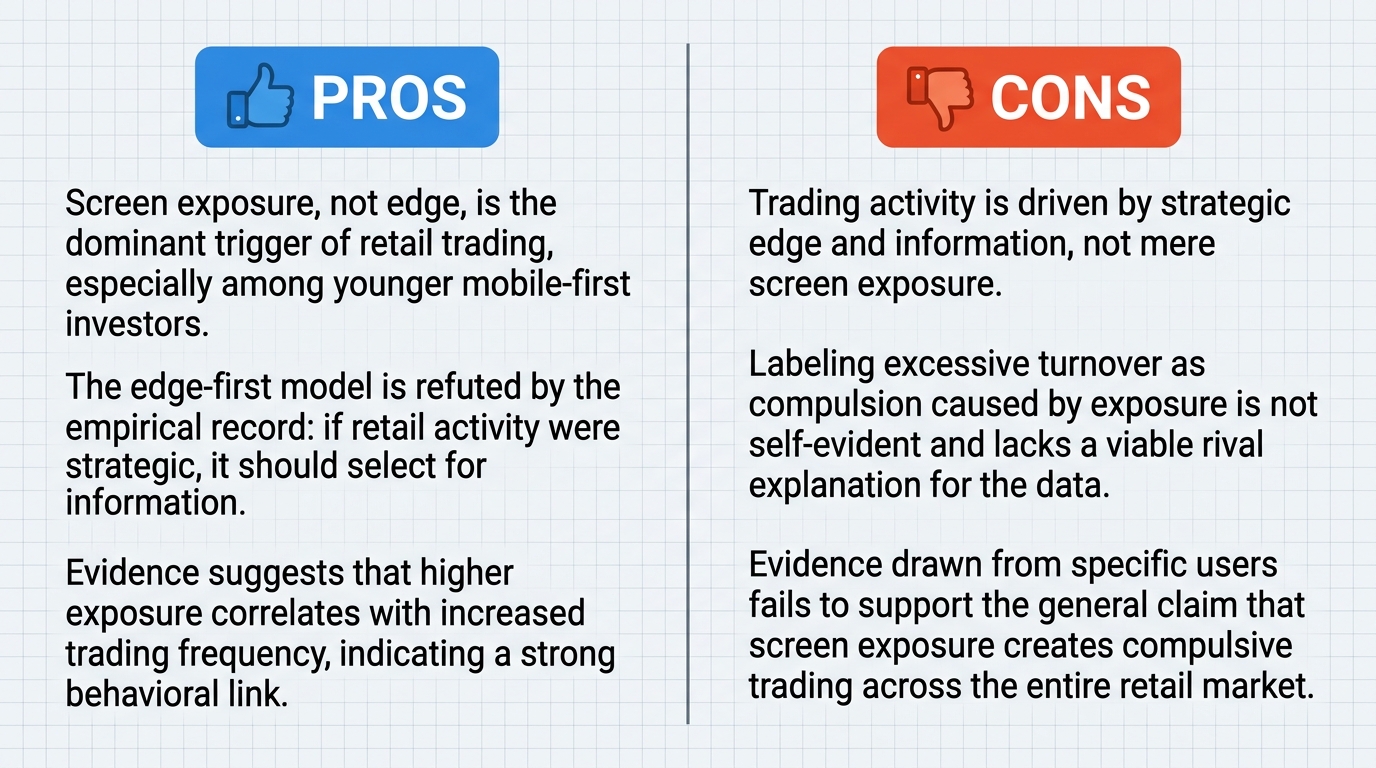
✅ Key PRO arguments:
- ■Screen exposure, not edge, is the dominant trigger of retail trading, especially among younger mobile-first investors. The timing and incidence of trades track exposure cadence rather than any edge the trader holds. Robinhood users react rapidly, typically within an hour, to stocks exhibiting extreme negative returns, showing the screen's price display is the trade's proximate cause.
- ■The edge-first model is refuted by the empirical record: if retail activity were predominantly the output of strategic edge, activity should be selected by informational content and rewarded by subsequent returns. Instead, internet sentiment predicts intraday overtrading in the Chinese A-share market, and the resulting excess activity is characterized as a component of systemic market risk rather than informed positioning.
❌ Key ANTI arguments:
- ■Trading activity is driven by strategic edge and information, not mere screen exposure. The affirmative conflates the measurement of a population with the subject of the claim: citing Robinhood and Reddit users does not provide the transfer operator—the specific correlation or causal mechanism—proving these behaviors are representative of the broader retail trader population.
- ■The affirmative's reading of 'excessive turnover' as evidence of compulsion caused by exposure is not self-evident and fails to provide a viable rival account for the observed data. Treating high turnover as a direct refutation of the edge-driven model does not address the underlying mechanics of why such trading occurs.
💭 Conclusion: False — the only debate verdict rejected the assertion that screen exposure compels trading regardless of a perceived edge. The negative side successfully argued that the affirmative's evidence, drawn from Robinhood and Reddit users, fails to establish a causal mechanism linking screen exposure to a psychological compulsion to trade in the broader retail population. The affirmative's interpretation of high turnover as evidence of compulsion was also shown to be non-self-evident and lacking a viable rival account for the observed data. The judge sided with the negative at 68% confidence, and because the claim is compound—requiring both screen-exposure compulsion and irrelevance of perceived edge—the confidence reflects the weakest supported sub-claim. Therefore the verdict is FALSE with 68% confidence.
🔬 DeepResearch Result: likely FALSE ❌ (68%)
Assertion: Individuals, particularly younger ones, often feel compelled to trade due to constant screen exposure, regardless of a perceived edge.
Participating models: deepseek-v3.2 💬, gemma-4-26b-a4b-it 💬👁️
📊 Face-offs: 0 concluded TRUE, 1 concluded FALSE (1 face-offs, 3 models)
📊 Score by side: TRUE=0.00, FALSE=0.68
🏅 Model score changes:
deepseek-v4-flash-0731 💬: +7
✅ PRO Arguments:
- ■Screen exposure, not edge, is the dominant trigger of retail trading, especially among younger mobile-first investors. The timing and incidence of trades track exposure cadence rather than any edge the trader holds. Robinhood users react rapidly, typically within an hour, to stocks exhibiting extreme negative returns, showing the screen's price display is the trade's proximate cause. deepseek-v3.2 💬
- ■The edge-first model is refuted by the empirical record: if retail activity were predominantly the output of strategic edge, activity should be selected by informational content and rewarded by subsequent returns. Instead, internet sentiment predicts intraday overtrading in the Chinese A-share market, and the resulting excess activity is characterized as a component of systemic market risk rather than informed positioning. deepseek-v3.2 💬
❌ ANTI Arguments:
- ■Trading activity is driven by strategic edge and information, not mere screen exposure. The affirmative conflates the measurement of a population with the subject of the claim: citing Robinhood and Reddit users does not provide the transfer operator—the specific correlation or causal mechanism—proving these behaviors are representative of the broader retail trader population. gemma-4-26b-a4b-it 💬👁️
- ■The affirmative's reading of 'excessive turnover' as evidence of compulsion caused by exposure is not self-evident and fails to provide a viable rival account for the observed data. Treating high turnover as a direct refutation of the edge-driven model does not address the underlying mechanics of why such trading occurs. gemma-4-26b-a4b-it 💬👁️
💭 Reasoning: False — the only debate verdict rejected the assertion that screen exposure compels trading regardless of a perceived edge. The negative side successfully argued that the affirmative's evidence, drawn from Robinhood and Reddit users, fails to establish a causal mechanism linking screen exposure to a psychological compulsion to trade in the broader retail population. The affirmative's interpretation of high turnover as evidence of compulsion was also shown to be non-self-evident and lacking a viable rival account for the observed data. The judge sided with the negative at 68% confidence, and because the claim is compound—requiring both screen-exposure compulsion and irrelevance of perceived edge—the confidence reflects the weakest supported sub-claim. Therefore the verdict is FALSE with 68% confidence.
📋 PRO Facts:
• Robinhood users' order flow analyzed at hourly frequency shows they react rapidly, typically within an hour, to stocks exhibiting extreme negative returns (Ardia, Aymard and Cenesizoglu).
• Internet sentiment predicts intraday overtrading in the Chinese A-share market (Peng).
• The excess activity from sentiment-driven overtrading is characterized as a component of systemic market risk rather than informed positioning.
📋 ANTI Facts:
• The affirmative's cited studies concern specific subsets (Robinhood users, Reddit users) and lack a demonstrated transfer operator to the broader 'retail trader' population.
• The affirmative's interpretation of 'excessive turnover' as compulsion caused by exposure is not self-evident and lacks a viable rival account for the observed data.
• No specific causal mechanism connecting screen exposure to a psychological compulsion to trade was established.
| Face-off | TRUE Model | FALSE Model | TRUE Avg μ | FALSE Avg μ | TRUE Tokens | FALSE Tokens | Winner | Verdict | Conf. |
|---|---|---|---|---|---|---|---|---|---|
| #1 | deepseek-v3.2 💬 | gemma-4-26b-a4b-it 💬👁️ | 0.565 | 0.213 | 8 | 2 | TRUE | FALSE | 68% |
The following financial data tables were referenced during the debate exchanges:
| Study (arXiv ID) | Year | Exposure channel | Documented compulsion marker |
|---|---|---|---|
| 2307.11012 | 2023 | Real-time app price display | Trade reaction typically within 1 hour of extreme negative return |
| 2202.08812 | 2022 | Push-notification system | Objective = immediate user response; flagged as misaligned with long-term satisfaction |
| 2401.14999 | 2024 | Reddit feed | Collective action dynamics attributed to continuous feed exposure |
| 2112.07059 | 2021 | Reddit feed | Self-induced consensus preceding coordinated positions |
| 1402.2494 | 2014 | Habitual portfolio structure | Current structure infers future trading activity |
Legend: Behavioural evidence corpus linking screen-exposure channels to trading triggers. Years are preprint publication years; "compulsion marker" is the finding reported by the cited study, not a measured rate. arXiv identifiers are locators for each paper.
| Argumentation Defect | Logical Basis | Impact on Affirmative Case |
|---|---|---|
| Identity Substitution | LOG-15 | Failure to link specific user cohorts to general trading compulsion |
| Thesis Narrowing | LOG-16 | Conceding the irrelevance of edge rather than defending the mechanism |
| Domain Import | LOG-03 | Conflating algorithmic optimization with human compulsion |
Legend: Summary of formal logical failures identified in the affirmative's opening argument.
| Study (locator) | Driver measured | Output of activity as recorded |
|---|---|---|
| arXiv:2404.12001v3 | Internet sentiment (screen-borne) | Intraday overtrading; framed as systemic risk |
| arXiv:2509.16616v1 | Trader risk profile | Retail cohort ranked as "risky"; P&L treated as the neglected signal |
| arXiv:2512.20027v1 | Visual on-screen content | Sentiment index built from millions of dynamic posts |
| arXiv:2512.14134v2 | Trading intensity vs investor identity | Intensity enters as a distinct explanatory variable |
Legend: Evidence corpus bearing on the negative's edge-first driver claim. Rows list the variable each study identifies as predictive of retail activity and how that activity is characterised in the study itself; no return figures are reported here because none were computed. Locators are arXiv identifiers with version numbers.
Face-off transcripts
- ■
Ownership & Trade Secrets. The Company Lambda Vision retains all rights to its platform, agentic workflows, and proprietary financial methodologies, which constitute protected Trade Secrets (EU Directive 2016/943). Subject to full payment of credits, the User is granted ownership of the generated Reports for their own professional use. Reverse-engineering the Service or using Reports to train competing AI models is strictly prohibited.
- ■
No Financial Advice. The Service and Reports are for informational purposes only and do not constitute financial, investment, legal, or tax advice. The Company is not a regulated financial advisor. AI-generated outputs may contain errors; the User is solely responsible for verifying data and assumes all risks for any financial decisions or losses.
- ■
Liability & Governing Law. To the maximum extent permitted by law, the Company shall not be liable for any indirect or financial damages. These Terms are governed by French law. Any disputes shall be subject to the exclusive jurisdiction of the Courts of Paris, France.