
Inflation can serve as a permanent and free solution for states to alleviate the real burden of their existing fixed-rate national debt.
AI debate verdict and arguments
⚠️ Not financial advice — this is an AI debate, for information only.
Completed October 30, 2026
Verdict
Verdict: likely FALSE (85%)
This section provides a brief overview of the key arguments. You do not need to read the full detailed report below.
✅ Key PRO arguments:
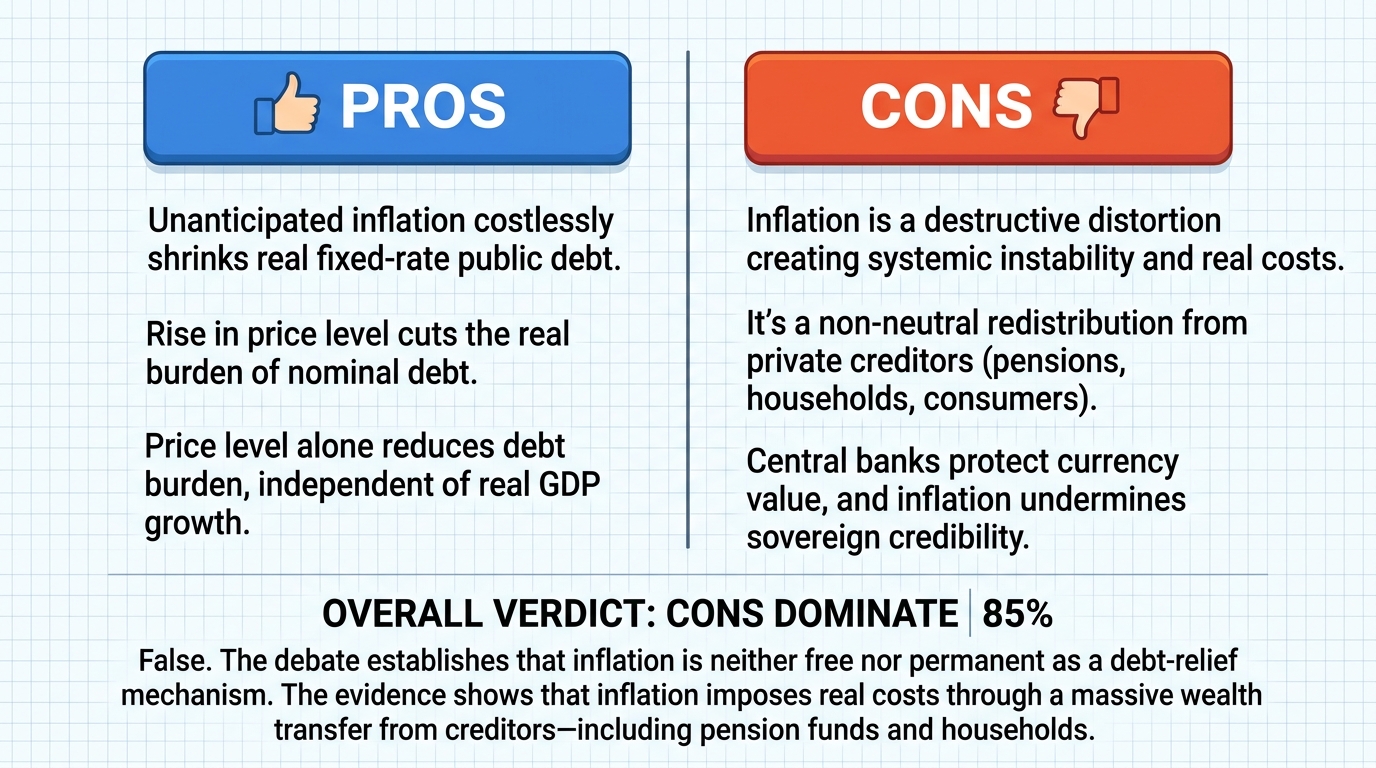
- ■Unanticipated inflation permanently and costlessly shrinks the real value of fixed-rate nominal public debt; a rise in the price level cuts the real burden of that stock without any budgetary outlay.
- ■The debt-to-GDP ratio evolves according to a stock-flow identity in which the stock is multiplied by the real-rate-minus-growth differential, making inflation a solvency term in the debt identity.
- ■Even at zero real growth, the price level alone cuts the real burden of fixed-rate nominal debt; the benefit does not depend on the real GDP denominator growing.
❌ Key ANTI arguments:
- ■Inflation is a destructive economic distortion that creates systemic instability and significant real costs; treating it as a 'free' transfer ignores the massive destruction of private capital and erosion of the economic foundations required for long-term solvency.
- ■The 'free' nature of inflation is an illusion: it is a massive non-neutral redistribution from private creditors, including pension funds, households, and the central bank, to the state, which creates systemic instability.
- ■In a modern globalized economy, the transfer is not largely internal; central banks act as guardians of the currency's value, and inflation undermines sovereign credit risk and fiscal stability.
💭 Conclusion: False. The debate establishes that inflation is neither free nor permanent as a debt-relief mechanism. The evidence shows that inflation imposes real costs through a massive wealth transfer from creditors—including pension funds and households—to the state, creating systemic instability. Because this transfer erodes the economic foundations required for long-term solvency and undermines the state's ability to function and borrow, it cannot be characterized as free. The same instability and higher borrowing costs mean the relief is not permanent, as it damages the very conditions needed for sustained fiscal health. Therefore, the assertion fails on both sub-claims, and the verdict is FALSE.
🔬 DeepResearch Result: likely FALSE ❌ (85%)
Assertion: Inflation can serve as a permanent and free solution for states to alleviate the real burden of their existing fixed-rate national debt.
Participating models: deepseek-v3.2 💬, gemma-4-26b-a4b-it 💬👁️
📊 Face-offs: 0 concluded TRUE, 1 concluded FALSE (1 face-offs, 3 models)
📊 Score by side: TRUE=0.00, FALSE=0.90
🏅 Model score changes:
deepseek-v4-flash-0731 💬: +9
✅ PRO Arguments:
- ■Unanticipated inflation permanently and costlessly shrinks the real value of fixed-rate nominal public debt; a rise in the price level cuts the real burden of that stock without any budgetary outlay. deepseek-v3.2 💬
- ■The debt-to-GDP ratio evolves according to a stock-flow identity in which the stock is multiplied by the real-rate-minus-growth differential, making inflation a solvency term in the debt identity. deepseek-v3.2 💬
- ■Even at zero real growth, the price level alone cuts the real burden of fixed-rate nominal debt; the benefit does not depend on the real GDP denominator growing. deepseek-v3.2 💬
- ■The mechanism is a redistribution rather than a payment, so it requires no budgetary outlay and leaves market access intact. deepseek-v3.2 💬
❌ ANTI Arguments:
- ■Inflation is a destructive economic distortion that creates systemic instability and significant real costs; treating it as a 'free' transfer ignores the massive destruction of private capital and erosion of the economic foundations required for long-term solvency. gemma-4-26b-a4b-it 💬👁️
- ■The 'free' nature of inflation is an illusion: it is a massive non-neutral redistribution from private creditors, including pension funds, households, and the central bank, to the state, which creates systemic instability. gemma-4-26b-a4b-it 💬👁️
- ■In a modern globalized economy, the transfer is not largely internal; central banks act as guardians of the currency's value, and inflation undermines sovereign credit risk and fiscal stability. gemma-4-26b-a4b-it 💬👁️
- ■Inflation undermines the state's ability to function and borrow, so it cannot serve as a permanent solution to debt burden. gemma-4-26b-a4b-it 💬👁️
💭 Reasoning: False. The debate establishes that inflation is neither free nor permanent as a debt-relief mechanism. The evidence shows that inflation imposes real costs through a massive wealth transfer from creditors—including pension funds and households—to the state, creating systemic instability. Because this transfer erodes the economic foundations required for long-term solvency and undermines the state's ability to function and borrow, it cannot be characterized as free. The same instability and higher borrowing costs mean the relief is not permanent, as it damages the very conditions needed for sustained fiscal health. Therefore, the assertion fails on both sub-claims, and the verdict is FALSE.
📋 PRO Facts:
• Unanticipated inflation reduces the real value of fixed-rate nominal debt.
• The debt-to-GDP identity includes a real-rate-minus-growth differential.
• The price level alone can cut the real burden even with zero real growth.
• The affirmative characterized the mechanism as a redistribution requiring no budgetary outlay.
📋 ANTI Facts:
• Inflation is a non-neutral redistribution from creditors to the state.
• Inflation creates systemic instability and erodes long-term solvency.
• The transfer affects pension funds and households.
• Inflation undermines sovereign credit risk and the state's ability to borrow.
| Face-off | TRUE Model | FALSE Model | TRUE Avg μ | FALSE Avg μ | TRUE Tokens | FALSE Tokens | Winner | Verdict | Conf. |
|---|---|---|---|---|---|---|---|---|---|
| #1 | deepseek-v3.2 💬 | gemma-4-26b-a4b-it 💬👁️ | 0.423 | 0.229 | 8 | 2 | TRUE | FALSE | 90% |
The following financial data tables were referenced during the debate exchanges:
| Assumed annual inflation (5 years, 2% real growth) | Real value of fixed nominal claim (% of issuance) | Debt-to-GDP ratio (% of starting level) | Erosion of claim vs 0% inflation |
|---|---|---|---|
| 0% | 100.0% | 90.6% | 0% |
| 2% | 90.6% | 82.2% | -9.4% |
| 4% | 82.2% | 74.7% | -17.8% |
| 6% | 74.7% | 68.1% | -25.3% |
| 8% | 68.1% | 62.1% | -32.0% |
Legend: Illustrative model of a frozen nominal debt stock over a five-year horizon. Columns 2 and 3 are indexed to 100 at issuance / at the start of the period; column 3 assumes 2% real GDP growth so nominal GDP grows at inflation + 2%. Final column is the percentage change in the real claim relative to the 0%-inflation row. Own calculation from the standard debt-accumulation identity.
| Economic Variable | Impact of Unanticipated Inflation | Impact on Debt Sustainability |
|---|---|---|
| Real Private Savings | Decrease | Negative (Lower long-term growth) |
| Risk Premium (Term Premium) | Increase | Negative (Higher borrowing costs) |
| Tax Revenue (Real Terms) | Lagged Decrease | Negative (Fiscal instability) |
| Capital Formation | Decrease | Negative (Reduced denominator growth) |
Legend: Qualitative assessment of the structural impacts of unanticipated inflation on a sovereign state's long-term fiscal position.
| Assumed five-year path (6% annual inflation) | Nominal GDP growth (π + real growth) | Debt-to-GDP ratio index (start = 100) | Real value of fixed nominal claim index (start = 100) | Effect of the real-growth assumption vs the 0%-growth row (index points) |
|---|---|---|---|---|
| 6% inflation, −6% real growth (break-even) | 0% | 100.0 | 74.7 | +25.3 |
| 6% inflation, −2% real growth (contraction) | 4% | 82.2 | 74.7 | +7.5 |
| 6% inflation, 0% real growth (the "pure mirage") | 6% | 74.7 | 74.7 | 0.0 |
| 6% inflation, +2% real growth | 8% | 68.1 | 74.7 | -6.6 |
Legend: Own arithmetic on a frozen nominal debt stock over a five-year horizon, indexed to 100 at the start. Nominal GDP growth uses the additive convention (inflation plus real growth); the claim index is 1/(1.06⁵) = 74.7 regardless of the real-growth assumption. Final column is the change in the ratio index relative to the zero-real-growth row, in index points.
Face-off transcripts
- ■
Ownership & Trade Secrets. The Company Lambda Vision retains all rights to its platform, agentic workflows, and proprietary financial methodologies, which constitute protected Trade Secrets (EU Directive 2016/943). Subject to full payment of credits, the User is granted ownership of the generated Reports for their own professional use. Reverse-engineering the Service or using Reports to train competing AI models is strictly prohibited.
- ■
No Financial Advice. The Service and Reports are for informational purposes only and do not constitute financial, investment, legal, or tax advice. The Company is not a regulated financial advisor. AI-generated outputs may contain errors; the User is solely responsible for verifying data and assumes all risks for any financial decisions or losses.
- ■
Liability & Governing Law. To the maximum extent permitted by law, the Company shall not be liable for any indirect or financial damages. These Terms are governed by French law. Any disputes shall be subject to the exclusive jurisdiction of the Courts of Paris, France.