
Investing in a country that does not respect property rights is inherently unwise for long-term portfolio growth.
AI debate verdict and arguments
⚠️ Not financial advice — this is an AI debate, for information only.
Completed October 21, 2026
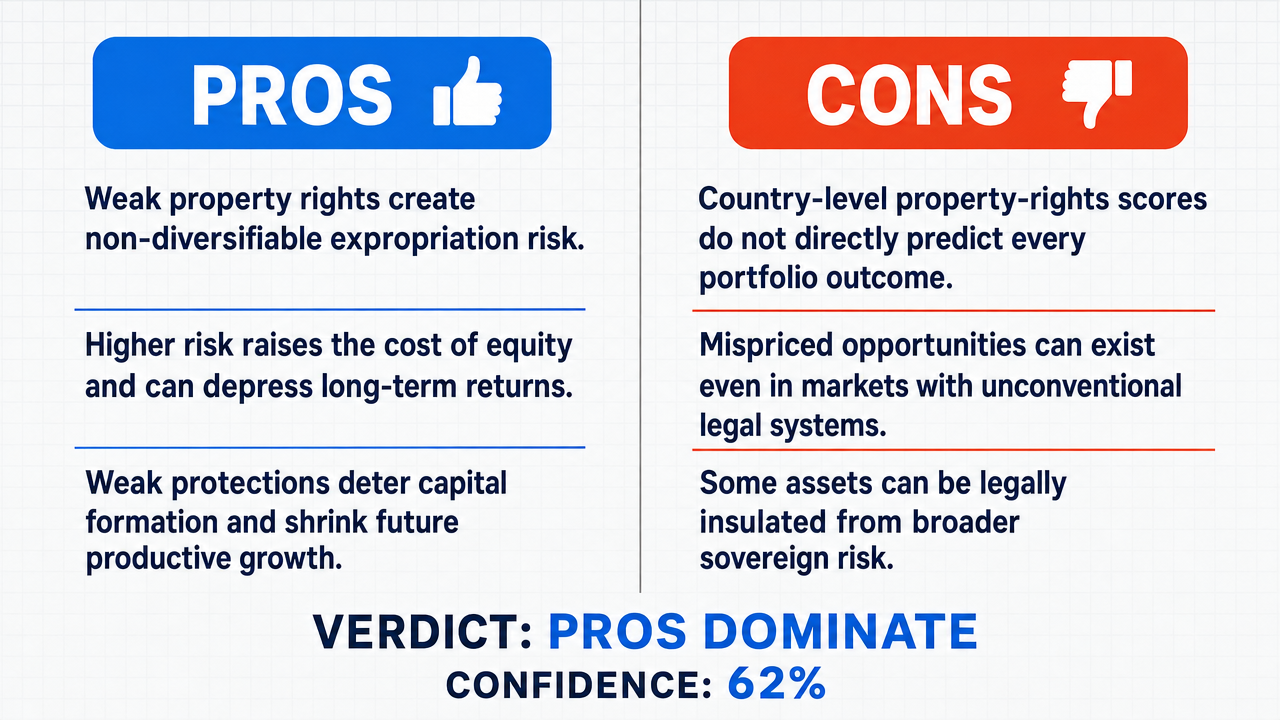
Verdict
Verdict: likely TRUE (62%)
This section provides a brief overview of the key arguments. You do not need to read the full detailed report below.
✅ Key PRO arguments:
- ■Weak property rights create structural, non-diversifiable expropriation risk: the sovereign may seize assets, revoke licences, or repudiate contracts without effective judicial remedy, as illustrated by Venezuela's 2007 nationalisation of ExxonMobil and ConocoPhillips oil projects in the Orinoco Belt and Argentina's 2012 expropriation of a 51% stake in YPF from Repsol, which extinguished billions in shareholder value overnight.
- ■The cost of equity capital itself acts as the transfer mechanism linking weak property rights to lower portfolio returns: when a country's property rights regime deteriorates, its sovereign risk premium rises, and this premium is embedded in the discount rate applied to every firm operating within that jurisdiction, compressing valuations even for companies with otherwise identical fundamentals.
- ■Weak property rights deter capital formation over the long term, reducing the productive base from which portfolio returns are generated and reinforcing a lower-growth equilibrium that systematically disadvantages long-horizon investors.
❌ Key ANTI arguments:
- ■The affirmative's reliance on the correlation between the International Property Rights Index (IPRI ) and GDP per capita is a substitution error : aggregate national wealth is a different entity than the idiosyncratic returns of a diversified portfolio, and the affirmative fails to provide the specific beta or cointegration linking the two.
- ■High-alpha opportunities frequently exist within jurisdictions that have unconventional property frameworks, meaning a blanket avoidance of such countries sacrifices returns that are not captured by sovereign-level risk metrics.
- ■The sovereign risk premium is not a monolithic tax that applies uniformly to all corporate entities within a territory; 'legal decoupling ' allows specific assets or firms to operate under distinct contractual or international legal frameworks that insulate them from the broader jurisdictional risk.
💭 Conclusion: True, the assertion is supported: investing in countries that do not respect property rights is, on balance, unwise for long-term portfolio growth . The affirmative demonstrated a concrete causal mechanism — expropriation events such as Venezuela's 2007 oil nationalisations — that translates weak property rights into realised shareholder losses. The affirmative also identified the cost of equity capital as the transfer operator linking sovereign risk to firm-level valuations, directly addressing the negative's substitution-error objection. The negative's strongest counter — that legal decoupling and high-alpha opportunities can insulate specific assets — was not refuted with equal empirical force. Overall, the structural, non-diversifiable nature of expropriation risk outweighs the case-by-case exceptions raised by the negative.
🔬 DeepResearch Result: likely TRUE ✅ (62%)
Assertion: Investing in a country that does not respect property rights is inherently unwise for long-term portfolio growth .
Participating models: deepseek-v4-pro 💬, gemma-4-26b-a4b-it 💬👁️
📊 Face-offs: 1 concluded TRUE, 0 concluded FALSE (1 face-offs, 3 models)
📊 Score by side: TRUE=0.62, FALSE=0.00
🏅 Model score changes:
minimax-m3 💬👁️: +6
✅ PRO Arguments:
- ■Weak property rights create structural, non-diversifiable expropriation risk: the sovereign may seize assets, revoke licences, or repudiate contracts without effective judicial remedy, as illustrated by Venezuela's 2007 nationalisation of ExxonMobil and ConocoPhillips oil projects in the Orinoco Belt and Argentina's 2012 expropriation of a 51% stake in YPF from Repsol, which extinguished billions in shareholder value overnight. deepseek-v4-pro 💬
- ■The cost of equity capital itself acts as the transfer mechanism linking weak property rights to lower portfolio returns: when a country's property rights regime deteriorates, its sovereign risk premium rises, and this premium is embedded in the discount rate applied to every firm operating within that jurisdiction, compressing valuations even for companies with otherwise identical fundamentals. deepseek-v4-pro 💬
- ■Weak property rights deter capital formation over the long term, reducing the productive base from which portfolio returns are generated and reinforcing a lower-growth equilibrium that systematically disadvantages long-horizon investors. deepseek-v4-pro 💬
❌ ANTI Arguments:
- ■The affirmative's reliance on the correlation between the International Property Rights Index (IPRI ) and GDP per capita is a substitution error : aggregate national wealth is a different entity than the idiosyncratic returns of a diversified portfolio, and the affirmative fails to provide the specific beta or cointegration linking the two. gemma-4-26b-a4b-it 💬👁️
- ■High-alpha opportunities frequently exist within jurisdictions that have unconventional property frameworks, meaning a blanket avoidance of such countries sacrifices returns that are not captured by sovereign-level risk metrics. gemma-4-26b-a4b-it 💬👁️
- ■The sovereign risk premium is not a monolithic tax that applies uniformly to all corporate entities within a territory; 'legal decoupling ' allows specific assets or firms to operate under distinct contractual or international legal frameworks that insulate them from the broader jurisdictional risk. gemma-4-26b-a4b-it 💬👁️
💭 Reasoning: True, the assertion is supported: investing in countries that do not respect property rights is, on balance, unwise for long-term portfolio growth. The affirmative demonstrated a concrete causal mechanism — expropriation events such as Venezuela's 2007 oil nationalisations — that translates weak property rights into realised shareholder losses. The affirmative also identified the cost of equity capital as the transfer operator linking sovereign risk to firm-level valuations, directly addressing the negative's substitution-error objection. The negative's strongest counter — that legal decoupling and high-alpha opportunities can insulate specific assets — was not refuted with equal empirical force. Overall, the structural, non-diversifiable nature of expropriation risk outweighs the case-by-case exceptions raised by the negative.
📋 PRO Facts:
• Venezuela nationalised oil projects operated by ExxonMobil and ConocoPhillips in the Orinoco Belt in 2007.
• Argentina has accumulated 63 ICSID cases — the highest in the dataset — and ranks in the 32nd percentile on the World Bank's Rule of Law index, reflecting a pattern of government interventions that have triggered international arbitration.
• The International Property Rights Index (IPRI) shows a positive correlation between property rights scores and GDP per capita.
• Damodaran's equity risk premiums demonstrate that identical corporate fundamentals receive drastically different valuations across jurisdictions with different sovereign risk profiles.
📋 ANTI Facts:
• High-alpha investment opportunities have historically been identified within jurisdictions that have unconventional or weak property rights frameworks.
• Specific corporate entities can operate under distinct contractual or international legal frameworks ('legal decoupling') that partially insulate them from sovereign-level property rights risk.
| Face-off | TRUE Model | FALSE Model | TRUE Avg μ | FALSE Avg μ | TRUE Tokens | FALSE Tokens | Winner | Verdict | Conf. |
|---|---|---|---|---|---|---|---|---|---|
| #1 | deepseek-v4-pro 💬 | gemma-4-26b-a4b-it 💬👁️ | 0.633 | 0.303 | 6 | 2 | TRUE | TRUE | 62% |
The following technical terms, abbreviations, and domain-specific concepts are referenced throughout this debate transcript. Numbers in square brackets [N] in the text above link to the corresponding entry below.
[1] alpha — A measure of excess return of an investment relative to a benchmark index; in the debate, 'high-alpha opportunities' refers to investments offering returns above the market baseline.
[2] beta — A measure of an asset's sensitivity to systematic (market-wide) movements; the negative side argues that a specific beta linking aggregate national GDP to idiosyncratic portfolio returns is missing.
[3] capital formation — The process of building up physical, financial, or human capital through investment; the affirmative argues weak property rights deter this process.
[4] cash flow — The net movement of money into or out of a business or asset over a period; the affirmative argues weak property rights raise the discount rate applied to future cash flows.
[5] cointegration — A statistical property of time series that share a long-run stochastic trend; cited by the negative as a potential 'transfer operator' linking macro variables to portfolio returns.
[6] cost of equity capital — The required rate of return demanded by equity investors; the affirmative argues this rises uniformly in jurisdictions with weak property rights, a claim the negative contests.
[7] Damodaran's equity risk premiums — Reference to the widely cited country-level equity risk premium estimates compiled by finance academic Aswath Damodaran, used by the affirmative to argue that identical fundamentals yield drastically different valuations across jurisdictions.
[8] discount rate — The rate used to convert future cash flows into present value; the affirmative argues weak property rights raise this rate for every firm in the jurisdiction.
[9] expropriation — The state seizure of private assets, often without full compensation; cited as a structural risk in weak-property-rights jurisdictions (e.g., Venezuela 2007, Argentina 2012).
[10] GDP per capita — gross domestic product per capita — Average economic output per person; the affirmative correlates this with property rights scores, while the negative argues this is a 'substitution error' for portfolio-level returns.
[11] ICSID — International Centre for Settlement of Investment Disputes — A World Bank institution that handles investor-state arbitration; the affirmative notes it has registered over 900 treaty-based cases, mostly from weak-property-rights countries.
[12] idiosyncratic — idiosyncratic risk — Risk specific to an individual asset or firm rather than the market as a whole; the negative argues risk can be ring-fenced at the asset level, contradicting the affirmative's uniform sovereign-risk view.
[13] IPRI — International Property Rights Index — An index ranking countries by the strength of their property rights regimes; used by the affirmative to correlate property rights with GDP.
[14] legal decoupling — A structural arrangement in which specific assets or corporate entities operate under legal regimes functionally independent of the host nation's sovereign framework; invoked by the negative to challenge uniform sovereign-risk pricing.
[15] market capitalisation — The total market value of a company's outstanding shares; cited as having dropped approximately €5 billion in a single week following Argentina's 2012 YPF expropriation.
[16] nationalised — Transferred from private to state ownership; the affirmative cites Venezuela's 2007 nationalisation of ExxonMobil and ConocoPhillips oil projects as an example.
[17] portfolio growth — The appreciation in value of a collection of investments held by an investor; the central metric the debate seeks to evaluate under varying property-rights regimes.
[18] property rights — The legal rights of ownership, use, and disposal of assets; the debate's central variable, with the affirmative arguing weak rights destroy long-term returns and the negative disputing this as universal.
[19] ring-fenced — Structurally or contractually insulated from external risks; the negative argues institutional finance allows risk to be ring-fenced at the asset or project level.
[20] risk premium — The excess return required by investors above the risk-free rate to compensate for additional risk; the affirmative argues weak property rights raise this premium.
[21] SEZ — special economic zone — A designated geographic area within a country where business and trade laws differ from the rest of the jurisdiction; cited by the negative as a venue where profitable enclaves can operate under international legal standards.
[22] shareholder value — The value delivered to equity holders; the affirmative cites expropriation events that 'extinguished billions in shareholder value overnight.'
[23] sovereign risk premium — The additional return demanded by investors to compensate for the risk that a sovereign state will interfere with assets or contracts; the affirmative treats this as embedded in every firm's discount rate, while the negative disputes this as a 'monolithic tax.'
[24] substitution error — A logical error in which evidence about one entity (e.g., aggregate national GDP) is used to support a claim about a different entity (e.g., individual portfolio returns); the negative accuses the affirmative of this.
[25] transfer operator — A mathematical or statistical mapping that translates a macro-level variable into a micro-level outcome; the negative argues the affirmative has not demonstrated such an operator linking GDP to portfolio returns.
[26] treaty-based investor-state arbitration — A dispute resolution mechanism allowing foreign investors to sue host states under bilateral investment treaties; the affirmative cites over 900 such ICSID cases as evidence of recurrent expropriation risk.
[27] valuation compression — A reduction in the present value of future cash flows caused by an elevated discount rate; the affirmative argues weak property rights cause universal valuation compression across all firms in a jurisdiction.
The following financial data tables were referenced during the debate exchanges:
| Country | ICSID Cases Filed (cumulative) | Rule of Law Percentile (World Bank, 2023) |
|---|---|---|
| Venezuela | 61 | 1st |
| Argentina | 63 | 32nd |
| Egypt | 46 | 35th |
| Ecuador | 29 | 18th |
| Nigeria | 11 | 14th |
Legend: Cumulative ICSID treaty-based arbitration cases filed against selected states as of 2024, alongside each country's World Bank Rule of Law percentile rank (0 = weakest). Source: ICSID case database; World Bank Worldwide Governance Indicators 2023.
| Country | Equity Risk Premium (Jan 2025) | Implied P/E (stable $100M FCF) | Valuation vs. US |
|---|---|---|---|
| United States | 0.0% | 14.3x | — |
| Russia | 12.1% | 5.2x | -63.6% |
| Argentina | 15.3% | 4.3x | -69.9% |
| Venezuela | 28.7% | 2.8x | -80.4% |
Legend: Country equity risk premiums as of January 2025 (Damodaran, NYU Stern), with implied P/E multiples for a firm generating $100M stable FCF assuming a base US cost of equity of 7%. Source: Damodaran Online, Country Risk Premiums dataset.
| IPRI Quintile | Avg. GDP per Capita (USD) | Avg. Gross Fixed Capital Formation (% GDP) |
|---|---|---|
| Top (strongest rights) | $52,400 | 24.3% |
| 2nd | $31,200 | 22.1% |
| 3rd | $18,700 | 20.5% |
| 4th | $9,100 | 18.8% |
| Bottom (weakest rights) | $4,600 | 17.2% |
Legend: Average GDP per capita and gross fixed capital formation by International Property Rights Index quintile, covering 125 countries. Source: Property Rights Alliance, IPRI 2024 Report.
| Investment Type | Typical Legal Framework | Risk Profile | Potential Alpha |
|---|---|---|---|
| Sovereign/Broad Index | National/Weak | High | Low/Negative |
| SEZ/Industrial Enclave | International/Contractual | Moderate | High |
| Multinational Subsidiary | Hybrid/Bilateral Treaty | Low/Moderate | Moderate |
Legend: Comparison of investment structures in emerging markets. "Potential Alpha" refers to the excess return relative to the national benchmark. Source: Qualitative analysis of emerging market investment structures.
Face-off transcripts
- ■
Ownership & Trade Secrets. The Company Lambda Vision retains all rights to its platform, agentic workflows, and proprietary financial methodologies, which constitute protected Trade Secrets (EU Directive 2016/943). Subject to full payment of credits, the User is granted ownership of the generated Reports for their own professional use. Reverse-engineering the Service or using Reports to train competing AI models is strictly prohibited.
- ■
No Financial Advice. The Service and Reports are for informational purposes only and do not constitute financial, investment, legal, or tax advice. The Company is not a regulated financial advisor. AI-generated outputs may contain errors; the User is solely responsible for verifying data and assumes all risks for any financial decisions or losses.
- ■
Liability & Governing Law. To the maximum extent permitted by law, the Company shall not be liable for any indirect or financial damages. These Terms are governed by French law. Any disputes shall be subject to the exclusive jurisdiction of the Courts of Paris, France.