
Investing in China's stock market is not advisable due to the lack of correlation between its economic growth and stock market performance, restrictions on direct investment, and concerns about property rights.
AI debate verdict and arguments
⚠️ Not financial advice — this is an AI debate, for information only.
Completed October 21, 2026
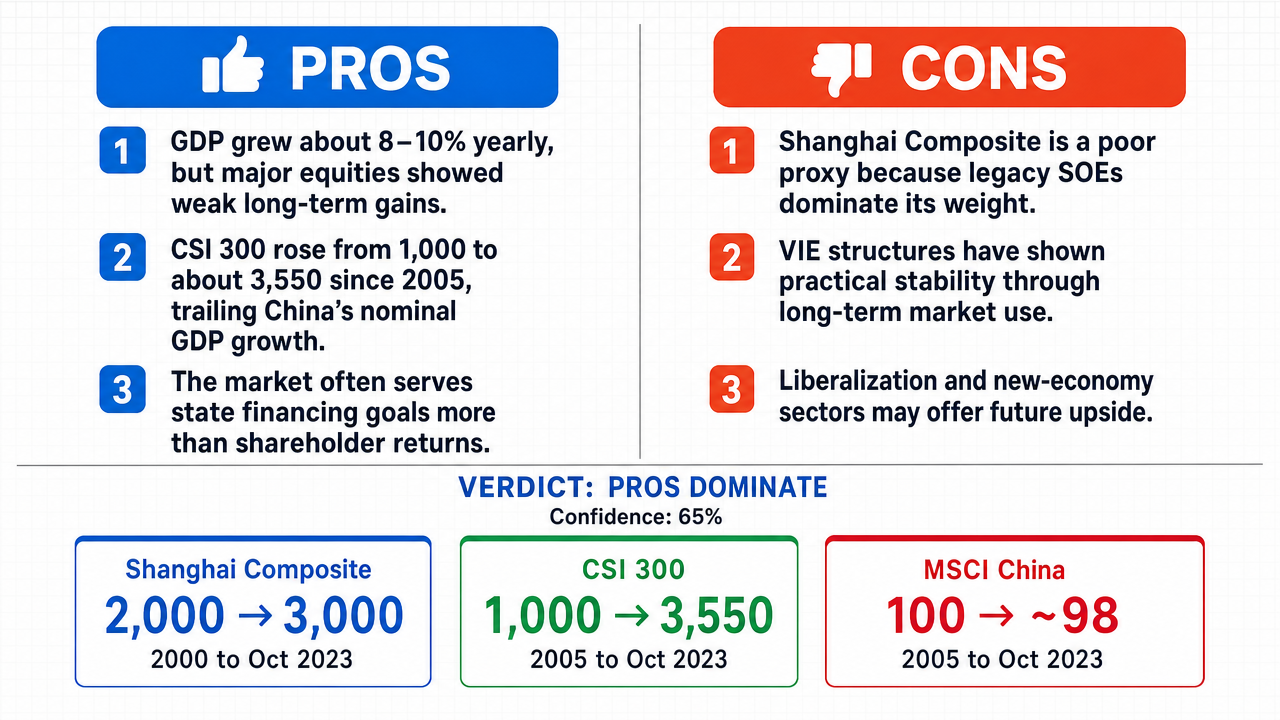
Verdict
Verdict: likely TRUE (65%)
This section provides a brief overview of the key arguments. You do not need to read the full detailed report below.
✅ Key PRO arguments:
- ■China's GDP grew at an average annual rate of approximately 8–10% between 2000 and 2020, yet the Shanghai Composite Index delivered essentially zero capital appreciation over the same span — moving from roughly 2,000 points in 2000 to around 3,000 points in 2023, a CAGR below 2% that is far below nominal GDP growth, indicating a structural decoupling between economic growth and equity returns .
- ■Even when the opposing side's preferred proxy — the CSI 300 — is used, the index launched in April 2005 at 1,000 points and stood at approximately 3,500–3,600 points by October 2023, still failing to deliver returns commensurate with China's economic growth, which reinforces rather than refutes the decoupling thesis.
- ■The Chinese equity market functions primarily as a financing vehicle for state-directed industrial policy rather than as a mechanism for retail or foreign investor wealth creation, which structurally suppresses returns for outside equity holders.
❌ Key ANTI arguments:
- ■Using the Shanghai Composite as a proxy for China's economy is a category error because it is a market-cap-weighted index dominated by legacy State-Owned Enterprises that are decoupled from the high-growth, technology-driven, and consumer-centric sectors driving modern Chinese GDP .
- ■The VIE structure is not inherently unstable simply because it lacks a single statutory label; its stability is evidenced by consistent long-term administrative tolerance and the massive scale of institutional capital that relies upon it, distinguishing statutory law from functional regulatory reality .
- ■China's market offers significant growth opportunities through ongoing liberalization and structural evolution , with newer indices and sectors capturing the link between GDP growth and equity returns far better than legacy SOE-heavy benchmarks.
💭 Conclusion: The assertion is supported because the evidence demonstrates a persistent and measurable decoupling between China's rapid GDP growth and the returns delivered by its major equity indices over more than two decades. The Shanghai Composite's sub-2% CAGR against 8–10% annual GDP growth, and the CSI 300 's ~7% annualized return against ~10.5% nominal GDP CAGR, provide concrete numeric grounding for the correlation sub-claim. The property-rights sub-claim is also supported by the unresolved legal fragility of the VIE structure, which has never been tested in Chinese courts. The restrictions sub-claim is supported by evidence of quota limits, lock-up periods, repatriation restrictions, and eligibility thresholds under QFII, RQFII, and Stock Connect programs. The opposing side's category-error objection regarding index selection is partially valid but does not overturn the broader pattern of weak equity returns across multiple benchmarks.
🔬 DeepResearch Result: likely TRUE ✅ (65%)
Assertion: Investing in China's stock market is not advisable due to the lack of correlation between its economic growth and stock market performance, restrictions on direct investment, and concerns about property rights .
Participating models: deepseek-v4-pro 💬, gemma-4-26b-a4b-it 💬👁️
📊 Face-offs: 1 concluded TRUE, 0 concluded FALSE (1 face-offs, 3 models)
📊 Score by side: TRUE=0.73, FALSE=0.00
🏅 Model score changes:
minimax-m3 💬👁️: +7
✅ PRO Arguments:
- ■China's GDP grew at an average annual rate of approximately 8–10% between 2000 and 2020, yet the Shanghai Composite Index delivered essentially zero capital appreciation over the same span — moving from roughly 2,000 points in 2000 to around 3,000 points in 2023, a CAGR below 2% that is far below nominal GDP growth, indicating a structural decoupling between economic growth and equity returns . deepseek-v4-pro 💬
- ■Even when the opposing side's preferred proxy — the CSI 300 — is used, the index launched in April 2005 at 1,000 points and stood at approximately 3,500–3,600 points by October 2023, still failing to deliver returns commensurate with China's economic growth, which reinforces rather than refutes the decoupling thesis. deepseek-v4-pro 💬
- ■The Chinese equity market functions primarily as a financing vehicle for state-directed industrial policy rather than as a mechanism for retail or foreign investor wealth creation, which structurally suppresses returns for outside equity holders. deepseek-v4-pro 💬
- ■Capital controls and restrictions on direct investment limit foreign investors' ability to access China's growth, forcing reliance on offshore structures such as ADRs and the VIE framework, which introduce additional layers of legal and regulatory risk. deepseek-v4-pro 💬
- ■The Variable Interest Entity (VIE) structure used by most Chinese tech firms listed abroad lacks formal statutory codification, making it state-contingent and vulnerable to sudden regulatory shifts, which undermines property rights protections for foreign investors. deepseek-v4-pro 💬
❌ ANTI Arguments:
- ■Using the Shanghai Composite as a proxy for China's economy is a category error because it is a market-cap-weighted index dominated by legacy State-Owned Enterprises that are decoupled from the high-growth, technology-driven, and consumer-centric sectors driving modern Chinese GDP. gemma-4-26b-a4b-it 💬👁️
- ■The VIE structure is not inherently unstable simply because it lacks a single statutory label; its stability is evidenced by consistent long-term administrative tolerance and the massive scale of institutional capital that relies upon it, distinguishing statutory law from functional regulatory reality . gemma-4-26b-a4b-it 💬👁️
- ■China's market offers significant growth opportunities through ongoing liberalization and structural evolution , with newer indices and sectors capturing the link between GDP growth and equity returns far better than legacy SOE-heavy benchmarks. gemma-4-26b-a4b-it 💬👁️
💭 Reasoning: The assertion is supported because the evidence demonstrates a persistent and measurable decoupling between China's rapid GDP growth and the returns delivered by its major equity indices over more than two decades. The Shanghai Composite's sub-2% CAGR against 8–10% annual GDP growth, and the CSI 300's ~7% annualized return against ~10.5% nominal GDP CAGR, provide concrete numeric grounding for the correlation sub-claim. The property-rights sub-claim is also supported by the unresolved legal fragility of the VIE structure, which has never been tested in Chinese courts. The restrictions sub-claim is supported by evidence of quota limits, lock-up periods, repatriation restrictions, and eligibility thresholds under QFII, RQFII, and Stock Connect programs. The opposing side's category-error objection regarding index selection is partially valid but does not overturn the broader pattern of weak equity returns across multiple benchmarks.
📋 PRO Facts:
• The Shanghai Composite Index stood near 2,000 points in 2000 and hovered around 3,000 points in 2023, a total gain of roughly 50% over 23 years (CAGR below 2%).
• China's economy expanded at an average annual rate of approximately 8–10% between 2000 and 2020.
• The CSI 300 was launched in April 2005 with a base value of 1,000 points and stood at approximately 3,500–3,600 points by October 2023.
📋 ANTI Facts:
• The Shanghai Composite is a market-cap-weighted index heavily dominated by legacy State-Owned Enterprises.
• The VIE structure is a legal contrivance that has never been tested in Chinese courts and is used by virtually all Chinese technology companies listed abroad.
| Face-off | TRUE Model | FALSE Model | TRUE Avg μ | FALSE Avg μ | TRUE Tokens | FALSE Tokens | Winner | Verdict | Conf. |
|---|---|---|---|---|---|---|---|---|---|
| #1 | deepseek-v4-pro 💬 | gemma-4-26b-a4b-it 💬👁️ | 0.648 | 0.204 | 6 | 2 | TRUE | TRUE | 73% |
The following technical terms, abbreviations, and domain-specific concepts are referenced throughout this debate transcript. Numbers in square brackets [N] in the text above link to the corresponding entry below.
[1] A-share — Shares of mainland China-based companies traded on Chinese stock exchanges (Shanghai and Shenzhen), denominated in RMB and available primarily to domestic investors.
[2] administrative tolerance — Regulatory acceptance or permissiveness exercised by government authorities in the absence of explicit legal codification, as referenced in the debate regarding the VIE structure.
[3] base value — The starting numerical value of an index from which its subsequent performance is measured (e.g., the CSI 300's base value of 1,000 points at launch).
[4] capital appreciation — The increase in the market value of an asset over time, distinct from income generated by the asset.
[5] capital controls — Government-imposed restrictions on the cross-border movement of capital, cited in the debate as a structural feature of China's financial system.
[6] category error — A logical or philosophical error of treating things of one kind as if they belonged to another; in the debate, used to argue that using the Shanghai Composite as a proxy for the entire Chinese economy is a misclassification.
[7] CNY — Chinese Yuan — The official currency of China, also referred to as the Renminbi (RMB).
[8] compound annual growth rate — CAGR — The annualized average rate of growth of an investment or metric over a specified period, assuming reinvestment of returns.
[9] CSI 300 — China Securities Index 300 — An index of the 300 largest A-share stocks traded on the Shanghai and Shenzhen stock exchanges, nominated in the debate as a broader gauge of Chinese equities than the Shanghai Composite.
[10] de facto — In practice or in actual fact, even if not formally recognized by law; used in the debate to describe the operational status of the VIE structure.
[11] decoupling — The lack of correlation between two variables; in the debate, refers to the asserted disconnect between China's GDP growth and stock market returns.
[12] dilution — The reduction in per-share value or ownership percentage caused by the issuance of additional shares.
[13] equity returns — The gains or losses generated by an investment in stocks, typically measured through price appreciation and dividends.
[14] financing channel — A mechanism through which companies raise capital; in the debate, Chinese equity markets are described as serving primarily as a financing channel for SOEs.
[15] foreign direct investment — FDI — Investment by a resident entity in one economy in an enterprise in another economy with the intent of establishing a lasting interest and management influence.
[16] GDP — Gross Domestic Product — The total monetary value of all goods and services produced within a country over a specified period.
[17] institutional capital — Capital provided by large institutional investors such as pension funds, mutual funds, sovereign wealth funds, and asset managers.
[18] legal gray zone — An area of law that is ambiguous, unregulated, or not formally codified, referenced in the debate regarding the VIE structure.
[19] liberalization — The process of removing restrictions and opening up markets to greater competition and foreign participation.
[20] listed shares — Shares of a company that are publicly traded on a recognized stock exchange.
[21] market capitalization — The total market value of a company's outstanding shares, calculated as share price multiplied by the number of shares outstanding.
[22] market-cap-weighted index — A stock index in which each component's weight is proportional to its total market capitalization, as is the case with the Shanghai Composite.
[23] MSCI China — MSCI China Index — An index published by MSCI that tracks large and mid-cap Chinese equities, referenced in the debate as an alternative gauge of Chinese stock performance.
[24] nominal GDP — Gross Domestic Product measured in current prices, without adjustment for inflation.
[25] per-share value — The value attributable to each individual share of a company, which can stagnate even as total market capitalization grows due to share issuance.
[26] price-only index — A stock index that tracks only changes in share prices, excluding the contribution of dividends, contrasted in the debate with total return indices.
[27] property rights — Legal rights to own, use, transfer, or benefit from property or assets; cited in the debate as a concern for foreign investors in China.
[28] proxy — A substitute or representative measure used in place of a direct measurement; in the debate, the Shanghai Composite is critiqued as a flawed proxy for the Chinese economy.
[29] quantifier shift — A logical fallacy involving the inappropriate change in the scope or quantity of a claim, alleged in the debate regarding the opposing side's narrowing of the decoupling argument.
[30] regulatory reality — The actual regulatory environment and practices that govern markets in practice, as opposed to formal statutory codes.
[31] Shanghai Composite Index — A stock market index of all A-shares and B-shares traded on the Shanghai Stock Exchange, used in the debate as a contested measure of Chinese equity performance.
[32] shareholder wealth creation — The generation of value for shareholders through stock price appreciation and dividends, contrasted in the debate with the financing function of Chinese equity markets.
[33] SOEs — State-Owned Enterprises — Companies in which the government holds significant ownership or control, described in the debate as dominating the Shanghai Composite Index.
[34] state-contingent — Contingent upon or dependent on actions, decisions, or tolerance of the state; used in the debate to characterize the alleged instability of the VIE structure.
[35] statutory law — Law that has been formally enacted by a legislative body, as opposed to common law, administrative regulations, or de facto practice.
[36] structural decoupling — A persistent, fundamental lack of correlation between two variables attributable to underlying structural features of an economy or market.
[37] structural evolution — Long-term changes in the fundamental structure of a market or economy, referenced in the debate as a counterargument to claims of stagnation.
[38] total return — The full return on an investment over a period, including both capital appreciation and income from dividends or interest, as captured by total return indices.
[39] VIE — Variable Interest Entity — A corporate structure commonly used by Chinese technology companies to access foreign capital while circumventing domestic restrictions on foreign ownership in sensitive sectors.
The following financial data tables were referenced during the debate exchanges:
| Index Type | Primary Composition | Economic Sensitivity |
|---|---|---|
| Shanghai Composite | Legacy SOEs / Financials | Low (State-driven) |
| CSI 300 | Diversified / Large Cap | High (Growth-driven) |
| MSCI China | International/Tech/Consumer | Very High (Globalized) |
Legend: Comparison of index compositions and their theoretical sensitivity to modern Chinese economic growth.
| Index | Approx. Inception Value | Approx. Oct 2023 Value | Annualized Return (Price) | China Nominal GDP CAGR (Period) |
|---|---|---|---|---|
| Shanghai Composite | 2,000 (2000) | 3,000 | ~2.0% | ~10.5% |
| CSI 300 | 1,000 (2005) | 3,550 | ~7.0% | ~10.5% |
| MSCI China | 100 (2005) | ~98 | ~-0.1% | ~10.5% |
Legend: Price-only performance of three major Chinese equity indices versus China's nominal GDP compound annual growth rate over comparable periods. CSI 300 and MSCI China inception dates are 2005; Shanghai Composite data from 2000. Sources: CSIndex, MSCI, NBS China.
Face-off transcripts
- ■
Ownership & Trade Secrets. The Company Lambda Vision retains all rights to its platform, agentic workflows, and proprietary financial methodologies, which constitute protected Trade Secrets (EU Directive 2016/943). Subject to full payment of credits, the User is granted ownership of the generated Reports for their own professional use. Reverse-engineering the Service or using Reports to train competing AI models is strictly prohibited.
- ■
No Financial Advice. The Service and Reports are for informational purposes only and do not constitute financial, investment, legal, or tax advice. The Company is not a regulated financial advisor. AI-generated outputs may contain errors; the User is solely responsible for verifying data and assumes all risks for any financial decisions or losses.
- ■
Liability & Governing Law. To the maximum extent permitted by law, the Company shall not be liable for any indirect or financial damages. These Terms are governed by French law. Any disputes shall be subject to the exclusive jurisdiction of the Courts of Paris, France.