
Investing in gold ETFs negates the primary benefit of gold as a real asset.
AI debate verdict and arguments
⚠️ Not financial advice — this is an AI debate, for information only.
Completed October 19, 2026
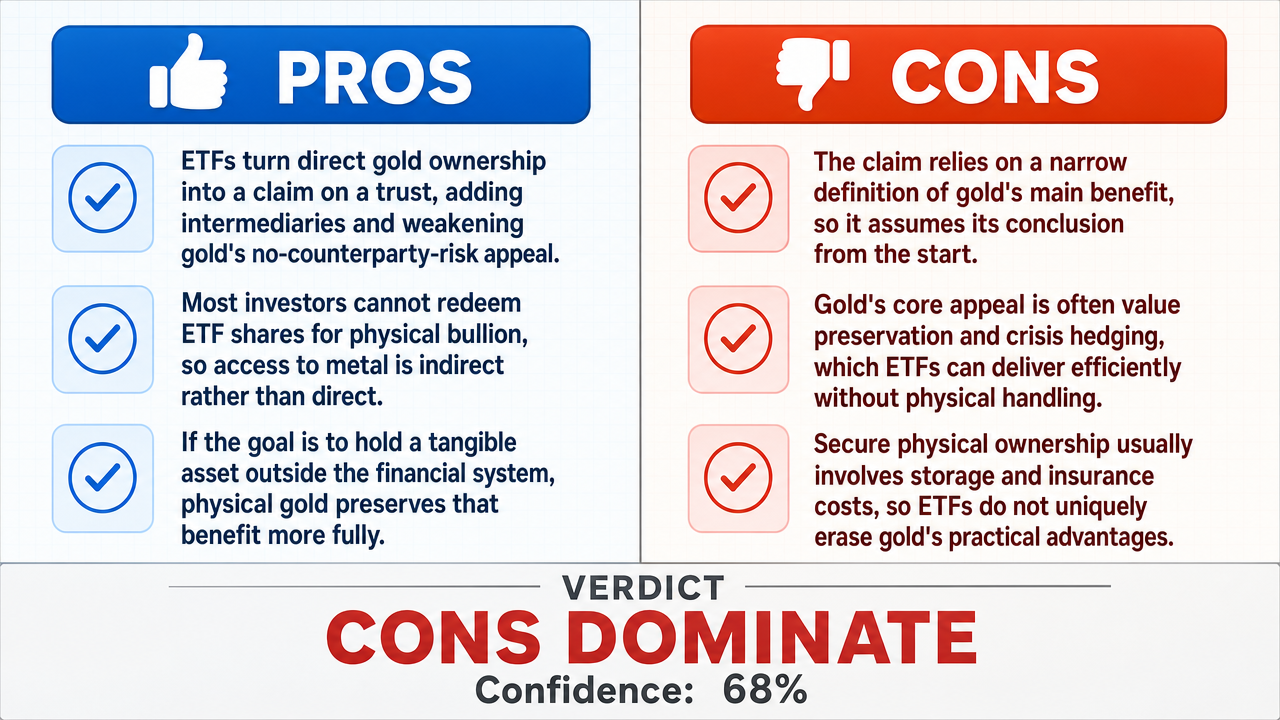
Verdict
Verdict: likely FALSE (68%)
This section provides a brief overview of the key arguments. You do not need to read the full detailed report below.
✅ Key PRO arguments:
- ■Gold ETFs replace physical ownership with paper claims on a trust structure, extinguishing gold's defining structural virtue of zero counterparty risk , since no bank, clearinghouse , or government can freeze, rehypothecate , dilute, or default on a gold coin held in one's own vault.
- ■The SPDR Gold Trust (GLD ) prospectus explicitly states that shareholders are not entitled to redeem shares for physical metal unless they are 'Authorized Participants ,' meaning ordinary investors hold a paper claim rather than direct ownership of metal.
- ■Physical gold storage costs are a choice rather than a structural necessity; an investor who holds gold as a real asset for its primary benefit of counterparty-free wealth can self-custody without incurring professional storage fees.
❌ Key ANTI arguments:
- ■The affirmative's argument is a tautology ('pétition de principe par définition tendancieuse'): by defining the 'primary benefit' of gold solely as the absence of counterparty risk through physical custody, they ensure their conclusion follows from their definition alone, ignoring gold's functional role as a monetary and economic store of value .
- ■The primary benefit of gold is its role as a store of value and a hedge against systemic instability , not merely physical possession; gold ETFs provide efficient, liquid exposure to this intrinsic value without negating it.
- ■The claim that physical gold carries a 0.00% explicit fee is a false universal: the moment gold is 'stored securely' through any professional mechanism—a prerequisite for the 'real asset ' benefit of safety and protection from theft or loss—it incurs ongoing, mandatory costs for insurance, professional vaulting, and security.
💭 Conclusion: False. The anti side won because it successfully exposed the pro argument as a definitional tautology that narrowly defines gold's 'primary benefit' as physical possession, then concludes ETFs negate it by construction. The anti side further undermined the pro claim that physical gold has zero costs by demonstrating that secure storage inherently requires ongoing expenses for insurance and professional custody. Gold ETFs preserve exposure to gold's intrinsic store-of-value and hedge -against-instability functions, which constitute its primary economic benefits, even if they do sacrifice the counterparty-free property of direct physical ownership. The confidence reflects that the pro side's point about ETF redemption restrictions and counterparty risk remains partially valid, preventing a stronger verdict.
🔬 DeepResearch Result: likely FALSE ❌ (68%)
Assertion: Investing in gold ETFs negates the primary benefit of gold as a real asset .
Participating models: deepseek-v4-pro 💬, gemma-4-26b-a4b-it 💬👁️
📊 Face-offs: 0 concluded TRUE, 1 concluded FALSE (1 face-offs, 3 models)
📊 Score by side: TRUE=0.00, FALSE=0.68
🏅 Model score changes:
minimax-m3 💬👁️: +7
✅ PRO Arguments:
- ■Gold ETFs replace physical ownership with paper claims on a trust structure, extinguishing gold's defining structural virtue of zero counterparty risk , since no bank, clearinghouse , or government can freeze, rehypothecate , dilute, or default on a gold coin held in one's own vault. deepseek-v4-pro 💬
- ■The SPDR Gold Trust (GLD ) prospectus explicitly states that shareholders are not entitled to redeem shares for physical metal unless they are 'Authorized Participants ,' meaning ordinary investors hold a paper claim rather than direct ownership of metal. deepseek-v4-pro 💬
- ■Physical gold storage costs are a choice rather than a structural necessity; an investor who holds gold as a real asset for its primary benefit of counterparty-free wealth can self-custody without incurring professional storage fees. deepseek-v4-pro 💬
❌ ANTI Arguments:
- ■The affirmative's argument is a tautology ('pétition de principe par définition tendancieuse'): by defining the 'primary benefit' of gold solely as the absence of counterparty risk through physical custody, they ensure their conclusion follows from their definition alone, ignoring gold's functional role as a monetary and economic store of value . gemma-4-26b-a4b-it 💬👁️
- ■The primary benefit of gold is its role as a store of value and a hedge against systemic instability , not merely physical possession; gold ETFs provide efficient, liquid exposure to this intrinsic value without negating it. gemma-4-26b-a4b-it 💬👁️
- ■The claim that physical gold carries a 0.00% explicit fee is a false universal: the moment gold is 'stored securely' through any professional mechanism—a prerequisite for the 'real asset' benefit of safety and protection from theft or loss—it incurs ongoing, mandatory costs for insurance, professional vaulting, and security. gemma-4-26b-a4b-it 💬👁️
💭 Reasoning: False. The anti side won because it successfully exposed the pro argument as a definitional tautology that narrowly defines gold's 'primary benefit' as physical possession, then concludes ETFs negate it by construction. The anti side further undermined the pro claim that physical gold has zero costs by demonstrating that secure storage inherently requires ongoing expenses for insurance and professional custody. Gold ETFs preserve exposure to gold's intrinsic store-of-value and hedge-against-instability functions, which constitute its primary economic benefits, even if they do sacrifice the counterparty-free property of direct physical ownership. The confidence reflects that the pro side's point about ETF redemption restrictions and counterparty risk remains partially valid, preventing a stronger verdict.
📋 PRO Facts:
• The SPDR Gold Trust (GLD) prospectus explicitly states that shareholders are not entitled to redeem shares for physical metal unless they are 'Authorized Participants.'
📋 ANTI Facts:
• Secure physical gold custody through any professional mechanism incurs ongoing, mandatory costs for insurance, vaulting, and security.
• Gold ETFs provide liquid market exposure to gold's price movements without requiring physical handling or storage logistics.
| Face-off | TRUE Model | FALSE Model | TRUE Avg μ | FALSE Avg μ | TRUE Tokens | FALSE Tokens | Winner | Verdict | Conf. |
|---|---|---|---|---|---|---|---|---|---|
| #1 | deepseek-v4-pro 💬 | gemma-4-26b-a4b-it 💬👁️ | 0.545 | 0.383 | 6 | 2 | TRUE | FALSE | 68% |
The following technical terms, abbreviations, and domain-specific concepts are referenced throughout this debate transcript. Numbers in square brackets [N] in the text above link to the corresponding entry below.
[1] Authorized Participants — Large institutional investors (typically market makers) who are permitted to create and redeem shares of an ETF in large blocks called creation units, and who play a key role in keeping an ETF's market price aligned with its underlying asset's value.
[2] Basket — Creation/redemption basket — In ETF terminology, a large block of shares (e.g., 100,000 shares of GLD) that Authorized Participants exchange with the fund to create or redeem shares, typically in exchange for the underlying asset or cash.
[3] Beneficial interest — An ownership interest in an asset held by another party (the legal owner or custodian) on one's behalf; the beneficial owner enjoys the economic benefits but not direct legal control of the asset.
[4] Bullion — Gold or other precious metals in bulk form (bars or ingots), valued primarily by weight and purity rather than numismatic value, commonly used as an investment-grade store of value.
[5] Clearinghouse — An intermediary entity that facilitates, clears, and settles trades between buyers and sellers, reducing counterparty risk in financial transactions.
[6] Commodity — A basic raw good or primary product (such as gold, oil, or agricultural goods) that is interchangeable with goods of the same type and typically traded on commodity markets.
[7] Counterparty risk — The risk that the other party to a contract, financial transaction, or arrangement will fail to meet its obligations, default, or otherwise be unable to perform as promised.
[8] Custodian — A financial institution that holds and safeguards assets (such as securities or physical gold) on behalf of investors, typically for a fee.
[9] Dilution — Share dilution — The reduction of existing shareholders' proportional ownership or claim on assets when new shares are issued or when the underlying asset backing is expanded without a corresponding increase in value.
[10] Expense ratio — The annual fee, expressed as a percentage of assets under management, that a fund (such as an ETF or mutual fund) charges to cover operating expenses including management, administration, and marketing.
[11] Financial claim — A right to receive payment or value from another party, such as a share, bond, or derivative, as opposed to direct ownership of a physical asset.
[12] GLD — SPDR Gold Shares (ticker: GLD) — The ticker symbol for the SPDR Gold Trust, one of the largest gold-backed exchange-traded funds, designed to track the spot price of gold.
[13] Gold ETF — Gold Exchange-Traded Fund — An exchange-traded fund that invests in gold bullion or tracks gold prices, allowing investors to gain exposure to gold's price movements without holding physical metal.
[14] Hedge — An investment or position taken to offset potential losses or volatility in another investment, commonly used to protect against systemic risk, inflation, or currency depreciation.
[15] IAU — iShares Gold Trust (ticker: IAU) — The ticker symbol for the iShares Gold Trust, a gold-backed ETF issued by BlackRock that tracks the price of gold bullion.
[16] Legal wrapper — The legal structure or vehicle (such as a trust, fund, or corporation) used to hold and manage an asset, which determines the rights, obligations, and protections afforded to investors.
[17] Management fees — Recurring fees charged by a fund manager or investment vehicle for the administration, oversight, and operation of an investment portfolio.
[18] Monetary asset — An asset that functions as a store of value, medium of exchange, or unit of account, traditionally including currency and historically gold.
[19] Prospectus — A formal legal document issued by a fund or company that provides detailed information about the investment offering, including risks, fees, structure, and terms.
[20] Pétition de principe — Pétition de principe (begging the question) — A logical fallacy in which the conclusion of an argument is assumed in its premises, making the argument circular; identified in the debate as the affirmative's framing of 'real asset' as requiring physical possession.
[21] Real asset — A physical asset with intrinsic value (such as gold, real estate, or commodities), as distinguished from financial or paper assets whose value derives from contractual claims.
[22] Rehypothecate — Rehypothecation — The practice by which a financial institution reuses or pledges customer collateral (such as securities or bullion) that it holds on the customer's behalf, often for its own borrowing or lending.
[23] Safe deposit box — A secure, individually locked container typically housed within a bank vault, used by customers to store valuables such as physical gold, documents, or jewelry.
[24] SPDR Gold Trust — A major gold-backed exchange-traded fund (ticker GLD) structured as a trust that holds gold bullion on behalf of shareholders, managed by State Street Global Advisors.
[25] Spot price — The current market price at which an asset (such as gold) can be bought or sold for immediate delivery and settlement, as opposed to a futures or forward price.
[26] Spread — Bid-ask spread — The difference between the price at which a seller is willing to sell (ask) and the price at which a buyer is willing to buy (bid) an asset, representing a transaction cost.
[27] Store of value — An asset that can be saved, retrieved, and exchanged in the future while retaining its purchasing power over time, preserving wealth against inflation or depreciation.
[28] Sub-custodian — A secondary custodian engaged by a primary custodian to hold assets, often in different jurisdictions, creating an additional layer in the custody chain.
[29] Systemic instability — Risk of disruption or collapse affecting an entire financial system or market, as opposed to isolated failures of individual institutions or assets.
[30] Tautology — A statement or argument that is true by definition or repetition of the same idea in different words, rendering it logically uninformative; identified in the debate as a flaw in the affirmative's reasoning.
[31] Trustee — A party that holds and manages assets on behalf of beneficiaries under the terms of a trust agreement, with fiduciary duties to safeguard those assets.
[32] Underlying commodity — The physical asset (such as gold bullion) that an ETF or derivative instrument is designed to track or provide exposure to, determining its economic value.
The following financial data tables were referenced during the debate exchanges:
| Counterparty Layer | Physical Gold (Direct) | Gold ETF (e.g., GLD) |
|---|---|---|
| Custodian Risk | None | HSBC / JPMorgan as sub-custodian |
| Trustee Discretion | None | BNY Mellon as trustee |
| Redemption Right | Immediate, unconditional | Only Authorized Participants; baskets of 100,000 shares |
| Rehypothecation Risk | Zero | Gold may be held in allocated or unallocated form |
| Freeze / Confiscation Risk | Low (possession-based) | High (financial system gatekeepers) |
Legend: Comparison of counterparty layers between direct physical gold ownership and gold ETF (GLD) exposure. Source: SPDR Gold Trust prospectus, World Gold Council structure analysis.
| Holding Form | Initial Investment | Annual Fee | Value After 30 Years | Fee Erosion |
|---|---|---|---|---|
| Physical Gold | $100,000 | 0.00% | $100,000 | 0.0% |
| IAU (0.25% fee) | $100,000 | 0.25% | $92,770 | -7.2% |
| GLD (0.40% fee) | $100,000 | 0.40% | $88,690 | -11.3% |
Legend: Erosion of a $100,000 gold position over 30 years under different fee structures, assuming constant gold price (fee effect isolated). Physical gold incurs no management fee; ETF expense ratios compound to a significant drag. Source: iShares (IAU) and SPDR (GLD) prospectus expense ratio disclosures.
| Asset Type | Explicit Fee (Annual) | Estimated Storage/Insurance/Spread | Total Estimated Annual Cost |
|---|---|---|---|
| Physical Gold (Vaulted) | 0.00% | 0.50% - 1.50% | 0.50% - 1.50% |
| Gold ETF (e.g., IAU) | 0.25% | Included in fee | 0.25% |
| Gold ETF (e.g., GLD) | 0.40% | Included in fee | 0.40% |
Legend: Comparison of explicit and estimated implicit costs for gold ownership. Physical gold costs include estimated professional vaulting, insurance, and liquidity premiums. ETF costs are based on prospectus disclosures.
Face-off transcripts
- ■
Ownership & Trade Secrets. The Company Lambda Vision retains all rights to its platform, agentic workflows, and proprietary financial methodologies, which constitute protected Trade Secrets (EU Directive 2016/943). Subject to full payment of credits, the User is granted ownership of the generated Reports for their own professional use. Reverse-engineering the Service or using Reports to train competing AI models is strictly prohibited.
- ■
No Financial Advice. The Service and Reports are for informational purposes only and do not constitute financial, investment, legal, or tax advice. The Company is not a regulated financial advisor. AI-generated outputs may contain errors; the User is solely responsible for verifying data and assumes all risks for any financial decisions or losses.
- ■
Liability & Governing Law. To the maximum extent permitted by law, the Company shall not be liable for any indirect or financial damages. These Terms are governed by French law. Any disputes shall be subject to the exclusive jurisdiction of the Courts of Paris, France.