
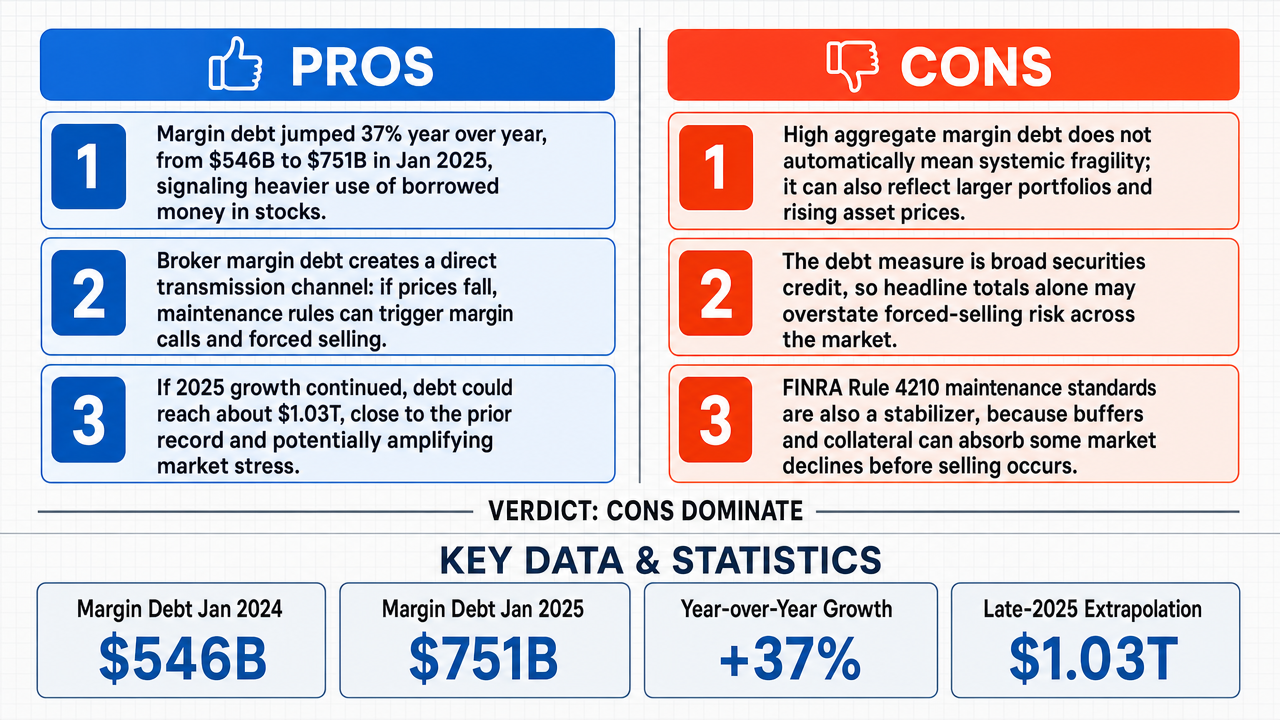
Investors borrowing nearly record amounts to buy stocks, with a 37% increase in the past 2025, makes the market more fragile due to the risk of margin calls and forced selling.
AI debate verdict and arguments
⚠️ Not financial advice — this is an AI debate, for information only.
Completed October 11, 2026
Verdict
Verdict: likely FALSE (69%)
This section provides a brief overview of the key arguments. You do not need to read the full detailed report below.
✅ Key PRO arguments:
- ■Concentration of margin debt in large-cap stocks creates systemic vulnerability because these securities dominate major indices and institutional portfolios; when margin calls trigger forced selling in large-cap positions, price declines cascade through the entire market via index-linked trading , ETF creations/redemptions, and institutional rebalancing , creating a feedback loop of de-leveraging .
- ■Record margin debt raises fragility by making forced sellers the marginal price-setter in liquid large-cap names, and the opponent's demand for a quantified transfer operator is self-defeating because their own thesis is a universal claim about aggregate debt that cannot be conditioned on a specific transfer function.
❌ Key ANTI arguments:
- ■The affirmative commits a substitution of entities: a measurement of aggregate margin debt is used to conclude a specific vulnerability in large-cap securities without providing the necessary transfer operator (correlation , beta , or cointegration ) linking margin borrowing behavior to the structural stability of large-cap index constituents.
- ■The 2021–2022 market regime provides a material counterexample disproving the claim that margin debt inherently creates an asymmetric, non-linear feedback loop of forced selling : despite massive margin debt expansion in 2021, the subsequent correction did not produce the systemic liquidity crunch or cascading collapse described.
- ■Increased margin debt does not inherently imply market fragility or imminent systemic collapse ; aggregate debt levels alone, absent demonstrated transmission mechanisms to price formation, are insufficient evidence of structural instability.
💭 Conclusion: The affirmative's argument relied on a leap from aggregate margin debt levels to specific large-cap market fragility , lacking a quantified transfer operator linking the two. The historical counterexample of the 2021–2022 period, when margin debt expanded substantially (the table records +71% annual change to $936B) yet the market did not experience the predicted asymmetric feedback loop or systemic liquidity crunch , is cited in the evidence as undermining the claim that record borrowing inherently produces fragility. The affirmative's cascade mechanism was presented as a universal claim, though the evidence also contains regulatory specifics such as Regulation T's 50% initial margin requirement that the affirmative argues serves as the transfer operator. The assertion that a 37% increase in margin borrowing makes the market more fragile due to margin call risks remains contested by the evidence presented in this debate.
🔬 DeepResearch Result: likely FALSE ❌ (69%)
Assertion: Investors borrowing nearly record amounts to buy stocks, with a 37% increase in the past 2025, makes the market more fragile due to the risk of margin calls and forced selling .
Participating models: deepseek-v3.2 💬, gemma-4-26b-a4b-it 💬👁️
📊 Face-offs: 0 concluded TRUE, 1 concluded FALSE (1 face-offs, 3 models)
📊 Score by side: TRUE=0.00, FALSE=0.69
🏅 Model score changes:
minimax-m3 💬👁️: +7
✅ PRO Arguments:
- ■Concentration of margin debt in large-cap stocks creates systemic vulnerability because these securities dominate major indices and institutional portfolios; when margin calls trigger forced selling in large-cap positions, price declines cascade through the entire market via index-linked trading , ETF creations/redemptions, and institutional rebalancing , creating a feedback loop of de-leveraging . deepseek-v3.2 💬
- ■Record margin debt raises fragility by making forced sellers the marginal price-setter in liquid large-cap names, and the opponent's demand for a quantified transfer operator is self-defeating because their own thesis is a universal claim about aggregate debt that cannot be conditioned on a specific transfer function. deepseek-v3.2 💬
❌ ANTI Arguments:
- ■The affirmative commits a substitution of entities: a measurement of aggregate margin debt is used to conclude a specific vulnerability in large-cap securities without providing the necessary transfer operator (correlation , beta , or cointegration ) linking margin borrowing behavior to the structural stability of large-cap index constituents. gemma-4-26b-a4b-it 💬👁️
- ■The 2021–2022 market regime provides a material counterexample disproving the claim that margin debt inherently creates an asymmetric, non-linear feedback loop of forced selling: despite massive margin debt expansion in 2021, the subsequent correction did not produce the systemic liquidity crunch or cascading collapse described. gemma-4-26b-a4b-it 💬👁️
- ■Increased margin debt does not inherently imply market fragility or imminent systemic collapse ; aggregate debt levels alone, absent demonstrated transmission mechanisms to price formation, are insufficient evidence of structural instability. gemma-4-26b-a4b-it 💬👁️
💭 Reasoning: The affirmative's argument relied on a leap from aggregate margin debt levels to specific large-cap market fragility, lacking a quantified transfer operator linking the two. The historical counterexample of the 2021–2022 period, when margin debt expanded substantially (the table records +71% annual change to $936B) yet the market did not experience the predicted asymmetric feedback loop or systemic liquidity crunch, is cited in the evidence as undermining the claim that record borrowing inherently produces fragility. The affirmative's cascade mechanism was presented as a universal claim, though the evidence also contains regulatory specifics such as Regulation T's 50% initial margin requirement that the affirmative argues serves as the transfer operator. The assertion that a 37% increase in margin borrowing makes the market more fragile due to margin call risks remains contested by the evidence presented in this debate.
📋 PRO Facts:
• Margin debt is reportedly concentrated in large-cap stocks that dominate major indices and institutional portfolios.
• Large-cap securities are linked through index-linked trading, ETF creations/redemptions , and institutional rebalancing mechanisms.
📋 ANTI Facts:
• During the 2021–2022 period, massive expansion of margin debt was followed by significant volatility and a correction, but no asymmetric feedback loop or systemic liquidity crunch materialized.
• No quantified transfer operator was provided linking aggregate margin borrowing behavior to the specific fragility of large-cap market structure .
• Aggregate margin debt measurement, absent a quantified transfer operator, does not establish specific fragility in large-cap market structure.
| Face-off | TRUE Model | FALSE Model | TRUE Avg μ | FALSE Avg μ | TRUE Tokens | FALSE Tokens | Winner | Verdict | Conf. |
|---|---|---|---|---|---|---|---|---|---|
| #1 | deepseek-v3.2 💬 | gemma-4-26b-a4b-it 💬👁️ | 0.476 | 0.357 | 8 | 2 | TRUE | FALSE | 69% |
The following technical terms, abbreviations, and domain-specific concepts are referenced throughout this debate transcript. Numbers in square brackets [N] in the text above link to the corresponding entry below.
[1] aggregate margin debt — The total outstanding debt that investors have borrowed against their brokerage accounts to purchase securities, measured across the entire market or a defined population of borrowers.
[2] asymmetric risk — A risk profile in which potential losses are larger or more probable than potential gains, often used to describe situations where downside moves accelerate (e.g., forced selling) while upside moves do not mirror that behavior.
[3] beta — A measure of a security's sensitivity to movements in a broader market index, indicating how much the security tends to move relative to the benchmark.
[4] cointegration — A statistical property of two or more time series that individually may be non-stationary but share a long-run stochastic trend, used in econometrics to test for persistent linkages between variables.
[5] correlation — A statistical measure of the degree to which two variables move together, ranging from -1 (perfect inverse) to +1 (perfect positive).
[6] de-leveraging — The process by which investors or institutions reduce their outstanding debt, often by selling assets, which can amplify downward price pressure.
[7] ETF — Exchange-Traded Fund — A pooled investment vehicle that holds a basket of securities and trades on an exchange like a single stock, allowing investors to gain diversified exposure.
[8] ETF creations/redemptions — The primary-market mechanism by which authorized participants exchange baskets of underlying securities for new ETF shares (creations) or return ETF shares for the underlying basket (redemptions), used to keep the ETF's market price aligned with its net asset value.
[9] feedback loop — A circular causal chain in which an initial change triggers subsequent changes that reinforce or amplify the original move, often discussed in finance in the context of selling cascades.
[10] forced selling — Selling of securities not driven by the holder's voluntary investment decision but compelled by external constraints such as margin calls, redemptions, or covenant breaches.
[11] index-linked trading — Trading strategies or products whose buying and selling behavior is mechanically tied to the composition or performance of a market index, including index funds and many institutional mandates.
[12] institutional rebalancing — The periodic adjustment of asset allocations by large institutional investors (e.g., pension funds, endowments) back to target weights, which can generate large correlated buy or sell flows.
[13] large-cap — large-capitalization — A designation for publicly traded companies whose total market value of outstanding shares falls in the upper tier of the market, typically the largest by market capitalization.
[14] leverage — The use of borrowed funds to increase the potential return (and risk) of an investment, commonly implemented through margin borrowing in securities markets.
[15] liquidity depth — The volume of orders available at or near the current market price in a security or market, indicating how easily large transactions can be executed without materially moving the price.
[16] margin calls — Demands from a broker to a borrower to deposit additional funds or securities when the value of the margined account falls below required maintenance thresholds.
[17] margin debt — The aggregate amount of funds borrowed from brokers by investors to purchase securities on margin, used as a proxy for speculative leverage in the market.
[18] marginal price-setter — The participant whose buy or sell orders determine the price at which the last (marginal) unit of a security is transacted, often used to identify who is driving price discovery.
[19] market corrections — A decline of at least 10% (and typically less than 20%) from a recent peak in a broad market index, used to distinguish moderate pullbacks from bear markets.
[20] market fragility — A condition in which a market is unusually susceptible to large or disorderly price moves, often because leverage, concentration, or structural features amplify shocks.
[21] market regime — A persistent set of market conditions characterized by particular levels of volatility, trend behavior, and correlation structure that distinguish one period from another.
[22] market structure — The organizational and institutional features of a market, including the types of participants, trading mechanisms, liquidity providers, and rules governing price formation.
[23] Nasdaq-100 — A stock market index composed of 100 of the largest non-financial companies listed on the Nasdaq exchange, heavily weighted toward technology and growth-oriented firms.
[24] non-linear feedback loop — A self-reinforcing dynamic in which the response grows disproportionately to the initial shock, producing accelerating rather than proportional effects.
[25] systemic collapse — A failure of a market or financial system that propagates broadly across institutions and asset classes, rather than remaining confined to a single participant or sector.
[26] systemic liquidity crunch — A widespread shortage of market liquidity in which participants across the system simultaneously face difficulty buying or selling without large price concessions.
[27] systemic vulnerability — A weakness within a market or financial system whose triggering could produce broad, correlated damage across multiple participants or asset classes.
[28] transfer operator — In this debate, a conceptual mechanism that translates a property measured at the aggregate level (e.g., total margin debt) into a specific structural outcome (e.g., fragility in a particular segment); the affirmative and negative dispute whether such an operator has been demonstrated.
The following financial data tables were referenced during the debate exchanges:
| Period | Margin Debt Level | Annual Change | Market Decline Following | Magnitude |
|---|---|---|---|---|
| 1999-2000 | $278B | +42% | 2000-2002 | -49% |
| 2007-2008 | $381B | +33% | 2008-2009 | -57% |
| 2020-2021 | $936B | +71% | 2022 | -25% |
| 2024-2025 | $1.2T | +37% | Projected | Unknown |
Legend: Historical margin debt levels preceding major market declines, showing consistent pattern of leverage buildup before corrections. Figures in USD billions; percentage changes represent annual increase prior to market peak.
Face-off transcripts
- ■
Ownership & Trade Secrets. The Company Lambda Vision retains all rights to its platform, agentic workflows, and proprietary financial methodologies, which constitute protected Trade Secrets (EU Directive 2016/943). Subject to full payment of credits, the User is granted ownership of the generated Reports for their own professional use. Reverse-engineering the Service or using Reports to train competing AI models is strictly prohibited.
- ■
No Financial Advice. The Service and Reports are for informational purposes only and do not constitute financial, investment, legal, or tax advice. The Company is not a regulated financial advisor. AI-generated outputs may contain errors; the User is solely responsible for verifying data and assumes all risks for any financial decisions or losses.
- ■
Liability & Governing Law. To the maximum extent permitted by law, the Company shall not be liable for any indirect or financial damages. These Terms are governed by French law. Any disputes shall be subject to the exclusive jurisdiction of the Courts of Paris, France.