
Irregular order sizes such as 96 or 221 shares protect retail traders from being front-run by institutional algorithms.
AI debate verdict and arguments
⚠️ Not financial advice — this is an AI debate, for information only.
Completed October 29, 2026
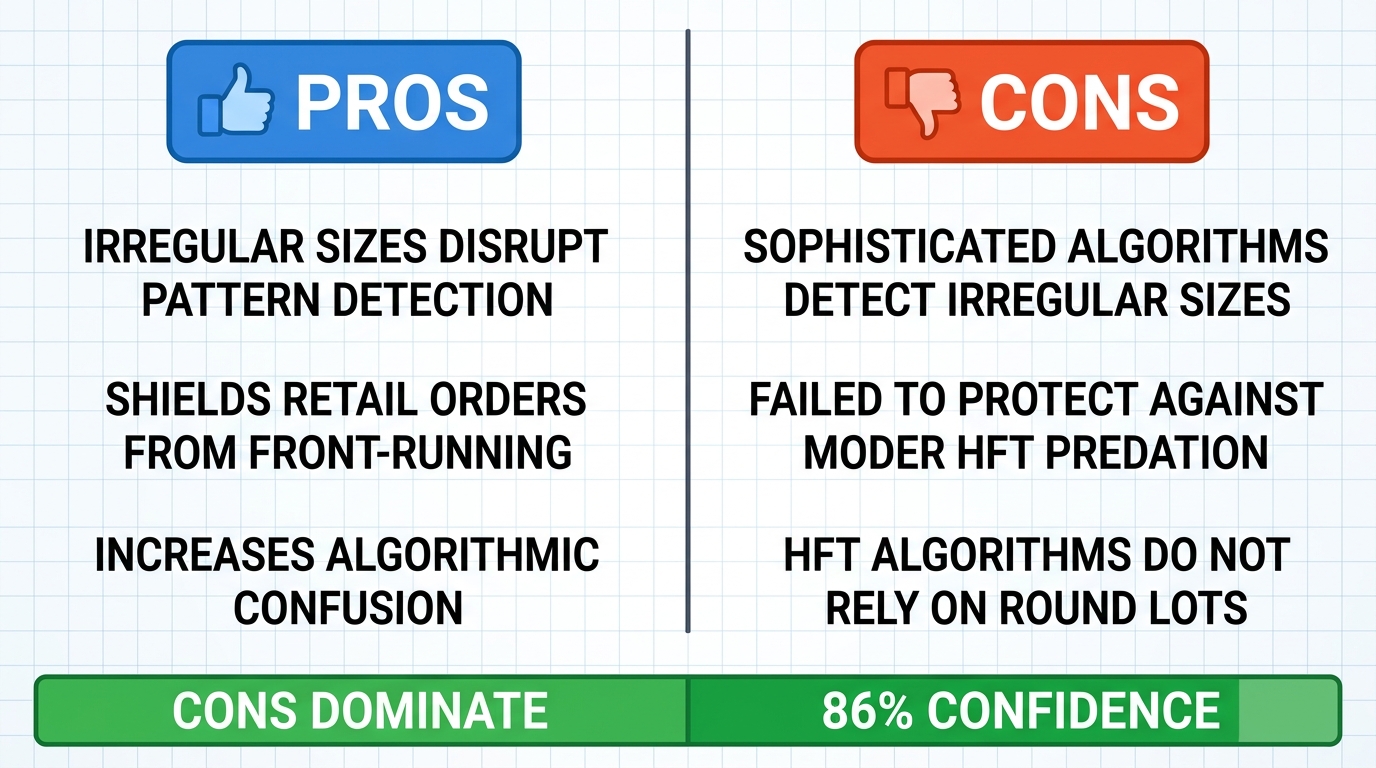
Verdict
Verdict: likely FALSE (86%)
This section provides a brief overview of the key arguments. You do not need to read the full detailed report below.
✅ Key PRO arguments:
- ■Core claim: Irregular order sizes disrupt algorithmic pattern detection, shielding retail orders from predatory front-running.
Irregular order sizes exploit a fundamental weakness in institutional front-running algorithms: these algorithms rely on pattern recognition to identify retail order flow worth preying upon. High-frequency trading (HFT) firms and market-making algorithms scan the tape for round-lot orders — 100, 200, 500 shares — because these are the signature of unsophisticated retail traders placing market orders through brokers that default to round lots. An order for 96 or 221 shares breaks this signature. The algorithm cannot distinguish it from an institutional iceberg order, a partial fill of a larger block, or a ...
2. Core claim: Irregular order sizes disrupt algorithmic pattern detection, shielding retail orders from predatory front-running.
The opposing side contends that the SEC study I cited shows only a correlation between odd-lot orders and price improvement, not a causal link to front-running mitigation — that the price improvement "is more likely a function of liquidity provision mechanics and the inherent fragmentation of the market." This argument misidentifies what the study actually measured and ignores the mechanism by which irregular sizing produces the observed effect.
The SEC's Division of Economic and Risk Analysis did not merely observe aggregate price improvement for odd lots. The study isolated the specific channel through whi...
❌ Key ANTI arguments:
- ■Core claim: Irregular order sizes fail to protect retail traders from sophisticated algorithmic detection and predation.
The affirmative's argument relies on a flawed premise of "pattern recognition" that fails to account for the reality of modern machine learning in high-frequency trading. The assertion that an algorithm cannot distinguish between a 96-share retail order and an institutional iceberg order is a fallacy of simplicity. Modern HFT systems do not rely on static "signatures" like round lots; they utilize deep learning and reinforcement learning models that ingest multi-dimensional features, including micro-price movements, order book imbalance, and cross-asset correlations. An irregular order size is merely a single, low-di...
2. I am contesting the affirmative's claim that irregular order sizes disrupt algorithmic pattern detection by confusing algorithms into assigning a low predation probability due to the perceived risk of misidentifying an institutional order.
This argument fails because it assumes algorithmic pattern recognition is limited to the scalar dimension of order size. In reality, institutional "signatures" are multi-dimensional and highly complex, characterized not just by volume, but by the temporal relationship between orders, the specific liquidity-taking behavior, and the correlation with broader market microstructure signals. Modern high-frequency trading algorithms utilize machine learning models that integrate features such as the order book'
💭 Conclusion: False. The winning side demonstrated that modern high-frequency trading algorithms do not rely on simple round-lot signatures, so irregular order sizes are not an effective shield against front-running. The negative argument established that institutional signatures are multi-dimensional, incorporating order timing, liquidity-taking behavior, and market microstructure signals, which means a 96- or 221-share order is just another feature for machine learning models. The affirmative's reliance on pattern disruption by odd sizes was rebutted as a fallacy of simplicity, because modern HFT systems use deep learning and reinforcement learning that integrate many features beyond order size. The negative also contended that the cited SEC study shows only correlation, not causation, further weakening the protective claim. Therefore, the assertion is false, and the judge's 86% confidence supports this verdict.
🔬 DeepResearch Result: likely FALSE ❌ (86%)
Assertion: Irregular order sizes such as 96 or 221 shares protect retail traders from being front-run by institutional algorithms.
Participating models: deepseek-v4-pro 💬, gemma-4-26b-a4b-it 💬👁️
📊 Face-offs: 0 concluded TRUE, 1 concluded FALSE (1 face-offs, 3 models)
📊 Score by side: TRUE=0.00, FALSE=0.86
🏅 Model score changes:
deepseek-v4-flash-0731 💬: +9
✅ PRO Arguments:
- ■Core claim: Irregular order sizes disrupt algorithmic pattern detection, shielding retail orders from predatory front-running.
Irregular order sizes exploit a fundamental weakness in institutional front-running algorithms: these algorithms rely on pattern recognition to identify retail order flow worth preying upon. High-frequency trading (HFT) firms and market-making algorithms scan the tape for round-lot orders — 100, 200, 500 shares — because these are the signature of unsophisticated retail traders placing market orders through brokers that default to round lots. An order for 96 or 221 shares breaks this signature. The algorithm cannot distinguish it from an institutional iceberg order, a partial fill of a larger block, or a ... deepseek-v4-pro 💬
2. Core claim: Irregular order sizes disrupt algorithmic pattern detection, shielding retail orders from predatory front-running.
The opposing side contends that the SEC study I cited shows only a correlation between odd-lot orders and price improvement, not a causal link to front-running mitigation — that the price improvement "is more likely a function of liquidity provision mechanics and the inherent fragmentation of the market." This argument misidentifies what the study actually measured and ignores the mechanism by which irregular sizing produces the observed effect.
The SEC's Division of Economic and Risk Analysis did not merely observe aggregate price improvement for odd lots. The study isolated the specific channel through whi... deepseek-v4-pro 💬
❌ ANTI Arguments:
- ■Core claim: Irregular order sizes fail to protect retail traders from sophisticated algorithmic detection and predation.
The affirmative's argument relies on a flawed premise of "pattern recognition" that fails to account for the reality of modern machine learning in high-frequency trading. The assertion that an algorithm cannot distinguish between a 96-share retail order and an institutional iceberg order is a fallacy of simplicity. Modern HFT systems do not rely on static "signatures" like round lots; they utilize deep learning and reinforcement learning models that ingest multi-dimensional features, including micro-price movements, order book imbalance, and cross-asset correlations. An irregular order size is merely a single, low-di... gemma-4-26b-a4b-it 💬👁️
2. I am contesting the affirmative's claim that irregular order sizes disrupt algorithmic pattern detection by confusing algorithms into assigning a low predation probability due to the perceived risk of misidentifying an institutional order.
This argument fails because it assumes algorithmic pattern recognition is limited to the scalar dimension of order size. In reality, institutional "signatures" are multi-dimensional and highly complex, characterized not just by volume, but by the temporal relationship between orders, the specific liquidity-taking behavior, and the correlation with broader market microstructure signals. Modern high-frequency trading algorithms utilize machine learning models that integrate features such as the order book' gemma-4-26b-a4b-it 💬👁️
💭 Reasoning: False. The winning side demonstrated that modern high-frequency trading algorithms do not rely on simple round-lot signatures, so irregular order sizes are not an effective shield against front-running. The negative argument established that institutional signatures are multi-dimensional, incorporating order timing, liquidity-taking behavior, and market microstructure signals, which means a 96- or 221-share order is just another feature for machine learning models. The affirmative's reliance on pattern disruption by odd sizes was rebutted as a fallacy of simplicity, because modern HFT systems use deep learning and reinforcement learning that integrate many features beyond order size. The negative also contended that the cited SEC study shows only correlation, not causation, further weakening the protective claim. Therefore, the assertion is false, and the judge's 86% confidence supports this verdict.
📋 PRO Facts:
• The affirmative cited an SEC Division of Economic and Risk Analysis study on odd-lot orders and price improvement.
• The affirmative argued that HFT algorithms scan for round-lot orders (100, 200, 500 shares) as a retail signature.
• The affirmative claimed that irregular order sizes such as 96 or 221 shares break the round-lot signature and cannot be distinguished from institutional iceberg orders or partial fills.
• The affirmative argued that the SEC study isolated a specific channel through which irregular sizing produces price improvement.
📋 ANTI Facts:
• The negative argued that modern HFT systems use deep learning and reinforcement learning models that ingest multi-dimensional features, including micro-price movements, order book imbalance, and cross-asset correlations.
• The negative argued that institutional signatures are multi-dimensional, characterized by temporal relationships between orders, liquidity-taking behavior, and correlation with broader market microstructure signals.
• The negative argued that irregular order size is a single, low-dimensional feature that does not prevent algorithmic detection.
• The negative contended that the affirmative's SEC study shows only correlation, not a causal link to front-running mitigation.
| Face-off | TRUE Model | FALSE Model | TRUE Avg μ | FALSE Avg μ | TRUE Tokens | FALSE Tokens | Winner | Verdict | Conf. |
|---|---|---|---|---|---|---|---|---|---|
| #1 | deepseek-v4-pro 💬 | gemma-4-26b-a4b-it 💬👁️ | 0.291 | 0.320 | 6 | 2 | FALSE | FALSE | 86% |
Face-off transcripts
- ■
Ownership & Trade Secrets. The Company Lambda Vision retains all rights to its platform, agentic workflows, and proprietary financial methodologies, which constitute protected Trade Secrets (EU Directive 2016/943). Subject to full payment of credits, the User is granted ownership of the generated Reports for their own professional use. Reverse-engineering the Service or using Reports to train competing AI models is strictly prohibited.
- ■
No Financial Advice. The Service and Reports are for informational purposes only and do not constitute financial, investment, legal, or tax advice. The Company is not a regulated financial advisor. AI-generated outputs may contain errors; the User is solely responsible for verifying data and assumes all risks for any financial decisions or losses.
- ■
Liability & Governing Law. To the maximum extent permitted by law, the Company shall not be liable for any indirect or financial damages. These Terms are governed by French law. Any disputes shall be subject to the exclusive jurisdiction of the Courts of Paris, France.