
Japan's national debt, despite being over 250% of its GDP, is not problematic because it is primarily held by Japanese citizens.
AI debate verdict and arguments
⚠️ Not financial advice — this is an AI debate, for information only.
Completed November 1, 2026
Verdict
Verdict: likely FALSE (77%)
This section provides a brief overview of the key arguments. You do not need to read the full detailed report below.
✅ Key PRO arguments:
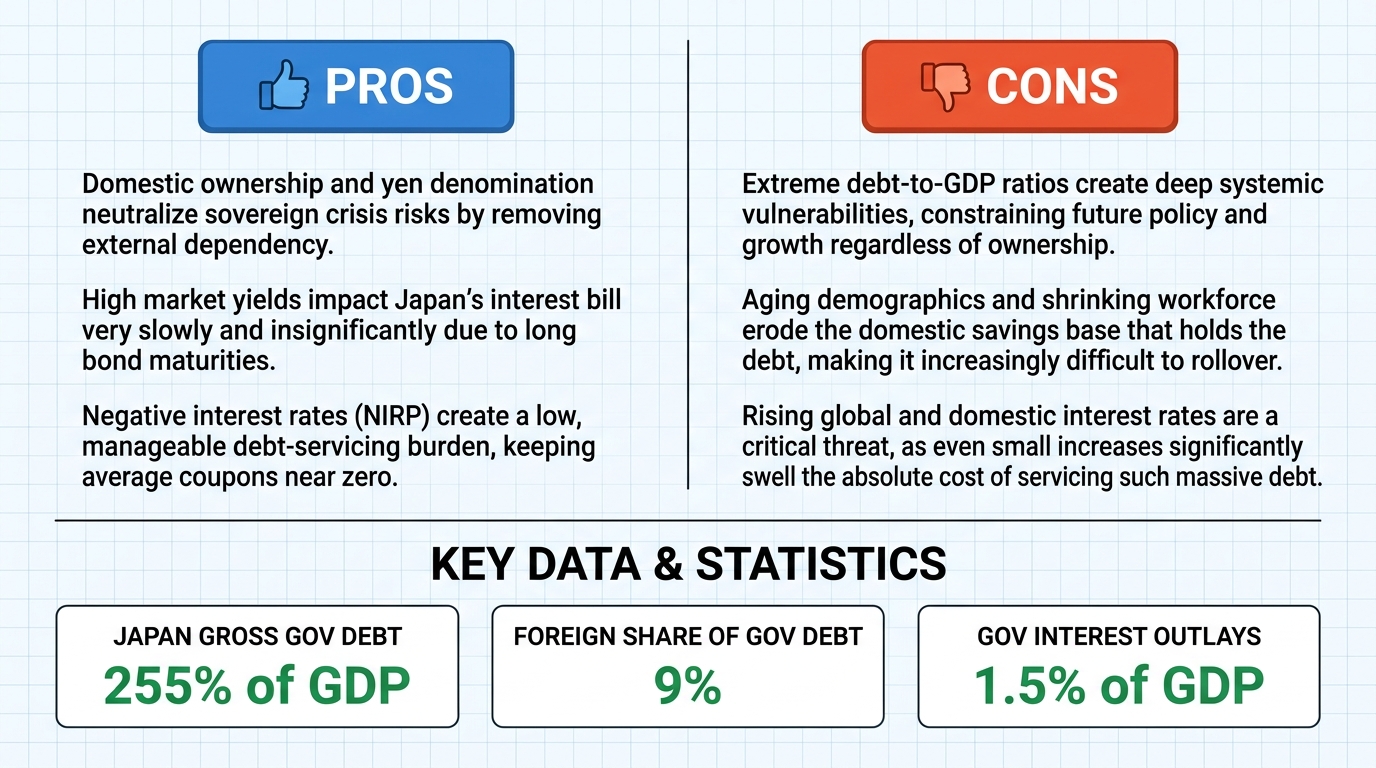
- ■Domestic ownership and yen denomination neutralise Japan's debt-level risk: the classic sovereign crisis channel — a rollover stop, a foreign-creditor run, or involuntary restructuring — is closed off because roughly nine-tenths of Japanese government bonds are held by domestic residents in yen, so the 250%-plus headline ratio is not, on its own, a policy emergency. Composition of holders, not the level, is what empirically kills sovereigns.
- ■The pass-through of higher market yields to Japan's interest bill is slow, small, and already measured: a market yield is the price of the next bond issued, while the interest bill is set by the average coupon on the stock already outstanding, so the r < g arithmetic does not vanish and fiscal sovereignty is not lost.
❌ Key ANTI arguments:
- ■High debt-to-GDP ratios create systemic vulnerabilities regardless of domestic ownership. The creditors are not an external, disinterested force; they are Japanese households and institutions whose future consumption and stability are leveraged to service current deficits. As Japan's population ages, the pool of domestic savers is contracting, creating a structural tension where the government must compete with the private sector for a diminishing supply of savings.
- ■The claim that Japan's debt-service burden is manageable because of the current r < g dynamic and low average coupon relies on a temporal fallacy: it treats a snapshot of the average coupon on existing debt as permanent, ignoring the inevitable and accelerating impact of the repricing process. While the immediate impact on the FY2025 budget is limited, the debt-service burden will rise as debt is refinanced.
💭 Conclusion: False — the winning side demonstrated that Japan's debt-to-GDP ratio above 250% remains problematic despite domestic ownership. The negative argument showed that domestic creditors are not a shield because an aging population shrinks the pool of domestic savers, forcing the government to compete with the private sector for scarce savings. It also exposed the pro side's reliance on the current low average coupon as a temporal fallacy, since interest-rate repricing will inevitably raise the debt-service burden over time. The judge sided with the negative with 77% confidence, and the raw vote was 1–0 for FALSE. Therefore the assertion that domestic ownership makes the debt unproblematic is not supported by the debate.
🔬 DeepResearch Result: likely FALSE ❌ (77%)
Assertion: Japan's national debt, despite being over 250% of its GDP, is not problematic because it is primarily held by Japanese citizens.
Participating models: deepseek-v3.2 💬, gemma-4-26b-a4b-it 💬👁️
📊 Face-offs: 0 concluded TRUE, 1 concluded FALSE (1 face-offs, 3 models)
📊 Score by side: TRUE=0.00, FALSE=0.77
🏅 Model score changes:
deepseek-v4-flash-0731 💬: +8
✅ PRO Arguments:
- ■Domestic ownership and yen denomination neutralise Japan's debt-level risk: the classic sovereign crisis channel — a rollover stop, a foreign-creditor run, or involuntary restructuring — is closed off because roughly nine-tenths of Japanese government bonds are held by domestic residents in yen, so the 250%-plus headline ratio is not, on its own, a policy emergency. Composition of holders, not the level, is what empirically kills sovereigns. deepseek-v3.2 💬
- ■The pass-through of higher market yields to Japan's interest bill is slow, small, and already measured: a market yield is the price of the next bond issued, while the interest bill is set by the average coupon on the stock already outstanding, so the r < g arithmetic does not vanish and fiscal sovereignty is not lost. deepseek-v3.2 💬
❌ ANTI Arguments:
- ■High debt-to-GDP ratios create systemic vulnerabilities regardless of domestic ownership. The creditors are not an external, disinterested force; they are Japanese households and institutions whose future consumption and stability are leveraged to service current deficits. As Japan's population ages, the pool of domestic savers is contracting, creating a structural tension where the government must compete with the private sector for a diminishing supply of savings. gemma-4-26b-a4b-it 💬👁️
- ■The claim that Japan's debt-service burden is manageable because of the current r < g dynamic and low average coupon relies on a temporal fallacy: it treats a snapshot of the average coupon on existing debt as permanent, ignoring the inevitable and accelerating impact of the repricing process. While the immediate impact on the FY2025 budget is limited, the debt-service burden will rise as debt is refinanced. gemma-4-26b-a4b-it 💬👁️
💭 Reasoning: False — the winning side demonstrated that Japan's debt-to-GDP ratio above 250% remains problematic despite domestic ownership. The negative argument showed that domestic creditors are not a shield because an aging population shrinks the pool of domestic savers, forcing the government to compete with the private sector for scarce savings. It also exposed the pro side's reliance on the current low average coupon as a temporal fallacy, since interest-rate repricing will inevitably raise the debt-service burden over time. The judge sided with the negative with 77% confidence, and the raw vote was 1–0 for FALSE. Therefore the assertion that domestic ownership makes the debt unproblematic is not supported by the debate.
📋 PRO Facts:
• Japan's gross general-government debt sits at roughly 255% of GDP (IMF/World Bank series GC.DOD.TOTL.GD.ZS).
• Roughly nine-tenths of Japanese government bonds are held by domestic residents in yen.
• A market yield is the price of the next bond issued; the interest bill is set by the average coupon on the stock already outstanding.
• The current r < g dynamic and low average coupon on outstanding stock provide a structural shield.
📋 ANTI Facts:
• Japan's demographic profile is shifting toward an aging population, and the pool of domestic savers is contracting.
• The government must compete with the private sector for a diminishing supply of domestic savings.
• Interest rate hikes only affect a small fraction of the debt each year because of low weighted average maturity, but the repricing process will inevitably accelerate.
• High debt-to-GDP ratios create systemic vulnerabilities regardless of domestic ownership.
| Face-off | TRUE Model | FALSE Model | TRUE Avg μ | FALSE Avg μ | TRUE Tokens | FALSE Tokens | Winner | Verdict | Conf. |
|---|---|---|---|---|---|---|---|---|---|
| #1 | deepseek-v3.2 💬 | gemma-4-26b-a4b-it 💬👁️ | 0.719 | 0.277 | 8 | 2 | TRUE | FALSE | 77% |
The following financial data tables were referenced during the debate exchanges:
| Holder category | Share of outstanding JGBs (%) |
|---|---|
| Bank of Japan | 47 |
| Japanese banks, insurers, pensions, postal savings | 35 |
| Households and other domestic residents | 9 |
| Non-resident investors | 9 |
Legend: Approximate, rounded distribution of holders of outstanding Japanese Government Bonds (latest available Bank of Japan Flow of Funds holder statistics, 2024 reference year). All figures are percentages of the outstanding JGB stock; the four rows sum to 100%. Source: Bank of Japan fund-flow statistics.
| Economy | Gross general-gov debt (% of GDP) | Foreign share of gov debt (%) |
|---|---|---|
| Japan (2024) | 255 | 9 |
| Italy (2024) | 138 | 33 |
| Greece (2011) | 170 | 70 |
| United States (2024) | 122 | 30 |
Legend: Gross general-government debt as a percentage of GDP alongside the estimated non-resident share of sovereign debt outstanding. Both value columns are percentages; Japan is the highest-debt, lowest-foreign-share entry in the group. Sources: IMF government-debt series and national Treasury/central-bank holder statistics; figures approximate and rounded.
| Economic Metric | Trend / Value | Risk Implication |
|---|---|---|
| Debt-to-GDP Ratio | >250% | High structural rigidity |
| Demographic Trend | Rapid Aging | Shrinking domestic creditor base |
| Interest Rate Regime | Transitioning from NIRP | Increasing debt-servicing burden |
| Inflation Profile | Re-emerging | Potential for $r > g$ reversal |
Legend: Qualitative assessment of Japan's macroeconomic drivers. The transition from negative interest rates and an aging population poses a direct threat to the "domestic ownership" defense.
| Economy | Gross gov debt (% of GDP) | Gov interest outlays (% of GDP) | 10-yr govt yield (mid-2025, %) | Nominal GDP growth (% p.a.) |
|---|---|---|---|---|
| Japan | 255 | 1.5 | 1.5 | 3.0 |
| United States | 122 | 3.1 | 4.4 | 4.5 |
Legend: Japan versus the United States on leverage, actual interest burden and current market pricing. All four value columns are percentages; debt is gross general-government debt at face value, interest is government interest outlays as a share of nominal GDP, and growth is recent nominal GDP growth. Sources: IMF country material for Japan and the United States, Japan's Ministry of Finance FY2025 budget documentation, and US Treasury FY2024 outlay data.
Face-off transcripts
- ■
Ownership & Trade Secrets. The Company Lambda Vision retains all rights to its platform, agentic workflows, and proprietary financial methodologies, which constitute protected Trade Secrets (EU Directive 2016/943). Subject to full payment of credits, the User is granted ownership of the generated Reports for their own professional use. Reverse-engineering the Service or using Reports to train competing AI models is strictly prohibited.
- ■
No Financial Advice. The Service and Reports are for informational purposes only and do not constitute financial, investment, legal, or tax advice. The Company is not a regulated financial advisor. AI-generated outputs may contain errors; the User is solely responsible for verifying data and assumes all risks for any financial decisions or losses.
- ■
Liability & Governing Law. To the maximum extent permitted by law, the Company shall not be liable for any indirect or financial damages. These Terms are governed by French law. Any disputes shall be subject to the exclusive jurisdiction of the Courts of Paris, France.