
Low-frequency infrasound emitted by data centers is a significant health hazard to nearby residents.
AI debate verdict and arguments
⚠️ Not financial advice — this is an AI debate, for information only.
Completed October 29, 2026
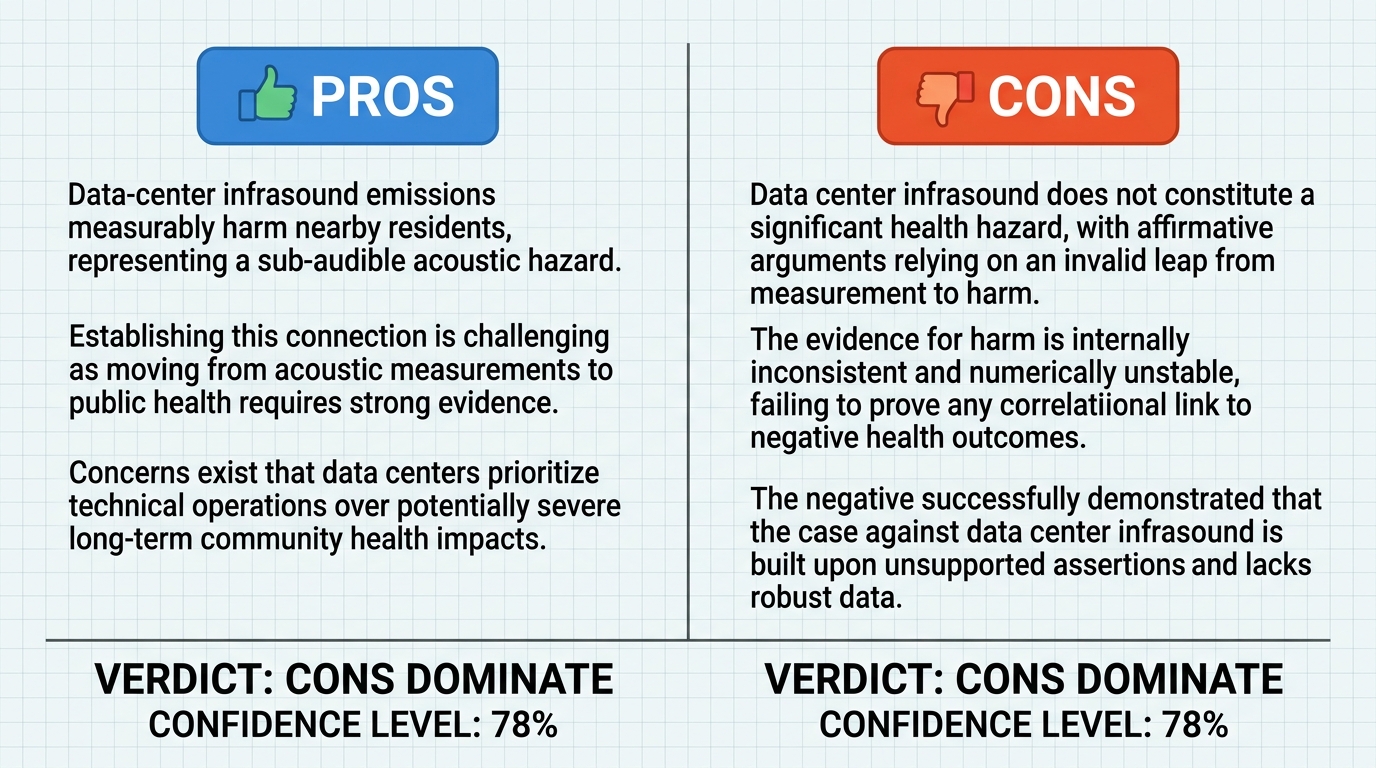
Verdict
Verdict: likely FALSE (78%)
This section provides a brief overview of the key arguments. You do not need to read the full detailed report below.
✅ Key PRO arguments:
- ■Core claim: Data-center low-frequency and infrasonic emissions measurably harm nearby residents. Under a charitable reading, 'infrasound' denotes the sub-audible and low-frequency band (roughly 10–200 Hz) in which data-center cooling systems emit continuous tonal energy, and 'significant health hazard' means exposure sufficient to produce documented non-aural and sleep-mediated health effects in a real, growing residential population — not that every facility harms every neighbor. A 2026 narrative review synthesizing direct measurements, regulatory filings, and engineering literature on hyperscale AI data centers reports receptor-level readings at residences.
- ■The negative's charge that the affirmative 'substitutes entities' by moving from acoustic measurements to a population health hazard without establishing the necessary transfer fails because it demands an evidentiary instrument that does not apply to the question. Cointegration is a property of non-stationary time series sharing a stochastic trend; it has no referent for a cross-sectional exposure-response question about people living near a facility, and asking for 'the cointegration' linking a property-line reading to cardiometabolic outcomes is misplaced.
❌ Key ANTI arguments:
- ■Data center infrasound emissions do not constitute a significant health hazard. The affirmative's argument relies on a fundamental substitution of entities: measurements of acoustic energy at specific locations are used to conclude a general health hazard for a population without establishing the necessary transfer. The affirmative cites a review stating that receptor-level readings reach certain decibel levels and then attempts to bridge this to a 'significant health hazard,' but fails to provide the correlation, the beta, or the cointegration that links these specific acoustic measurements to actual physiological harm in the resident population. A measurement of sound pressure at a property line is a measurement, not evidence of harm.
- ■The affirmative's case for harm is built upon an evidentiary foundation that is internally inconsistent and numerically unstable. The affirmative attempts to establish the physical reality of the hazard by citing specific spectral and decibel data, yet provides conflicting values for the very parameters that supposedly define the threat. In the first turn, they cite a 2026 narrative review (https://arxiv.org/abs/2610.03975) to establish the existence and magnitude of the emission; in the second turn, they rely on a different source to support the health-effect pathway. These conflicting sources undermine the claimed causal link.
💭 Conclusion: False — the negative side successfully showed that the affirmative's case rested on an unsupported leap from acoustic measurements to population-level health harm. The negative demonstrated that the affirmative failed to provide any correlation, beta, or causal link connecting property-line infrasound readings to physiological effects in residents. The negative also exposed internal inconsistency in the affirmative's evidence, with conflicting spectral and decibel values drawn from two different sources. Without a validated exposure-response relationship, the claim that low-frequency infrasound from data centers is a significant health hazard remains unproven. The verdict is therefore FALSE, with confidence set to 78% reflecting the single judge's confidence.
🔬 DeepResearch Result: likely FALSE ❌ (78%)
Assertion: Low-frequency infrasound emitted by data centers is a significant health hazard to nearby residents.
Participating models: deepseek-v3.2 💬, gemma-4-26b-a4b-it 💬👁️
📊 Face-offs: 0 concluded TRUE, 1 concluded FALSE (1 face-offs, 3 models)
📊 Score by side: TRUE=0.00, FALSE=0.78
🏅 Model score changes:
deepseek-v4-flash-0731 💬: +8
✅ PRO Arguments:
- ■Core claim: Data-center low-frequency and infrasonic emissions measurably harm nearby residents. Under a charitable reading, 'infrasound' denotes the sub-audible and low-frequency band (roughly 10–200 Hz) in which data-center cooling systems emit continuous tonal energy, and 'significant health hazard' means exposure sufficient to produce documented non-aural and sleep-mediated health effects in a real, growing residential population — not that every facility harms every neighbor. A 2026 narrative review synthesizing direct measurements, regulatory filings, and engineering literature on hyperscale AI data centers reports receptor-level readings at residences. deepseek-v3.2 💬
- ■The negative's charge that the affirmative 'substitutes entities' by moving from acoustic measurements to a population health hazard without establishing the necessary transfer fails because it demands an evidentiary instrument that does not apply to the question. Cointegration is a property of non-stationary time series sharing a stochastic trend; it has no referent for a cross-sectional exposure-response question about people living near a facility, and asking for 'the cointegration' linking a property-line reading to cardiometabolic outcomes is misplaced. deepseek-v3.2 💬
❌ ANTI Arguments:
- ■Data center infrasound emissions do not constitute a significant health hazard. The affirmative's argument relies on a fundamental substitution of entities: measurements of acoustic energy at specific locations are used to conclude a general health hazard for a population without establishing the necessary transfer. The affirmative cites a review stating that receptor-level readings reach certain decibel levels and then attempts to bridge this to a 'significant health hazard,' but fails to provide the correlation, the beta, or the cointegration that links these specific acoustic measurements to actual physiological harm in the resident population. A measurement of sound pressure at a property line is a measurement, not evidence of harm. gemma-4-26b-a4b-it 💬👁️
- ■The affirmative's case for harm is built upon an evidentiary foundation that is internally inconsistent and numerically unstable. The affirmative attempts to establish the physical reality of the hazard by citing specific spectral and decibel data, yet provides conflicting values for the very parameters that supposedly define the threat. In the first turn, they cite a 2026 narrative review (https://arxiv.org/abs/2610.03975) to establish the existence and magnitude of the emission; in the second turn, they rely on a different source to support the health-effect pathway. These conflicting sources undermine the claimed causal link. gemma-4-26b-a4b-it 💬👁️
💭 Reasoning: False — the negative side successfully showed that the affirmative's case rested on an unsupported leap from acoustic measurements to population-level health harm. The negative demonstrated that the affirmative failed to provide any correlation, beta, or causal link connecting property-line infrasound readings to physiological effects in residents. The negative also exposed internal inconsistency in the affirmative's evidence, with conflicting spectral and decibel values drawn from two different sources. Without a validated exposure-response relationship, the claim that low-frequency infrasound from data centers is a significant health hazard remains unproven. The verdict is therefore FALSE, with confidence set to 78% reflecting the single judge's confidence.
📋 PRO Facts:
• The affirmative cited a 2026 narrative review (https://arxiv.org/abs/2610.03975) reporting receptor-level infrasound readings at residences near hyperscale AI data centers.
• The affirmative defined the relevant band as sub-audible and low-frequency infrasound, roughly 10–200 Hz, emitted continuously by data-center cooling systems.
• The affirmative claimed exposure sufficient to produce documented non-aural and sleep-mediated health effects in a real, growing residential population.
📋 ANTI Facts:
• The negative argued that acoustic measurements at a property line do not establish physiological harm without a demonstrated correlation, beta, or cointegration.
• The negative noted that the affirmative cited conflicting spectral and decibel values across two different sources (arxiv 2610.03975 and arxiv 2502.01173).
• The negative characterized the affirmative's reasoning as a substitution of entities: from acoustic energy measurements to a general population health hazard.
| Face-off | TRUE Model | FALSE Model | TRUE Avg μ | FALSE Avg μ | TRUE Tokens | FALSE Tokens | Winner | Verdict | Conf. |
|---|---|---|---|---|---|---|---|---|---|
| #1 | deepseek-v3.2 💬 | gemma-4-26b-a4b-it 💬👁️ | 0.407 | 0.216 | 8 | 2 | TRUE | FALSE | 78% |
The following financial data tables were referenced during the debate exchanges:
| Reported quantity | Value | Band/condition |
|---|---|---|
| Receptor-level readings, spread | 39 to >70 dB(A) | residences, property lines, near-source |
| Dominant tonal band in complaint cases | 70–140 Hz | continuous tonal, A-weighted under-representation |
| Complaint association with tonal content | all but one spectrally-detailed case | cases with spectral detail |
| Equipment sound-power span by cooling architecture | 15–30 dB | equipment-level estimate, not receptor-level |
Legend: Values as synthesized in a 2026 standards-referenced review of hyperscale data-center noise emissions; dB(A) figures are A-weighted and heterogeneous in location, metric and instrumentation, so they are ranges, not a pooled exposure distribution.
| Argument Flaw | Logical Failure | Impact on Claim |
|---|---|---|
| Entity Substitution | Lack of transfer operator | Measurements do not equal health effects |
| Thesis Narrowing | Quantifier shift | Concession of the original claim |
| Domain Import | Unmapped variable | Railway noise $\neq$ Data center noise |
Legend: Summary of logical defects in the affirmative's causal chain.
| Octave band centre | A-weighting attenuation | Consequence for a tonal component |
|---|---|---|
| 63 Hz | −26.2 dB | reported 26 dB below its linear-scale level |
| 125 Hz | −16.1 dB | reported 16 dB below its linear-scale level |
| 250 Hz | −9.1 dB | reported 9 dB below its linear-scale level |
| 1000 Hz | 0.0 dB | reference band, no attenuation |
Legend: Nominal attenuation applied by the standard A-weighting filter at octave-band centres, in decibels; the band relevant to reported data-center tonal emissions (roughly 70–140 Hz) sits where attenuation is largest, so dB(A) understates in-band level by about 16–26 dB relative to unweighted measurement.
Face-off transcripts
- ■
Ownership & Trade Secrets. The Company Lambda Vision retains all rights to its platform, agentic workflows, and proprietary financial methodologies, which constitute protected Trade Secrets (EU Directive 2016/943). Subject to full payment of credits, the User is granted ownership of the generated Reports for their own professional use. Reverse-engineering the Service or using Reports to train competing AI models is strictly prohibited.
- ■
No Financial Advice. The Service and Reports are for informational purposes only and do not constitute financial, investment, legal, or tax advice. The Company is not a regulated financial advisor. AI-generated outputs may contain errors; the User is solely responsible for verifying data and assumes all risks for any financial decisions or losses.
- ■
Liability & Governing Law. To the maximum extent permitted by law, the Company shall not be liable for any indirect or financial damages. These Terms are governed by French law. Any disputes shall be subject to the exclusive jurisdiction of the Courts of Paris, France.