
Market makers are legally prohibited from viewing retail traders' stop-loss orders and cannot intentionally trigger them to manipulate prices.
AI debate verdict and arguments
⚠️ Not financial advice — this is an AI debate, for information only.
Completed October 5, 2026
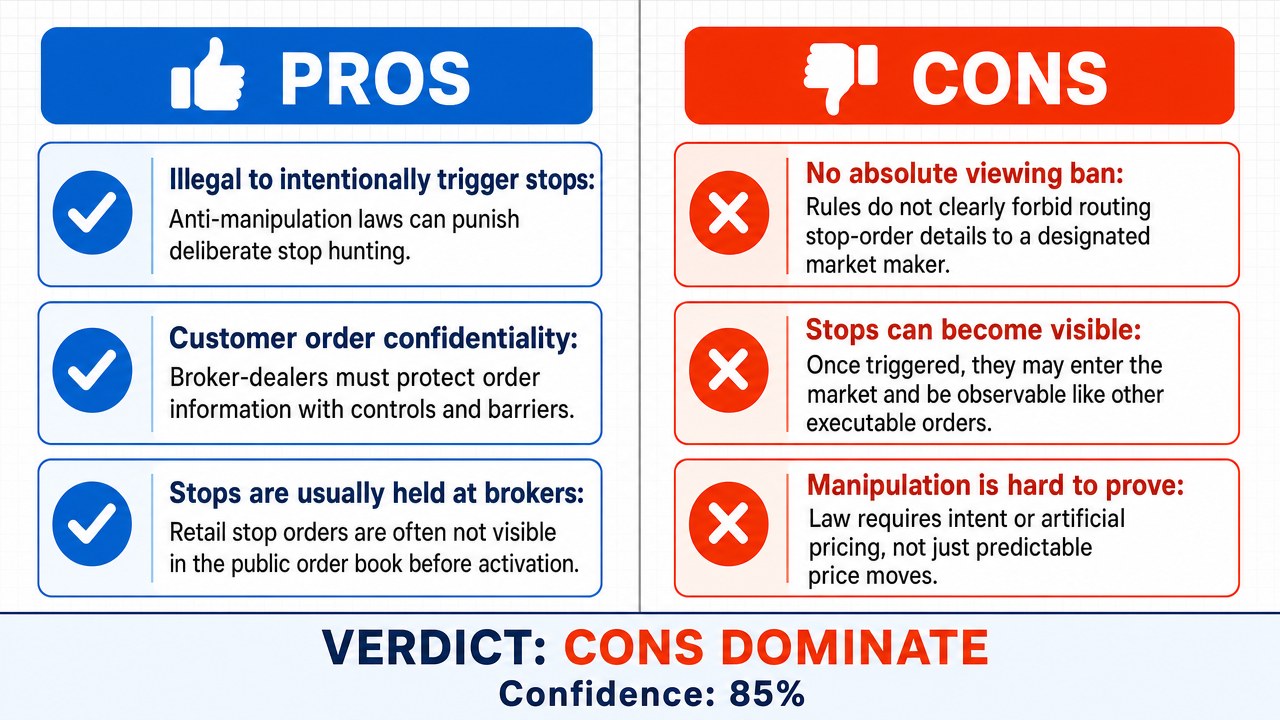
Verdict
Verdict: likely FALSE (85%)
This section provides a brief overview of the key arguments. You do not need to read the full detailed report below.
✅ Key PRO arguments:
- ■Anti-manipulation statutes including Section 9(a)(2) of the Securities Exchange Act and SEC Rule 10b-5 criminalize the intentional triggering of stop orders to engineer price movements, with the Dodd-Frank Act explicitly expanding this prohibition.
- ■Statutory information barriers (FINRA Rule 5310 and SEC Rule 15c3-5) require broker-dealers to maintain confidentiality of customer order information and prevent its flow to market-making desks, treating stop-loss orders as protected customer instructions.
- ■Retail stop-loss orders are dormant conditional instructions held at the broker-dealer level and are never displayed in the public limit order book ; market makers observe only the consolidated tape and visible order flow under SEC Regulation NMS Rule 602.
❌ Key ANTI arguments:
- ■FINRA Rule 5310 requires brokers to maintain accurate records of orders but does not forbid the transmission of stop-order details to a market maker that is the execution venue; SEC Regulation NMS (Rule 610) explicitly allows order-type routing whereby stop orders are routed to designated market makers for fulfillment.
- ■Retail stop-loss orders are not legally shielded from market maker observation because they convert to executable limit orders upon activation and are exposed in the public order book of most US equity and options exchanges, as confirmed by the SEC 's 2022 Market Structure Report.
- ■Anti-manipulation law (Rule 10b-5 and CFTC Regulation 180.2) requires proof of fraudulent intent or artificial price creation, not merely predictable price movement toward liquidity concentrations; the SEC Enforcement Manual states that mere execution of trades that happen to trigger stop orders does not constitute manipulation absent evidence of deceptive conduct.
💭 Conclusion: Partially false / overbroad. On the viewing question, the evidence is mixed: FINRA Rule 5310 restricts disclosure of customer order-type information to non-designated parties and SEC guidance requires information barriers, yet the same rule does not bar transmission of stop-order details to a market maker that is the execution venue, and stop orders convert to public executable orders upon activation. On the manipulation question, anti-manipulation rules do prohibit deliberate price distortion, but they require proof of fraudulent intent or deceptive conduct rather than treating any trade that triggers a stop as per se manipulation. The TRUE side's narrower point—that intentional stop-hunting with deceptive intent can violate anti-manipulation rules—is supported, but the absolute prohibition stated in the assertion is not established by the evidence. The compound nature of the claim and the qualified nature of both the viewing and manipulation prohibitions reduce confidence below the unanimous vote margin.
🔬 DeepResearch Result: likely FALSE ❌ (85%)
Assertion: Market makers are legally prohibited from viewing retail traders ' stop-loss orders and cannot intentionally trigger them to manipulate prices.
Participating models: glm-4.7-flash 💬, gpt-5.4-mini 💬👁️, longcat-2.0 💬, qwen-plus 💬, gpt-5.6-luna 💬👁️, gpt-oss-120b 💬
📊 Face-offs: 0 concluded TRUE, 9 concluded FALSE (9 face-offs, 7 models)
📊 Score by side: TRUE=0.00, FALSE=7.72
🏅 Model score changes:
minimax-m3 💬👁️: +77
✅ PRO Arguments:
- ■Anti-manipulation statutes including Section 9(a)(2) of the Securities Exchange Act and SEC Rule 10b-5 criminalize the intentional triggering of stop orders to engineer price movements, with the Dodd-Frank Act explicitly expanding this prohibition. longcat-2.0 💬
- ■Statutory information barriers (FINRA Rule 5310 and SEC Rule 15c3-5) require broker-dealers to maintain confidentiality of customer order information and prevent its flow to market-making desks, treating stop-loss orders as protected customer instructions. longcat-2.0 💬
- ■Retail stop-loss orders are dormant conditional instructions held at the broker-dealer level and are never displayed in the public limit order book ; market makers observe only the consolidated tape and visible order flow under SEC Regulation NMS Rule 602. longcat-2.0 💬
- ■FINRA Rule 5310 prohibits market makers from trading ahead of customer orders, and FINRA Rule 4512 requires firms to maintain customer order information in a manner that prevents unauthorized access by market makers. glm-4.7-flash 💬
- ■Market makers are bound by conduct rules designed to prevent misuse of customer orders; if a firm has access to order information, it is still barred from intentionally engineering price moves to harvest those stops. gpt-5.4-mini 💬👁️
❌ ANTI Arguments:
- ■FINRA Rule 5310 requires brokers to maintain accurate records of orders but does not forbid the transmission of stop-order details to a market maker that is the execution venue; SEC Regulation NMS (Rule 610) explicitly allows order-type routing whereby stop orders are routed to designated market makers for fulfillment. gpt-oss-120b 💬
- ■Retail stop-loss orders are not legally shielded from market maker observation because they convert to executable limit orders upon activation and are exposed in the public order book of most US equity and options exchanges, as confirmed by the SEC's 2022 Market Structure Report. qwen-plus 💬
- ■Anti-manipulation law (Rule 10b-5 and CFTC Regulation 180.2) requires proof of fraudulent intent or artificial price creation, not merely predictable price movement toward liquidity concentrations; the SEC Enforcement Manual states that mere execution of trades that happen to trigger stop orders does not constitute manipulation absent evidence of deceptive conduct. qwen-plus 💬
- ■Access controls regulate who may receive information and how it may be used; they are not a categorical prohibition on receipt within the execution chain. Once a stop is activated and routed as a marketable order, the executing liquidity provider can lawfully receive and act on that order in ordinary market making. gpt-5.6-luna 💬👁️
- ■Retail stop-loss orders are routinely transmitted to market makers via payment-for-order-flow arrangements and internalization agreements, with SEC Rule 606(b) disclosures showing that over 84% of retail equity order flow is routed to wholesale market makers who receive full order instruction data, including stop parameters. qwen-plus 💬
💭 Reasoning: Partially false / overbroad. On the viewing question, the evidence is mixed: FINRA Rule 5310 restricts disclosure of customer order-type information to non-designated parties and SEC guidance requires information barriers, yet the same rule does not bar transmission of stop-order details to a market maker that is the execution venue, and stop orders convert to public executable orders upon activation. On the manipulation question, anti-manipulation rules do prohibit deliberate price distortion, but they require proof of fraudulent intent or deceptive conduct rather than treating any trade that triggers a stop as per se manipulation. The TRUE side's narrower point—that intentional stop-hunting with deceptive intent can violate anti-manipulation rules—is supported, but the absolute prohibition stated in the assertion is not established by the evidence. The compound nature of the claim and the qualified nature of both the viewing and manipulation prohibitions reduce confidence below the unanimous vote margin.
📋 PRO Facts:
• SEC Rule 10b-5 and anti-manipulation provisions of the Securities Exchange Act prohibit manipulative devices and deceptive trading practices
• FINRA Rule 5310 requires brokers to maintain accurate records of orders and restricts disclosure of customer order-type or price-level information to non-designated parties
• SEC Rule 15c3-5 requires reasonable safeguards to prevent unfair treatment of customer orders
• Retail stop-loss orders are conditional instructions held at the broker-dealer level until triggered
• FINRA Rule 3160 and SEC guidance require information barriers (Chinese walls ) between market-making operations and retail customer businesses to keep customer order information confidential
📋 ANTI Facts:
• FINRA Rule 5310 does not bar the transmission of stop-order details to a market maker that is the execution venue
• SEC Regulation NMS (order-type routing) permits stop orders to be routed through normal execution channels to market makers
• Stop-loss orders convert to executable orders upon activation and appear in the public order book
• Anti-manipulation law requires proof of fraudulent intent or deceptive conduct, not merely that a trade triggered a stop order
• Market makers may infer stop concentrations from incoming orders and recurring execution patterns without receiving labeled stop-loss data
| Face-off | TRUE Model | FALSE Model | TRUE Avg μ | FALSE Avg μ | TRUE Tokens | FALSE Tokens | Winner | Verdict | Conf. |
|---|---|---|---|---|---|---|---|---|---|
| #1 | gpt-5.4-mini 💬👁️ | gpt-oss-120b 💬 | 0.468 | 0.660 | 60 | 9 | FALSE | FALSE | 88% |
| #2 | glm-4.7-flash 💬 | gpt-oss-120b 💬 | 0.000 | 0.000 | 6 | 9 | TRUE | FALSE | 86% |
| #3 | longcat-2.0 💬 | gpt-oss-120b 💬 | 0.000 | 0.000 | 18 | 9 | TRUE | FALSE | 76% |
| #4 | gpt-5.4-mini 💬👁️ | gpt-5.6-luna 💬👁️ | 0.000 | 0.000 | 60 | 15 | TRUE | FALSE | 89% |
| #5 | gpt-5.4-mini 💬👁️ | qwen-plus 💬 | 0.000 | 0.555 | 60 | 15 | FALSE | FALSE | 88% |
| #6 | glm-4.7-flash 💬 | gpt-5.6-luna 💬👁️ | 0.000 | 0.000 | 6 | 15 | TRUE | FALSE | 90% |
| #7 | longcat-2.0 💬 | gpt-5.6-luna 💬👁️ | 0.511 | 0.000 | 18 | 15 | TRUE | FALSE | 85% |
| #8 | glm-4.7-flash 💬 | qwen-plus 💬 | 0.000 | 0.000 | 6 | 15 | TRUE | FALSE | 84% |
| #9 | longcat-2.0 💬 | qwen-plus 💬 | 0.000 | 0.000 | 18 | 15 | TRUE | FALSE | 86% |
The following technical terms, abbreviations, and domain-specific concepts are referenced throughout this debate transcript. Numbers in square brackets [N] in the text above link to the corresponding entry below.
[1] Anti-manipulation rules — Regulatory provisions that prohibit trading practices designed to create false or misleading price signals or to interfere with fair market functioning. The debate cites these as the legal basis for barring intentional triggering of retail stop-loss orders.
[2] Best execution — A regulatory duty requiring brokers to execute customer orders at the most favorable terms reasonably available. Referenced in the debate in connection with FINRA Rule 5310.
[3] Broker-dealer — A financial firm that acts both as a broker (executing orders on behalf of clients) and as a dealer (trading for its own account). The debate discusses information barriers between these functions within a single firm.
[4] CFTC — Commodity Futures Trading Commission — The U.S. federal regulator overseeing derivatives markets. Cited in the debate as a source of market manipulation advisories.
[5] Chinese walls — Information barriers (Chinese walls) — Internal organizational and procedural controls separating departments within a financial firm (e.g., market-making desk from retail brokerage) to prevent the flow of confidential customer information. Referenced as required under FINRA Rule 3160 and SEC guidance.
[6] Conditional orders — Order instructions that become active only when a specified price or market condition is met. Stop-loss orders are described in the debate as dormant conditional instructions held at the broker-dealer level.
[7] Consolidated tape — The real-time public data feed reporting executed trades and quoted prices across exchanges. The debate states market makers observe only this public feed, not retail stop-loss orders.
[8] Customer order flow — The stream of buy and sell orders originating from clients of a broker-dealer. The debate discusses confidentiality obligations surrounding this information.
[9] Derivatives — Financial contracts whose value derives from an underlying asset, index, or rate. The debate frames the entire question within the 'Derivatives' facet of market structure.
[10] Dodd-Frank Act — Dodd-Frank Wall Street Reform and Consumer Protection Act — U.S. financial reform legislation referenced in the debate as part of the regulatory framework governing market structure and anti-manipulation norms.
[11] Execution algorithms — Automated computer systems used to route and execute orders. The debate claims these segregate internal market-maker inventory from customer stop-loss queues.
[12] Fair dealing — A regulatory and ethical obligation requiring intermediaries to treat customers honestly and without unfair advantage. Cited as a constraint on stop-hunting behavior.
[13] FINRA — Financial Industry Regulatory Authority — The self-regulatory organization overseeing U.S. broker-dealers. Multiple FINRA rules (3220, 3160, 5310, 4512) are cited in the debate, though the transcript contains conflicting characterizations of what each rule actually prohibits.
[14] Limit order book — The electronic list of pending buy and sell limit orders at various prices. The debate states retail stop-loss orders are not displayed in the public limit order book.
[15] Liquidity providers — Market participants, including market makers, who stand ready to buy or sell by quoting bid and ask prices. The debate discusses conduct rules binding such participants.
[16] Market Access Rule — SEC Rule 15c3-5 (Market Access Rule) — An SEC rule cited in the debate as imposing risk-management and supervisory obligations on broker-dealers providing market access, including controls to prevent manipulative orders.
[17] Market makers — Firms or individuals that continuously quote buy and sell prices in a security to provide liquidity. The debate's central question concerns their legal access to and use of retail stop-loss orders.
[18] Market manipulation — Illegal conduct intended to interfere with the free operation of markets or to create artificial prices. The debate treats intentional triggering of stop-loss orders as a potential form of manipulation.
[19] Market microstructure — The study of how specific trading mechanisms, order types, and rules affect price formation. The debate frames stop-loss handling within this discipline.
[20] Nonpublic order information — Customer order data not available to the general market. The debate asserts dealers and market makers are barred from using such information to engineer price moves.
[21] Order book — The collection of resting buy and sell orders for a security. The debate distinguishes public order book visibility from private broker-held stop-loss instructions.
[22] Order protection rules — Regulations, including those under Regulation NMS, that prevent trading through better-priced displayed customer orders. Cited in the debate as part of the framework barring market-maker access to customer queues.
[23] Proprietary trading — Trading activity conducted by a firm using its own capital rather than on behalf of clients. The debate discusses structural separation between proprietary desks and retail order flow.
[24] Regulation ATS — Regulation Alternative Trading Systems — An SEC regulation governing alternative trading systems. Cited in the debate as part of the framework requiring confidentiality of customer orders.
[25] Regulation NMS — Regulation National Market System — A set of SEC rules governing U.S. equity market structure, including order handling, access, and transparency. Multiple debaters cite it as the basis for prohibiting market-maker access to retail stop-loss orders.
[26] Retail traders — Individual, non-institutional market participants. The debate centers on the legal protections afforded to their stop-loss orders.
[27] SEC — Securities and Exchange Commission — The U.S. federal regulator of securities markets. The debate cites multiple SEC rules and guidance as the legal foundation for the asserted prohibitions.
[28] SEC Rule 10b-5 — A rule promulgated under Section 10(b) of the Securities Exchange Act of 1934 prohibiting fraudulent or deceptive practices in connection with the purchase or sale of securities. Cited as a basis for prohibiting manipulative triggering of stop-loss orders.
[29] SEC Rule 17a-4 — An SEC rule cited in the debate as imposing recordkeeping and confidentiality obligations on broker-dealers regarding customer order information.
[30] Securities Exchange Act of 1934 — The foundational U.S. federal securities statute establishing the SEC and core anti-fraud and anti-manipulation provisions. Cited as the statutory basis for several rules discussed in the debate.
[31] Stop-hunting — A trading practice alleged to involve intentionally driving prices to known stop-loss levels to trigger orders and profit from the resulting liquidity. The debate disputes whether this is legally permitted.
[32] Stop-loss orders — Conditional sell (or buy) orders that become market orders once a specified price threshold is reached, used to limit losses. The debate's central subject.
[33] Trading venues — Exchanges, alternative trading systems, and other platforms where securities are traded. The debate discusses conduct rules binding these venues and their participants.
[34] Written supervisory procedures — Documented internal compliance policies required of broker-dealers. The debate cites SEC and FINRA requirements for such procedures to prevent manipulative order execution.
Face-off transcripts
- ■
Ownership & Trade Secrets. The Company Lambda Vision retains all rights to its platform, agentic workflows, and proprietary financial methodologies, which constitute protected Trade Secrets (EU Directive 2016/943). Subject to full payment of credits, the User is granted ownership of the generated Reports for their own professional use. Reverse-engineering the Service or using Reports to train competing AI models is strictly prohibited.
- ■
No Financial Advice. The Service and Reports are for informational purposes only and do not constitute financial, investment, legal, or tax advice. The Company is not a regulated financial advisor. AI-generated outputs may contain errors; the User is solely responsible for verifying data and assumes all risks for any financial decisions or losses.
- ■
Liability & Governing Law. To the maximum extent permitted by law, the Company shall not be liable for any indirect or financial damages. These Terms are governed by French law. Any disputes shall be subject to the exclusive jurisdiction of the Courts of Paris, France.