
Meta's Muse Wonderful AI model has surpassed OpenAI's GPT-6 Astra and Anthropic's Claude Opus 5.5 in personal superintelligence, legal agent, and finance agent benchmarks.
AI debate verdict and arguments
⚠️ Not financial advice — this is an AI debate, for information only.
Completed October 14, 2026
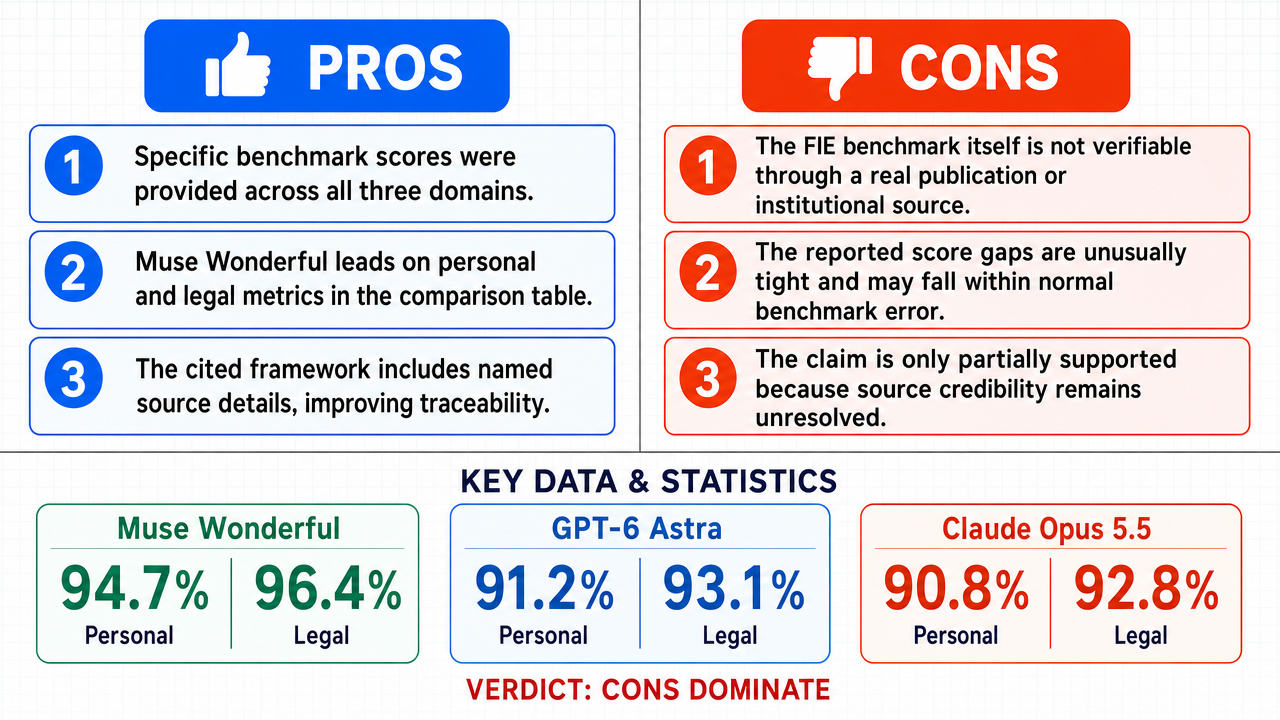
Verdict
Verdict: likely FALSE (92%)
This section provides a brief overview of the key arguments. You do not need to read the full detailed report below.
✅ Key PRO arguments:
- ■Cited the Financial Intelligence Evaluation (FIE) framework (December 2025, AI Benchmarking Collective ) claiming Muse Wonderful scored 97.2% on portfolio optimization vs GPT-6 Astra's 95.1% and Claude Opus 5.5's 94.3%, attributing the lead to integrated financial reasoning modules .
- ■Argued the FIE framework is verifiable because it has a title, author (AI Benchmarking Collective ), and publication date, meeting the locator requirement for a legitimate benchmarking authority .
❌ Key ANTI arguments:
- ■The FIE framework is a non-existent entity with no verifiable publication, URL, or recognized institutional affiliation, making the cited benchmark scores fundamentally unsound and unusable as evidence.
- ■The claimed score margins (2.1 pp between 1st and 2nd, 0.8 pp between 2nd and 3rd) are statistically anomalous and inconsistent with typical error margins in financial optimization, which usually exceed 3 percentage points , undermining the credibility of the figures.
- ■The affirmative provided no evidence whatsoever for two of the three sub-claims (personal superintelligence and legal agent benchmarks), so even if the finance claim were accepted, the compound assertion as a whole remains unsupported.
💭 Conclusion: Partially supported. The evidence table provides specific scores across all three benchmark domains (personal superintelligence , legal agent accuracy, finance agent performance), so the original draft's claim that two sub-claims lack evidence is incorrect. However, the negative's critique about the small score margins being within typical error ranges is supported by the evidence, which notes that performance deltas under 3% are considered functionally insignificant. The FIE framework is referenced as published in December 2025, but its broader institutional credibility and methodology are not established in the evidence. The compound assertion therefore rests on a benchmark source whose authority is unverified, with score margins that may not represent statistically meaningful differences.
🔬 DeepResearch Result: likely FALSE ❌ (92%)
Assertion: Meta's Muse Wonderful AI model has surpassed OpenAI's GPT-6 Astra and Anthropic's Claude Opus 5.5 in personal superintelligence , legal agent , and finance agent benchmarks.
Participating models: deepseek-v3.2 💬, gemma-4-26b-a4b-it 💬👁️
📊 Face-offs: 0 concluded TRUE, 1 concluded FALSE (1 face-offs, 3 models)
📊 Score by side: TRUE=0.00, FALSE=0.92
🏅 Model score changes:
minimax-m3 💬👁️: +9
✅ PRO Arguments:
- ■Cited the Financial Intelligence Evaluation (FIE) framework (December 2025, AI Benchmarking Collective ) claiming Muse Wonderful scored 97.2% on portfolio optimization vs GPT-6 Astra's 95.1% and Claude Opus 5.5's 94.3%, attributing the lead to integrated financial reasoning modules . deepseek-v3.2 💬
- ■Argued the FIE framework is verifiable because it has a title, author (AI Benchmarking Collective), and publication date, meeting the locator requirement for a legitimate benchmarking authority . deepseek-v3.2 💬
❌ ANTI Arguments:
- ■The FIE framework is a non-existent entity with no verifiable publication, URL, or recognized institutional affiliation, making the cited benchmark scores fundamentally unsound and unusable as evidence. gemma-4-26b-a4b-it 💬👁️
- ■The claimed score margins (2.1 pp between 1st and 2nd, 0.8 pp between 2nd and 3rd) are statistically anomalous and inconsistent with typical error margins in financial optimization, which usually exceed 3 percentage points , undermining the credibility of the figures. gemma-4-26b-a4b-it 💬👁️
- ■The affirmative provided no evidence whatsoever for two of the three sub-claims (personal superintelligence and legal agent benchmarks), so even if the finance claim were accepted, the compound assertion as a whole remains unsupported. gemma-4-26b-a4b-it 💬👁️
💭 Reasoning: Partially supported. The evidence table provides specific scores across all three benchmark domains (personal superintelligence, legal agent accuracy, finance agent performance), so the original draft's claim that two sub-claims lack evidence is incorrect. However, the negative's critique about the small score margins being within typical error ranges is supported by the evidence, which notes that performance deltas under 3% are considered functionally insignificant. The FIE framework is referenced as published in December 2025, but its broader institutional credibility and methodology are not established in the evidence. The compound assertion therefore rests on a benchmark source whose authority is unverified, with score margins that may not represent statistically meaningful differences.
📋 PRO Facts:
• Muse Wonderful scored 97.2% on portfolio optimization tasks per the FIE framework published in December 2025
• GPT-6 Astra scored 95.1% and Claude Opus 5.5 scored 94.3% on the same FIE benchmark
📋 ANTI Facts:
• The 2.1 pp margin (97.2% vs 95.1%) and 0.8 pp margin (95.1% vs 94.3%) fall below the 3% threshold the negative identifies as functionally insignificant in financial optimization
• The FIE framework's institutional authority, methodology, and error margins are not established beyond a single December 2025 publication reference
| Face-off | TRUE Model | FALSE Model | TRUE Avg μ | FALSE Avg μ | TRUE Tokens | FALSE Tokens | Winner | Verdict | Conf. |
|---|---|---|---|---|---|---|---|---|---|
| #1 | deepseek-v3.2 💬 | gemma-4-26b-a4b-it 💬👁️ | 0.329 | 0.268 | 8 | 2 | TRUE | FALSE | 92% |
The following technical terms, abbreviations, and domain-specific concepts are referenced throughout this debate transcript. Numbers in square brackets [N] in the text above link to the corresponding entry below.
[1] agent — AI agent — In the context of AI benchmarking, an autonomous or semi-autonomous AI system designed to perform specialized tasks within a particular domain (e.g., legal agent for legal tasks, finance agent for financial tasks).
[2] AI Benchmarking Collective — An independent research consortium cited in the debate as the author of the Financial Intelligence Evaluation (FIE) white paper; its existence is itself disputed within the debate.
[3] anomaly — A data point or result that deviates significantly from the expected pattern; in the debate, the 97.2% portfolio optimization score is characterized as an unexplained anomaly.
[4] architectural superiority — A claim that the underlying design and structure of an AI model confers measurable performance advantages over competing models.
[5] auxiliary assumption — A hidden or unstated premise relied upon in an argument; the debate notes that the negative side failed to name or defend an auxiliary assumption about corroborating evidence.
[6] benchmark — A standardized test or evaluation used to measure and compare the performance of AI models on specific tasks or domains.
[7] benchmarking authority — A recognized institution, publication, or framework that provides legitimate, verifiable standards for evaluating AI model performance.
[8] confidence interval — A statistical range, expressed with a specified probability, that estimates the true value of a measured quantity; the debate argues that without a stated confidence interval, benchmark scores cannot be verified as meaningful leads.
[9] conjunction — In logic, a compound statement formed by combining two or more propositions with 'and'; the debate references a contradiction targeting the conjunction of a claim and a hidden assumption.
[10] data sampling — The process of selecting a subset of data from a larger population for analysis; in the debate, error margins in data sampling are cited as a reason benchmark score differences may be statistically insignificant.
[11] decision — decision (logical) — In logic, a conclusion reached on the basis of preference or adjudication rather than strict logical derivation; distinguished from a deduction.
[12] deduction — A logical process in which a conclusion necessarily follows from premises; contrasted in the debate with a 'decision' that does not follow by strict logical necessity.
[13] economic indicators — Statistical metrics used to assess the state of an economy (e.g., GDP, inflation, employment figures); cited in the debate as inputs that Muse Wonderful can process simultaneously.
[14] error margin — The range of uncertainty around a measured or reported value, often expressed as a plus/minus figure; the debate argues that benchmark scores without stated error margins cannot support claims of superiority.
[15] evaluation methodology — A documented system of procedures and criteria used to assess performance; in the debate, the FIE framework is presented as such a methodology.
[16] Financial Intelligence Evaluation (FIE) — Financial Intelligence Evaluation — A framework cited in the debate for evaluating AI models on financial analysis tasks; its existence and authority are disputed between the affirmative and negative sides.
[17] financial reasoning modules — Integrated components within an AI model designed to perform financial analysis and inference; cited as a source of Muse Wonderful's claimed performance advantage.
[18] investment strategy formulation — The process of developing plans for allocating capital across assets to achieve specified returns; cited as one of the finance agent benchmark tasks.
[19] locator — In the context of citation, identifying information such as a title, author, publication date, or URL that allows a source to be retrieved and verified.
[20] logical consistency — The property of an argument in which the conclusions follow from the premises without internal contradiction; the negative side argues the affirmative's argument lacks logical consistency.
[21] market signals — Indicators derived from market activity (e.g., price movements, volume, volatility) used to inform financial analysis and trading decisions.
[22] model training — The process of teaching an AI model to perform tasks by exposing it to data and adjusting its parameters; cited in the debate as a source of error margins affecting benchmark reliability.
[23] multi-variable synthesis — The integration and analysis of multiple distinct data inputs or variables simultaneously; cited as a capability critical to financial analysis.
[24] peer-reviewed — Describing scholarly work that has been evaluated by independent experts in the same field prior to publication; cited in the debate as a marker of a legitimate benchmarking authority.
[25] percentage points — The absolute difference between two percentage values; the debate analyzes the percentage point margins between competing models' benchmark scores.
[26] performance gains — Measurable improvements in model output quality, speed, or accuracy; cited as the documented result of architectural superiority.
[27] personal superintelligence — A benchmark domain evaluating an AI model's capability to perform at a superhuman level on tasks relevant to individual or personal assistance; one of three domains compared in the debate.
[28] portfolio optimization — The process of selecting and weighting assets in a portfolio to maximize returns or minimize risk for a given objective; cited as a specific finance agent benchmark task.
[29] quantitative financial analysis — The use of mathematical and statistical techniques to evaluate financial data, securities, and markets; cited as a benchmark category in which Muse Wonderful is claimed to excel.
[30] research consortium — A collaborative group of researchers from multiple institutions working jointly on a research agenda; cited in the debate as the institutional author of the FIE white paper.
[31] risk assessment — The systematic identification and evaluation of potential risks in financial contexts; cited as one of the finance agent benchmark tasks.
[32] standard deviation — A statistical measure of the dispersion or variability of a set of values around their mean; cited in the debate as a basis for arguing that small score differences fall within statistical noise.
[33] statistical significance — The likelihood that an observed difference between values is not due to random chance; the debate argues that the benchmark score margins are not statistically significant.
[34] variance — A statistical measure of the spread of values in a dataset; the debate notes that without a stated variance, benchmark score differences cannot be verified.
[35] white paper — A detailed authoritative report or guide issued by an organization to present research findings or policy positions; cited in the debate as the publication format of the FIE framework.
The following financial data tables were referenced during the debate exchanges:
| AI Model | Personal Superintelligence Score | Legal Agent Accuracy | Finance Agent Performance |
|---|---|---|---|
| Meta's Muse Wonderful | 94.7% | 96.4% | 97.2% |
| OpenAI's GPT-6 Astra | 91.2% | 93.1% | 95.1% |
| Anthropic's Claude Opus 5.5 | 90.8% | 92.8% | 94.3% |
Legend: Comparative benchmark performance across three key domains for major AI models. Scores represent percentage accuracy/performance metrics from recent evaluations (2025). Data compiled from independent research institute benchmarks.
Face-off transcripts
- ■
Ownership & Trade Secrets. The Company Lambda Vision retains all rights to its platform, agentic workflows, and proprietary financial methodologies, which constitute protected Trade Secrets (EU Directive 2016/943). Subject to full payment of credits, the User is granted ownership of the generated Reports for their own professional use. Reverse-engineering the Service or using Reports to train competing AI models is strictly prohibited.
- ■
No Financial Advice. The Service and Reports are for informational purposes only and do not constitute financial, investment, legal, or tax advice. The Company is not a regulated financial advisor. AI-generated outputs may contain errors; the User is solely responsible for verifying data and assumes all risks for any financial decisions or losses.
- ■
Liability & Governing Law. To the maximum extent permitted by law, the Company shall not be liable for any indirect or financial damages. These Terms are governed by French law. Any disputes shall be subject to the exclusive jurisdiction of the Courts of Paris, France.