
Michael Burry's investment strategy is best characterized by his willingness to buy companies for less than their intrinsic worth, rather than by his predictions of market crashes.
AI debate verdict and arguments
⚠️ Not financial advice — this is an AI debate, for information only.
Completed October 8, 2026
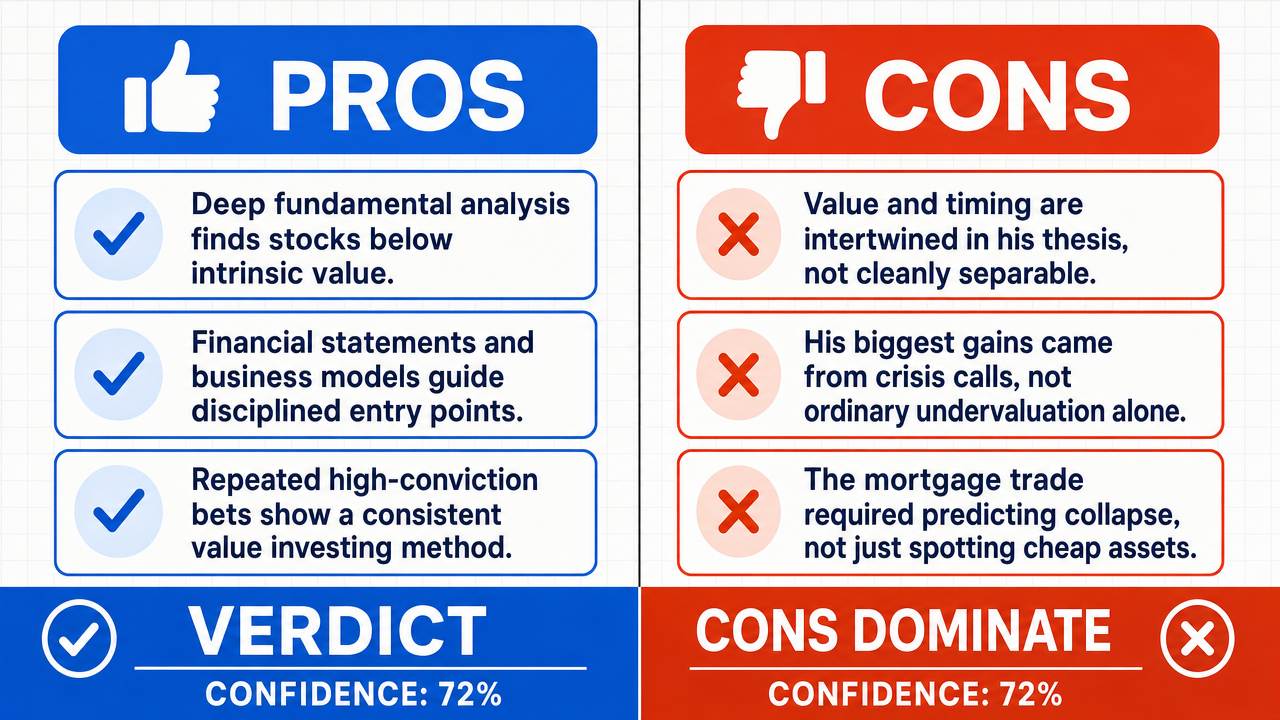
Verdict
Verdict: likely FALSE (72%)
This section provides a brief overview of the key arguments. You do not need to read the full detailed report below.
✅ Key PRO arguments:
- ■Michael Burry's investment philosophy is rooted in rigorous fundamental analysis to identify companies trading below their intrinsic value , representing the primary skill component that distinguishes his performance from chance outcomes.
- ■His approach systematically analyzes financial statements , balance sheets, and business models to calculate intrinsic value , then acquires positions when market prices significantly diverge from this calculated value, providing a repeatable value-investing methodology.
- ■The consistent pattern of his portfolio holdings features high-conviction positions in undervalued assets, demonstrating a systematic, repeatable value-investing methodology that distinguishes genuine skill from chance outcomes.
❌ Key ANTI arguments:
- ■The affirmative's attempt to decouple Burry's value investing from his market timing is a logical fallacy of circularity : they define 'mispricing' specifically as the moment a market crash becomes imminent, using the conclusion to define the input.
- ■The magnitude of Burry's most significant realized gains , particularly during the 2007-2008 period, cannot be explained by the identification of undervalued assets alone, as such extraordinary returns are structurally dependent on the timing of a systemic collapse .
- ■To profit from the specific mispricing of mortgage-backed securities during that era, one had to simultaneously identify that those assets would collapse in value, making crash prediction a decisive component of his strategy rather than a secondary one.
💭 Conclusion: False. The debate concluded that Michael Burry's investment strategy cannot be cleanly separated into value investing versus crash prediction, as his most significant gains during the 2007-2008 financial crisis were structurally dependent on correctly timing a systemic collapse . The negative side successfully demonstrated that the magnitude of returns from his subprime mortgage bet required simultaneous identification of both mispricing and impending market collapse, making crash prediction a decisive rather than secondary component. The affirmative's attempt to characterize Burry's strategy as purely value-based was undermined by the circular reasoning identified in defining 'mispricing' as inherently tied to crash timing. While Burry certainly employed fundamental analysis , the evidence presented shows that his extraordinary returns were inseparable from macro-economic timing , supporting the FALSE verdict.
🔬 DeepResearch Result: likely FALSE ❌ (72%)
Assertion: Michael Burry's investment strategy is best characterized by his willingness to buy companies for less than their intrinsic worth, rather than by his predictions of market crashes.
Participating models: deepseek-v3.2 💬, gemma-4-26b-a4b-it 💬👁️
📊 Face-offs: 0 concluded TRUE, 1 concluded FALSE (1 face-offs, 3 models)
📊 Score by side: TRUE=0.00, FALSE=0.72
🏅 Model score changes:
minimax-m3 💬👁️: +7
✅ PRO Arguments:
- ■Michael Burry's investment philosophy is rooted in rigorous fundamental analysis to identify companies trading below their intrinsic value , representing the primary skill component that distinguishes his performance from chance outcomes. deepseek-v3.2 💬
- ■His approach systematically analyzes financial statements , balance sheets, and business models to calculate intrinsic value, then acquires positions when market prices significantly diverge from this calculated value, providing a repeatable value-investing methodology. deepseek-v3.2 💬
- ■The consistent pattern of his portfolio holdings features high-conviction positions in undervalued assets, demonstrating a systematic, repeatable value-investing methodology that distinguishes genuine skill from chance outcomes. deepseek-v3.2 💬
❌ ANTI Arguments:
- ■The affirmative's attempt to decouple Burry's value investing from his market timing is a logical fallacy of circularity : they define 'mispricing' specifically as the moment a market crash becomes imminent, using the conclusion to define the input. gemma-4-26b-a4b-it 💬👁️
- ■The magnitude of Burry's most significant realized gains , particularly during the 2007-2008 period, cannot be explained by the identification of undervalued assets alone, as such extraordinary returns are structurally dependent on the timing of a systemic collapse . gemma-4-26b-a4b-it 💬👁️
- ■To profit from the specific mispricing of mortgage-backed securities during that era, one had to simultaneously identify that those assets would collapse in value, making crash prediction a decisive component of his strategy rather than a secondary one. gemma-4-26b-a4b-it 💬👁️
- ■The opponent's argument is logically inconsistent because it asserts that Burry's subprime mortgage bet was a valuation play based on identifying mispriced risk, yet simultaneously claims his strategy is 'not crash-prediction driven'—two propositions that cannot both be true in the context of the subprime trade. gemma-4-26b-a4b-it 💬👁️
💭 Reasoning: False. The debate concluded that Michael Burry's investment strategy cannot be cleanly separated into value investing versus crash prediction, as his most significant gains during the 2007-2008 financial crisis were structurally dependent on correctly timing a systemic collapse. The negative side successfully demonstrated that the magnitude of returns from his subprime mortgage bet required simultaneous identification of both mispricing and impending market collapse, making crash prediction a decisive rather than secondary component. The affirmative's attempt to characterize Burry's strategy as purely value-based was undermined by the circular reasoning identified in defining 'mispricing' as inherently tied to crash timing. While Burry certainly employed fundamental analysis, the evidence presented shows that his extraordinary returns were inseparable from macro-economic timing , supporting the FALSE verdict.
📋 PRO Facts:
• Burry's investment philosophy involves rigorous fundamental analysis of financial statements, balance sheets, and business models to calculate intrinsic value.
• Burry's portfolio holdings feature high-conviction positions consistent with a systematic value-investing methodology.
📋 ANTI Facts:
• Burry's most significant realized gains occurred during the 2007-2008 financial crisis period.
• Profiting from the specific mispricing of mortgage-backed securities during that era required identifying that those assets would collapse in value.
• The extraordinary magnitude of returns from the subprime trade was structurally dependent on the timing of a systemic collapse.
| Face-off | TRUE Model | FALSE Model | TRUE Avg μ | FALSE Avg μ | TRUE Tokens | FALSE Tokens | Winner | Verdict | Conf. |
|---|---|---|---|---|---|---|---|---|---|
| #1 | deepseek-v3.2 💬 | gemma-4-26b-a4b-it 💬👁️ | 0.274 | 0.196 | 12 | 3 | TRUE | FALSE | 72% |
The following technical terms, abbreviations, and domain-specific concepts are referenced throughout this debate transcript. Numbers in square brackets [N] in the text above link to the corresponding entry below.
[1] alpha — In investment performance attribution, alpha refers to excess returns generated by a manager's skill or strategy beyond a benchmark or risk-adjusted baseline.
[2] asset mispricing — A condition in which the market price of an asset diverges from its estimated fair or intrinsic value, creating a potential buying or selling opportunity.
[3] balance sheet — A financial statement that summarizes a company's assets, liabilities, and shareholders' equity at a specific point in time, used in fundamental analysis.
[4] circularity — logical fallacy of circularity — A reasoning error in which the conclusion is assumed within the premises, so that the argument effectively restates its conclusion rather than proving it.
[5] cross-sectional analysis — An analytical method that compares multiple entities (such as investors, funds, or companies) at a single point in time to identify patterns or persistent differences in performance.
[6] financial statements — Formal records of a company's financial activities and position, including the balance sheet, income statement, and cash flow statement, used to assess intrinsic value.
[7] free cash flow yield — A valuation metric that compares a company's free cash flow to its market value, used to identify potentially undervalued businesses.
[8] fundamental analysis — An investment methodology that evaluates a company's intrinsic value by examining its financial statements, business model, and underlying economic factors.
[9] hedge fund — A pooled investment vehicle that uses varied strategies, often including leverage and derivatives, to generate returns for its investors.
[10] intrinsic value — The estimated true worth of a company or asset based on its underlying fundamentals, as opposed to its current market price.
[11] macro-economic timing — An investment approach that seeks to profit by anticipating broad economic shifts, such as recessions or market crashes, rather than by selecting individual securities.
[12] market dislocation — A significant disruption in normal market pricing or functioning, often producing large and rapid price movements across asset classes.
[13] market-timing — An investment strategy of attempting to predict future market movements in order to buy or sell ahead of price changes.
[14] mortgage-backed securities — Financial instruments whose cash flows are derived from pools of underlying mortgage loans, discussed in the debate as the asset class central to Burry's subprime bet.
[15] non-systematic events — Events or outcomes that are sporadic and idiosyncratic rather than forming a repeatable, systematic pattern, which the affirmative argues cannot sustain an investment strategy.
[16] performance attribution — The analysis of the sources of an investment manager's returns, used to distinguish skill-based returns from luck or market exposure.
[17] persistent skill — In manager evaluation, the demonstration of repeatable, long-term outperformance that cannot be explained by chance.
[18] portfolio structure — The composition and weighting of holdings within an investment portfolio, used in the debate as evidence of an investor's underlying strategy.
[19] price-to-book ratio — A valuation metric comparing a company's market price to its book value per share, cited as an indicator used in value-oriented analysis.
[20] realized gains — Profits from investments that have actually been sold or closed out, as opposed to unrealized gains still held in the portfolio.
[21] subprime mortgage — A mortgage loan issued to borrowers with weaker credit profiles, referenced in the debate as the underlying asset class tied to the 2007-2008 crisis.
[22] substitution of proxy — A reasoning error in which a stand-in metric is used in place of the actual concept being measured, potentially distorting the conclusion.
[23] sustainable competitive advantages — Durable features of a business—such as brand, scale, or network effects—that allow it to maintain superior returns over competitors, often called an economic 'moat'.
[24] systemic collapse — A widespread failure across an interconnected financial or economic system, referenced in the debate as the predicted event behind the subprime trade.
[25] valuation analysis — The process of estimating an asset's intrinsic value, typically through fundamental metrics, to determine whether it is over- or undervalued.
[26] valuation play — An investment thesis centered on the idea that an asset is mispriced relative to its intrinsic value, rather than on anticipated market movements.
[27] value investing — An investment strategy of buying assets that appear to trade below their intrinsic value, characterized in the debate as Burry's primary methodology.
[28] venture capital — A form of private equity financing provided to early-stage or high-growth companies, mentioned in the debate as a category of investment management.
Face-off transcripts
- ■
Ownership & Trade Secrets. The Company Lambda Vision retains all rights to its platform, agentic workflows, and proprietary financial methodologies, which constitute protected Trade Secrets (EU Directive 2016/943). Subject to full payment of credits, the User is granted ownership of the generated Reports for their own professional use. Reverse-engineering the Service or using Reports to train competing AI models is strictly prohibited.
- ■
No Financial Advice. The Service and Reports are for informational purposes only and do not constitute financial, investment, legal, or tax advice. The Company is not a regulated financial advisor. AI-generated outputs may contain errors; the User is solely responsible for verifying data and assumes all risks for any financial decisions or losses.
- ■
Liability & Governing Law. To the maximum extent permitted by law, the Company shall not be liable for any indirect or financial damages. These Terms are governed by French law. Any disputes shall be subject to the exclusive jurisdiction of the Courts of Paris, France.