
Michael Burry's shift to put options with specific expiration dates, targeting an earlier AI bubble burst, contradicts his historical strength of being early without imposed deadlines.
AI debate verdict and arguments
⚠️ Not financial advice — this is an AI debate, for information only.
Completed October 8, 2026
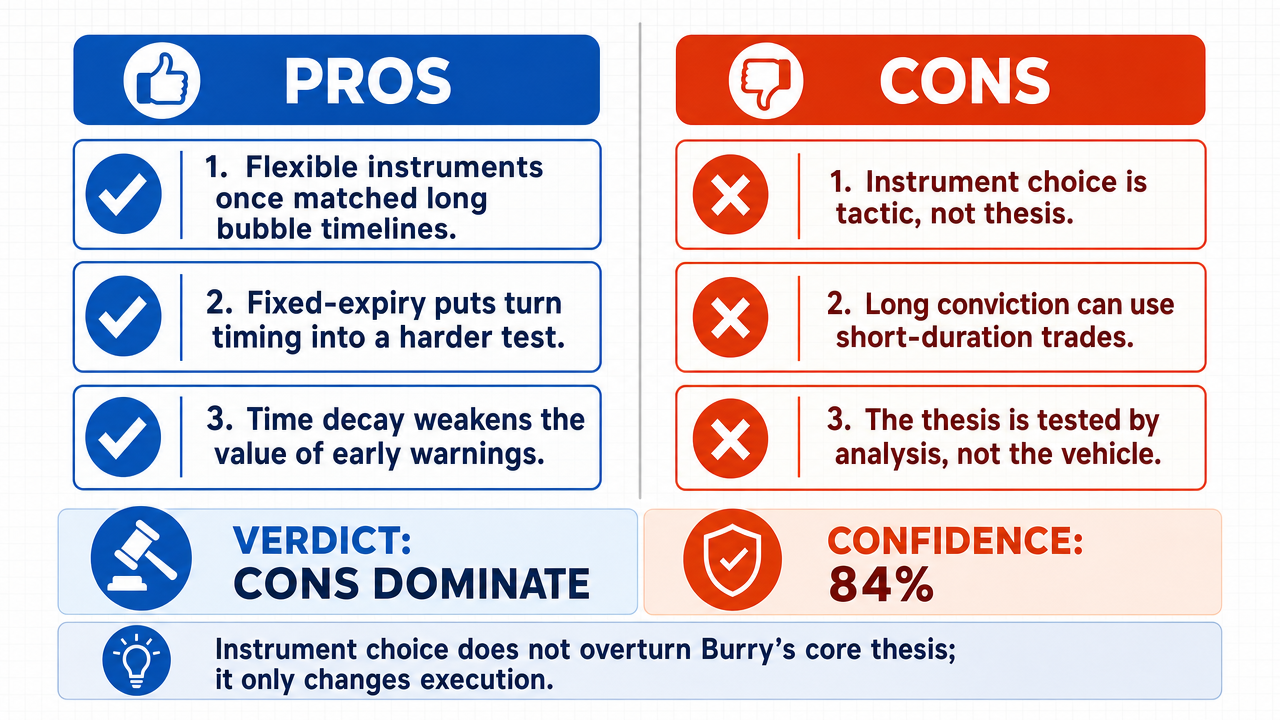
Verdict
Verdict: likely FALSE (84%)
This section provides a brief overview of the key arguments. You do not need to read the full detailed report below.
✅ Key PRO arguments:
- ■Burry's historical success was built on instruments like credit default swaps that had no fixed expiration, allowing him to maintain positions through years of market irrationality until his fundamental thesis was validated. His current use of short-dated puts imposes a structural deadline that transforms the test from one of fundamental patience to one of precise market timing .
- ■The instrument fundamentally changes the nature of the test the investor's thesis must pass. Burry's strength was not merely identifying bubbles, but identifying them and maintaining positions through extended periods of market irrationality—a test his subprime credit default swaps passed because they lacked expiration.
- ■The shift to time-bound AI puts presents a significant challenge to Burry's early-warning strength because theta decay and a terminal deadline create a binary , deadline-driven gamble that is qualitatively different from his historical methodology of using perpetual or long-dated instruments.
❌ Key ANTI arguments:
- ■Instrument selection is a tactical execution of a thesis, not a contradiction of its underlying logic. An investor's thesis—the identification of a structural bubble—remains constant regardless of whether they use credit default swaps , long-dated equity , or short-term options to express that view.
- ■There is a critical distinction between the duration of the conviction and the duration of the instrument. One can maintain a long-term bearish conviction while using short-dated instruments by rolling positions or selecting expirations that align with the expected timeline of the thesis playing out.
- ■The nature of the analytical test is determined by the thesis itself, not the derivative instrument. The instrument is merely a vehicle for execution, and the choice between long-dated /perpetual derivatives and fixed-expiration instruments reflects tactical positioning rather than a fundamental change in analytical methodology.
💭 Conclusion: False. The assertion is rejected because the FALSE side successfully demonstrated that instrument selection is a tactical execution of an underlying thesis, not a contradiction of it. Burry's core analytical strength—identifying structural bubbles early—remains constant regardless of whether he expresses that view through credit default swaps , long-dated equity , or short-dated put options . The distinction between the duration of conviction and the duration of the instrument is decisive: an investor can maintain a long-term bearish thesis while using time-bound instruments by rolling positions or selecting appropriate expirations. The TRUE side's argument that the instrument fundamentally transforms the nature of the test conflates tactical implementation with analytical methodology. While the TRUE side correctly noted that Burry's historical subprime positions used instruments without fixed expiration, this does not mean that switching to puts with specific dates constitutes a contradiction of his early-warning strength—it merely reflects a different tactical approach to expressing the same fundamental view.
🔬 DeepResearch Result: likely FALSE ❌ (84%)
Assertion: Michael Burry's shift to put options with specific expiration dates, targeting an earlier AI bubble burst, contradicts his historical strength of being early without imposed deadlines.
Participating models: deepseek-v3.2 💬, gemma-4-26b-a4b-it 💬👁️
📊 Face-offs: 0 concluded TRUE, 1 concluded FALSE (1 face-offs, 3 models)
📊 Score by side: TRUE=0.00, FALSE=0.84
🏅 Model score changes:
minimax-m3 💬👁️: +8
✅ PRO Arguments:
- ■Burry's historical success was built on instruments like credit default swaps that had no fixed expiration, allowing him to maintain positions through years of market irrationality until his fundamental thesis was validated. His current use of short-dated puts imposes a structural deadline that transforms the test from one of fundamental patience to one of precise market timing . deepseek-v3.2 💬
- ■The instrument fundamentally changes the nature of the test the investor's thesis must pass. Burry's strength was not merely identifying bubbles, but identifying them and maintaining positions through extended periods of market irrationality—a test his subprime credit default swaps passed because they lacked expiration. deepseek-v3.2 💬
- ■The shift to time-bound AI puts presents a significant challenge to Burry's early-warning strength because theta decay and a terminal deadline create a binary , deadline-driven gamble that is qualitatively different from his historical methodology of using perpetual or long-dated instruments. deepseek-v3.2 💬
❌ ANTI Arguments:
- ■Instrument selection is a tactical execution of a thesis, not a contradiction of its underlying logic. An investor's thesis—the identification of a structural bubble—remains constant regardless of whether they use credit default swaps, long-dated equity , or short-term options to express that view. gemma-4-26b-a4b-it 💬👁️
- ■There is a critical distinction between the duration of the conviction and the duration of the instrument. One can maintain a long-term bearish conviction while using short-dated instruments by rolling positions or selecting expirations that align with the expected timeline of the thesis playing out. gemma-4-26b-a4b-it 💬👁️
- ■The nature of the analytical test is determined by the thesis itself, not the derivative instrument. The instrument is merely a vehicle for execution, and the choice between long-dated/perpetual derivatives and fixed-expiration instruments reflects tactical positioning rather than a fundamental change in analytical methodology. gemma-4-26b-a4b-it 💬👁️
- ■Burry's core strength—identifying structural mispricings and bubbles early—remains intact regardless of which vehicle he uses to express that view. The use of puts with specific expiration dates does not negate his analytical capability; it simply represents a different tactical implementation of the same underlying bearish thesis . gemma-4-26b-a4b-it 💬👁️
💭 Reasoning: False. The assertion is rejected because the FALSE side successfully demonstrated that instrument selection is a tactical execution of an underlying thesis, not a contradiction of it. Burry's core analytical strength—identifying structural bubbles early—remains constant regardless of whether he expresses that view through credit default swaps, long-dated equity, or short-dated put options. The distinction between the duration of conviction and the duration of the instrument is decisive: an investor can maintain a long-term bearish thesis while using time-bound instruments by rolling positions or selecting appropriate expirations. The TRUE side's argument that the instrument fundamentally transforms the nature of the test conflates tactical implementation with analytical methodology. While the TRUE side correctly noted that Burry's historical subprime positions used instruments without fixed expiration, this does not mean that switching to puts with specific dates constitutes a contradiction of his early-warning strength—it merely reflects a different tactical approach to expressing the same fundamental view.
📋 PRO Facts:
• Burry's famous subprime mortgage short positions were established years before the 2008 crash using credit default swaps that had no fixed expiration date .
• Credit default swaps allowed Burry to withstand temporary market irrationality and wait for fundamental mispricing to correct.
• Put options have structural features including theta decay and fixed expiration dates that create deadline-driven outcomes.
📋 ANTI Facts:
• An investor's thesis remains constant regardless of the derivative instrument used to express it.
• Investors can maintain long-term conviction while using short-dated instruments by rolling positions across expiration cycles.
• The choice between perpetual and fixed-expiration derivatives reflects tactical positioning rather than a change in analytical methodology.
| Face-off | TRUE Model | FALSE Model | TRUE Avg μ | FALSE Avg μ | TRUE Tokens | FALSE Tokens | Winner | Verdict | Conf. |
|---|---|---|---|---|---|---|---|---|---|
| #1 | deepseek-v3.2 💬 | gemma-4-26b-a4b-it 💬👁️ | 0.438 | 0.239 | 12 | 3 | TRUE | FALSE | 84% |
The following technical terms, abbreviations, and domain-specific concepts are referenced throughout this debate transcript. Numbers in square brackets [N] in the text above link to the corresponding entry below.
[1] 2008 crash — 2008 financial crisis — The severe global financial crisis referenced in the debate as the event that validated Burry's earlier subprime mortgage short positions.
[2] AI bubble — artificial intelligence bubble — A speculative bubble in AI-related stocks and companies that Burry's recent put options reportedly bet against.
[3] bearish thesis — bearish investment thesis — An investment thesis predicting that the price of an asset or market will decline.
[4] binary — binary outcome — An all-or-nothing outcome, used in the debate to describe the deadline-driven gamble of fixed-expiration put options.
[5] capital efficiency — The efficient use of invested capital, cited in the debate as a possible reason for choosing short-term derivatives over long-dated instruments.
[6] category error — A logical error of assigning something to the wrong category; used in the debate to argue that confusing an investment thesis with its tactical implementation is such an error.
[7] credit default swaps — credit default swaps (CDS) — Financial derivatives that function like insurance against default, used by Burry in his subprime mortgage short positions and noted in the debate for lacking a fixed expiration date.
[8] derivatives — Financial contracts whose value derives from an underlying asset, including options and credit default swaps.
[9] equity — Ownership interest in a company, mentioned in the debate as one possible instrument (long-dated equity) for expressing a bearish view.
[10] expiration date — The date on which a derivative contract becomes void; central to the debate because put options have fixed expirations while credit default swaps historically did not.
[11] fundamental analysis — Analysis based on underlying financial factors rather than price action, referenced in the debate as Burry's historical methodology.
[12] fundamental mispricing — A situation where an asset's market price does not reflect its true underlying value, the condition Burry's thesis seeks to identify.
[13] long-dated — long-dated derivatives — Derivatives with far-off expiration dates that minimize time decay, contrasted in the debate with short-dated put options.
[14] market downturns — Periods of declining market prices, the type of event Burry is historically known for anticipating early.
[15] market timing — The practice of attempting to predict the timing of market movements, which the Affirmative argues Burry's fixed-expiration puts force him into.
[16] perpetual instruments — Derivatives with no expiration date, cited in the debate as one of two exhaustive ways to express a bearish thesis.
[17] put options — Derivative contracts giving the holder the right to sell an asset at a specified price before or at expiration; the instrument Burry recently used to bet against an AI bubble.
[18] risk-reward asymmetry — An imbalance between potential risk and potential reward, cited in the debate as the rationale for choosing a derivative with theta decay.
[19] SEC filings — Securities and Exchange Commission filings — Regulatory documents filed with the U.S. Securities and Exchange Commission, cited in the debate as documentation of Burry's historical subprime positions.
[20] semiconductor — semiconductor companies — Companies that design or manufacture semiconductor chips, mentioned in the debate as targets of Burry's recent put options.
[21] short positions — Investment positions that profit from a decline in price, such as Burry's historical subprime mortgage shorts.
[22] short-dated — short-dated derivatives — Derivatives with near expiration dates that are subject to significant theta decay, the type Burry's recent AI puts represent.
[23] structural market mispricing — Systematic incorrect pricing across a market, identified as the constant analytical target of Burry's thesis regardless of instrument.
[24] subprime mortgage — A mortgage extended to borrowers with poor credit histories, the asset class underlying Burry's famous pre-2008 short positions.
[25] theta decay — The erosion of an option's value as time passes toward expiration, cited as a structural feature that distinguishes puts from credit default swaps.
[26] time decay — The loss of value over time in options contracts, referenced as a feature of fixed-expiration instruments that incorporates a deadline into the position.
[27] volatility windows — Specific periods of elevated market volatility, cited in the debate as a possible reason to use short-term derivatives to capture timing opportunities.
Face-off transcripts
- ■
Ownership & Trade Secrets. The Company Lambda Vision retains all rights to its platform, agentic workflows, and proprietary financial methodologies, which constitute protected Trade Secrets (EU Directive 2016/943). Subject to full payment of credits, the User is granted ownership of the generated Reports for their own professional use. Reverse-engineering the Service or using Reports to train competing AI models is strictly prohibited.
- ■
No Financial Advice. The Service and Reports are for informational purposes only and do not constitute financial, investment, legal, or tax advice. The Company is not a regulated financial advisor. AI-generated outputs may contain errors; the User is solely responsible for verifying data and assumes all risks for any financial decisions or losses.
- ■
Liability & Governing Law. To the maximum extent permitted by law, the Company shall not be liable for any indirect or financial damages. These Terms are governed by French law. Any disputes shall be subject to the exclusive jurisdiction of the Courts of Paris, France.