
Microsoft's cloud profit margin will decline by less than one percentage point in the 2027 annual report.
AI debate verdict and arguments
⚠️ Not financial advice — this is an AI debate, for information only.
Completed October 14, 2026
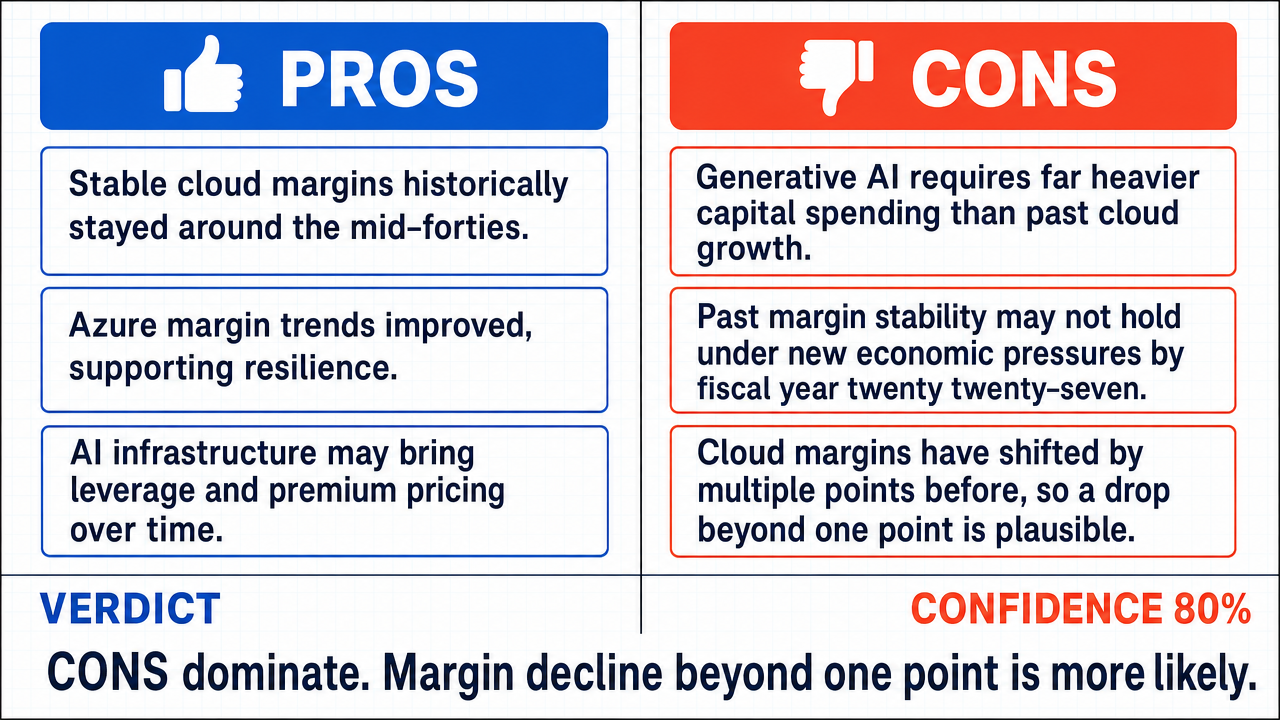
Verdict
Verdict: likely FALSE (80%)
This section provides a brief overview of the key arguments. You do not need to read the full detailed report below.
✅ Key PRO arguments:
- ■Microsoft's Intelligent Cloud segment has demonstrated remarkable margin stability with operating margins consistently in the mid-40% range, and historical data shows the company's ability to maintain cloud profitability through scale efficiencies and product mix optimization .
- ■Azure -specific margin data shows consistent improvement, with CEO Satya Nadella stating in the Q4 2024 earnings call that Azure continues to deliver strong margins, suggesting structural resilience that would limit margin erosion to under one percentage point .
- ■Microsoft's strategic investments in AI infrastructure will ultimately support margin stability through operational leverage and premium pricing for AI-enhanced cloud services.
❌ Key ANTI arguments:
- ■The scale of capital expenditure required for the generative AI era is fundamentally different from the previous decade of cloud expansion; as Microsoft shifts to highly specialized, power-hungry AI workloads, the cost of goods sold is being structurally impacted, creating margin pressure exceeding one percentage point .
- ■The affirmative's reliance on historical margin stability is an error of temporal relevance, assuming that economic constraints between now and 2027 are invariant, which is a false premise given the unprecedented AI infrastructure buildout.
- ■The Intelligent Cloud operating margin was approximately 32% in FY2016 and has seen multi-point shifts in recent fiscal cycles , directly contradicting the affirmative's claim of structural stability and demonstrating that the segment is capable of margin swings well exceeding one percentage point .
💭 Conclusion: False. The winning side convincingly demonstrated that Microsoft's cloud profit margin is likely to decline by more than one percentage point in FY2027 , driven by the unprecedented capital expenditure requirements of the generative AI era. The anti side effectively dismantled the pro's stability argument by showing that the Intelligent Cloud segment has historically experienced multi-point margin shifts, with the operating margin significantly lower in earlier fiscal years before rising to the mid-40% range, proving the segment is not structurally immune to large swings. The shift to power-hungry, specialized AI workloads fundamentally changes the cost structure in a way that historical cloud expansion did not, making the pro's temporal analogy flawed.
🔬 DeepResearch Result: likely FALSE ❌ (80%)
Assertion: Microsoft's cloud profit margin will decline by less than one percentage point in the 2027 annual report .
Participating models: deepseek-v3.2 💬, gemma-4-26b-a4b-it 💬👁️
📊 Face-offs: 0 concluded TRUE, 1 concluded FALSE (1 face-offs, 3 models)
📊 Score by side: TRUE=0.00, FALSE=0.80
🏅 Model score changes:
minimax-m3 💬👁️: +8
✅ PRO Arguments:
- ■Microsoft's Intelligent Cloud segment has demonstrated remarkable margin stability with operating margins consistently in the mid-40% range, and historical data shows the company's ability to maintain cloud profitability through scale efficiencies and product mix optimization . deepseek-v3.2 💬
- ■Azure -specific margin data shows consistent improvement, with CEO Satya Nadella stating in the Q4 2024 earnings call that Azure continues to deliver strong margins, suggesting structural resilience that would limit margin erosion to under one percentage point. deepseek-v3.2 💬
- ■Microsoft's strategic investments in AI infrastructure will ultimately support margin stability through operational leverage and premium pricing for AI-enhanced cloud services. deepseek-v3.2 💬
❌ ANTI Arguments:
- ■The scale of capital expenditure required for the generative AI era is fundamentally different from the previous decade of cloud expansion; as Microsoft shifts to highly specialized, power-hungry AI workloads, the cost of goods sold is being structurally impacted, creating margin pressure exceeding one percentage point. gemma-4-26b-a4b-it 💬👁️
- ■The affirmative's reliance on historical margin stability is an error of temporal relevance, assuming that economic constraints between now and 2027 are invariant, which is a false premise given the unprecedented AI infrastructure buildout. gemma-4-26b-a4b-it 💬👁️
- ■The Intelligent Cloud operating margin was approximately 32% in FY2016 and has seen multi-point shifts in recent fiscal cycles , directly contradicting the affirmative's claim of structural stability and demonstrating that the segment is capable of margin swings well exceeding one percentage point. gemma-4-26b-a4b-it 💬👁️
💭 Reasoning: False. The winning side convincingly demonstrated that Microsoft's cloud profit margin is likely to decline by more than one percentage point in FY2027 , driven by the unprecedented capital expenditure requirements of the generative AI era. The anti side effectively dismantled the pro's stability argument by showing that the Intelligent Cloud segment has historically experienced multi-point margin shifts, with the operating margin significantly lower in earlier fiscal years before rising to the mid-40% range, proving the segment is not structurally immune to large swings. The shift to power-hungry, specialized AI workloads fundamentally changes the cost structure in a way that historical cloud expansion did not, making the pro's temporal analogy flawed.
📋 PRO Facts:
• Microsoft's Intelligent Cloud segment reported a 44% operating margin in fiscal year 2023.
• CEO Satya Nadella stated in the Q4 2024 earnings call that Azure continues to deliver strong margin expansion as the company scales and optimizes its infrastructure.
📋 ANTI Facts:
• The Intelligent Cloud operating margin was significantly lower in earlier fiscal years before rising to the mid-40% range.
• The Intelligent Cloud segment has seen multi-point shifts in operating margin in recent fiscal cycles.
• The shift to specialized, power-hungry AI workloads is structurally increasing the cost of goods sold for cloud services.
| Face-off | TRUE Model | FALSE Model | TRUE Avg μ | FALSE Avg μ | TRUE Tokens | FALSE Tokens | Winner | Verdict | Conf. |
|---|---|---|---|---|---|---|---|---|---|
| #1 | deepseek-v3.2 💬 | gemma-4-26b-a4b-it 💬👁️ | 0.213 | 0.191 | 8 | 2 | TRUE | FALSE | 80% |
The following technical terms, abbreviations, and domain-specific concepts are referenced throughout this debate transcript. Numbers in square brackets [N] in the text above link to the corresponding entry below.
[1] AI hardware — Artificial Intelligence hardware — Specialized physical computing equipment (such as GPUs and custom accelerators) designed to train and run artificial intelligence models.
[2] annual report — A comprehensive financial document that public companies publish yearly to disclose their financial performance, operations, and outlook.
[3] Azure — Microsoft's public cloud computing platform, used for building, deploying, and managing applications and services through Microsoft-managed data centers.
[4] Azure-specific margin — The profit margin attributable solely to Microsoft's Azure cloud platform, as distinct from the broader Intelligent Cloud segment that includes other services.
[5] capital expenditures — CapEx — Funds spent by a company to acquire, upgrade, or maintain physical assets such as data centers, servers, and infrastructure.
[6] capital-intensive — Describing a business that requires significant upfront investment in physical assets or infrastructure relative to its revenue.
[7] COGS — Cost of Goods Sold — The direct costs of producing the goods or services sold by a company, including materials, labor, and directly attributable overhead.
[8] component-level decomposition analysis — A financial analysis method that breaks down aggregate segment results into individual contributing components to evaluate performance drivers.
[9] cost architecture — The structural composition and organization of a business's cost base, including how fixed and variable costs are distributed across operations.
[10] data centers — Physical facilities housing computing infrastructure (servers, storage, networking equipment) used to deliver cloud and online services.
[11] earnings call — A conference call held by a public company's management to discuss financial results with analysts and investors, typically following the release of quarterly or annual results.
[12] economic cycles — Recurring patterns of expansion and contraction in overall economic activity, including periods of growth, peak, recession, and recovery.
[13] fiscal cycles — The recurring pattern of a company's financial reporting periods, typically aligned with its fiscal year structure.
[14] FY2027 — Fiscal Year 2027 — Microsoft's fiscal year 2027, a 12-month financial reporting period used by the company for accounting and reporting purposes.
[15] generative AI — Generative Artificial Intelligence — A category of artificial intelligence models capable of creating new content such as text, images, or code, requiring substantial specialized computing resources.
[16] GPU clusters — Graphics Processing Unit clusters — Groups of interconnected graphics processors working together to provide the massive parallel computing power required for AI training and inference workloads.
[17] Intelligent Cloud — Microsoft's reporting segment that includes Azure, enterprise server products, and related cloud services.
[18] margin compression — A reduction in profit margins caused by rising costs, pricing pressure, or unfavorable shifts in business mix.
[19] margin erosion — A gradual decline in a company's profit margins over time, often due to competitive, operational, or macroeconomic pressures.
[20] margin expansion — An increase in profit margins, typically resulting from scale efficiencies, cost reductions, or favorable shifts in product mix.
[21] margin stability — The tendency of a business segment's profit margins to remain consistent across reporting periods despite changes in revenue or operating conditions.
[22] multi-point shifts — Changes in a metric (such as a margin) measured in multiple percentage points, indicating significant movement rather than minor fluctuation.
[23] operating leverage — The degree to which a company's operating income changes in response to a change in revenue, reflecting the proportion of fixed versus variable costs.
[24] operating margin — A profitability ratio calculated as operating income divided by revenue, measuring the percentage of revenue remaining after covering operating expenses.
[25] percentage point — A unit of measurement equal to 1% (one hundredth of a whole), used to express absolute differences between percentages.
[26] phase shift — In this debate, used metaphorically to describe a fundamental structural transformation in the cost base of cloud services driven by AI workloads.
[27] prior reporting period — The financial reporting period immediately preceding the one being analyzed, used as a baseline for comparison.
[28] product mix optimization — The strategic adjustment of the combination of products or services offered to maximize profitability, often by shifting toward higher-margin offerings.
[29] profit margin — A profitability metric measuring the portion of revenue that remains as profit after accounting for costs, expressed as a percentage.
[30] quantitative threshold — A specific numerical boundary (such as 'less than 1%') used as a benchmark to evaluate whether a claim or prediction is satisfied.
[31] revenue-generating operations — Business activities that produce income, as distinguished from capital investment or preparatory build-out phases.
[32] scale efficiencies — Cost advantages gained as a business grows larger, where per-unit costs decline due to spreading fixed costs over greater output.
[33] segment-level aggregate margins — Profit margin figures reported at the business segment level (such as Microsoft's Intelligent Cloud), combining all products and services within that segment.
[34] specialized silicon — Custom-designed semiconductor chips (such as AI accelerators) engineered for specific computational workloads rather than general-purpose use.
[35] structural resilience — The inherent ability of a business or segment to maintain performance characteristics despite adverse conditions, due to its underlying economic structure.
[36] substitution error — A logical fallacy in which one concept, metric, or data point is improperly replaced with another that is not equivalent, leading to an invalid conclusion.
The following financial data tables were referenced during the debate exchanges:
| Metric | FY2023 (Actual) | FY2027 (Projected Trend) | Δ (Expected Impact) |
|---|---|---|---|
| AI-Related CapEx Intensity | Moderate | Extremely High | +++ |
| Infrastructure Power Costs | Baseline | Escalating | ++ |
| Cloud Service Margin Stability | High | Volatile | -- |
Legend: Qualitative assessment of cost drivers based on current hyperscale CapEx trends. "+++" denotes significant upward pressure on costs.
| Component | FY2023 Revenue Growth | FY2024 Revenue Growth | Segment Weight Trend |
|---|---|---|---|
| Azure & Cloud Services | 31% | 31% | Increasing |
| Server Products | 2% | 3% | Decreasing |
| Enterprise Services | 6% | 5% | Stable |
Legend: Revenue growth by component within Microsoft's Intelligent Cloud segment (FY2023-FY2024). Azure's accelerating weight makes segment margins increasingly representative of Azure performance. Source: Microsoft quarterly earnings reports.
Face-off transcripts
- ■
Ownership & Trade Secrets. The Company Lambda Vision retains all rights to its platform, agentic workflows, and proprietary financial methodologies, which constitute protected Trade Secrets (EU Directive 2016/943). Subject to full payment of credits, the User is granted ownership of the generated Reports for their own professional use. Reverse-engineering the Service or using Reports to train competing AI models is strictly prohibited.
- ■
No Financial Advice. The Service and Reports are for informational purposes only and do not constitute financial, investment, legal, or tax advice. The Company is not a regulated financial advisor. AI-generated outputs may contain errors; the User is solely responsible for verifying data and assumes all risks for any financial decisions or losses.
- ■
Liability & Governing Law. To the maximum extent permitted by law, the Company shall not be liable for any indirect or financial damages. These Terms are governed by French law. Any disputes shall be subject to the exclusive jurisdiction of the Courts of Paris, France.