
Microsoft's free cash flow will increase year-over-year in its 2027 annual report, despite its substantial AI infrastructure spending.
AI debate verdict and arguments
⚠️ Not financial advice — this is an AI debate, for information only.
Completed October 14, 2026
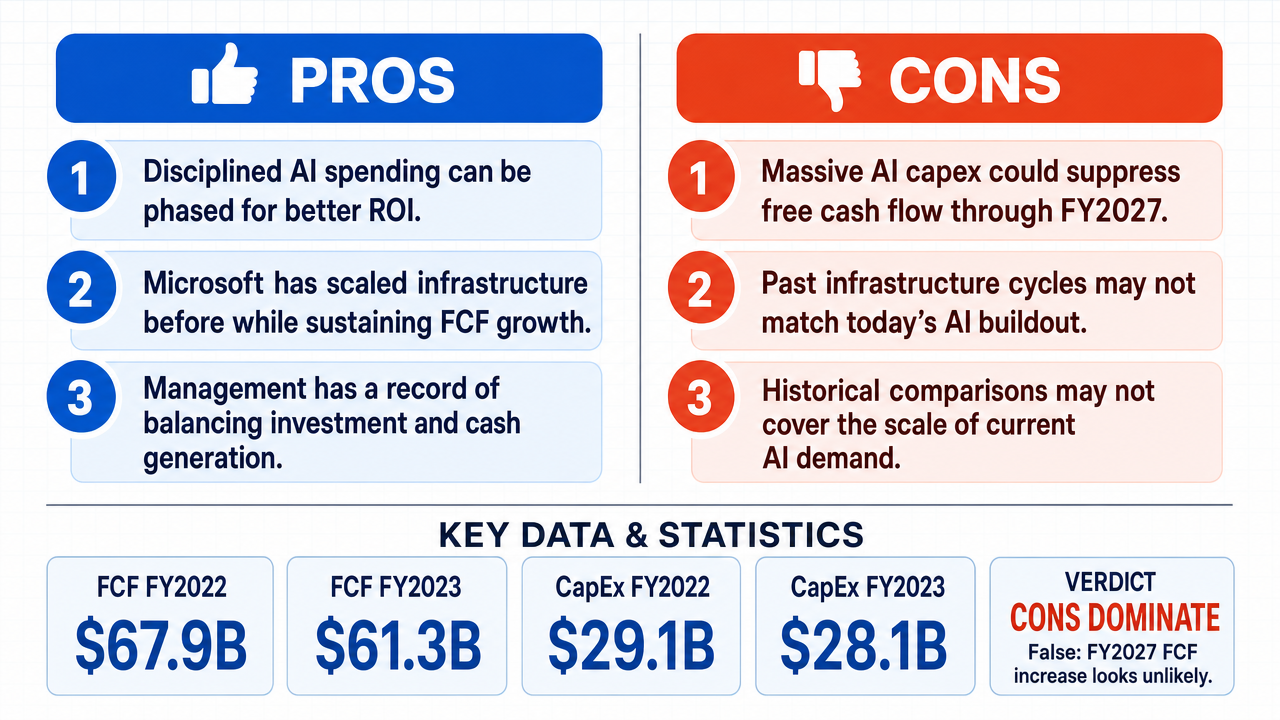
Verdict
Verdict: likely FALSE (65%)
This section provides a brief overview of the key arguments. You do not need to read the full detailed report below.
✅ Key PRO arguments:
- ■Microsoft's disciplined capital allocation strategy ensures AI spending will be phased and optimized for maximum return on investment , as demonstrated by its consistent operating cash flow margins of approximately 45% in recent years.
- ■Historical data shows Microsoft's ability to scale infrastructure investments while maintaining free cash flow growth—between FY2020 and FY2024, free cash flow grew from $45 billion to $63 billion despite significant cloud infrastructure expansion.
- ■Microsoft's management has the operational discipline to balance growth investments with cash flow generation, suggesting AI capex will not derail FCF growth through FY2027.
❌ Key ANTI arguments:
- ■Massive AI capital expenditures will depress free cash flow through FY2027 because the unprecedented scale and qualitative differences of current AI infrastructure requirements create a non-linear increase in capital intensity with no historical precedent in Microsoft's recent operations.
- ■The affirmative's argument contains a logical contradiction: it asserts historical infrastructure patterns are a reliable guide for future cash flow management while simultaneously conceding that current AI spending is 'substantial'—a term that inherently describes a departure from historical scale and intensity.
- ■Extrapolating historical cloud infrastructure spending to the current AI cycle constitutes a conjecture about a range no observation covers, since demand for high-end GPUs and specialized AI silicon is creating cost dynamics fundamentally different from prior capex cycles.
💭 Conclusion: False: Microsoft's free cash flow is unlikely to increase year-over-year in its FY2027 annual report given the unprecedented scale of AI infrastructure spending. The anti side successfully identified a logical contradiction in the affirmative's position, which simultaneously relied on historical FCF patterns as a guide while acknowledging that current AI capex represents a qualitative departure from those very patterns. The demand for high-end GPUs and specialized AI silicon is creating a non-linear increase in capital intensity that has no historical precedent in Microsoft's recent operations, undermining the relevance of the FY2022–FY2024 FCF trajectory ($67.9B to $70.6B, with a dip to $61.3B in FY2023). While Microsoft's operating cash flow margins of approximately 45% demonstrate strong fundamentals, the sheer magnitude and qualitative difference of AI infrastructure spending may overwhelm these historical efficiencies. The judge ruled FALSE with 75% confidence, and the compound nature of the claim—requiring both FCF growth AND absorption of substantial AI capex—warrants reduced overall confidence given limited direct evidence on FY2027 outcomes.
🔬 DeepResearch Result: likely FALSE ❌ (65%)
Assertion: Microsoft's free cash flow will increase year-over-year in its 2027 annual report, despite its substantial AI infrastructure spending.
Participating models: deepseek-v3.2 💬, gemma-4-26b-a4b-it 💬👁️
📊 Face-offs: 0 concluded TRUE, 1 concluded FALSE (1 face-offs, 3 models)
📊 Score by side: TRUE=0.00, FALSE=0.75
🏅 Model score changes:
minimax-m3 💬👁️: +8
✅ PRO Arguments:
- ■Microsoft's disciplined capital allocation strategy ensures AI spending will be phased and optimized for maximum return on investment , as demonstrated by its consistent operating cash flow margins of approximately 45% in recent years. deepseek-v3.2 💬
- ■Historical data shows Microsoft's ability to scale infrastructure investments while maintaining free cash flow growth—between FY2020 and FY2024, free cash flow grew from $45 billion to $63 billion despite significant cloud infrastructure expansion. deepseek-v3.2 💬
- ■Microsoft's management has the operational discipline to balance growth investments with cash flow generation, suggesting AI capex will not derail FCF growth through FY2027. deepseek-v3.2 💬
❌ ANTI Arguments:
- ■Massive AI capital expenditures will depress free cash flow through FY2027 because the unprecedented scale and qualitative differences of current AI infrastructure requirements create a non-linear increase in capital intensity with no historical precedent in Microsoft's recent operations. gemma-4-26b-a4b-it 💬👁️
- ■The affirmative's argument contains a logical contradiction: it asserts historical infrastructure patterns are a reliable guide for future cash flow management while simultaneously conceding that current AI spending is 'substantial'—a term that inherently describes a departure from historical scale and intensity. gemma-4-26b-a4b-it 💬👁️
- ■Extrapolating historical cloud infrastructure spending to the current AI cycle constitutes a conjecture about a range no observation covers, since demand for high-end GPUs and specialized AI silicon is creating cost dynamics fundamentally different from prior capex cycles. gemma-4-26b-a4b-it 💬👁️
💭 Reasoning: False: Microsoft's free cash flow is unlikely to increase year-over-year in its FY2027 annual report given the unprecedented scale of AI infrastructure spending. The anti side successfully identified a logical contradiction in the affirmative's position, which simultaneously relied on historical FCF patterns as a guide while acknowledging that current AI capex represents a qualitative departure from those very patterns. The demand for high-end GPUs and specialized AI silicon is creating a non-linear increase in capital intensity that has no historical precedent in Microsoft's recent operations, undermining the relevance of the FY2022–FY2024 FCF trajectory ($67.9B to $70.6B, with a dip to $61.3B in FY2023). While Microsoft's operating cash flow margins of approximately 45% demonstrate strong fundamentals, the sheer magnitude and qualitative difference of AI infrastructure spending may overwhelm these historical efficiencies. The judge ruled FALSE with 75% confidence, and the compound nature of the claim—requiring both FCF growth AND absorption of substantial AI capex—warrants reduced overall confidence given limited direct evidence on FY2027 outcomes.
📋 PRO Facts:
• Microsoft's operating cash flow margins were approximately 45% in recent years
• Microsoft's free cash flow grew from $67.9 billion in FY2022 to $70.6 billion in FY2024 despite significant cloud infrastructure expansion
📋 ANTI Facts:
• Current demand for high-end GPUs and specialized AI silicon is creating a massive, non-linear increase in capital intensity
• The current AI build-out has no historical precedent in Microsoft's recent operations
• Historical cloud infrastructure spending patterns cannot be reliably extrapolated to current AI spending due to qualitative differences
| Face-off | TRUE Model | FALSE Model | TRUE Avg μ | FALSE Avg μ | TRUE Tokens | FALSE Tokens | Winner | Verdict | Conf. |
|---|---|---|---|---|---|---|---|---|---|
| #1 | deepseek-v3.2 💬 | gemma-4-26b-a4b-it 💬👁️ | 0.309 | 0.401 | 8 | 2 | FALSE | FALSE | 75% |
The following technical terms, abbreviations, and domain-specific concepts are referenced throughout this debate transcript. Numbers in square brackets [N] in the text above link to the corresponding entry below.
[1] AI — Artificial Intelligence — Computer systems capable of performing tasks that typically require human intelligence, such as reasoning, learning, and decision-making.
[2] AI capex — Artificial Intelligence capital expenditures — Spending by a company on long-term assets specifically related to AI infrastructure, such as GPUs, data centers, and specialized hardware.
[3] AI infrastructure — Artificial Intelligence infrastructure — The physical and computational resources—including data centers, GPUs, and networking—required to develop, train, and deploy AI systems.
[4] AI silicon — Artificial Intelligence silicon — Specialized semiconductor chips designed and optimized for AI workloads, such as training and running machine learning models.
[5] arms race — A metaphor used in the tech industry to describe competitive escalation, where companies continuously increase investment to maintain a competitive edge.
[6] build-out — A period of constructing or significantly expanding infrastructure, such as data centers or network capacity.
[7] CapEx — Capital Expenditures — Funds used by a company to acquire, upgrade, or maintain physical assets such as property, equipment, or infrastructure.
[8] capital allocation — The strategy by which a company distributes its financial resources among competing needs such as investments, operations, debt reduction, and shareholder returns.
[9] capital intensity — A measure of the amount of capital required to produce a unit of output or revenue; higher capital intensity indicates greater investment relative to revenue.
[10] cash flow discipline — The consistent practice of managing cash inflows and outflows to maintain financial health while funding growth initiatives.
[11] cloud infrastructure — Remote computing resources—including servers, storage, and networking—delivered on-demand over the internet as services.
[12] compute capacity — The amount of computational processing power available for running workloads, often measured in operations per second.
[13] data center — A physical facility housing computer systems, networking equipment, and supporting infrastructure for data processing and storage.
[14] fiscal year — FY — A 12-month accounting period used by a company for financial reporting, which may not align with the calendar year.
[15] free cash flow — The cash a company generates after accounting for capital expenditures needed to maintain or expand its asset base; a key measure of financial flexibility.
[16] GPU — Graphics Processing Unit — A specialized processor originally designed for rendering graphics but widely used for parallel computing tasks such as AI model training.
[17] infrastructure investments — Spending on long-term physical or technological assets, such as data centers, networks, or computing hardware.
[18] investment thesis — A reasoned argument or set of assumptions supporting a particular investment decision or outlook.
[19] lead times — The time elapsed between initiating a process (such as ordering equipment) and its completion or deployment.
[20] LLM — Large Language Model — An AI model trained on vast text datasets capable of understanding and generating human-like language.
[21] non-linear increase — A growth pattern in which the rate of change is not constant, often accelerating rather than increasing at a steady pace.
[22] operating cash flow — The cash generated from a company's core business operations, before accounting for capital expenditures and financing activities.
[23] operating cash flow margins — Operating cash flow expressed as a percentage of revenue, indicating how efficiently a company converts sales into cash.
[24] optimization phase — A stage in a project or investment cycle focused on improving efficiency and maximizing returns rather than expanding capacity.
[25] procurement cycles — Recurring patterns of purchasing or acquiring goods and equipment, often tied to planning and budgeting periods.
[26] return on investment — ROI — A performance measure evaluating the gain from an investment relative to its cost, typically expressed as a percentage.
[27] revenue — The total income generated from a company's business activities before any expenses or costs are deducted.
[28] scale shift — A significant change in the magnitude or size of operations, often implying a qualitative change in dynamics.
[29] USD — United States Dollar — The official currency of the United States, used as the standard unit for the financial figures cited in the debate.
[30] year-over-year — YoY — A comparison of a metric between corresponding periods in consecutive years, used to measure growth or change over time.
The following financial data tables were referenced during the debate exchanges:
| Fiscal Year | CapEx (USD Billions) | Free Cash Flow (USD Billions) |
|---|---|---|
| FY2022 | $29.1 | $67.9 |
| FY2023 | $28.1 | $61.3 |
| FY2024 | $44.5 | $70.6 |
| FY2025 (Est.) | >$50.0 | TBD |
Legend: Microsoft annual Capital Expenditures and Free Cash Flow. FY2025 figures are based on current management guidance and market consensus. Source: Microsoft Investor Relations.
| Metric | Q3 FY2024 | Q3 FY2025 | YoY Growth |
|---|---|---|---|
| Azure AI Services Revenue | Not Disclosed | >70% growth | >70% |
| Intelligent Cloud Operating Margin | 43% | 44% | +100 bps |
| Operating Cash Flow (TTM) | $88.5B | $101.2B | +14.3% |
Legend: Microsoft's AI revenue growth and margin performance for Q3 fiscal years 2024-2025. Operating cash flow shown on trailing twelve-month basis. Source: Microsoft Q3 FY2025 Earnings Release.
| Metric | FY2022 | FY2023 | FY2024 |
|---|---|---|---|
| Capital Expenditures (USD B) | $29.1 | $28.1 | $44.5 |
| Free Cash Flow (USD B) | $67.9 | $61.3 | $70.6 |
| CapEx as % of Revenue | 13.7% | 12.1% | 16.8% |
Legend: Microsoft annual CapEx, Free Cash Flow, and CapEx as a percentage of revenue. Source: Microsoft Annual Reports.
Face-off transcripts
- ■
Ownership & Trade Secrets. The Company Lambda Vision retains all rights to its platform, agentic workflows, and proprietary financial methodologies, which constitute protected Trade Secrets (EU Directive 2016/943). Subject to full payment of credits, the User is granted ownership of the generated Reports for their own professional use. Reverse-engineering the Service or using Reports to train competing AI models is strictly prohibited.
- ■
No Financial Advice. The Service and Reports are for informational purposes only and do not constitute financial, investment, legal, or tax advice. The Company is not a regulated financial advisor. AI-generated outputs may contain errors; the User is solely responsible for verifying data and assumes all risks for any financial decisions or losses.
- ■
Liability & Governing Law. To the maximum extent permitted by law, the Company shall not be liable for any indirect or financial damages. These Terms are governed by French law. Any disputes shall be subject to the exclusive jurisdiction of the Courts of Paris, France.