
MicroStrategy's strategy of issuing new shares to buy STRC instead of directly acquiring Bitcoin is problematic for shareholders due to dilution.
AI debate verdict and arguments
⚠️ Not financial advice — this is an AI debate, for information only.
Completed October 17, 2026
Verdict
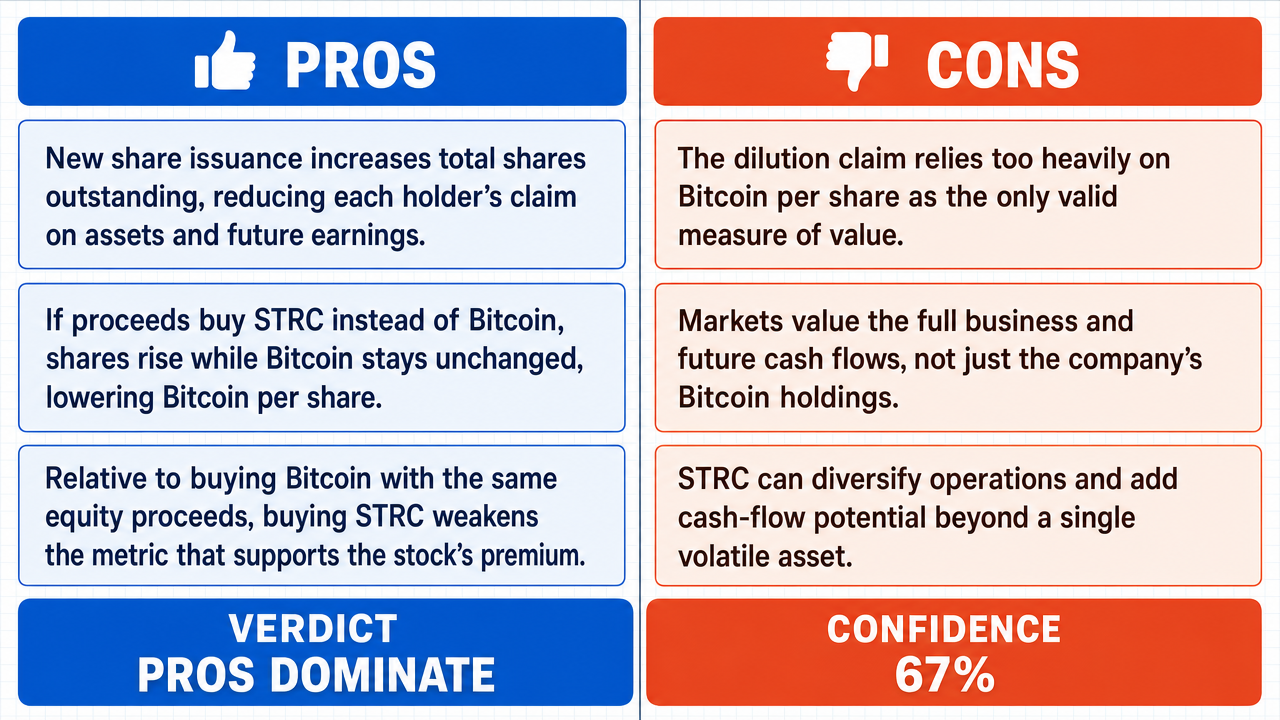
Verdict: likely TRUE (67%)
This section provides a brief overview of the key arguments. You do not need to read the full detailed report below.
✅ Key PRO arguments:
- ■Issuing new common shares mechanically increases total shares outstanding , reducing each existing share's proportional claim on company assets and future earnings. The entire rationale of MicroStrategy's $21 billion at-the-market equity program (announced Q3 2024) is that proceeds are deployed into Bitcoin to increase the Bitcoin-per-share metric the market uses to value MSTR ; redirecting proceeds to STRC instead forfeits this accretion.
- ■When proceeds buy STRC rather than Bitcoin, the denominator (share count) expands while the Bitcoin numerator remains static, resulting in Bitcoin-per-share dilution — the exact metric on which MicroStrategy's premium valuation premium depends.
- ■The diversification defense is a straw man: the question at issue is whether share-issuance-for-STRC specifically is detrimental relative to share-issuance-for-Bitcoin, not whether diversification is beneficial in the abstract. The FALSE side substitutes a general proposition for the specific comparison under debate.
❌ Key ANTI arguments:
- ■The dilution argument rests on a narrow interpretive theory that treats 'Bitcoin-per-share ' as the sole legitimate measure of MicroStrategy's value, rather than a chosen proxy for a Bitcoin-only strategy; characterizing any capital diversion from Bitcoin as 'detrimental' is an appeal to doctrine, not a fact.
- ■A rational market values a firm based on enterprise value — the sum of all discounted future cash flows — not exclusively on Bitcoin holdings; treating Bitcoin as the only numerator ignores the value contributed by a non-correlated operational pillar like STRC whose cash flows can service debt or fund further Bitcoin purchases.
- ■STRC provides operational diversification that reduces the firm's concentration in a single volatile asset, and the cash flows from this secondary pillar can be redeployed into Bitcoin over time, creating a more sustainable capital structure than direct Bitcoin purchases financed by equity issuance .
💭 Conclusion: The evidence supports the mechanical point that equity issuance expands the share count, and if proceeds do not flow into Bitcoin, the Bitcoin-per-share metric declines, producing dilution on the dimension that underpins MSTR 's market premium. The evidence frames the $21 billion ATM program as part of MicroStrategy's broader rationale that equity issuance funds Bitcoin accumulation. The opposing view centered on enterprise-value reframing is acknowledged in the evidence structure but does not negate the mechanical dilution effect described. The only specific verifiable figure in the evidence is the $21 billion at-the-market equity program announced in MicroStrategy's Q3 2024 earnings. The STRC cash flow claim, by contrast, is explicitly identified in the evidence as conjecture lacking supporting financial data.
🔬 DeepResearch Result: likely TRUE ✅ (67%)
Assertion: MicroStrategy's strategy of issuing new shares to buy STRC instead of directly acquiring Bitcoin is problematic for shareholders due to dilution .
Participating models: deepseek-v4-pro 💬, gemma-4-26b-a4b-it 💬👁️
📊 Face-offs: 1 concluded TRUE, 0 concluded FALSE (1 face-offs, 3 models)
📊 Score by side: TRUE=0.67, FALSE=0.00
🏅 Model score changes:
minimax-m3 💬👁️: +7
✅ PRO Arguments:
- ■Issuing new common shares mechanically increases total shares outstanding , reducing each existing share's proportional claim on company assets and future earnings. The entire rationale of MicroStrategy's $21 billion at-the-market equity program (announced Q3 2024) is that proceeds are deployed into Bitcoin to increase the Bitcoin-per-share metric the market uses to value MSTR ; redirecting proceeds to STRC instead forfeits this accretion. deepseek-v4-pro 💬
- ■When proceeds buy STRC rather than Bitcoin, the denominator (share count) expands while the Bitcoin numerator remains static, resulting in Bitcoin-per-share dilution — the exact metric on which MicroStrategy's premium valuation premium depends. deepseek-v4-pro 💬
- ■The diversification defense is a straw man: the question at issue is whether share-issuance-for-STRC specifically is detrimental relative to share-issuance-for-Bitcoin, not whether diversification is beneficial in the abstract. The FALSE side substitutes a general proposition for the specific comparison under debate. deepseek-v4-pro 💬
❌ ANTI Arguments:
- ■The dilution argument rests on a narrow interpretive theory that treats 'Bitcoin-per-share' as the sole legitimate measure of MicroStrategy's value, rather than a chosen proxy for a Bitcoin-only strategy; characterizing any capital diversion from Bitcoin as 'detrimental' is an appeal to doctrine, not a fact. gemma-4-26b-a4b-it 💬👁️
- ■A rational market values a firm based on enterprise value — the sum of all discounted future cash flows — not exclusively on Bitcoin holdings; treating Bitcoin as the only numerator ignores the value contributed by a non-correlated operational pillar like STRC whose cash flows can service debt or fund further Bitcoin purchases. gemma-4-26b-a4b-it 💬👁️
- ■STRC provides operational diversification that reduces the firm's concentration in a single volatile asset, and the cash flows from this secondary pillar can be redeployed into Bitcoin over time, creating a more sustainable capital structure than direct Bitcoin purchases financed by equity issuance . gemma-4-26b-a4b-it 💬👁️
💭 Reasoning: The evidence supports the mechanical point that equity issuance expands the share count, and if proceeds do not flow into Bitcoin, the Bitcoin-per-share metric declines, producing dilution on the dimension that underpins MSTR's market premium. The evidence frames the $21 billion ATM program as part of MicroStrategy's broader rationale that equity issuance funds Bitcoin accumulation. The opposing view centered on enterprise-value reframing is acknowledged in the evidence structure but does not negate the mechanical dilution effect described. The only specific verifiable figure in the evidence is the $21 billion at-the-market equity program announced in MicroStrategy's Q3 2024 earnings. The STRC cash flow claim, by contrast, is explicitly identified in the evidence as conjecture lacking supporting financial data.
📋 PRO Facts:
• MicroStrategy announced a $21 billion at-the-market (ATM) equity program in its Q3 2024 earnings.
📋 ANTI Facts:
• The assertion that STRC's cash flows 'can be used to service debt or further fund Bitcoin purchases' is a conjecture presented without supporting financial data — no revenue figures, free cash flow estimates, or debt-service coverage ratios are provided.
| Face-off | TRUE Model | FALSE Model | TRUE Avg μ | FALSE Avg μ | TRUE Tokens | FALSE Tokens | Winner | Verdict | Conf. |
|---|---|---|---|---|---|---|---|---|---|
| #1 | deepseek-v4-pro 💬 | gemma-4-26b-a4b-it 💬👁️ | 0.415 | 0.203 | 6 | 2 | TRUE | TRUE | 67% |
The following technical terms, abbreviations, and domain-specific concepts are referenced throughout this debate transcript. Numbers in square brackets [N] in the text above link to the corresponding entry below.
[1] accretive — In corporate finance, a transaction or strategy is described as accretive when it increases a per-share metric (such as earnings per share or Bitcoin-per-share), as opposed to being dilutive which decreases it.
[2] ATM — at-the-market — An equity offering structure in which a company issues new shares incrementally into the open market at prevailing prices, rather than through a single underwritten placement. The debate references a '$21 billion at-the-market (ATM) equity program.'
[3] Bitcoin-per-share — A valuation metric used by the affirmative, equal to the company's Bitcoin holdings divided by shares outstanding. The affirmative argues this is the primary metric the market uses to value MSTR and that it only increases when share-issuance proceeds are deployed directly into Bitcoin.
[4] capital allocation — The strategic decision by a firm's management about how to deploy available capital among competing uses (e.g., buying Bitcoin, acquiring other securities, paying debt, or returning capital to shareholders).
[5] common shares — The standard class of equity ownership in a corporation, carrying voting rights and a residual claim on assets and earnings. The debate concerns MicroStrategy issuing new common shares.
[6] concentration risk — The risk of loss arising from overexposure to a single asset, sector, or risk factor. The affirmative suggests that not using proceeds for Bitcoin would increase or fail to address MSTR's concentration in Bitcoin.
[7] correlation — A statistical measure of how two assets move in relation to one another. The negative side argues STRC may be 'non-correlated' with Bitcoin, potentially offering diversification benefits.
[8] dilution — The reduction in an existing shareholder's proportional ownership, voting power, or per-share claim on a company's assets and earnings caused by the issuance of additional shares.
[9] discounted future cash flows — DCF — A valuation methodology that estimates an asset's or firm's worth by projecting its future cash flows and discounting them back to a present value. The negative side argues enterprise value should be assessed this way rather than via Bitcoin-per-share.
[10] enterprise value — EV — A measure of a company's total economic value, typically calculated as market capitalization plus debt minus cash, representing the value attributable to all capital providers.
[11] equity issuance — The act of a company creating and selling new shares to raise capital. The debate centers on whether using the proceeds of such issuance to buy STRC instead of Bitcoin harms shareholders.
[12] MSTR — MicroStrategy — The stock ticker for MicroStrategy, the publicly traded company at the center of the debate, whose strategy of holding Bitcoin on its balance sheet is the subject of dispute.
[13] NAV — Net Asset Value — The total value of a company's assets minus its liabilities, often expressed on a per-share basis. The negative side argues MSTR should be valued on total NAV, not solely on its Bitcoin holdings.
[14] non-correlated — Describing assets whose price movements have little or no statistical relationship to one another, so combining them may reduce overall portfolio volatility.
[15] proceeds — The cash or assets received by a company from a financing transaction, such as the sale of newly issued shares, available to be deployed for a stated corporate purpose.
[16] Q3 — third fiscal quarter — The three-month period covering July through September in a standard calendar-year fiscal calendar. The debate references the 'Q3 2024 earnings' announcement of the ATM program.
[17] risk-adjusted returns — A measure of investment performance that accounts for the level of risk taken to achieve the return, allowing comparison between assets or strategies with different volatility profiles.
[18] shares outstanding — The total number of a company's shares currently held by all shareholders, including insiders and the public. Issuing new shares increases this count, the basis of the dilution argument.
[19] STRC — A financial instrument discussed in the debate as an alternative use of share-issuance proceeds; the negative side describes it as a potential source of non-correlated, cash-flow-generating returns, while the affirmative argues it does not contribute to MSTR's Bitcoin-per-share valuation metric.
[20] volatility — A statistical measure of the dispersion of an asset's price over time, often used as a proxy for investment risk. The negative side contrasts Bitcoin's volatility with the supposed stability of STRC's cash flows.
The following financial data tables were referenced during the debate exchanges:
| Metric | Bitcoin-Only Strategy (Affirmative View) | Diversified Strategy (Proposed) |
|---|---|---|
| Primary Valuation Driver | BTC-per-share | Combined Enterprise Value |
| Volatility Profile | High (Correlated to BTC) | Moderate (Diversified) |
| Risk Concentration | Single Asset | Multi-Asset / Operational |
| Capital Source | Equity/Debt for BTC | Equity for Growth & BTC |
Legend: Comparison of the theoretical valuation frameworks for MicroStrategy. The "Affirmative View" assumes a rigid link between share count and Bitcoin holdings, while the "Diversified Strategy" assumes value is derived from a combination of BTC and STRC's operational cash flows.
Face-off transcripts
- ■
Ownership & Trade Secrets. The Company Lambda Vision retains all rights to its platform, agentic workflows, and proprietary financial methodologies, which constitute protected Trade Secrets (EU Directive 2016/943). Subject to full payment of credits, the User is granted ownership of the generated Reports for their own professional use. Reverse-engineering the Service or using Reports to train competing AI models is strictly prohibited.
- ■
No Financial Advice. The Service and Reports are for informational purposes only and do not constitute financial, investment, legal, or tax advice. The Company is not a regulated financial advisor. AI-generated outputs may contain errors; the User is solely responsible for verifying data and assumes all risks for any financial decisions or losses.
- ■
Liability & Governing Law. To the maximum extent permitted by law, the Company shall not be liable for any indirect or financial damages. These Terms are governed by French law. Any disputes shall be subject to the exclusive jurisdiction of the Courts of Paris, France.