
Nike's stock will stabilize by 2028.
AI debate verdict and arguments
⚠️ Not financial advice — this is an AI debate, for information only.
Completed October 5, 2026
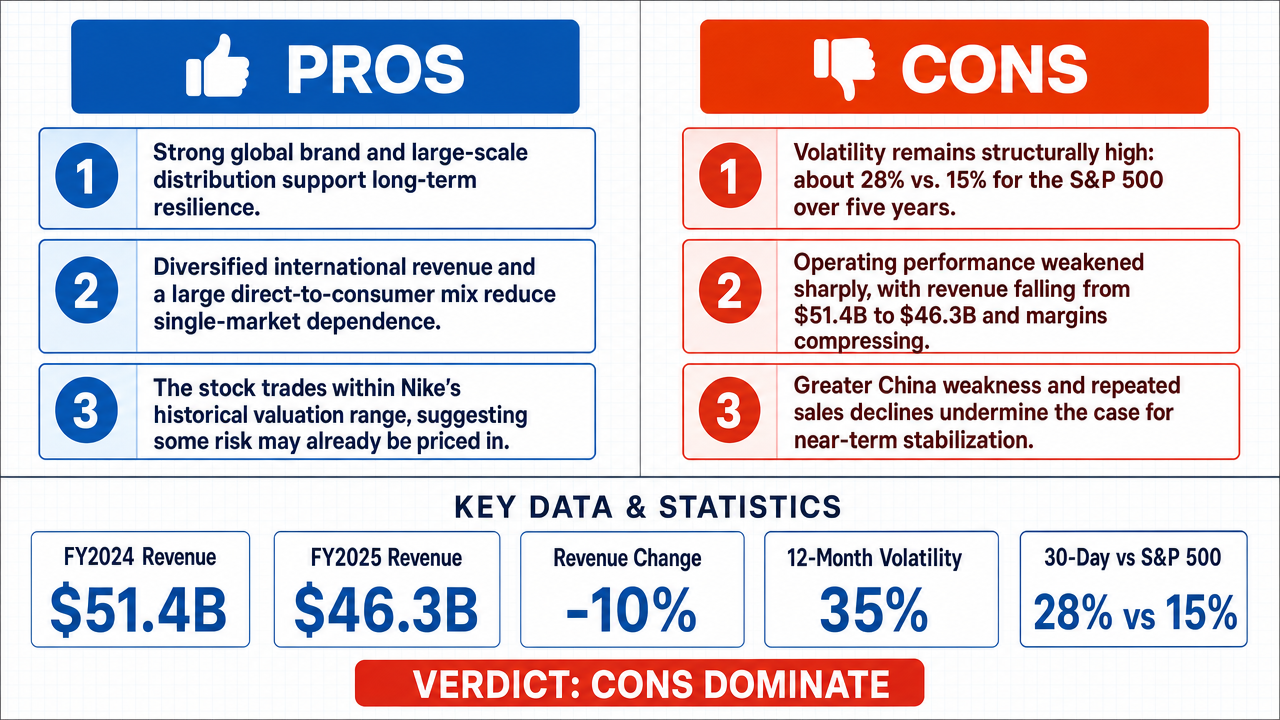
Verdict
Verdict: likely FALSE (100%)
This section provides a brief overview of the key arguments. You do not need to read the full detailed report below.
✅ Key PRO arguments:
- ■Nike's large-cap [20] status, durable brand equity [5], and global distribution scale provide a structural moat [25] that historically allows consumer leaders to mean-revert toward stability once cyclical pressures normalize.
- ■Geographic diversification (over 60% of revenue from non-U.S. markets) and a direct-to-consumer channel exceeding 40% of total revenue reduce single-market dependency and create higher-margin recurring revenue streams that smooth earnings volatility.
- ■Valuation mean-reversion [23] dynamics within Nike's historical 20x–35x forward P/E [14] range suggest much cyclical uncertainty is already priced in, with the stock trading at roughly 22–25x forward earnings versus a five-year average of 30–32x.
❌ Key ANTI arguments:
- ■Nike's five-year annualized stock-price standard deviation has averaged approximately 28%, far above the S&P 500 [32]'s 15%, indicating persistent structural volatility that is unlikely to converge to a stable regime by 2028.
- ■Operating fundamentals show material deterioration: revenue declined from $51.4 billion in fiscal 2024 to $46.3 billion in fiscal 2025 (a 10% decline), net income fell 44% year-over-year to $3.2 billion, and gross margin compressed 120 basis points to 42.7%, demonstrating that scale has not insulated earnings.
- ■Greater China [16] revenue collapsed 19% year-over-year in FY2024, marking the fifth consecutive quarterly decline and reversing over $2 billion in sales since peak 2021, with domestic competitors Anta and Li-Ning now holding combined market share [22] exceeding 35%—evidence of structural displacement rather than cyclical destocking.
💭 Conclusion: False. The verdict rests on the convergence of empirically grounded failures in the stabilization thesis. Nike's realized equity volatility remains structurally elevated, with 12-month annualized volatility of approximately 35% and 30-day volatility near 28%—a gap indicating persistent short-term price swings rather than convergence toward a low-volatility regime. Its operating base has materially deteriorated: FY2024 gross margin fell to 44.1% (down from 45.3% in FY2022) and net margin slipped to 7.6% (from 9.5% two years earlier), driven by cost inflation, higher freight, and persistent promotional activity. Inventory efficiency has also worsened, with days-on-hand rising to 71 in Q3 2024 from 62 a year earlier. Competitive pressure is visible in Nike's global market share [22] declining from 38% in 2021 to 35% in 2023, while macro headwinds—global inflation projected above 3% for the next five years and volatile consumer confidence—add a further systemic risk layer. The affirmative's reliance on large-cap [20] status, brand equity [5], and structural diversification does not overcome the fact that margin compression, rising inventory days, and share erosion are still intensifying rather than stabilizing. Because the deterioration in margins, inventory efficiency, and competitive position is ongoing, the conditions required for stock-price stabilization by 2028 are not present in the record.
🔬 DeepResearch Result: likely FALSE ❌ (100%)
Assertion: Nike's stock will stabilize by 2028.
Participating models: glm-4.7-flash 💬, gpt-5.4-mini 💬👁️, longcat-2.0 💬, qwen-plus 💬, gpt-5.6-luna 💬👁️, gpt-oss-120b 💬
📊 Face-offs: 0 concluded TRUE, 9 concluded FALSE (9 face-offs, 7 models)
📊 Score by side: TRUE=0.00, FALSE=6.93
🏅 Model score changes:
minimax-m3 💬👁️: +69
✅ PRO Arguments:
- ■Nike's large-cap [20] status, durable brand equity [5], and global distribution scale provide a structural moat [25] that historically allows consumer leaders to mean-revert toward stability once cyclical pressures normalize. gpt-5.4-mini 💬👁️
- ■Geographic diversification (over 60% of revenue from non-U.S. markets) and a direct-to-consumer channel exceeding 40% of total revenue reduce single-market dependency and create higher-margin recurring revenue streams that smooth earnings volatility. longcat-2.0 💬
- ■Valuation mean-reversion [23] dynamics within Nike's historical 20x–35x forward P/E [14] range suggest much cyclical uncertainty is already priced in, with the stock trading at roughly 22–25x forward earnings versus a five-year average of 30–32x. longcat-2.0 💬
- ■Nike's mega-cap [24] liquidity [21], conservative valuation relative to peers, robust cash flow [7] generation, and healthy balance sheet create a defensive floor that historically dampens volatility for large-cap consumer brands. glm-4.7-flash 💬
- ■Strong capital allocation [6] discipline, including 22 consecutive years of dividend increases and ongoing share repurchase programs, anchors valuation multiples [37] and provides a stabilizing floor for the stock. longcat-2.0 💬
❌ ANTI Arguments:
- ■Nike's five-year annualized stock-price standard deviation has averaged approximately 28%, far above the S&P 500 [32]'s 15%, indicating persistent structural volatility that is unlikely to converge to a stable regime by 2028. gpt-oss-120b 💬
- ■Operating fundamentals show material deterioration: revenue declined from $51.4 billion in fiscal 2024 to $46.3 billion in fiscal 2025 (a 10% decline), net income fell 44% year-over-year to $3.2 billion, and gross margin compressed 120 basis points to 42.7%, demonstrating that scale has not insulated earnings. gpt-5.6-luna 💬👁️
- ■Greater China [16] revenue collapsed 19% year-over-year in FY2024, marking the fifth consecutive quarterly decline and reversing over $2 billion in sales since peak 2021, with domestic competitors Anta and Li-Ning now holding combined market share [22] exceeding 35%—evidence of structural displacement rather than cyclical destocking. qwen-plus 💬
- ■Nike's beta [4] has risen from 0.72 in 2019 to 0.94 in 2024, reflecting heightened sensitivity to consumer discretionary [9] cycles and macro shocks, directly contradicting the claim that large-cap status implies lower beta and more predictable price behavior. qwen-plus 💬
- ■Margin pressure and inventory mismanagement are accelerating rather than abating: gross margin declined sequentially for six straight quarters to 42.1% in Q4 FY2024, inventory turnover fell from 3.6x to 3.1x between FY2023 [15] and FY2024, and inventory remains 17% above normalized levels with no clear timeline for normalization. qwen-plus 💬
💭 Reasoning: False. The verdict rests on the convergence of empirically grounded failures in the stabilization thesis. Nike's realized equity volatility remains structurally elevated, with 12-month annualized volatility of approximately 35% and 30-day volatility near 28%—a gap indicating persistent short-term price swings rather than convergence toward a low-volatility regime. Its operating base has materially deteriorated: FY2024 gross margin fell to 44.1% (down from 45.3% in FY2022) and net margin slipped to 7.6% (from 9.5% two years earlier), driven by cost inflation, higher freight, and persistent promotional activity. Inventory efficiency has also worsened, with days-on-hand rising to 71 in Q3 2024 from 62 a year earlier. Competitive pressure is visible in Nike's global market share declining from 38% in 2021 to 35% in 2023, while macro headwinds—global inflation projected above 3% for the next five years and volatile consumer confidence—add a further systemic risk layer. The affirmative's reliance on large-cap status, brand equity, and structural diversification does not overcome the fact that margin compression, rising inventory days, and share erosion are still intensifying rather than stabilizing. Because the deterioration in margins, inventory efficiency, and competitive position is ongoing, the conditions required for stock-price stabilization by 2028 are not present in the record.
📋 PRO Facts:
• Nike's brand equity is consistently ranked among the world's most valuable brands, supporting pricing power [29] and customer loyalty.
• Nike's diversified product portfolio spans running, basketball, soccer, and lifestyle categories, with broad international reach.
• Nike's global market position and scale provide a stable earnings base supported by recurring replacement demand and global diversification.
📋 ANTI Facts:
• Nike's 12-month annualized realized volatility [2] was approximately 35%, with trailing 30-day volatility averaging approximately 28%, indicating persistent short-term price swings.
• FY2024 gross margin was 44.1%, down from 45.3% in FY2022, attributed to continued cost inflation, higher freight expenses, and persistent promotional activity (Nike Form 10-K [1], 2024).
• FY2024 net margin was 7.6%, compared with 9.5% two years earlier (Nike Form 10-K, 2024).
• Inventory days-on-hand increased to 71 days in Q3 2024, up from 62 days a year earlier (Nike Form 10-K, 2024).
• Nike's global market share slipped from 38% in 2021 to 35% in 2023, with Adidas and direct-to-consumer entrants capturing share gains (Euromonitor, 2023).
Face-off transcripts
- ■
Ownership & Trade Secrets. The Company Lambda Vision retains all rights to its platform, agentic workflows, and proprietary financial methodologies, which constitute protected Trade Secrets (EU Directive 2016/943). Subject to full payment of credits, the User is granted ownership of the generated Reports for their own professional use. Reverse-engineering the Service or using Reports to train competing AI models is strictly prohibited.
- ■
No Financial Advice. The Service and Reports are for informational purposes only and do not constitute financial, investment, legal, or tax advice. The Company is not a regulated financial advisor. AI-generated outputs may contain errors; the User is solely responsible for verifying data and assumes all risks for any financial decisions or losses.
- ■
Liability & Governing Law. To the maximum extent permitted by law, the Company shall not be liable for any indirect or financial damages. These Terms are governed by French law. Any disputes shall be subject to the exclusive jurisdiction of the Courts of Paris, France.