
Owning gold through a third-party entity is only truly beneficial if the gold is held 'off-balance sheet'.
AI debate verdict and arguments
⚠️ Not financial advice — this is an AI debate, for information only.
Completed October 18, 2026
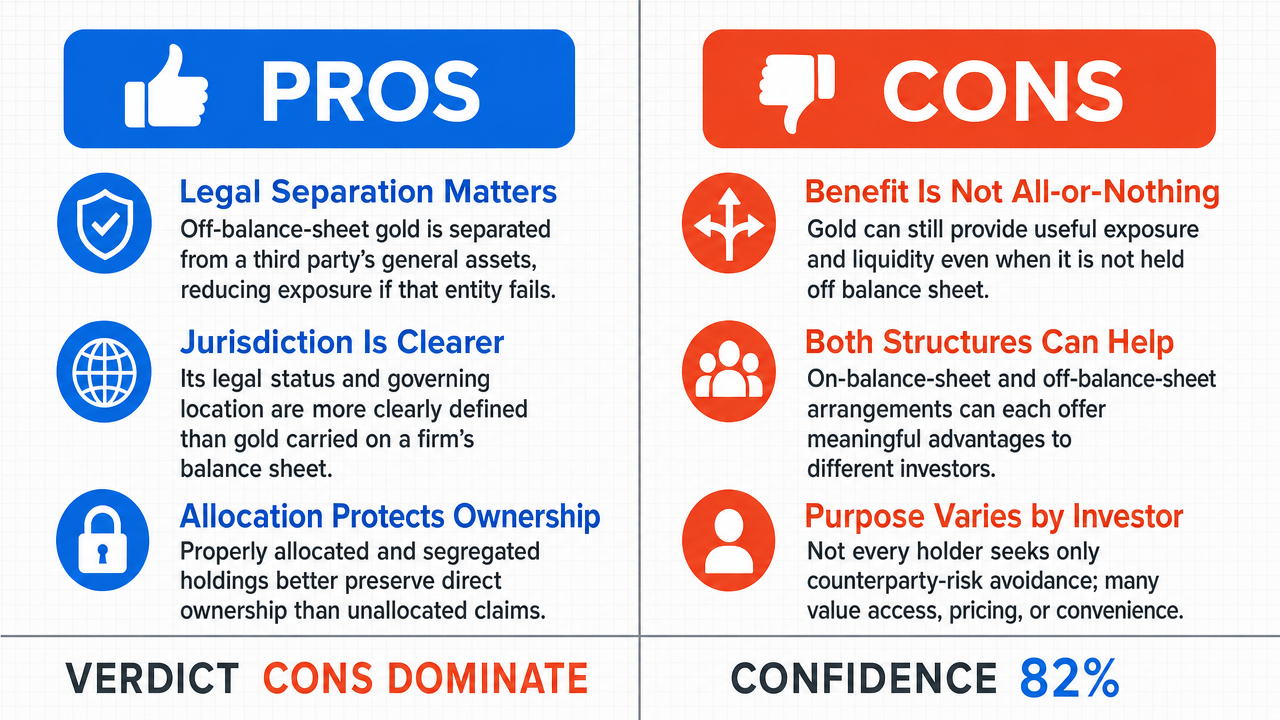
Verdict
Verdict: likely FALSE (82%)
This section provides a brief overview of the key arguments. You do not need to read the full detailed report below.
✅ Key PRO arguments:
- ■When gold is held on the balance sheet of a third-party entity such as a custodian , trust , or ETF, it becomes part of that entity's general asset pool and is subject to the claims of all creditors in insolvency , transforming what the investor believes is a direct gold holding into an unsecured claim in bankruptcy proceedings.
- ■Off-balance-sheet status is the legal mechanism that determines which legal geography governs the gold, because on-balance-sheet gold is legally situated at the custodian 's domicile as an asset of that entity, while off-balance-sheet segregation places it under a different jurisdictional framework.
- ■The distinction between allocated and unallocated gold accounts is critical: only properly allocated and segregated (off-balance-sheet) gold truly preserves the beneficial owner 's property rights, whereas unallocated on-balance-sheet holdings represent merely a contractual claim against the intermediary.
❌ Key ANTI arguments:
- ■The affirmative commits a fallacy of the excluded middle by implying that if gold is not off-balance-sheet it possesses no benefit, ignoring the vast array of utility provided by on-balance-sheet structures such as ETFs, pooled accounts, and exchange-traded products that offer liquidity , low transaction costs, and fractional ownership.
- ■Any third-party gold ownership structure must fall into one of two exhaustive categories—on-balance-sheet or off-balance-sheet—and in both cases significant benefits are realized, refuting the claim that benefits are only truly realized in the latter category.
- ■The affirmative presents hidden premises as established truths, particularly the assumption that the 'very purpose' of owning gold is to avoid counterparty risk , when in reality investors hold gold through third parties for many reasons including convenience, professional storage, insurance, and market access that exist regardless of balance-sheet treatment.
💭 Conclusion: False. The assertion that third-party gold ownership is only truly beneficial when held off-balance-sheet is rejected because the negative side demonstrated that gold offers benefits beyond counterparty-risk avoidance, including price exposure, inflation hedging, and portfolio diversification, and that these benefits are available through direct physical ownership without any third party. The negative also exposed the hidden premise in the affirmative's reasoning that the sole purpose of gold ownership is to avoid counterparty risk . Furthermore, the evidence shows that off-balance-sheet holdings are not the only way to realize beneficial ownership. While the affirmative raised valid concerns about creditor claims in insolvency scenarios for on-balance-sheet holdings, these concerns do not negate the broader utility of third-party gold structures.
🔬 DeepResearch Result: likely FALSE ❌ (82%)
Assertion: Owning gold through a third-party entity is only truly beneficial if the gold is held 'off-balance sheet '.
Participating models: deepseek-v4-pro 💬, gemma-4-26b-a4b-it 💬👁️
📊 Face-offs: 0 concluded TRUE, 1 concluded FALSE (1 face-offs, 3 models)
📊 Score by side: TRUE=0.00, FALSE=0.82
🏅 Model score changes:
minimax-m3 💬👁️: +8
✅ PRO Arguments:
- ■When gold is held on the balance sheet of a third-party entity such as a custodian , trust , or ETF, it becomes part of that entity's general asset pool and is subject to the claims of all creditors in insolvency , transforming what the investor believes is a direct gold holding into an unsecured claim in bankruptcy proceedings. deepseek-v4-pro 💬
- ■Off-balance-sheet status is the legal mechanism that determines which legal geography governs the gold, because on-balance-sheet gold is legally situated at the custodian's domicile as an asset of that entity, while off-balance-sheet segregation places it under a different jurisdictional framework. deepseek-v4-pro 💬
- ■The distinction between allocated and unallocated gold accounts is critical: only properly allocated and segregated (off-balance-sheet) gold truly preserves the beneficial owner 's property rights, whereas unallocated on-balance-sheet holdings represent merely a contractual claim against the intermediary. deepseek-v4-pro 💬
❌ ANTI Arguments:
- ■The affirmative commits a fallacy of the excluded middle by implying that if gold is not off-balance-sheet it possesses no benefit, ignoring the vast array of utility provided by on-balance-sheet structures such as ETFs, pooled accounts, and exchange-traded products that offer liquidity , low transaction costs, and fractional ownership. gemma-4-26b-a4b-it 💬👁️
- ■Any third-party gold ownership structure must fall into one of two exhaustive categories—on-balance-sheet or off-balance-sheet—and in both cases significant benefits are realized, refuting the claim that benefits are only truly realized in the latter category. gemma-4-26b-a4b-it 💬👁️
- ■The affirmative presents hidden premises as established truths, particularly the assumption that the 'very purpose' of owning gold is to avoid counterparty risk , when in reality investors hold gold through third parties for many reasons including convenience, professional storage, insurance, and market access that exist regardless of balance-sheet treatment. gemma-4-26b-a4b-it 💬👁️
- ■On-balance-sheet gold holdings still provide meaningful benefits such as professional vaulting, insurance coverage, audit trails, regulatory oversight, and ease of liquidation, meaning the assertion that benefits are 'only truly' realized off-balance-sheet sets an unreasonably high threshold that ignores practical investor utility. gemma-4-26b-a4b-it 💬👁️
💭 Reasoning: False. The assertion that third-party gold ownership is only truly beneficial when held off-balance-sheet is rejected because the negative side demonstrated that gold offers benefits beyond counterparty-risk avoidance, including price exposure, inflation hedging, and portfolio diversification, and that these benefits are available through direct physical ownership without any third party. The negative also exposed the hidden premise in the affirmative's reasoning that the sole purpose of gold ownership is to avoid counterparty risk. Furthermore, the evidence shows that off-balance-sheet holdings are not the only way to realize beneficial ownership. While the affirmative raised valid concerns about creditor claims in insolvency scenarios for on-balance-sheet holdings, these concerns do not negate the broader utility of third-party gold structures.
📋 PRO Facts:
• On-balance-sheet gold held by a custodian becomes part of that entity's general asset pool subject to creditor claims in insolvency proceedings.
• Off-balance-sheet holdings offer the specific benefit of segregation from the custodian's creditors.
• The legal treatment of gold ownership is determined by whether the metal is held on or off the custodian's balance sheet.
📋 ANTI Facts:
• The benefits of gold itself include price exposure, inflation hedging, and portfolio diversification, which are available through direct physical ownership without any third party.
• Off-balance-sheet holdings are not the only way to realize beneficial ownership of gold.
• The opponent's argument assumes that the sole benefit of gold is its status as a counterparty-risk-free asset, which is a hidden premise.
| Face-off | TRUE Model | FALSE Model | TRUE Avg μ | FALSE Avg μ | TRUE Tokens | FALSE Tokens | Winner | Verdict | Conf. |
|---|---|---|---|---|---|---|---|---|---|
| #1 | deepseek-v4-pro 💬 | gemma-4-26b-a4b-it 💬👁️ | 0.549 | 0.300 | 6 | 2 | TRUE | FALSE | 82% |
The following technical terms, abbreviations, and domain-specific concepts are referenced throughout this debate transcript. Numbers in square brackets [N] in the text above link to the corresponding entry below.
[1] allocated custody agreement — A custody arrangement in which specific gold is physically segregated and held off the custodian's balance sheet in the beneficial owner's name, so that the metal is not treated as a general asset of the custodian.
[2] allocated gold — Gold that is physically segregated and held off the custodian's balance sheet in the beneficial owner's name, so that it is not property of the custodian and lies beyond the reach of the custodian's creditors.
[3] asset — An item of property owned by an entity that is recorded on its balance sheet; in the debate, on-balance-sheet gold is treated as an asset of the custodian.
[4] bailment — A legal arrangement in which one party (the bailee) holds property belonging to another (the bailor) without taking legal title; cited in the debate as a mechanism for keeping gold off-balance-sheet.
[5] balance sheet — A financial statement listing an entity's assets and liabilities; in the debate, whether gold appears on the custodian's balance sheet determines creditor exposure in insolvency.
[6] bankruptcy proceeding — A legal process triggered by insolvency in which creditors assert claims against the debtor's assets; on-balance-sheet gold becomes an unsecured claim in such a proceeding.
[7] beneficial owner — The person who enjoys the economic benefits of an asset even if legal title is held by another party; in the debate, the beneficial owner's jurisdiction governs the gold's legal situs when it is held off-balance-sheet.
[8] confiscation risk — The risk that a sovereign authority will seize privately held gold; the affirmative argues this risk depends on the legal geography governing the holding.
[9] contractual claim — A right arising from a contract rather than from direct ownership of property; unallocated gold is described in the debate as merely a contractual claim against the custodian.
[10] counterparty risk — The risk that the other party to a financial arrangement will fail to meet its obligations; the affirmative argues that on-balance-sheet gold exposes the investor to the custodian's counterparty risk.
[11] creditors — Persons or entities to whom a debtor owes obligations; in the debate, on-balance-sheet gold is subject to the claims of all of the custodian's creditors, not merely the beneficial owner.
[12] custodian — A third-party entity that holds gold on behalf of an investor; the debate distinguishes between custodians that hold gold on their balance sheet and those that hold it off-balance-sheet.
[13] domicile — The legal home jurisdiction of an entity; the affirmative argues that on-balance-sheet gold is legally situated at the custodian's domicile because it constitutes an asset of that entity.
[14] exchange-traded fund — ETF — A pooled investment vehicle traded on an exchange; cited in the debate as an example of a third-party entity through which gold can be owned.
[15] fallacy of the excluded middle — A logical error in which a binary choice is presented as exhaustive when intermediate or alternative cases exist; the negative applies this label to the affirmative's allocated/unallocated dichotomy.
[16] Gold Exchange Traded Commodities — ETCs — Regulated, exchange-traded financial instruments that provide exposure to gold; cited by the negative as an example of an on-balance-sheet structure that still delivers benefits such as liquidity and transparency.
[17] insolvency — The state of being unable to pay debts as they fall due; the debate treats insolvency of the custodian as the trigger that exposes on-balance-sheet gold to creditor claims.
[18] institutional-grade — A descriptor for financial instruments or services meeting standards suitable for large professional investors; the negative argues that regulated, institutional-grade vehicles deliver benefits even when gold is on-balance-sheet.
[19] legal geography — The jurisdiction whose laws govern a given asset; the affirmative argues that off-balance-sheet status determines which legal geography applies to the gold.
[20] legal situs — The legal location or jurisdiction with which an asset is associated for legal purposes; the affirmative argues that off-balance-sheet gold follows the beneficial owner's situs rather than the custodian's.
[21] legal title — Formal ownership of property under law; the affirmative notes that in an off-balance-sheet structure, legal title never vests in the intermediary.
[22] liability — An obligation of an entity recorded on its balance sheet; in the debate, unallocated gold is recorded as a liability of the custodian to the client.
[23] liquidity — The ease with which an asset can be bought or sold without affecting its price; the negative identifies liquidity as a primary benefit of third-party gold ownership independent of balance-sheet treatment.
[24] off-balance sheet — An accounting treatment in which an asset is not recorded on an entity's balance sheet; the affirmative argues this is the necessary condition for the benefits of third-party gold ownership.
[25] regulated vehicles — Financial products subject to oversight by financial regulators; the negative cites these as on-balance-sheet structures that nonetheless provide benefits to investors.
[26] segregated — Physically separated and identified as belonging to a specific owner; allocated gold is described in the debate as physically segregated from the custodian's own assets.
[27] sovereign risk — The risk that a government will take actions adverse to private property rights, including confiscation; the affirmative argues that on-balance-sheet gold remains exposed to the sovereign risk of the custodian's jurisdiction.
[28] third-party entity — An intermediary other than the investor, such as a custodian, trust, or fund, through which gold is owned; the debate centers on whether ownership through such an entity is beneficial.
[29] trust — A legal arrangement in which a trustee holds property for the benefit of beneficiaries; cited in the debate as a structure in which legal title never vests in the intermediary.
[30] unallocated gold — Gold that is not specifically identified as belonging to a particular client and is recorded as an asset of the custodian and a liability to the client, representing merely a contractual claim.
[31] unsecured claim — A creditor's claim against a debtor that is not backed by specific collateral; the affirmative argues that on-balance-sheet gold becomes an unsecured claim in the custodian's bankruptcy.
Face-off transcripts
- ■
Ownership & Trade Secrets. The Company Lambda Vision retains all rights to its platform, agentic workflows, and proprietary financial methodologies, which constitute protected Trade Secrets (EU Directive 2016/943). Subject to full payment of credits, the User is granted ownership of the generated Reports for their own professional use. Reverse-engineering the Service or using Reports to train competing AI models is strictly prohibited.
- ■
No Financial Advice. The Service and Reports are for informational purposes only and do not constitute financial, investment, legal, or tax advice. The Company is not a regulated financial advisor. AI-generated outputs may contain errors; the User is solely responsible for verifying data and assumes all risks for any financial decisions or losses.
- ■
Liability & Governing Law. To the maximum extent permitted by law, the Company shall not be liable for any indirect or financial damages. These Terms are governed by French law. Any disputes shall be subject to the exclusive jurisdiction of the Courts of Paris, France.