
Poor performance in trading offers no valuable lessons and can only lead to incorrect learning.
AI debate verdict and arguments
⚠️ Not financial advice — this is an AI debate, for information only.
Completed October 11, 2026
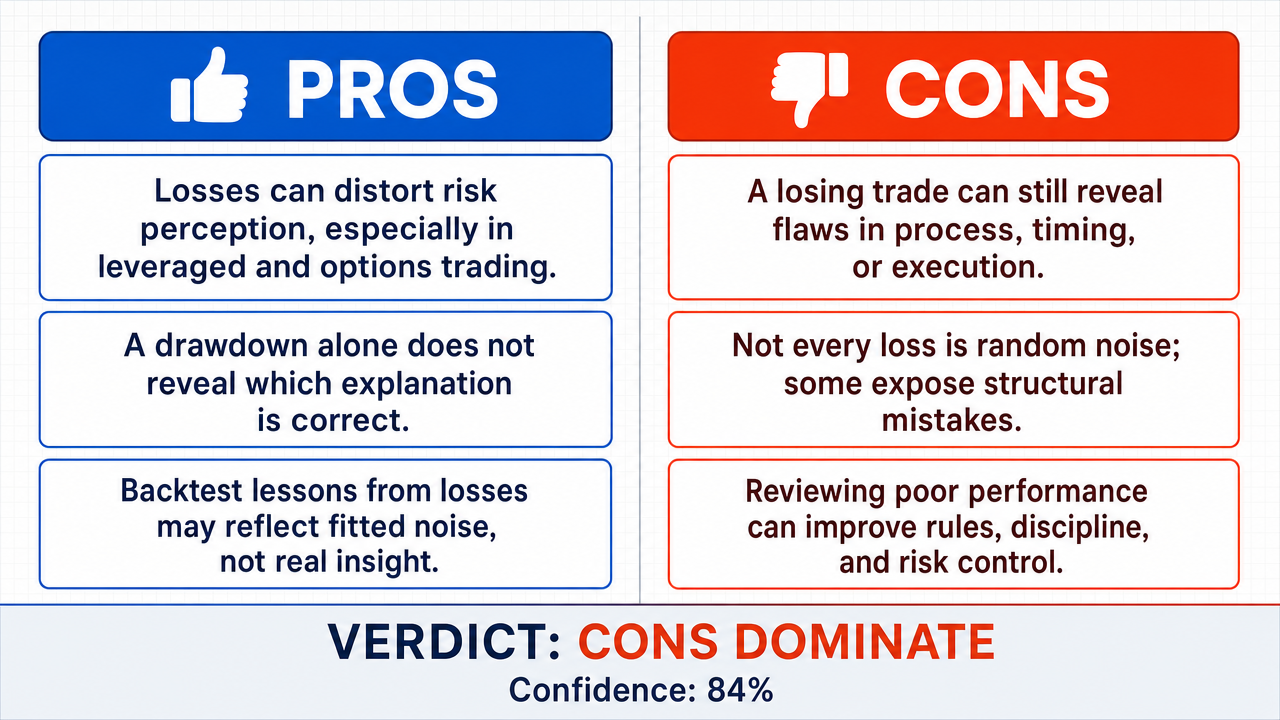
Verdict: likely FALSE (84%)
This section provides a brief overview of the key arguments. You do not need to read the full detailed report below.
✅ Key PRO arguments:
- ■In derivatives markets, poor performance creates negative feedback loops that systematically distort risk perception rather than improving it; retail options traders who experience losses often abandon volatility -based pricing models and adopt pattern-recognition fallacies , mistaking random outcomes for genuine market insight.
- ■Drawdowns are scalar events that cannot rank rival explanations, so any 'lessons' extracted from backtests are fitted noise rather than genuine knowledge; the filter or stop-loss rule is constructed on the very window that produced the loss, leaving no out-of-sample confirmation.
❌ Key ANTI arguments:
- ■The affirmative commits a substitution-of-proxy fallacy by equating retail psychological error with the inherent informational value of a loss; a poor trade remains a discrete data point about market behavior, and the lesson's quality depends on the methodology applied to it, not on the loss itself.
- ■The claim that losing trades are indistinguishable between skill deficiency and market noise rests on an incomplete taxonomy; a third category — structural or mechanical failure such as liquidity gaps, execution slippage , or model-parameter mismatch during regime shifts — provides distinct, actionable information that neither skill error nor randomness can explain.
💭 Conclusion: False — the assertion that poor trading performance offers no valuable lessons and can only produce incorrect learning was rejected by the judge with 84% confidence. The winning side demonstrated that the affirmative's argument confuses the observer (retail traders who mis-interpret losses) with the observed (the loss itself as a data point), committing a substitution-of-proxy fallacy. The negative also exposed an incomplete taxonomy in the affirmative's case by introducing structural and mechanical failure modes — liquidity gaps, execution slippage , and regime-shift parameter mismatches — as a third source of information that neither skill deficiency nor pure randomness can account for. While the affirmative raised a legitimate concern about overfitting filters to the same window that generated the loss, the judge found this critique insufficient to override the broader point that disciplined analysis of poor performance can yield genuine, out-of-sample -validated insights. The verdict therefore rests on the recognition that the pedagogical value of a loss depends on the analytical framework applied to it, not on the loss occurring in isolation.
🔬 DeepResearch Result: likely FALSE ❌ (84%)
Assertion: Poor performance in trading offers no valuable lessons and can only lead to incorrect learning.
Participating models: deepseek-v3.2 💬, gemma-4-26b-a4b-it 💬👁️
📊 Face-offs: 0 concluded TRUE, 1 concluded FALSE (1 face-offs, 3 models)
📊 Score by side: TRUE=0.00, FALSE=0.84
🏅 Model score changes:
minimax-m3 💬👁️: +8
✅ PRO Arguments:
- ■In derivatives markets, poor performance creates negative feedback loops that systematically distort risk perception rather than improving it; retail options traders who experience losses often abandon volatility -based pricing models and adopt pattern-recognition fallacies , mistaking random outcomes for genuine market insight. deepseek-v3.2 💬
- ■Drawdowns are scalar events that cannot rank rival explanations, so any 'lessons' extracted from backtests are fitted noise rather than genuine knowledge; the filter or stop-loss rule is constructed on the very window that produced the loss, leaving no out-of-sample confirmation. deepseek-v3.2 💬
❌ ANTI Arguments:
- ■The affirmative commits a substitution-of-proxy fallacy by equating retail psychological error with the inherent informational value of a loss; a poor trade remains a discrete data point about market behavior, and the lesson's quality depends on the methodology applied to it, not on the loss itself. gemma-4-26b-a4b-it 💬👁️
- ■The claim that losing trades are indistinguishable between skill deficiency and market noise rests on an incomplete taxonomy; a third category — structural or mechanical failure such as liquidity gaps, execution slippage , or model-parameter mismatch during regime shifts — provides distinct, actionable information that neither skill error nor randomness can explain. gemma-4-26b-a4b-it 💬👁️
💭 Reasoning: False — the assertion that poor trading performance offers no valuable lessons and can only produce incorrect learning was rejected by the judge with 84% confidence. The winning side demonstrated that the affirmative's argument confuses the observer (retail traders who mis-interpret losses) with the observed (the loss itself as a data point), committing a substitution-of-proxy fallacy. The negative also exposed an incomplete taxonomy in the affirmative's case by introducing structural and mechanical failure modes — liquidity gaps, execution slippage, and regime-shift parameter mismatches — as a third source of information that neither skill deficiency nor pure randomness can account for. While the affirmative raised a legitimate concern about overfitting filters to the same window that generated the loss, the judge found this critique insufficient to override the broader point that disciplined analysis of poor performance can yield genuine, out-of-sample-validated insights. The verdict therefore rests on the recognition that the pedagogical value of a loss depends on the analytical framework applied to it, not on the loss occurring in isolation.
📋 PRO Facts:
• Retail options traders frequently abandon volatility-based pricing models after losses and adopt pattern-recognition fallacies with no statistical validity.
• A drawdown is a scalar event, meaning the space of filters or stop-loss rules consistent with it is not unique, which complicates any single 'lesson' drawn from it.
• Filters or rules fitted on the same window that produced the loss lack out-of-sample confirmation, raising overfitting concerns.
📋 ANTI Facts:
• A loss is a discrete data point about market behavior whose informational value is independent of how a particular trader psychologically reacts to it.
• Structural or mechanical failures — including liquidity gaps, execution slippage, and model-parameter mismatch during regime shifts — constitute a distinct third category of loss causation beyond skill deficiency and random noise.
• The pedagogical quality of a poor trade depends on the methodology applied to it, not on the loss occurring in isolation.
| Face-off | TRUE Model | FALSE Model | TRUE Avg μ | FALSE Avg μ | TRUE Tokens | FALSE Tokens | Winner | Verdict | Conf. |
|---|---|---|---|---|---|---|---|---|---|
| #1 | deepseek-v3.2 💬 | gemma-4-26b-a4b-it 💬👁️ | 0.435 | 0.426 | 8 | 2 | TRUE | FALSE | 84% |
The following technical terms, abbreviations, and domain-specific concepts are referenced throughout this debate transcript. Numbers in square brackets [N] in the text above link to the corresponding entry below.
[1] Backtest — In the transcript, refers to testing a trading strategy on historical data; the debater argues that 'lessons' derived this way are 'fitted noise' because filters are fitted on the very window that generated the loss, leaving no out-of-sample confirmation.
[2] Benchmark failure — Mentioned alongside drawdowns as a 'primary mechanism for validating or rejecting a hypothesis' in quantitative trading, where a strategy underperforms its reference benchmark.
[3] Borrow-cost shift — Listed in the debate as one of several mutually incompatible diagnoses that a single losing period could be attributed to, alongside vol-regime breaks, liquidity gaps, skew mispricing, data error, or plain variance.
[4] Derivatives — Financial instruments such as options and futures whose value is derived from an underlying asset; the debate focuses on derivatives markets where poor performance is said to create negative feedback loops distorting risk perception.
[5] Drawdowns — Described in the debate as 'a scalar event' and 'an underdetermined datum' — a peak-to-trough decline that is compatible with multiple, mutually incompatible explanations (vol-regime break, liquidity gap, skew mispricing, borrow-cost shift, data error, or variance).
[6] Execution slippage — Cited in the debate both as a discrete data point a loss can reveal about market conditions and as a third, distinct category of loss cause (a 'structural or mechanical failure') beyond skill deficiency or noise.
[7] Fitted noise — The debater's term for what backtest 'lessons' actually amount to: patterns extracted from a single historical window that have no out-of-sample confirmation and therefore do not constitute knowledge.
[8] Futures — Listed alongside options as a complex derivative instrument on which retail traders can develop superstitious beliefs after losses.
[9] Greeks — Sensitivities (such as delta, gamma, vega, theta) used in derivatives pricing; the debate cites 'fundamental misunderstandings of Greeks' as a danger when traders double down on flawed leveraged strategies.
[10] Implied volatility — The volatility input used to price an options trade; the debater argues that comparing realized volatility against implied volatility makes 'noise' a quantifiable statistical event rather than a black box.
[11] Leveraged products — Instruments that use borrowed capital to amplify returns; the debate notes that in such products 'small mistakes compound rapidly,' leading traders to double down on flawed strategies.
[12] Liquidity gap — Listed in the debate as one possible diagnosis for a single losing period and as an example of a 'structural or mechanical failure' distinct from skill deficiency or probability noise.
[13] Market liquidity — Cited in the debate as one of the pieces of information (alongside volatility and execution slippage) that a loss remains a 'discrete data point' about, regardless of how the trader psychologically interprets it.
[14] Model-parameter mismatch — A cited cause of loss during regime shifts, classified in the debate as a 'structural or mechanical failure' rather than skill deficiency or unfavorable probability realization.
[15] Negative feedback loops — In the affirmative's claim, poor performance in derivatives markets creates these loops, which 'systematically distort risk perception rather than improving it.'
[16] Options — Derivative contracts giving the right to buy or sell at a specified price; the debate cites retail options traders abandoning volatility-based pricing models after losses in favor of pattern-recognition fallacies.
[17] Out-of-sample — Refers to testing a hypothesis on data not used to fit it; the debater argues that because filters are fitted on the very window that generated the loss, 'no out-of-sample confirmation exists in the operation at all.'
[18] Pattern-recognition fallacies — Cognitive errors in which traders believe they have identified meaningful market patterns from random outcomes; the debate cites retail options traders adopting these after losing trades.
[19] Quantitative trading — The context in which the debater frames drawdowns as 'the primary mechanism for validating or rejecting a hypothesis,' with losses used to implement volatility filters or stop-loss mechanisms.
[20] Realized volatility — The actual historical volatility of an underlying; the debate argues that comparing realized volatility against the implied volatility used to price a trade makes noise quantifiable rather than indistinguishable from skill deficiency.
[21] Regime shifts — Changes in underlying market conditions (e.g., volatility regimes); cited in the debate as the environment in which model-parameter mismatches can drive losses.
[22] Retail traders — Individual, non-professional market participants; the debate cites evidence that after losing trades they 'frequently abandon volatility-based pricing models' for pattern-recognition fallacies.
[23] Skew mispricing — A mispricing in the volatility skew (the differential implied volatility across strike prices); listed in the debate as one possible diagnosis for a single losing period.
[24] Stop-loss mechanism — An automatic order designed to limit losses; cited in the debate as an example of a fix that a desk might implement after a strategy fails in a liquidity crisis.
[25] Strategy execution — The implementation of a trading strategy; the debate frames 'poor strategy execution (skill deficiency)' as one branch of possible loss causes, contrasted with noise and mechanical failures.
[26] Term structure — The relationship between derivative prices (or yields) and their maturities; the debate cites 'fundamental misunderstandings of... term structure' as a danger when traders double down on flawed leveraged strategies.
[27] Underdetermined datum — The debater's characterization of a drawdown: a single data point that is compatible with multiple mutually incompatible explanations, so the desk must 'select' one from a candidate set rather than 'read' it off the loss.
[28] Vol-regime break — A break or shift in the prevailing volatility regime; listed in the debate as one possible diagnosis for a single losing period.
[29] Volatility — The degree of variation of a trading price over time; the debate discusses volatility-based pricing models, volatility filters, implied vs. realized volatility, and vol-regime breaks.
[30] Volatility filter — A rule that screens or adjusts trading based on volatility levels; cited in the debate as an example of a fix a desk might implement after a strategy fails in a liquidity crisis.
The following financial data tables were referenced during the debate exchanges:
| Number of parametrizations tried (N) | Best-of Sharpe obtainable from pure noise (annualised) |
|---|---|
| 10 | 0.96 |
| 100 | 1.36 |
| 1,000 | 1.66 |
| 10,000 | 1.92 |
Legend: Expected maximum Sharpe ratio among N independent trials of a zero-edge strategy, using the asymptotic approximation sqrt(2 ln N / T) scaled by sqrt(252), with T = 1,260 daily observations (five years). Sharpe is annualised and unitless; N is a count of candidate specifications. Method per Bailey, Borwein, López de Prado and Zhu, "The Probability of Backtest Overfitting," Journal of Computational Finance (2016).
Face-off transcripts
- ■
Ownership & Trade Secrets. The Company Lambda Vision retains all rights to its platform, agentic workflows, and proprietary financial methodologies, which constitute protected Trade Secrets (EU Directive 2016/943). Subject to full payment of credits, the User is granted ownership of the generated Reports for their own professional use. Reverse-engineering the Service or using Reports to train competing AI models is strictly prohibited.
- ■
No Financial Advice. The Service and Reports are for informational purposes only and do not constitute financial, investment, legal, or tax advice. The Company is not a regulated financial advisor. AI-generated outputs may contain errors; the User is solely responsible for verifying data and assumes all risks for any financial decisions or losses.
- ■
Liability & Governing Law. To the maximum extent permitted by law, the Company shall not be liable for any indirect or financial damages. These Terms are governed by French law. Any disputes shall be subject to the exclusive jurisdiction of the Courts of Paris, France.