
Preferred Networks (PFN) will achieve its goal of approximately 10 times the AI inference performance of current solutions with its MN-Core L1000 by December 2027.
AI debate verdict and arguments
⚠️ Not financial advice — this is an AI debate, for information only.
Completed October 11, 2026
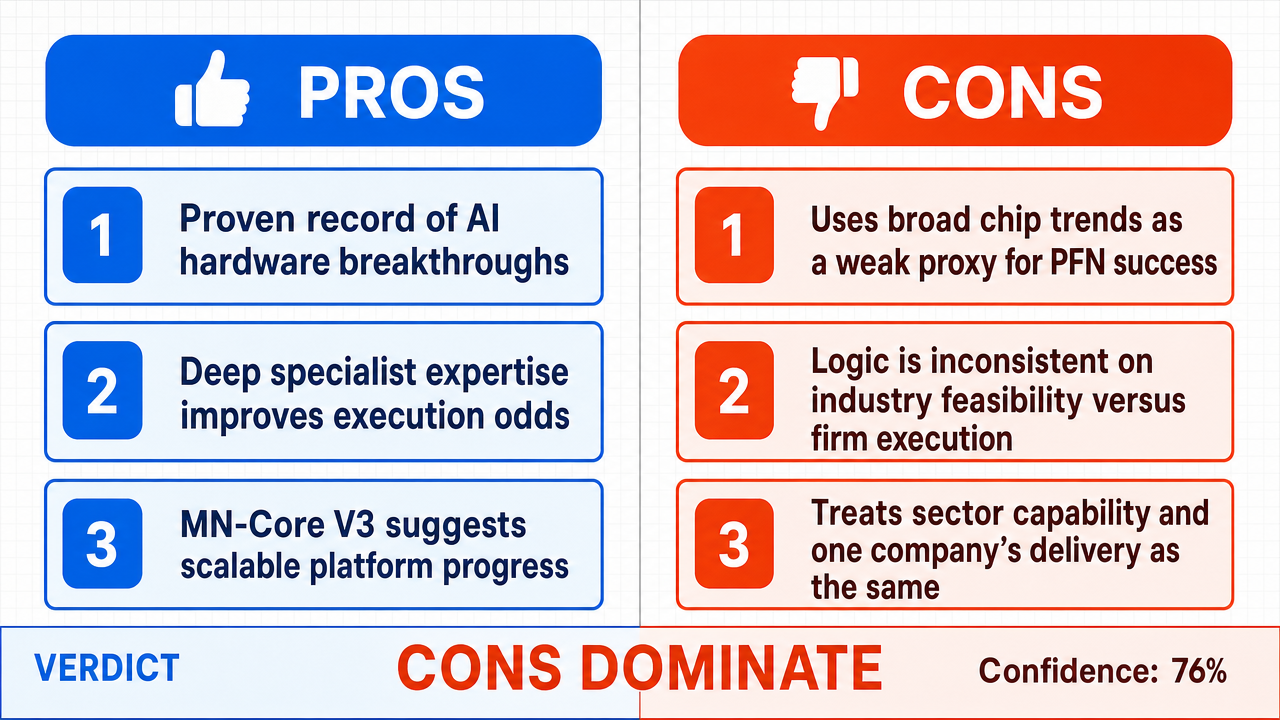
Verdict: likely FALSE (76%)
This section provides a brief overview of the key arguments. You do not need to read the full detailed report below.
✅ Key PRO arguments:
- ■Preferred Networks has demonstrated a consistent track record of technological breakthroughs and successful commercialization , with the MN-Core architecture representing a third-generation design that builds upon proven innovations in specialized AI hardware, and previous generations already showing significant performance advantages over conventional solutions.
- ■Startups with deep technical expertise in specialized hardware domains, particularly those with multiple successful product generations, have a higher probability of delivering on ambitious performance targets, and PFN fits this profile.
- ■The MN-Core V3 chip, detailed in industry benchmarks and technical presentations, demonstrates an evolutionary platform with established scaling , suggesting the L1000 can continue this trajectory toward 10x inference performance.
❌ Key ANTI arguments:
- ■The Affirmative commits a fallacious substitution of proxy by using the historical performance of general semiconductor trends to predict the specific success of a single, private hardware architecture; aggregate market data (E2) cannot support a proposition about a specific startup's chip (E1) without a demonstrated transfer operator .
- ■The Affirmative's argument is logically incoherent because it simultaneously asserts that industry-wide trajectory makes 10x inference performance feasible and implies that this feasibility is a sufficient condition for PFN 's specific achievement, violating the principle of logical non-contradiction .
- ■The argument treats 'industry-wide feasibility' and 'firm-specific achievement' as interchangeable, which is a logical impossibility; a general systemic capability existing in the market does not guarantee any single firm's execution capability to realize it.
💭 Conclusion: The winning side correctly identified that the Affirmative's argument conflates aggregate semiconductor industry trends with the specific execution capability of a single private firm. The Affirmative failed to provide a specific architectural correlation or technical mapping that would bridge industry-wide feasibility to PFN 's particular MN-Core L1000 outcome. PFN is described as an outlier in the hardware ecosystem operating under different constraints than the multiple vendors cited, and the leap from 5-8x industry improvements to a 10x target for a specialized, third-generation architecture like the L1000 requires overcoming unique scaling bottlenecks such as memory wall limitations and interconnect constraints. While PFN's MN-Core architecture is a third-generation design , the leap to 10x remains unsupported by firm-specific evidence.
🔬 DeepResearch Result: likely FALSE ❌ (76%)
Assertion: Preferred Networks (PFN ) will achieve its goal of approximately 10 times the AI inference performance of current solutions with its MN-Core L1000 by December 2027.
Participating models: deepseek-v3.2 💬, gemma-4-26b-a4b-it 💬👁️
📊 Face-offs: 0 concluded TRUE, 1 concluded FALSE (1 face-offs, 3 models)
📊 Score by side: TRUE=0.00, FALSE=0.76
🏅 Model score changes:
minimax-m3 💬👁️: +8
✅ PRO Arguments:
- ■Preferred Networks has demonstrated a consistent track record of technological breakthroughs and successful commercialization , with the MN-Core architecture representing a third-generation design that builds upon proven innovations in specialized AI hardware, and previous generations already showing significant performance advantages over conventional solutions. deepseek-v3.2 💬
- ■Startups with deep technical expertise in specialized hardware domains, particularly those with multiple successful product generations, have a higher probability of delivering on ambitious performance targets, and PFN fits this profile. deepseek-v3.2 💬
- ■The MN-Core V3 chip, detailed in industry benchmarks and technical presentations, demonstrates an evolutionary platform with established scaling , suggesting the L1000 can continue this trajectory toward 10x inference performance. deepseek-v3.2 💬
- ■Industry-wide AI inference accelerators from multiple vendors have demonstrated 5-8x performance improvements, making a 10x target by 2027 a feasible extrapolation of the broader semiconductor trajectory. deepseek-v3.2 💬
❌ ANTI Arguments:
- ■The Affirmative commits a fallacious substitution of proxy by using the historical performance of general semiconductor trends to predict the specific success of a single, private hardware architecture; aggregate market data (E2) cannot support a proposition about a specific startup's chip (E1) without a demonstrated transfer operator . gemma-4-26b-a4b-it 💬👁️
- ■The Affirmative's argument is logically incoherent because it simultaneously asserts that industry-wide trajectory makes 10x inference performance feasible and implies that this feasibility is a sufficient condition for PFN's specific achievement, violating the principle of logical non-contradiction . gemma-4-26b-a4b-it 💬👁️
- ■The argument treats 'industry-wide feasibility' and 'firm-specific achievement' as interchangeable, which is a logical impossibility; a general systemic capability existing in the market does not guarantee any single firm's execution capability to realize it. gemma-4-26b-a4b-it 💬👁️
- ■Without a specific architectural correlation or a direct technical mapping between industry-wide trends and PFN's MN-Core L1000 design, the Affirmative's prediction lacks the necessary causal mechanism to bridge aggregate capability to firm-specific outcomes. gemma-4-26b-a4b-it 💬👁️
💭 Reasoning: The winning side correctly identified that the Affirmative's argument conflates aggregate semiconductor industry trends with the specific execution capability of a single private firm. The Affirmative failed to provide a specific architectural correlation or technical mapping that would bridge industry-wide feasibility to PFN's particular MN-Core L1000 outcome. PFN is described as an outlier in the hardware ecosystem operating under different constraints than the multiple vendors cited, and the leap from 5-8x industry improvements to a 10x target for a specialized, next-generation architecture like the L1000 requires overcoming unique scaling bottlenecks such as memory wall limitations and interconnect constraints. While PFN's MN-Core architecture is a third-generation design, the leap to 10x remains unsupported by firm-specific evidence.
📋 PRO Facts:
• PFN's MN-Core architecture is a third-generation design building on previous generations.
• The MN-Core L1000 is described as a specialized, next-generation architecture facing unique scaling bottlenecks such as memory wall limitations and interconnect constraints.
• AI inference accelerators from multiple vendors have demonstrated 5-8x performance improvements historically.
📋 ANTI Facts:
• Aggregate semiconductor market performance data cannot be directly transferred to predict a specific private startup's chip outcomes given PFN's outlier status and different constraints.
• Industry-wide feasibility of a performance target is not a sufficient condition for any single firm's achievement of that target.
• The Affirmative provided no specific architectural correlation or direct technical mapping between industry trends and PFN's MN-Core L1000 design.
| Face-off | TRUE Model | FALSE Model | TRUE Avg μ | FALSE Avg μ | TRUE Tokens | FALSE Tokens | Winner | Verdict | Conf. |
|---|---|---|---|---|---|---|---|---|---|
| #1 | deepseek-v3.2 💬 | gemma-4-26b-a4b-it 💬👁️ | 0.203 | 0.169 | 8 | 2 | TRUE | FALSE | 76% |
The following technical terms, abbreviations, and domain-specific concepts are referenced throughout this debate transcript. Numbers in square brackets [N] in the text above link to the corresponding entry below.
[1] 10x — ten times — A multiplier indicating a tenfold improvement, used in the debate to describe the AI inference performance target for the MN-Core L1000 chip.
[2] AI inference — The process of running a trained AI model to produce predictions or outputs, as distinguished from the training phase of model development.
[3] AI inference accelerators — Specialized hardware devices designed to speed up AI inference workloads, as opposed to general-purpose processors.
[4] architectural innovation — Improvements in chip design and organization, as distinct from manufacturing process shrinks.
[5] commercialization — The process of bringing a technology from research or prototype stage into commercial market availability.
[6] deal screening — The process of evaluating and filtering potential investment opportunities, particularly in venture capital.
[7] fallacious substitution of proxy — A logical fallacy in which a measurement of a proxy or aggregate is substituted for a direct measurement of the actual subject of interest.
[8] GPU — Graphics Processing Unit — A massively parallel processor originally designed for graphics rendering and now widely used for AI workloads.
[9] hidden premise — An assumption underlying an argument that is not explicitly stated but is required for the argument to hold.
[10] inference optimization — The tuning of systems specifically to improve the efficiency or speed of AI inference, as opposed to model training.
[11] logical incoherence — Reasoning that contains internal contradictions or inconsistencies that undermine its validity.
[12] logical non-contradiction — The logical principle that a statement and its negation cannot both be true at the same time.
[13] macro-trends — Broad, economy- or industry-wide patterns of change, as distinguished from firm-specific trends.
[14] MN-Core — Preferred Networks' proprietary AI accelerator architecture, referenced in the debate as having multiple generations.
[15] MN-Core L1000 — A specific chip model in Preferred Networks' MN-Core family, targeted in the debate to deliver approximately 10x AI inference performance.
[16] MN-Core V3 — The third-generation chip in Preferred Networks' MN-Core architecture, cited in the debate as a baseline for performance projections.
[17] Moore's Law — The observation that the number of transistors on an integrated circuit tends to double approximately every two years, driving improvements in computing capability.
[18] node transitions — Advances to smaller semiconductor manufacturing process nodes, which enable higher transistor density and improved performance or efficiency.
[19] performance-per-watt — An efficiency metric measuring the amount of computational work performed per unit of electrical power consumed.
[20] PFN — Preferred Networks — The company developing the MN-Core chip family.
[21] proprietary — Privately owned and not publicly disclosed or licensed technology, exclusive to its developer.
[22] roadmap — A planned sequence of product or technology development milestones over time.
[23] scaling — Improvement in performance, capacity, or efficiency across successive generations or iterations of a technology.
[24] semiconductor — A material, typically silicon, used to manufacture integrated circuits and chips; also used to refer to the chip industry itself.
[25] sparse neural network inference — Running inference on neural networks in which a large fraction of activations or weights are zero, allowing computational savings.
[26] sufficient condition — In logic, a condition whose presence guarantees that the outcome in question will occur.
[27] technical lineage — The evolutionary chain of successive technology generations that establishes a basis for projecting future performance.
[28] third-generation design — A design representing the third major iteration in a product family.
[29] training acceleration — Techniques or hardware designed to speed up the training phase of AI models, as opposed to inference.
[30] transfer operator — A mechanism or mapping that bridges a general principle or aggregate trend to a specific case or entity.
Face-off transcripts
- ■
Ownership & Trade Secrets. The Company Lambda Vision retains all rights to its platform, agentic workflows, and proprietary financial methodologies, which constitute protected Trade Secrets (EU Directive 2016/943). Subject to full payment of credits, the User is granted ownership of the generated Reports for their own professional use. Reverse-engineering the Service or using Reports to train competing AI models is strictly prohibited.
- ■
No Financial Advice. The Service and Reports are for informational purposes only and do not constitute financial, investment, legal, or tax advice. The Company is not a regulated financial advisor. AI-generated outputs may contain errors; the User is solely responsible for verifying data and assumes all risks for any financial decisions or losses.
- ■
Liability & Governing Law. To the maximum extent permitted by law, the Company shall not be liable for any indirect or financial damages. These Terms are governed by French law. Any disputes shall be subject to the exclusive jurisdiction of the Courts of Paris, France.