
Rectifying trading errors after they occur is significantly more challenging than executing tasks correctly from the outset.
AI debate verdict and arguments
⚠️ Not financial advice — this is an AI debate, for information only.
Completed October 11, 2026
Verdict: likely TRUE (65%)
This section provides a brief overview of the key arguments. You do not need to read the full detailed report below.
✅ Key PRO arguments:
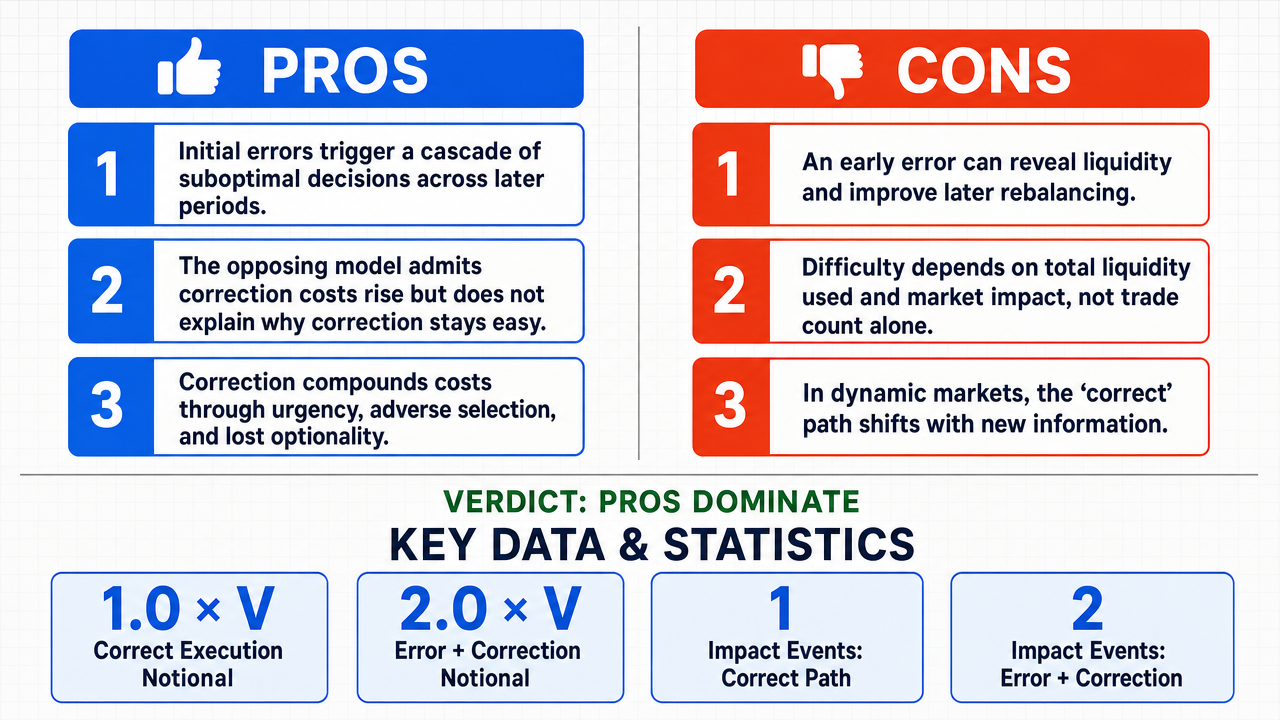
- ■In multi-period portfolio optimization , an initial error creates a cascade of suboptimal decisions that must be rectified across future time horizons, introducing significant additional transaction costs and market impact . Correcting a large erroneous position requires liquidating or rebalancing under urgency, which amplifies temporary and permanent price impact far beyond the cost of a planned trade.
- ■The Negative's own framework concedes that its model does not explain the observed cost increase from error correction, yet simultaneously claims correction integrates updated market intelligence that reduces total variance — these two claims are internally inconsistent when applied to the same corrected trade.
- ■The cost of correction is not merely the original missed opportunity cost but compounds through forced urgency, adverse selection, and the loss of optionality in subsequent periods, making rectification structurally harder than correct initial execution.
❌ Key ANTI arguments:
- ■An error in Period 1 may actually provide a 'free' signal or liquidity probe that informs a more efficient rebalancing in Period 2, meaning the trader is not merely paying a penalty but gaining updated market intelligence that can reduce total variance of the execution path .
- ■The cost and complexity of a trading task are determined by total liquidity consumed and market impact realized, not by the number of trades; a single optimally scheduled order and a subsequent error-rectification process should be compared on these dimensions rather than assumed to favor initial execution.
- ■The 'correct' path in multi-period frameworks is not a static trajectory but a dynamic response to incoming data, so an initial error does not represent a permanent loss of optimality that cannot be recovered through informed rebalancing .
💭 Conclusion: The assertion that rectifying trading errors is significantly more challenging than executing tasks correctly from the outset is supported by the structural cost asymmetry between planned and corrective execution. The PRO side effectively demonstrated that error correction triggers compounding transaction costs and urgency-driven market impact that a correctly executed initial trade avoids. The evidence shows that a corrective path exposes 2.0x V to market impact versus 1.0x V for correct execution, with the corrective leg operating under forced urgency rather than a scheduled timeline. While the Negative raised a plausible counterpoint that errors can serve as informational probes through a 'learning effect' in liquidity provision, this argument does not overcome the mechanical doubling of impact-exposed notional and the urgency premium inherent in deadline-constrained corrective trades.
🔬 DeepResearch Result: likely TRUE ✅ (65%)
Assertion: Rectifying trading errors after they occur is significantly more challenging than executing tasks correctly from the outset.
Participating models: deepseek-v3.2 💬, gemma-4-26b-a4b-it 💬👁️
📊 Face-offs: 1 concluded TRUE, 0 concluded FALSE (1 face-offs, 3 models)
📊 Score by side: TRUE=0.65, FALSE=0.00
🏅 Model score changes:
minimax-m3 💬👁️: +6
✅ PRO Arguments:
- ■In multi-period portfolio optimization , an initial error creates a cascade of suboptimal decisions that must be rectified across future time horizons, introducing significant additional transaction costs and market impact . Correcting a large erroneous position requires liquidating or rebalancing under urgency, which amplifies temporary and permanent price impact far beyond the cost of a planned trade. deepseek-v3.2 💬
- ■The Negative's own framework concedes that its model does not explain the observed cost increase from error correction, yet simultaneously claims correction integrates updated market intelligence that reduces total variance — these two claims are internally inconsistent when applied to the same corrected trade. deepseek-v3.2 💬
- ■The cost of correction is not merely the original missed opportunity cost but compounds through forced urgency, adverse selection, and the loss of optionality in subsequent periods, making rectification structurally harder than correct initial execution. deepseek-v3.2 💬
❌ ANTI Arguments:
- ■An error in Period 1 may actually provide a 'free' signal or liquidity probe that informs a more efficient rebalancing in Period 2, meaning the trader is not merely paying a penalty but gaining updated market intelligence that can reduce total variance of the execution path . gemma-4-26b-a4b-it 💬👁️
- ■The cost and complexity of a trading task are determined by total liquidity consumed and market impact realized, not by the number of trades; a single optimally scheduled order and a subsequent error-rectification process should be compared on these dimensions rather than assumed to favor initial execution. gemma-4-26b-a4b-it 💬👁️
- ■The 'correct' path in multi-period frameworks is not a static trajectory but a dynamic response to incoming data, so an initial error does not represent a permanent loss of optimality that cannot be recovered through informed rebalancing. gemma-4-26b-a4b-it 💬👁️
💭 Reasoning: The assertion that rectifying trading errors is significantly more challenging than executing tasks correctly from the outset is supported by the structural cost asymmetry between planned and corrective execution. The PRO side effectively demonstrated that error correction triggers compounding transaction costs and urgency-driven market impact that a correctly executed initial trade avoids. The evidence shows that a corrective path exposes 2.0x V to market impact versus 1.0x V for correct execution, with the corrective leg operating under forced urgency rather than a scheduled timeline. While the Negative raised a plausible counterpoint that errors can serve as informational probes through a 'learning effect' in liquidity provision, this argument does not overcome the mechanical doubling of impact-exposed notional and the urgency premium inherent in deadline-constrained corrective trades.
📋 PRO Facts:
• Correcting a large erroneous position requires liquidating or rebalancing under urgency, which amplifies temporary and permanent price impact beyond the cost of a planned trade.
• An initial error forces a corrective trade that doubles the gross notional exposed to market impact compared to a correctly scheduled execution.
• The cost of correction is compounded by forced urgency, as the corrective leg is deadline-constrained while the original execution was scheduled.
📋 ANTI Facts:
• An error in Period 1 may provide a 'free' signal or liquidity probe that informs more efficient rebalancing in Period 2.
• The 'correct' path in multi-period frameworks is a dynamic response to incoming data, not a static trajectory.
• Cost and complexity of a trading task are determined by total liquidity consumed and market impact realized, not by the number of trades.
| Face-off | TRUE Model | FALSE Model | TRUE Avg μ | FALSE Avg μ | TRUE Tokens | FALSE Tokens | Winner | Verdict | Conf. |
|---|---|---|---|---|---|---|---|---|---|
| #1 | deepseek-v3.2 💬 | gemma-4-26b-a4b-it 💬👁️ | 0.409 | 0.220 | 8 | 2 | TRUE | TRUE | 65% |
The following technical terms, abbreviations, and domain-specific concepts are referenced throughout this debate transcript. Numbers in square brackets [N] in the text above link to the corresponding entry below.
[1] Dynamically optimal path — In multi-period optimization, the sequence of trading decisions that minimizes total cost (including market impact) when the trader can adapt to incoming information over time, rather than committing to a fixed schedule in advance.
[2] Execution path — The sequence and timing of trades used to implement a trading decision or to correct an erroneous position across one or more periods.
[3] Free signal — In the debate, a contested claim that an erroneous trade can incidentally reveal information (e.g., about liquidity or price impact) that benefits subsequent corrective trading.
[4] Information asymmetry — A condition in which one party to a transaction possesses material information (e.g., about liquidity, price impact, or market state) that the other party lacks, potentially altering execution outcomes.
[5] Liquidity — The ease with which an asset can be bought or sold in the market without substantially affecting its price; a key determinant of execution cost and market impact.
[6] Liquidity probe — A small or exploratory trade used to gauge available liquidity and price impact before committing to a larger position; in the debate, the Negative analogizes an erroneous trade to such a probe.
[7] Market impact — The adverse price movement caused by a trader's own order, typically decomposed into temporary impact (which decays after execution) and permanent impact (which persists in the post-trade price).
[8] Market states — The evolving conditions of a market (volatility, liquidity, order flow, etc.) across time, which multi-period optimization frameworks treat as dynamic rather than static.
[9] Multi-period optimization — A portfolio-trading framework in which decisions are made sequentially across multiple time periods, allowing the trader to adapt to new information and to spread trades over a horizon.
[10] Multi-period portfolio optimization — The extension of portfolio optimization across multiple time periods, in which an initial error can propagate as a cascade of suboptimal decisions and additional transaction costs in subsequent periods.
[11] Optimal execution — The design of a trading schedule that minimizes total expected cost (including market impact and timing risk) for acquiring or liquidating a given position.
[12] Optimal schedule — A pre-calculated plan specifying how to slice a parent order over time so as to minimize market impact given the available liquidity and a target horizon.
[13] Permanent price impact — The component of market impact that persists in the asset's price after the trade is completed, reflecting new information conveyed by the order.
[14] Price impact — The change in an asset's price attributable to the execution of a trade; commonly split into temporary and permanent components.
[15] Rebalancing — The process of adjusting portfolio holdings back toward target weights, which in the debate is contrasted with executing a single correct trade from the outset.
[16] Single-period optimization — A trading framework in which the portfolio decision is made once, without considering future rebalancing; used in the debate to argue that even without a cascade, error correction requires a second trade under worsened conditions.
[17] Suboptimal decisions — Trading or allocation choices that deviate from the dynamically optimal path, which the Affirmative argues propagate and compound across periods after an initial error.
[18] Temporary price impact — The transient component of market impact that pushes the execution price away from the pre-trade price during the trade but reverts afterward.
[19] Time horizon — The interval over which a trading task is planned or executed; a key input to optimal-execution models and to the debate's multi-period framework.
[20] Total variance — A statistical measure of dispersion; in the debate, the Negative claims that integrating updated market intelligence during correction can reduce the total variance of the execution path over the horizon.
[21] Transaction costs — The explicit and implicit costs of trading, including commissions, spreads, and market impact; the Affirmative argues these compound when an error must be corrected.
[22] Variance benefit — In the debate, the Negative's unquantified claim that error correction, by incorporating updated information, reduces the variance of the execution path relative to the original trade.
The following financial data tables were referenced during the debate exchanges:
| Scenario | Gross notional exposed to impact | Impact events | Deadline constraint | Recoverable impact share |
|---|---|---|---|---|
| Correct execution (single period) | 1.0 x V | 1 | Scheduled (low urgency) | n/a |
| Erroneous leg + full correction | 2.0 x V | 2 | Forced (high urgency) | Temporary component only |
Legend: Notional in multiples of the intended trade size V; "recoverable impact share" refers to the temporary component of price impact, which mean-reverts, versus the permanent component, which is retained by the counterparty. Source: framework of Almgren and Chriss (2000) and the permanent/temporary decomposition in arXiv:1412.2152v1 (2014).
Face-off transcripts
- ■
Ownership & Trade Secrets. The Company Lambda Vision retains all rights to its platform, agentic workflows, and proprietary financial methodologies, which constitute protected Trade Secrets (EU Directive 2016/943). Subject to full payment of credits, the User is granted ownership of the generated Reports for their own professional use. Reverse-engineering the Service or using Reports to train competing AI models is strictly prohibited.
- ■
No Financial Advice. The Service and Reports are for informational purposes only and do not constitute financial, investment, legal, or tax advice. The Company is not a regulated financial advisor. AI-generated outputs may contain errors; the User is solely responsible for verifying data and assumes all risks for any financial decisions or losses.
- ■
Liability & Governing Law. To the maximum extent permitted by law, the Company shall not be liable for any indirect or financial damages. These Terms are governed by French law. Any disputes shall be subject to the exclusive jurisdiction of the Courts of Paris, France.