
Retail investors leveraging AI can consistently gain an edge over traditional hedge funds by accessing and processing market information faster.
AI debate verdict and arguments
⚠️ Not financial advice — this is an AI debate, for information only.
Completed October 19, 2026
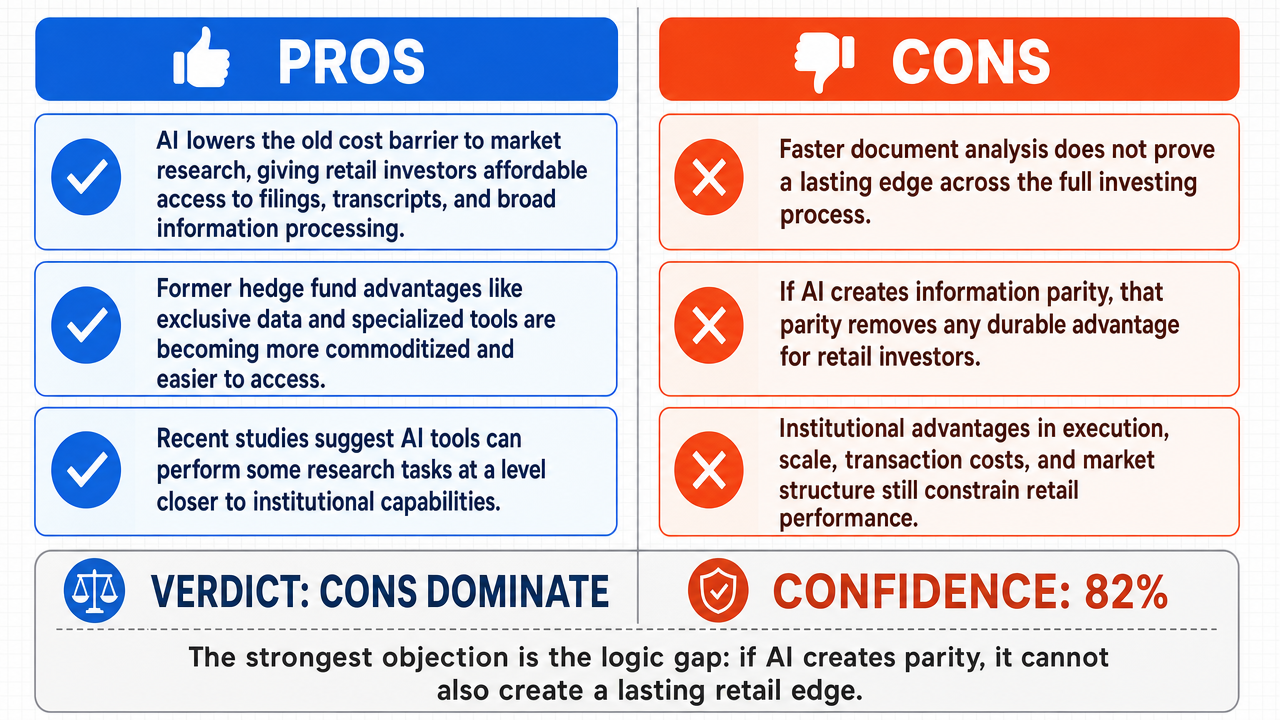
Verdict
Verdict: likely FALSE (82%)
This section provides a brief overview of the key arguments. You do not need to read the full detailed report below.
✅ Key PRO arguments:
- ■AI collapses the historical cost barrier to market data: retail investors with a $20/month AI research subscription can now ingest earnings transcripts, SEC filings , macro releases, and social sentiment within seconds, replacing the six- and seven-figure annual Bloomberg/Reuters/bespoke data costs hedge funds once paid.
- ■The structural moats that insulated hedge funds — exclusive alternative data , proprietary satellite imagery, and HFT infrastructure — are dissolving as commoditized AI tools democratize capabilities that were once institution-only.
- ■Recent empirical studies (2024 GPT-4 earnings-prediction study, 2023 University of Chicago satellite-imagery study) demonstrate that AI tools can deliver institutional-grade analytical output to retail users, and the affirmative argues these findings remain valid because no evidence was offered that market complexity has increased enough to invalidate them.
❌ Key ANTI arguments:
- ■The affirmative commits a scale-and-substitution error: measuring the latency of a single document-processing task and concluding it applies to the entire competitive market ecosystem, without supplying the necessary transfer operator that bridges individual analytical speed to a sustained market edge .
- ■The affirmative's argument is internally inconsistent — if AI -powered platforms truly collapse the cost barrier and produce information parity , that very parity erodes the 'edge ' retail investors are claimed to maintain; an edge cannot exist in a market where everyone has the same information at the same speed.
- ■Structural institutional advantages — transaction costs , slippage , capacity constraints , and execution infrastructure — remain binding constraints that retail investors cannot overcome through faster information processing alone.
💭 Conclusion: False. The winning side's strongest argument is the internal logical inconsistency in the affirmative's case: if AI truly collapses the cost barrier and produces information parity between retail and institutional investors, then no sustainable edge can exist because an edge requires an asymmetry that the affirmative's own premise eliminates. The negative also correctly identified that the affirmative conflated single-document processing latency with a competitive market-wide edge, failing to supply the transfer operator that would connect faster individual analysis to consistent outperformance. Structural frictions such as slippage and capacity constraints further bind retail investors regardless of how quickly they can read a 10-K. Finally, the cited 2023–2024 studies were not shown to translate into risk-adjusted returns net of those frictions, leaving the 'consistently gain an edge' claim unsupported.
🔬 DeepResearch Result: likely FALSE ❌ (82%)
Assertion: Retail investors leveraging AI can consistently gain an edge over traditional hedge funds by accessing and processing market information faster.
Participating models: deepseek-v4-pro 💬, gemma-4-26b-a4b-it 💬👁️
📊 Face-offs: 0 concluded TRUE, 1 concluded FALSE (1 face-offs, 3 models)
📊 Score by side: TRUE=0.00, FALSE=0.82
🏅 Model score changes:
minimax-m3 💬👁️: +8
✅ PRO Arguments:
- ■AI collapses the historical cost barrier to market data: retail investors with a $20/month AI research subscription can now ingest earnings transcripts, SEC filings , macro releases, and social sentiment within seconds, replacing the six- and seven-figure annual Bloomberg/Reuters/bespoke data costs hedge funds once paid. deepseek-v4-pro 💬
- ■The structural moats that insulated hedge funds — exclusive alternative data , proprietary satellite imagery, and HFT infrastructure — are dissolving as commoditized AI tools democratize capabilities that were once institution-only. deepseek-v4-pro 💬
- ■Recent empirical studies (2024 GPT-4 earnings-prediction study, 2023 University of Chicago satellite-imagery study) demonstrate that AI tools can deliver institutional-grade analytical output to retail users, and the affirmative argues these findings remain valid because no evidence was offered that market complexity has increased enough to invalidate them. deepseek-v4-pro 💬
- ■The temporal trajectory of AI capability continues to improve, meaning any current limitations retail investors face are narrowing over time rather than being permanent structural barriers. deepseek-v4-pro 💬
❌ ANTI Arguments:
- ■The affirmative commits a scale-and-substitution error: measuring the latency of a single document-processing task and concluding it applies to the entire competitive market ecosystem, without supplying the necessary transfer operator that bridges individual analytical speed to a sustained market edge. gemma-4-26b-a4b-it 💬👁️
- ■The affirmative's argument is internally inconsistent — if AI-powered platforms truly collapse the cost barrier and produce information parity , that very parity erodes the 'edge' retail investors are claimed to maintain; an edge cannot exist in a market where everyone has the same information at the same speed. gemma-4-26b-a4b-it 💬👁️
- ■Structural institutional advantages — transaction costs , slippage , capacity constraints , and execution infrastructure — remain binding constraints that retail investors cannot overcome through faster information processing alone. gemma-4-26b-a4b-it 💬👁️
- ■AI tools provide retail investors with information access but cannot overcome the institutional advantages that hedge funds derive from scale, capital, and execution capabilities that operate independently of information-processing speed. gemma-4-26b-a4b-it 💬👁️
💭 Reasoning: False. The winning side's strongest argument is the internal logical inconsistency in the affirmative's case: if AI truly collapses the cost barrier and produces information parity between retail and institutional investors, then no sustainable edge can exist because an edge requires an asymmetry that the affirmative's own premise eliminates. The negative also correctly identified that the affirmative conflated single-document processing latency with a competitive market-wide edge, failing to supply the transfer operator that would connect faster individual analysis to consistent outperformance. Structural frictions such as slippage and capacity constraints further bind retail investors regardless of how quickly they can read a 10-K. Finally, the cited 2023–2024 studies were not shown to translate into risk-adjusted returns net of those frictions, leaving the 'consistently gain an edge' claim unsupported.
📋 PRO Facts:
• Retail AI research platforms are available at approximately $20 per month, compared to five- and six-figure annual costs historically paid by hedge funds for Bloomberg terminals and proprietary alternative data feeds.
• A 2024 NBER paper examined GPT-based models' ability to generate abnormal returns and a 2023 University of Chicago study examined satellite-imagery applications, both cited as evidence of retail-accessible AI analytical power.
📋 ANTI Facts:
• Hedge funds historically paid five- and six-figure annual sums for Bloomberg terminals and proprietary alternative data feeds.
• Retail investors face binding constraints from slippage and capacity constraints that operate independently of information-processing speed.
| Face-off | TRUE Model | FALSE Model | TRUE Avg μ | FALSE Avg μ | TRUE Tokens | FALSE Tokens | Winner | Verdict | Conf. |
|---|---|---|---|---|---|---|---|---|---|
| #1 | deepseek-v4-pro 💬 | gemma-4-26b-a4b-it 💬👁️ | 0.478 | 0.314 | 6 | 2 | TRUE | FALSE | 82% |
The following technical terms, abbreviations, and domain-specific concepts are referenced throughout this debate transcript. Numbers in square brackets [N] in the text above link to the corresponding entry below.
[1] 10-K filings — Form 10-K — Annual reports filed with the SEC that provide a comprehensive overview of a company's financial performance, audited financial statements, and risk factors.
[2] AI — Artificial Intelligence — Computer systems designed to perform tasks that typically require human intelligence, such as learning, reasoning, and language understanding.
[3] alternative data — Non-traditional datasets (e.g., satellite imagery, social media sentiment, credit card transactions) used by investors to gain insights beyond conventional financial statements.
[4] capacity constraints — Limits on the size or volume of trades an investment strategy can execute without adversely affecting market prices or strategy performance.
[5] cost barrier — The financial threshold required to access certain tools, data, or infrastructure, which historically limited participation to well-capitalized institutions.
[6] earnings call transcripts — Written records of quarterly or annual conference calls where company management discusses financial results with analysts and investors.
[7] edge — trading edge — A sustained competitive advantage that allows an investor or trader to generate returns superior to the market or to competitors over time.
[8] execution — trade execution — The process of completing a buy or sell order in the market, including the speed and price at which the trade is filled.
[9] GAAP — Generally Accepted Accounting Principles — A standardized set of accounting rules and guidelines used in the United States to prepare and present financial statements.
[10] GPT-4 — Generative Pre-trained Transformer 4 — A large language model developed by OpenAI, capable of processing and generating natural language text, referenced in the debate for earnings-prediction research.
[11] hedge funds — Privately pooled investment vehicles that use varied strategies, often including leverage and derivatives, to generate returns for accredited investors.
[12] high-fidelity data — Data of high accuracy, completeness, and reliability, often referring to non-public or structured institutional-grade datasets.
[13] high-frequency trading — HFT — An algorithmic trading strategy characterized by extremely fast execution speeds and very short holding periods, typically measured in milliseconds or microseconds.
[14] information parity — A state in which all market participants have roughly equal access to the same information, eliminating informational advantages.
[15] inventory build-up — An increase in a company's stock of unsold goods, which can signal weakening demand or production inefficiencies.
[16] latency — The time delay between an event and a response; in trading, the delay between receiving market data and executing a trade.
[17] liquidity capture — The ability to efficiently buy or sell assets without significantly moving their price, often requiring access to deep order books and fast execution.
[18] LLMs — Large Language Models — AI models trained on vast text corpora that can understand, generate, and analyze natural language, used in the debate for parsing financial filings.
[19] macroeconomic releases — Official publications of economy-wide data such as GDP, inflation, and employment figures that influence market-wide investment decisions.
[20] market complexity — The degree of interconnectedness, speed, and number of participants and strategies in financial markets, referenced in the debate as a factor that may outpace AI capability gains.
[21] market returns — The gains or losses generated by an investment or by the overall market over a specified period.
[22] non-GAAP earnings — Earnings figures that exclude certain items (e.g., one-time charges, stock-based compensation) to present an alternative view of underlying profitability.
[23] revenue recognition — The accounting principle determining when and how revenue is recorded, a key area where accounting anomalies can arise.
[24] SEC filings — Securities and Exchange Commission filings — Mandatory regulatory documents submitted by publicly traded companies to the U.S. SEC, including annual and quarterly reports.
[25] signal extraction — The process of identifying statistically meaningful patterns or predictive information from raw data, often using AI or quantitative methods.
[26] slippage — The difference between the expected price of a trade and the actual execution price, often caused by market movement or insufficient liquidity.
[27] social media sentiment — Aggregated analysis of public opinion and emotional tone expressed on social platforms, used as an alternative data input for trading decisions.
[28] structural moat — A durable competitive advantage that protects a firm or strategy from competitors, such as exclusive data access or proprietary infrastructure.
[29] transaction costs — The expenses incurred when buying or selling securities, including brokerage fees, bid-ask spreads, and market impact costs.
[30] transfer operator — In the debate's context, the conceptual bridge between an individual's analytical speed and the systemic ability to execute profitable, large-scale trades in a competitive market.
The following financial data tables were referenced during the debate exchanges:
| Cost Category | Traditional Hedge Fund | AI-Equipped Retail Investor |
|---|---|---|
| Market data terminal (annual) | $24,000 (Bloomberg) | $240–$600 (AI platform subscription) |
| Alternative data (satellite, credit card) | $50,000–$500,000+ | Included in AI platform or $0–$1,000 |
| Research analyst (annual salary) | $150,000–$300,000 | $0 (AI replaces first-pass analysis) |
| Latency infrastructure (colocation) | $10,000–$50,000/month | $0 (cloud-based AI, no colocation needed) |
| Total annual cost advantage | — | ~$343,760–$1,422,400 savings |
Legend: Approximate annual costs for market data, alternative data, personnel, and infrastructure. Hedge fund figures are industry estimates; retail AI costs reflect current subscription pricing for premium AI research tools. All figures in USD.
| Cost Component | Retail AI Capability | Institutional Hedge Fund Capability | Gap Type |
|---|---|---|---|
| Data Access | Public/Commodity Data | Proprietary/Exclusive Data | Source Asymmetry |
| Execution Speed | Standard Internet Latency | Microwave/Colocated Latency | Temporal Asymmetry |
| Capital Capacity | Low (High Slippage) | High (Deep Liquidity) | Scale Asymmetry |
| Analytical Depth | Pattern Recognition | Multi-Factor Quantitative Models | Complexity Asymmetry |
Legend: Comparison of the qualitative and structural gaps between retail AI users and institutional funds. The "Gap Type" identifies the specific structural moat that AI processing alone cannot bridge.
| Data Category | Retail AI Access | Institutional Access | Barrier Status |
|---|---|---|---|
| Public Filings/News | High | High | Collapsed |
| Structured Financials | Moderate | High | Persistent |
| Proprietary Alt-Data | Negligible | Very High | Intact |
| Low-Latency Feeds | None | Extreme | Intact |
Legend: Comparison of data accessibility between retail AI users and hedge funds. "Barrier Status" indicates whether the cost/access gap has actually closed.
Face-off transcripts
- ■
Ownership & Trade Secrets. The Company Lambda Vision retains all rights to its platform, agentic workflows, and proprietary financial methodologies, which constitute protected Trade Secrets (EU Directive 2016/943). Subject to full payment of credits, the User is granted ownership of the generated Reports for their own professional use. Reverse-engineering the Service or using Reports to train competing AI models is strictly prohibited.
- ■
No Financial Advice. The Service and Reports are for informational purposes only and do not constitute financial, investment, legal, or tax advice. The Company is not a regulated financial advisor. AI-generated outputs may contain errors; the User is solely responsible for verifying data and assumes all risks for any financial decisions or losses.
- ■
Liability & Governing Law. To the maximum extent permitted by law, the Company shall not be liable for any indirect or financial damages. These Terms are governed by French law. Any disputes shall be subject to the exclusive jurisdiction of the Courts of Paris, France.