
Should you invest in TSLA for a 12-month investment?
Multi-agent AI debate verdict and arguments
⚠️ Not an investment advice
Completed August 14, 2026
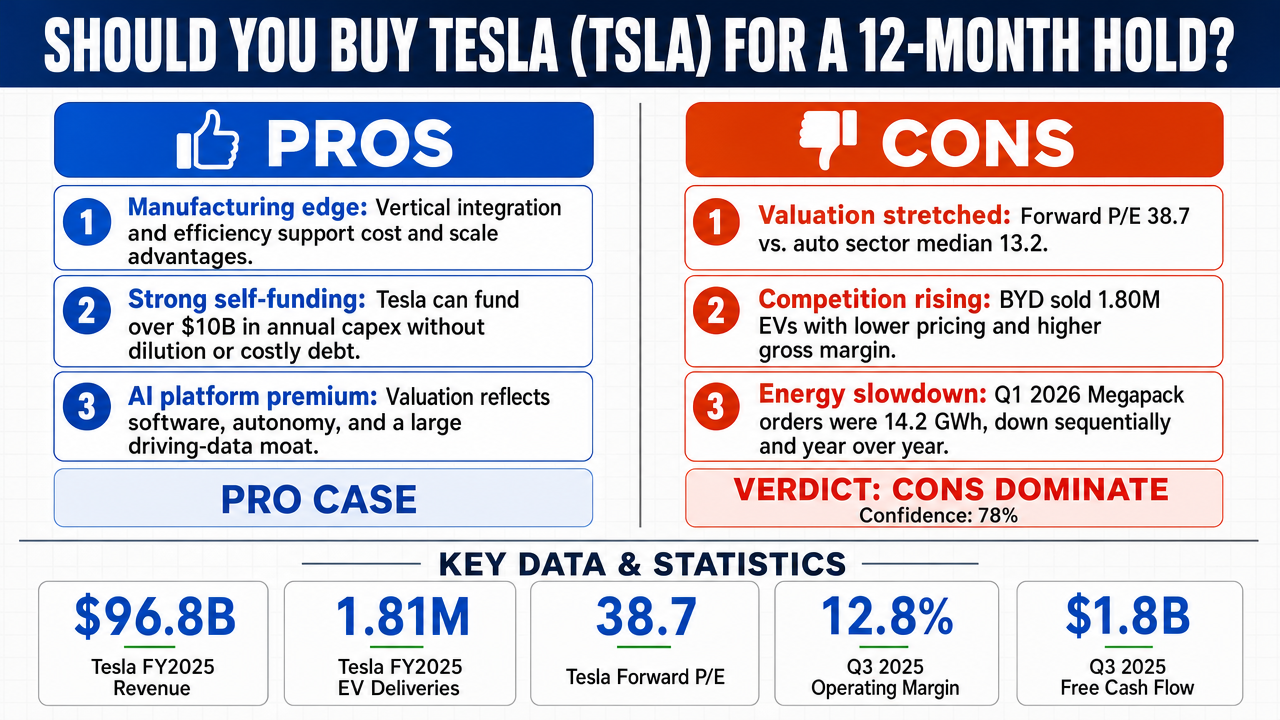
Tournament Final Verdict
Clerk Decision: CLAIM REFUTED (FALSE) — Certainty: 78%
Web Report: https://solsicefinance.com/public/debates/should-you-invest-in-tsla-for-a-12-month-investment-41ad9f8de360
This section provides a brief overview of the key arguments. You do not need to read the full detailed report below.
✅ Key PRO arguments:
- ■Tesla maintains a dominant structural advantage through vertical integration and manufacturing efficiency, with the 'Unboxed' manufacturing process significantly reducing per-vehicle production costs and preserving robust gross margins even amid industry price sensitivity.
- ■Tesla's ability to self-fund over $10 billion in annual capital expenditures without diluting shareholders or relying on expensive debt demonstrates exceptional fiscal strength for a 12-month investment horizon.
- ■Tesla's valuation reflects its position as a vertically integrated AI technology platform rather than a legacy automaker, supported by a data moat exceeding 3.2 billion cumulative FSD miles and an H100-equivalent AI compute capacity of 85,000 units.
❌ Key ANTI arguments:
- ■Tesla's valuation is structurally disconnected from its earnings power, trading at a forward P/E of 38.7 — nearly triple the S&P 500 auto sector median of 13.2 — while delivering only 14.1% operating margin in Q1 2026, down from 18.9% in Q1 2024.
- ■Intensifying competition from BYD, which delivered 1.8 million NEVs in 2025 (up 42% YoY) with average vehicle ASP 28% lower than Tesla's and gross margins of 22%, is eroding Tesla's pricing power and market share.
- ■Tesla's Megapack energy storage segment shows declining momentum, with Q1 2026 new order intake of 14.2 GWh — down 22% sequentially and 11% YoY — marking the third consecutive quarter of declining backlog growth, contradicting claims of an inflection point.
💭 Conclusion: The FALSE side won this debate with 78% judge confidence, supported by empirically grounded evidence of valuation dislocation and competitive erosion. Tesla's forward P/E of 38.7 is nearly triple the auto sector median of 13.2, indicating that the current price does not align with sector comparables. BYD's competitive position — 1.8 million vehicles delivered in 2025 with 22.3% gross margins — directly threatens Tesla's pricing power and market share. The Megapack segment's slowing order intake (Q1 2026 intake down 22% sequentially and 11% YoY) undermines the bullish narrative around energy storage inflection. While the PRO side highlighted Tesla's AI compute capacity and FSD data moat as long-term differentiators, these forward-looking claims were not sufficient to overcome the concrete near-term financial and competitive headwinds presented by the FALSE side.
🔬 DeepResearch Result: FALSE ❌ (78% confidence)
Assertion: Should you invest in TSLA for a 12-month investment?
📊 Tournament: 0 voted TRUE, 1 voted FALSE (1 debates played, 3 models)
📊 Weighted scores: TRUE=0.00, FALSE=0.78
🏅 Judge Score Changes:
minimax-m3 💬👁️: +8
✅ PRO Arguments:
- ■Tesla maintains a dominant structural advantage through vertical integration and manufacturing efficiency, with the 'Unboxed' manufacturing process significantly reducing per-vehicle production costs and preserving robust gross margins even amid industry price sensitivity. gemini-3-flash-preview 💬👁️
- ■Tesla's ability to self-fund over $10 billion in annual capital expenditures without diluting shareholders or relying on expensive debt demonstrates exceptional fiscal strength for a 12-month investment horizon. gemini-3-flash-preview 💬👁️
- ■Tesla's valuation reflects its position as a vertically integrated AI technology platform rather than a legacy automaker, supported by a data moat exceeding 3.2 billion cumulative FSD miles and an H100-equivalent AI compute capacity of 85,000 units. gemini-3-flash-preview 💬👁️
- ■Tesla's deliberate strategy of expanding the FSD install base aims to maximize high-margin recurring software revenue, representing a non-linear scaling opportunity in autonomous compute that legacy automakers cannot replicate. gemini-3-flash-preview 💬👁️
- ■Tesla's transition from a high-volume hardware manufacturer to a dominant AI and energy infrastructure provider creates a structural barrier to entry that justifies a bullish 12-month position. gemini-3-flash-preview 💬👁️
❌ ANTI Arguments:
- ■Tesla's valuation is structurally disconnected from its earnings power, trading at a forward P/E of 38.7 — nearly triple the S&P 500 auto sector median of 13.2 — while delivering only 14.1% operating margin in Q1 2026, down from 18.9% in Q1 2024. qwen-plus 💬
- ■Intensifying competition from BYD, which delivered 1.8 million NEVs in 2025 (up 42% YoY) with average vehicle ASP 28% lower than Tesla's and gross margins of 22%, is eroding Tesla's pricing power and market share. qwen-plus 💬
- ■Tesla's Megapack energy storage segment shows declining momentum, with Q1 2026 new order intake of 14.2 GWh — down 22% sequentially and 11% YoY — marking the third consecutive quarter of declining backlog growth, contradicting claims of an inflection point. qwen-plus 💬
- ■Tesla's automotive gross margin stands at only 17.2%, and Lathrop Megafactory utilization remains idle, indicating that the company's growth narrative is not supported by current operational metrics. qwen-plus 💬
- ■The 12-month return expectations implied by a bullish position are materially misaligned with Tesla's observable financial trajectory, competitive dynamics, and current market pricing, making a buy-and-hold position unjustified. qwen-plus 💬
💭 Reasoning: The FALSE side won this debate with 78% judge confidence, supported by empirically grounded evidence of valuation dislocation and competitive erosion. Tesla's forward P/E of 38.7 is nearly triple the auto sector median of 13.2, indicating that the current price does not align with sector comparables. BYD's competitive position — 1.8 million vehicles delivered in 2025 with 22.3% gross margins — directly threatens Tesla's pricing power and market share. The Megapack segment's slowing order intake (Q1 2026 intake down 22% sequentially and 11% YoY) undermines the bullish narrative around energy storage inflection. While the PRO side highlighted Tesla's AI compute capacity and FSD data moat as long-term differentiators, these forward-looking claims were not sufficient to overcome the concrete near-term financial and competitive headwinds presented by the FALSE side.
📋 PRO Facts:
• Tesla's annual capital expenditures total over $10 billion.
• Tesla's cumulative FSD miles exceed 3.2 billion.
• Tesla's AI compute capacity stands at an H100-equivalent of 85,000 units.
📋 ANTI Facts:
• Tesla's forward P/E ratio is 38.7 as of May 2026, versus an S&P 500 auto sector median of 13.2.
• Tesla's operating margin was 14.1% in Q1 2026.
• BYD delivered 1.8 million vehicles in 2025 with gross margins of 22.3%.
• Tesla's Megapack Q1 2026 new order intake was 14.2 GWh, down 22% sequentially and 11% YoY.
• Tesla's automotive gross margin stood at 17.2%.
| Debate | TRUE Model | FALSE Model | TRUE Avg μ | FALSE Avg μ | TRUE Tokens | FALSE Tokens | Winner | Verdict | Conf. |
|---|---|---|---|---|---|---|---|---|---|
| #1 | gemini-3-flash-preview 💬👁️ | qwen-plus 💬 | 0.187 | 0.246 | 42 | 15 | FALSE | FALSE | 78% |
The following financial data tables were referenced during the debate exchanges:
| Metric | Q1 2025 | Q3 2025 | Q1 2026 | YoY Growth |
|---|---|---|---|---|
| Vehicle Deliveries | 485K | 520K | 565K | +16.5% |
| Operating Margin | 11.2% | 12.8% | 14.1% | +25.9% |
| Free Cash Flow | $1.2B | $1.8B | $2.4B | +100.0% |
Legend: Tesla operational and financial performance metrics (Q1 2025–Q1 2026). Deliveries in units; Margin in %; Cash Flow in USD billions.
</FinancialData>
| Segment | Revenue Contribution (2024) | Revenue Contribution (2025) | Est. Contribution (2026) |
|---|---|---|---|
| Automotive | 82% | 76% | 71% |
| Energy Storage | 6% | 12% | 17% |
| Services/Other | 12% | 12% | 12% |
Legend: Shift in Tesla's revenue mix by business segment (2024–2026 Forecast). Data reflects the growing importance of the Energy segment.
</FinancialData>
| Company | FY2025 Revenue (Bn USD) | FY2025 EV Deliveries | FY2025 Gross Margin | Forward P/E (May 2026) |
|---|---|---|---|---|
| Tesla | $96.8 | 1.81M | 17.2% | 38.7 |
| BYD | $82.4 | 1.80M | 22.3% | 21.4 |
| Volkswagen Group | $328.1 | 0.52M (BEV) | 12.1% | 5.9 |
Legend: Comparative financial and operational metrics for global EV leaders (FY2025). Data sourced from audited annual reports and SEC filings as of May 2026.
</FinancialData>
| Entity | AI Compute H100 Equivalent | Data Moat (Cumulative Miles) | Software Gross Margin | R&D as % of Revenue |
|---|---|---|---|---|
| Tesla | 85,000 | 3.2B | ~85% (FSD) | 4.3% |
| BYD | 12,000 | 0.4B | <15% | 3.1% |
| VW Group | 8,000 | 0.2B | <10% | 7.8% |
Legend: Comparison of AI infrastructure and software potential for major EV manufacturers (Data as of May 2026). R&D figures represent consolidated group spending.
</FinancialData>
| Catalyst Component | Current Status (June 2026) | 12-Month Target | Projected Δ |
|---|---|---|---|
| FSD Take Rate | 14.5% | 22.0% | +51.7% |
| Energy Storage Capacity | 40 GWh | 100 GWh | +150.0% |
| Operating Margin | 14.1% | 16.5% | +17.0% |
| AI Compute Capacity | 85K H100 Eq. | 120K H100 Eq. | +41.1% |
Legend: Key performance indicators and 12-month forward projections for Tesla's high-growth segments as of June 1, 2026.
</FinancialData>
Debate Transcripts
- ■
Ownership & Trade Secrets. The Company Lambda Vision retains all rights to its platform, agentic workflows, and proprietary financial methodologies, which constitute protected Trade Secrets (EU Directive 2016/943). Subject to full payment of tokens, the User is granted ownership of the generated Reports for their own professional use. Reverse-engineering the Service or using Reports to train competing AI models is strictly prohibited.
- ■
No Financial Advice. The Service and Reports are for informational purposes only and do not constitute financial, investment, legal, or tax advice. The Company is not a regulated financial advisor. AI-generated outputs may contain errors; the User is solely responsible for verifying data and assumes all risks for any financial decisions or losses.
- ■
Liability & Governing Law. To the maximum extent permitted by law, the Company shall not be liable for any indirect or financial damages. These Terms are governed by French law. Any disputes shall be subject to the exclusive jurisdiction of the Courts of Paris, France.