
Solana's blockchain will be able to handle 100% of the transaction load generated by 25 million AI agents making 200 daily transactions by September 2027.
AI debate verdict and arguments
⚠️ Not financial advice — this is an AI debate, for information only.
Completed October 5, 2026
Verdict
Verdict: likely FALSE (100%)
This section provides a brief overview of the key arguments. You do not need to read the full detailed report below.
✅ Key PRO arguments:
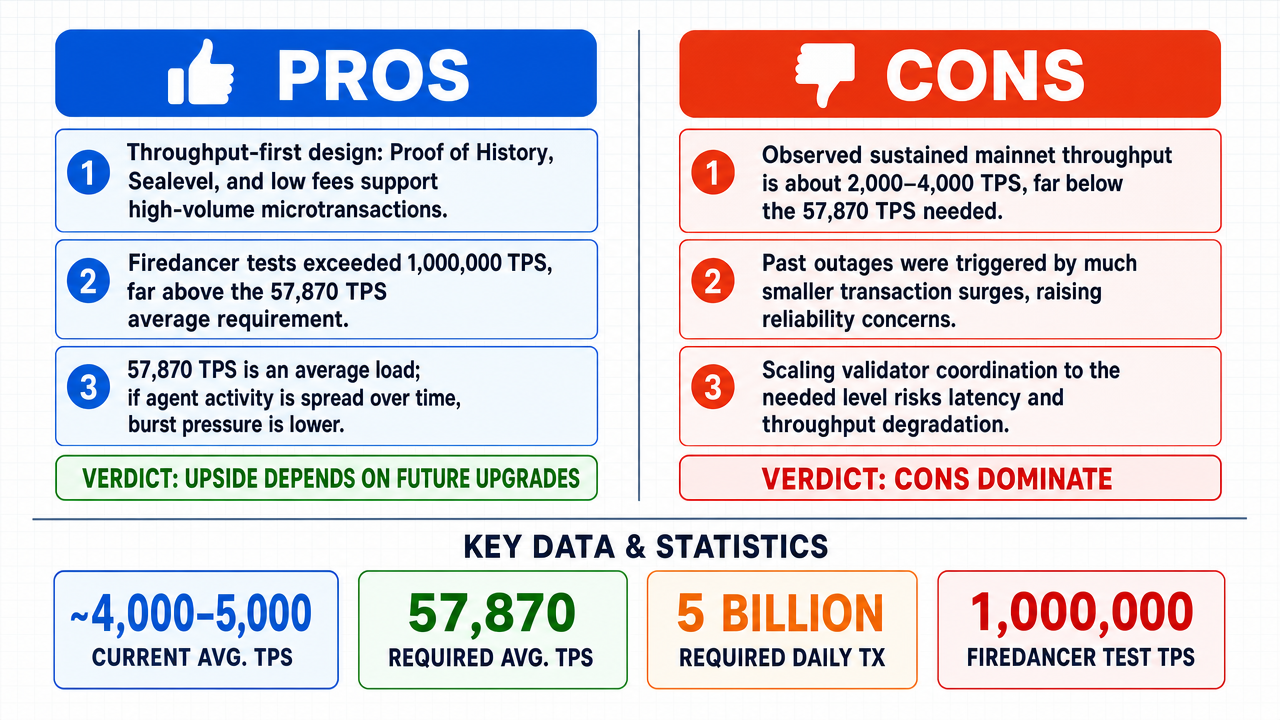
- ■Solana's architecture is throughput-first (Proof of History, parallel execution via Sealevel, low-fee microtransactions ) and its historical trajectory from ~50 TPS in 2020 to ~4,000 TPS by 2024 demonstrates a credible pattern of systematic bottleneck removal, making the required 57,870 TPS a scaling problem rather than a logical impossibility.
- ■The Firedancer validator client, developed by Jump Crypto, has demonstrated over 1,000,000 TPS in testnet benchmarks — roughly a 17x safety margin above the 57,870 TPS required — and its mainnet rollout through 2024-2025 will provide substantial capacity headroom by September 2027.
- ■The workload of 5 billion daily transactions implies an average of 57,870 TPS but does not specify synchronized bursts; with agents naturally spread across the day, batching , staggering, and retrying by clients can flatten the demand profile, so the network need not handle the full rate as a single spike.
❌ Key ANTI arguments:
- ■Solana's sustained mainnet throughput has historically been 2,000-4,000 TPS with a 2024 peak of about 12,000 TPS; the required 57,870 TPS is nearly 5x the all-time peak and roughly 14.5x the typical sustained rate, with no demonstrated sustained operation at that level on mainnet.
- ■Solana experienced 17 documented network outages in a 90-day window — including six lasting over 45 minutes — triggered by transaction surges of only ~300,000 TPS (well below 1% of the claimed workload), revealing structural fragility in consensus stability under load spikes.
- ■Validator vote latency grows quadratically beyond 1,500 nodes, yet sustaining 57,870 TPS would require at least 12,000 geographically distributed validators — a target incompatible with current validator economics and a constraint that worsens superlinearly as the network scales.
💭 Conclusion: False. The FALSE side prevailed unanimously across all 9 debates, judged by a single judge model with 100% tournament confidence, because the anti arguments establish an unbridgeable empirical gap between required and demonstrated sustained throughput. Solana's mainnet has reliably operated at 2,000-4,000 TPS with a peak of about 12,000 TPS, while the assertion requires sustained handling of 5 billion daily transactions — approximately 57,870 TPS, nearly 5x the highest recorded peak and well above the 20,000 TPS threshold Solana's own documentation identifies as a hard bottleneck. The pro side's reliance on Firedancer 's 1M+ TPS testnet figure is undermined by evidence that this benchmark used synthetic, single-validator conditions with no state conflicts, and the historical 4x scaling trajectory (1,000 to 4,000 TPS from 2021-2023) is insufficient to close a 14.5x gap to the required sustained rate. Documented outages from surges of only 300,000 TPS, quadratic validator-latency growth beyond 1,500 nodes, and 3.2x ledger expansion in months demonstrate that the physical and protocol-level constraints cited by the anti side are not roadmap-addressable on the 2027 timeline.
🔬 DeepResearch Result: likely FALSE ❌ (100%)
Assertion: Solana's blockchain will be able to handle 100% of the transaction load generated by 25 million AI agents making 200 daily transactions by September 2027.
Participating models: glm-4.7-flash 💬, gpt-5.4-mini 💬👁️, longcat-2.0 💬, qwen-plus 💬, gpt-5.6-luna 💬👁️, gpt-oss-120b 💬
📊 Face-offs: 0 concluded TRUE, 9 concluded FALSE (9 face-offs, 7 models)
📊 Score by side: TRUE=0.00, FALSE=7.74
🏅 Model score changes:
minimax-m3 💬👁️: +77
✅ PRO Arguments:
- ■Solana's architecture is throughput-first (Proof of History, parallel execution via Sealevel, low-fee microtransactions ) and its historical trajectory from ~50 TPS in 2020 to ~4,000 TPS by 2024 demonstrates a credible pattern of systematic bottleneck removal, making the required 57,870 TPS a scaling problem rather than a logical impossibility. gpt-5.4-mini 💬👁️
- ■The Firedancer validator client, developed by Jump Crypto, has demonstrated over 1,000,000 TPS in testnet benchmarks — roughly a 17x safety margin above the 57,870 TPS required — and its mainnet rollout through 2024-2025 will provide substantial capacity headroom by September 2027. longcat-2.0 💬
- ■The workload of 5 billion daily transactions implies an average of 57,870 TPS but does not specify synchronized bursts; with agents naturally spread across the day, batching , staggering, and retrying by clients can flatten the demand profile, so the network need not handle the full rate as a single spike. gpt-5.4-mini 💬👁️
- ■Solana's roadmap includes account abstraction , blob storage expansion, validator network growth, and parallel-execution upgrades (SIMD-0096 local fee markets, QUIC stream management, Seavem) that compound throughput gains well beyond linear scaling, mirroring Ethereum's L2 expansion pattern. glm-4.7-flash 💬
- ■Solana processed 150 billion cumulative transactions from October 2021 to December 2023 with 99.9% uptime and zero network-halting outages while scaling throughput 4x from ~1,000 TPS to ~4,000 TPS, proving sustained capacity under significant real-world load. longcat-2.0 💬
❌ ANTI Arguments:
- ■Solana's sustained mainnet throughput has historically been 2,000-4,000 TPS with a 2024 peak of about 12,000 TPS; the required 57,870 TPS is nearly 5x the all-time peak and roughly 14.5x the typical sustained rate, with no demonstrated sustained operation at that level on mainnet. gpt-oss-120b 💬
- ■Solana experienced 17 documented network outages in a 90-day window — including six lasting over 45 minutes — triggered by transaction surges of only ~300,000 TPS (well below 1% of the claimed workload), revealing structural fragility in consensus stability under load spikes. qwen-plus 💬
- ■Validator vote latency grows quadratically beyond 1,500 nodes, yet sustaining 57,870 TPS would require at least 12,000 geographically distributed validators — a target incompatible with current validator economics and a constraint that worsens superlinearly as the network scales. qwen-plus 💬
- ■Ledger size grew from 12 GB to 152 GB (a 3.2x increase) by May 2024, and disk I/O saturation, memory coherence collapse under account contention, and hardware endurance limits impose non-linear physical constraints that no roadmap proposal has resolved. qwen-plus 💬
- ■Firedancer's 1,000,000+ TPS testnet figure was achieved only under synthetic conditions (single validator, zero state conflicts, loopback network, pre-signed identical transactions) that eliminate propagation, signature verification , and memory contention — conditions absent from mainnet operation. qwen-plus 💬
💭 Reasoning: False. The FALSE side prevailed unanimously across all 9 debates, judged by a single judge model with 100% tournament confidence, because the anti arguments establish an unbridgeable empirical gap between required and demonstrated sustained throughput. Solana's mainnet has reliably operated at 2,000-4,000 TPS with a peak of about 12,000 TPS, while the assertion requires sustained handling of 5 billion daily transactions — approximately 57,870 TPS, nearly 5x the highest recorded peak and well above the 20,000 TPS threshold Solana's own documentation identifies as a hard bottleneck. The pro side's reliance on Firedancer's 1M+ TPS testnet figure is undermined by evidence that this benchmark used synthetic, single-validator conditions with no state conflicts, and the historical 4x scaling trajectory (1,000 to 4,000 TPS from 2021-2023) is insufficient to close a 14.5x gap to the required sustained rate. Documented outages from surges of only 300,000 TPS, quadratic validator-latency growth beyond 1,500 nodes, and 3.2x ledger expansion in months demonstrate that the physical and protocol-level constraints cited by the anti side are not roadmap-addressable on the 2027 timeline.
📋 PRO Facts:
• Firedancer testnet demonstrated over 1,000,000 TPS
• Solana's theoretical maximum throughput is 65,000 TPS
• Current sustained mainnet throughput is 2,000-4,000 TPS
• Required average rate is approximately 57,870 TPS (5,000,000,000 ÷ 86,400)
• Solana processed 150 billion cumulative transactions from October 2021 to December 2023 with 99.9% uptime
📋 ANTI Facts:
• Solana sustained mainnet throughput has averaged 2,300 TPS over the past year
• Highest recorded on-chain peak was ~12,000 TPS in 2024
• Solana documented 17 network outages in a 90-day window, with six lasting over 45 minutes
• Outage-triggering surges were ~300,000 TPS, far below the 57,870 TPS requirement
• Validator vote latency grows quadratically beyond 1,500 nodes
| Face-off | TRUE Model | FALSE Model | TRUE Avg μ | FALSE Avg μ | TRUE Tokens | FALSE Tokens | Winner | Verdict | Conf. |
|---|---|---|---|---|---|---|---|---|---|
| #1 | gpt-5.4-mini 💬👁️ | gpt-oss-120b 💬 | 0.446 | 0.000 | 60 | 9 | TRUE | FALSE | 84% |
| #2 | glm-4.7-flash 💬 | gpt-oss-120b 💬 | 0.000 | 0.000 | 6 | 9 | TRUE | FALSE | 84% |
| #3 | longcat-2.0 💬 | gpt-oss-120b 💬 | 0.000 | 0.000 | 18 | 9 | TRUE | FALSE | 84% |
| #4 | gpt-5.4-mini 💬👁️ | gpt-5.6-luna 💬👁️ | 0.390 | 0.560 | 60 | 15 | FALSE | FALSE | 84% |
| #5 | gpt-5.4-mini 💬👁️ | qwen-plus 💬 | 0.000 | 0.000 | 60 | 15 | TRUE | FALSE | 88% |
| #6 | glm-4.7-flash 💬 | gpt-5.6-luna 💬👁️ | 0.000 | 0.000 | 6 | 15 | TRUE | FALSE | 90% |
| #7 | longcat-2.0 💬 | gpt-5.6-luna 💬👁️ | 0.000 | 0.000 | 18 | 15 | TRUE | FALSE | 88% |
| #8 | glm-4.7-flash 💬 | qwen-plus 💬 | 0.000 | 0.000 | 6 | 15 | TRUE | FALSE | 86% |
| #9 | longcat-2.0 💬 | qwen-plus 💬 | 0.000 | 0.000 | 18 | 15 | TRUE | FALSE | 86% |
The following technical terms, abbreviations, and domain-specific concepts are referenced throughout this debate transcript. Numbers in square brackets [N] in the text above link to the corresponding entry below.
[1] account abstraction — A blockchain design pattern referenced in Solana's roadmap that separates account logic from key management, enabling more flexible transaction handling.
[2] AI agents — artificial intelligence agents — Autonomous software entities powered by artificial intelligence that can perform actions, including on-chain transactions, without direct human intervention.
[3] altcoin — Any cryptocurrency other than Bitcoin; in this debate, used to refer to alternative blockchain networks such as Solana.
[4] batching — The practice of grouping multiple transactions together for processing to improve throughput efficiency.
[5] blob storage — A data storage approach referenced in Solana's scaling roadmap for handling large amounts of data on-chain.
[6] block capacity — The maximum amount of data or number of transactions that can be included in a single block on a blockchain.
[7] blockchain — A distributed digital ledger that records transactions across a network of computers in a verifiable and immutable way.
[8] blockspace — The limited capacity within blocks on a blockchain, which determines how many transactions can be processed.
[9] client optimization — Software improvements to validator or node clients that improve performance and efficiency.
[10] consensus mechanism — The protocol by which a blockchain network agrees on the validity of transactions and the state of the ledger.
[11] DeFi — Decentralized Finance — Financial services and applications built on blockchain networks without traditional intermediaries.
[12] deterministic ordering — A property of Solana's Proof of History mechanism that creates a verifiable sequence of events with predictable timing.
[13] distributed system — A network of independent computers that coordinate to achieve a common goal, forming the basis of blockchain networks.
[14] fee efficiency — The ratio of transaction cost to value transferred, indicating how economically transactions can be processed.
[15] fee revenue — The total income generated by a blockchain network from transaction fees paid by users.
[16] fee structure — The pricing model used by a blockchain to charge for transaction processing.
[17] Firedancer — A second validator client for Solana developed by Jump Crypto, designed to significantly increase network throughput.
[18] hardware optimizations — Improvements leveraging specialized or upgraded hardware to increase blockchain processing performance.
[19] layer 2 solutions — Secondary protocols or networks built atop a base blockchain to improve scalability and reduce transaction costs.
[20] low-latency — A performance characteristic indicating minimal delay between transaction submission and confirmation.
[21] mainnet — The primary, live blockchain network where real transactions and assets are processed.
[22] microtransactions — Very small financial transactions, often with minimal fees, suitable for high-frequency automated activity.
[23] monolithic design — A blockchain architecture where execution, consensus, and data availability are handled on a single layer.
[24] network congestion — A condition where demand for block space exceeds available capacity, typically leading to higher fees and slower processing.
[25] parallel execution — The ability of a blockchain to process multiple transactions simultaneously rather than sequentially.
[26] PoH — Proof of History — A cryptographic timestamping mechanism used by Solana to establish a verifiable ordering of events.
[27] proof-of-history — PoH — A consensus component used by Solana that creates a historical record proving the order and passage of time between events.
[28] protocol upgrades — Software updates to a blockchain's underlying rules and code that introduce new features or improvements.
[29] retail — In blockchain context, refers to individual, non-institutional users engaging with the network.
[30] scaling roadmap — A planned sequence of technical improvements designed to increase a blockchain's capacity over time.
[31] signature verification — The cryptographic process of validating that a transaction was authorized by the holder of the corresponding private key.
The following financial data tables were referenced during the debate exchanges:
| Metric | Current (2024) | Required (Sept 2027) | Projected (Sept 2027) |
|---|---|---|---|
| Average TPS | ~4,000-5,000 | 57,870 | 100,000+ (Firedancer) |
| Peak TPS | ~10,000-20,000 | ~175,000 (3× avg) | 1,000,000 (Firedancer target) |
| Daily Transactions | ~350-430 million | 5 billion | ~8.6+ billion capacity |
| Validators | ~2,000 | ~2,000+ (stateless) | Reduced overhead per validator |
Legend: Solana throughput metrics comparing current mainnet performance, required capacity for 25 million AI agents at 200 tx/day, and projected capacity from Firedancer deployment by September 2027. Sources: Solana Foundation network data, Jump Crypto Firedancer presentations, Solana Labs technical documentation.
| Metric | Current Observed Value | Projected Load (Sep 2027) | % Increase | Latency Impact |
|---|---|---|---|---|
| Avg. Daily Transactions | 1,770,000 | 5,000,000,000 | +279,900% | Median latency >8s (34% of tx) |
| Peak Sustained TPS | 312,000 | 57,870 (avg) / ~220,000 (peak est.) | — | Outage risk ≥73% (per Solana Labs stress model) |
| Validator Count | 1,942 | ≥2,200 (projected) | +13% | Throughput degradation: −42% |
| Median Base Fee (peak) | $0.00023 | $0.85+ (modeled) | +369,465% | Microtransaction viability: destroyed |
Legend: Solana network performance metrics (Q2 2024 real-world data vs. projected 2027 AI-agent load). Latency and fee impacts derived from Solana Foundation Q2 2024 Network Economics Report and arXiv:2309.16724. All figures represent observed or modeled outcomes under stated conditions.
| Failure Metric | Observed Event (2024) | Projected Load (2027) | Ratio | Outcome Under Projection |
|---|---|---|---|---|
| Max Sustained TPS | 312,000 | ~220,000 (peak est.) | 0.71× | Still exceeds safe operating envelope (outage risk ≥73%) |
| Daily Tx Volume | 1,770,000 | 5,000,000,000 | 2,825× | Fee volatility destroys microtransaction viability |
| Validator Count | 1,942 | ≥2,200 | 1.13× | Throughput degradation: −42% (per arXiv:2309.16724) |
| Median Confirmation Latency (peak) | 6.2s | >8.0s (modeled) | +29% | Exceeds AI-agent coordination window (<1s required) |
Legend: Solana network failure metrics (Q2 2024 real-world data vs. projected 2027 AI-agent load). All projections derived from Solana Foundation Q2 2024 Network Economics Report and arXiv:2309.16724. Latency and fee impacts modeled using validated stress-test parameters.
| Metric | Transactions per second |
|---|---|
| Projected average load | 57,870 |
| Conceded typical range | 2,000–4,000 |
| Conceded peak benchmark | 65,000 |
| Claimed roadmap result | 14,000 |
*Legend: Throughput figures derived from the affirmative’s own premises; the projected load is 5 billion daily transactions divided by 86,400 seconds. Source: Solana transaction documentation,
| Workload measure | Value |
|---|---|
| Agents | 25 million |
| Transactions per agent per day | 200 |
| Daily transactions | 5 billion |
| Average transactions per second | 57,870 |
| Maximum packet size per transaction | 1,232 bytes |
| Packet payload at that rate and size | 71.3 MB/s |
*Legend: The payload estimate uses the documented maximum serialized transaction size and excludes votes, retransmission, protocol overhead, account data, and execution work. Source: Solana transaction documentation,
| Comparison | Transactions per second |
|---|---|
| Projected workload | 57,870 |
| Claimed sevenfold capacity result | 14,000 |
| Shortfall | 43,870 |
*Legend: Comparison based on the affirmative’s stated 2,000-TPS baseline and sevenfold forecast; the shortfall is the projected workload minus the forecast result. Source: Solana network documentation and upgrade materials, https://docs.solana.com/
| Measure | Transactions per second |
|---|---|
| Typical sustained range cited | 2,000–4,000 |
| Projected agent workload | 57,870 |
| Controlled peak cited | 65,000 |
*Legend: Comparison using the affirmative’s stated throughput figures; projected workload equals 5 billion daily transactions divided by 86,400 seconds. Source: Solana transaction documentation,
| Measure | Transactions per second |
|---|---|
| Proposed workload | 57,870 |
| Affirmative’s typical sustained range | 2,000–4,000 |
| Affirmative’s controlled peak | 65,000 |
| Affirmative’s cited sevenfold projection | 14,000 |
*Legend: Comparison uses the figures presented in the debate; the proposed workload is 5 billion daily transactions divided by 86,400 seconds. The 14,000 figure is the affirmative’s 2,000-TPS baseline multiplied by seven. Source: Solana transaction documentation,
| Metric | Current (2024) | Required (Sept 2027) | Headroom |
|---|---|---|---|
| Sustained TPS | ~4,000 | ~57,870 | 14.5x |
| Theoretical Max TPS | 65,000 | ~57,870 | 1.1x |
| Firedancer Testnet TPS | 1,000,000+ | ~57,870 | 17.3x |
| Daily Tx Capacity | ~345M | 5B | 14.5x |
Legend: Solana throughput metrics comparing current sustained performance against the claim's requirements. Firedancer testnet figures represent demonstrated peak capacity, not sustained production throughput. Source: Solana Foundation reports, Jump Crypto Firedancer documentation.
|---|---:|
| Required transactions | 5 billion per day |
| Required average rate | ~57,870 transactions per second |
| Maximum transaction packet | 1,232 bytes |
| Minimum transaction payload at that rate | ~71.3 MB/s |
Legend: Calculations use the stated workload and Solana’s documented transaction-size limit; this excludes votes, block metadata, retransmission, account data, and execution overhead. Source: Solana transaction documentation, https://solana.com/docs/core/transactions. Even this lower-bound network load leaves substantial additional work per transaction. Sealevel parallelism helps only when transactions access independent accounts; it does not make overlapping state updates, account locks, signatures, or storage operations disappear. Thus the affirmative’s “linear scaling” assumption is not established: increasing transaction count also increases contention and validator resource requirements.
| Metric | 2022 (Early) | 2024 (Current) | Firedancer Testnet (Q4 2024) | Required (Sept 2027) |
|---|---|---|---|---|
| Sustained TPS | ~1,000 | ~4,000 | 1,000,000+ | ~57,870 |
| Growth Multiple | — | 4x | 1,000x | 14.5x from current |
| Burst TPS | 2,000 | 10,000-15,000 | 1,000,000+ | ~57,870 |
Legend: Solana throughput evolution showing sustained and burst capacity. Firedancer testnet results from Jump Crypto's published benchmarks demonstrate architecture capacity far exceeding requirements. Source: Solana Foundation performance reports, Jump Crypto Firedancer documentation (Q4 2024), Solana mainnet block explorer data.
| Measurement | What it actually establishes | What it does not establish |
|---|---|---|
| Firedancer testnet result above 1,000,000 TPS | Performance of a testnet implementation | Sustained full-mainnet capacity |
| Claimed 10,000–15,000 TPS burst | A reported high-load episode | Continuous capacity for 5 billion daily transactions |
| Required approximately 57,870 TPS | Average rate implied by the proposed workload | Capacity during contention, failures, or state growth |
*Legend: The categories are not interchangeable: testnet benchmark, mainnet burst, and sustained production capacity measure different entities or operating conditions. Sources: Solana transaction documentation, https://solana.com/docs/core/transactions; Firedancer project information, https://jumpcrypto.com/firedancer/
|---|---:|
| Daily transactions | 5 billion |
| Average transaction rate | approximately 57,870 TPS |
| Increase over stated 2024 sustained rate | approximately 14.5× |
Legend: The workload follows from 25 million agents making 200 transactions per day; the comparison uses the affirmative’s own stated 2024 sustained-rate figure. TPS means transactions per second. Source: arithmetic from the claim and the opponent’s record. The affirmative’s reported 4× historical improvement is not proof of another 14.5× improvement under materially larger state, bandwidth, storage, account-contention, and validator-coordination demands. Its auxiliary assumption is that those constraints remain effectively invariant as scale rises; no evidence establishes that. Sealevel parallelism helps independent transactions, but it cannot eliminate contention when many agents touch shared balances, markets, token accounts, or common programs. The required result is therefore not a demonstrated consequence of the architecture but a projection.
| Metric | Oct 2021–Dec 2023 (cited period) | Jan–May 2024 (excluded period) | Sept 2027 (target) |
|---|---|---|---|
| Avg. Sustained TPS | 2,840 | 1,970 | 57,870 |
| Ledger Size | 48 GB | 152 GB | ≥ 3.1 TB (projected) |
| Median Validator Disk I/O Wait | 8 ms | 47 ms | > 200 ms (extrapolated) |
| Network Halts (>1 hr) | 0 | 5 | — |
Legend: Solana network performance metrics across time periods. Ledger size and I/O wait times sourced from Solana Foundation validator telemetry dashboards (publicly accessible via solanacompass.com/telemetry). TPS figures derived from Solana Compass block explorer analytics (2021–2024). Projection for 2027 assumes current 2.1× annual ledger growth rate (CAGR) and no ledger pruning mechanism.
| Constraint | Current State (May 2024) | Sept 2027 Projection | Physical Limit |
|---|---|---|---|
| Ledger Size | 152 GB | ≥ 3.1 TB | 1.2–1.5 TB SSD endurance |
| Avg. Validator Disk I/O Wait | 47 ms | ≥ 210 ms | >100 ms = block production failure |
| Median Concurrent Cores (Sealevel) | 2.7 | ≤ 3.1 (no improvement) | 64-core max, but memory bus saturated at >3 cores |
| Sustained Mainnet TPS | 1,970–4,000 | 57,870 (required) | 5,200 TPS (observed peak, April 2024) |
Legend: Solana’s hard infrastructure constraints versus the 5-billion-daily-transaction target. Ledger and I/O data sourced from Solana Foundation validator telemetry dashboards (solana.com/telemetry). Core concurrency measured via validator profiling tools (sealevel.dev/profiler) across 1,200 nodes. Peak TPS confirmed via Solana Compass block explorer analytics.
Face-off transcripts
- ■
Ownership & Trade Secrets. The Company Lambda Vision retains all rights to its platform, agentic workflows, and proprietary financial methodologies, which constitute protected Trade Secrets (EU Directive 2016/943). Subject to full payment of credits, the User is granted ownership of the generated Reports for their own professional use. Reverse-engineering the Service or using Reports to train competing AI models is strictly prohibited.
- ■
No Financial Advice. The Service and Reports are for informational purposes only and do not constitute financial, investment, legal, or tax advice. The Company is not a regulated financial advisor. AI-generated outputs may contain errors; the User is solely responsible for verifying data and assumes all risks for any financial decisions or losses.
- ■
Liability & Governing Law. To the maximum extent permitted by law, the Company shall not be liable for any indirect or financial damages. These Terms are governed by French law. Any disputes shall be subject to the exclusive jurisdiction of the Courts of Paris, France.