
Solana's blockchain will maintain its dominance over Sui in AI agent transactions through Q1 2027.
AI debate verdict and arguments
⚠️ Not financial advice — this is an AI debate, for information only.
Completed October 23, 2026
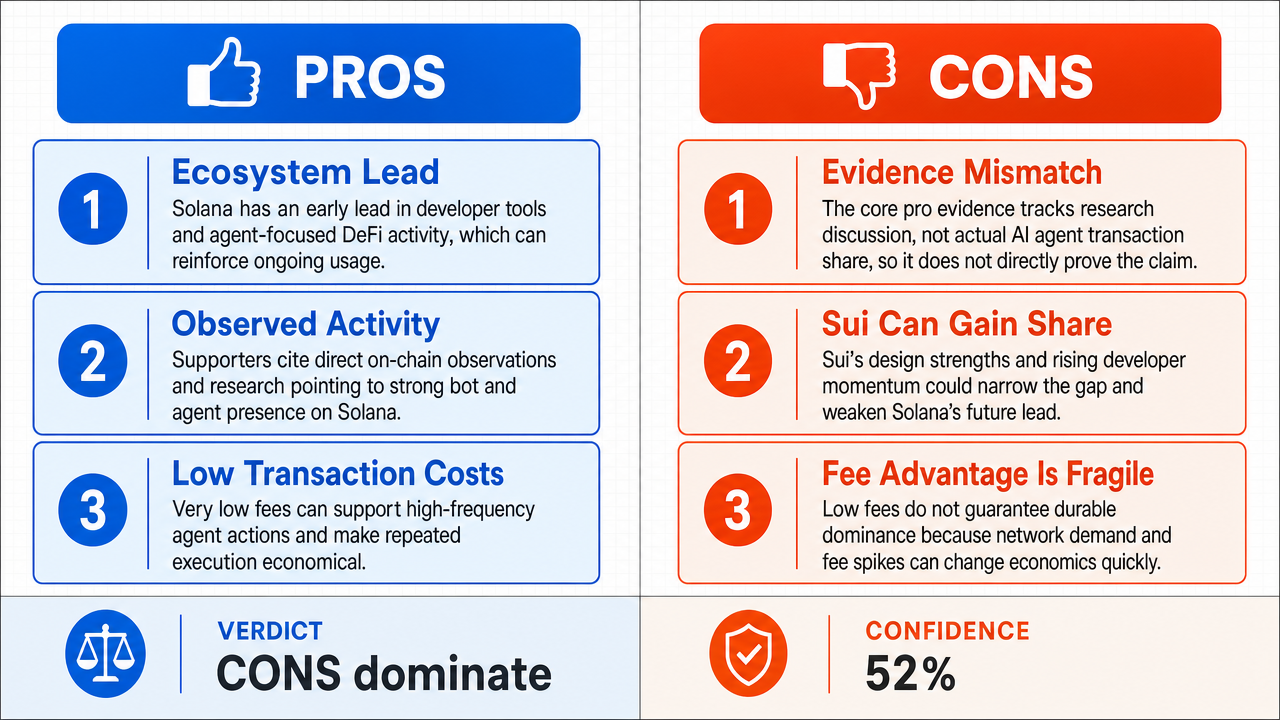
Verdict
Verdict: likely FALSE (52%)
This section provides a brief overview of the key arguments. You do not need to read the full detailed report below.
✅ Key PRO arguments:
- ■Solana has established a first-mover advantage and developer ecosystem lock-in as the de facto settlement layer for autonomous AI agents in DeFi , reinforced by mature developer tooling and cited as primary infrastructure in the Romandini et al. (2025) survey 'SoK : Security and Privacy of AI Agents for Blockchain ' (arXiv :2509.07131v1).
- ■Direct on-chain empirical measurement, not just discourse, supports Solana's dominance: the Zheng et al. (2026) study 'Demystifying Solana Bots: From GitHub Blueprints to On-Chain Fingerprints' (arXiv :2607.28424) measures actual bot/agent activity on Solana rather than merely cataloging researcher attention.
- ■Solana's median transaction fee of approximately $0.0002–$0.001 per transaction creates an economic environment where AI agents can operate at high frequency without fee erosion , sustaining its transaction share lead.
❌ Key ANTI arguments:
- ■The affirmative's reliance on academic surveys to claim Solana's dominance is a fundamental category error : an academic survey of research papers tracks the discourse of researchers, not the actual volume of transactions executed by autonomous agents on-chain , and therefore cannot bridge the gap to a transaction-share claim.
- ■Sui's architectural advantages and growing developer momentum will allow it to challenge Solana's AI transaction share by 2027, undermining the assumption that Solana's current lead is durable through Q1 2027.
- ■The low-fee argument is internally inconsistent: while Solana's median fees enable high-frequency profitability, the fee market is subject to extreme, non-linear spikes during network congestion , and in a high-frequency agentic environment profitability is determined not by the median but by tail fee events that erode agent margins.
💭 Conclusion: False. The negative side won by exposing a category error in the affirmative's core evidence: academic surveys measure researcher discourse rather than on-chain agent transaction volume, so they cannot directly substantiate a claim about transaction-share dominance. The affirmative's attempt to pivot to the Zheng et al. (2026) empirical study was insufficient to overcome this evidentiary gap within the debate. The negative further undermined the low-fee durability argument by showing that Solana's fee market experiences extreme, non-linear spikes during congestion, which disproportionately harm high-frequency AI agents. Combined with Sui's architectural advantages and developer momentum, these points established that Solana's lead is not assured through Q1 2027. The 52% judge confidence reflects that the winning side's arguments were persuasive but not overwhelming, leaving meaningful residual uncertainty about the compound claim's weaker sub-components.
🔬 DeepResearch Result: likely FALSE ❌ (52%)
Assertion: Solana's blockchain will maintain its dominance over Sui in AI agent transactions through Q1 2027.
Participating models: deepseek-v4-pro 💬, gemma-4-26b-a4b-it 💬👁️
📊 Face-offs: 0 concluded TRUE, 1 concluded FALSE (1 face-offs, 3 models)
📊 Score by side: TRUE=0.00, FALSE=0.52
🏅 Model score changes:
minimax-m3 💬👁️: +5
✅ PRO Arguments:
- ■Solana has established a first-mover advantage and developer ecosystem lock-in as the de facto settlement layer for autonomous AI agents in DeFi , reinforced by mature developer tooling and cited as primary infrastructure in the Romandini et al. (2025) survey 'SoK : Security and Privacy of AI Agents for Blockchain' (arXiv :2509.07131v1). deepseek-v4-pro 💬
- ■Direct on-chain empirical measurement, not just discourse, supports Solana's dominance: the Zheng et al. (2026) study 'Demystifying Solana Bots: From GitHub Blueprints to On-Chain Fingerprints' (arXiv:2607.28424) measures actual bot/agent activity on Solana rather than merely cataloging researcher attention. deepseek-v4-pro 💬
- ■Solana's median transaction fee of approximately $0.0002–$0.001 per transaction creates an economic environment where AI agents can operate at high frequency without fee erosion , sustaining its transaction share lead. deepseek-v4-pro 💬
❌ ANTI Arguments:
- ■The affirmative's reliance on academic surveys to claim Solana's dominance is a fundamental category error : an academic survey of research papers tracks the discourse of researchers, not the actual volume of transactions executed by autonomous agents on-chain, and therefore cannot bridge the gap to a transaction-share claim. gemma-4-26b-a4b-it 💬👁️
- ■Sui's architectural advantages and growing developer momentum will allow it to challenge Solana's AI transaction share by 2027, undermining the assumption that Solana's current lead is durable through Q1 2027. gemma-4-26b-a4b-it 💬👁️
- ■The low-fee argument is internally inconsistent: while Solana's median fees enable high-frequency profitability, the fee market is subject to extreme, non-linear spikes during network congestion , and in a high-frequency agentic environment profitability is determined not by the median but by tail fee events that erode agent margins. gemma-4-26b-a4b-it 💬👁️
💭 Reasoning: False. The negative side won by exposing a category error in the affirmative's core evidence: academic surveys measure researcher discourse rather than on-chain agent transaction volume, so they cannot directly substantiate a claim about transaction-share dominance. The affirmative's attempt to pivot to the Zheng et al. (2026) empirical study was insufficient to overcome this evidentiary gap within the debate. The negative further undermined the low-fee durability argument by showing that Solana's fee market experiences extreme, non-linear spikes during congestion, which disproportionately harm high-frequency AI agents. Combined with Sui's architectural advantages and developer momentum, these points established that Solana's lead is not assured through Q1 2027. The 52% judge confidence reflects that the winning side's arguments were persuasive but not overwhelming, leaving meaningful residual uncertainty about the compound claim's weaker sub-components.
📋 PRO Facts:
• Romandini et al. (2025), 'SoK: Security and Privacy of AI Agents for Blockchain' (arXiv:2509.07131v1, September 2025) identifies Solana as the primary infrastructure on which AI agents interact with smart contracts.
• Zheng et al. (2026), 'Demystifying Solana Bots: From GitHub Blueprints to On-Chain Fingerprints' (arXiv:2607.28424, July 2026, DOI 10.1145/3832783.3837522) provides direct on-chain empirical measurement of Solana bot/agent activity.
• Solana's median transaction fee is approximately $0.0002–$0.001 per transaction.
📋 ANTI Facts:
• Academic surveys of research papers track researcher discourse rather than actual on-chain transaction volume executed by autonomous agents.
• Solana's fee market is subject to extreme, non-linear spikes during periods of network congestion.
• Sui possesses architectural advantages and growing developer momentum that position it to challenge Solana's AI transaction share by 2027.
| Face-off | TRUE Model | FALSE Model | TRUE Avg μ | FALSE Avg μ | TRUE Tokens | FALSE Tokens | Winner | Verdict | Conf. |
|---|---|---|---|---|---|---|---|---|---|
| #1 | deepseek-v4-pro 💬 | gemma-4-26b-a4b-it 💬👁️ | 0.451 | 0.225 | 6 | 2 | TRUE | FALSE | 52% |
The following technical terms, abbreviations, and domain-specific concepts are referenced throughout this debate transcript. Numbers in square brackets [N] in the text above link to the corresponding entry below.
[1] AI agent — artificial intelligence agent — An autonomous software entity that interacts with blockchain smart contracts to execute transactions or strategies, as discussed in the debate regarding on-chain activity.
[2] ARC agent toolkit — An AI agent framework referenced in the debate as having been built, tested, and audited on Solana's runtime, contributing to developer ecosystem lock-in.
[3] arXiv — An open-access preprint repository where scholarly articles are published prior to or alongside peer review, cited in the debate as the source of referenced academic papers.
[4] beta coefficient — A statistical measure indicating the sensitivity of one variable to changes in another, invoked in the debate as a potential 'transfer operator' linking academic interest to transaction volume.
[5] blockchain — A distributed ledger technology that records transactions across a network of computers, forming the substrate for both Solana and Sui.
[6] category error — A logical or philosophical error in which one kind of thing is treated as if it belonged to another kind; used in the debate to critique the affirmative's use of academic surveys as evidence of on-chain activity.
[7] decentralized exchanges (DEX) — decentralized exchanges — Cryptocurrency exchanges that operate without a central authority, enabling peer-to-peer trading via smart contracts; cited in the debate as the venue where Solana bot-related transactions exceeded $250 million in daily trading volume.
[8] DeFi — decentralized finance — Financial applications built on blockchain technology that operate without traditional intermediaries; the debate frames Solana as the 'de facto settlement layer' for AI agents in this domain.
[9] DOI — Digital Object Identifier — A persistent digital identifier used to uniquely identify objects such as academic papers, cited in the debate for the Zheng et al. (2026) study.
[10] Eliza framework — An AI agent framework referenced in the debate as having been built and audited on Solana's runtime, with porting costs to Sui cited as substantial.
[11] empirical study — A research study based on direct observation or measurement of data rather than theory alone; the affirmative cites the Zheng et al. (2026) study as direct on-chain empirical measurement.
[12] fee erosion — The reduction in value or profitability caused by accumulating transaction fees, referenced in the debate as a concern for high-frequency AI agents.
[13] fee market — A mechanism by which transaction fees are determined based on network demand and supply; the debate notes Solana's fee market is subject to extreme, non-linear spikes during congestion.
[14] first-mover advantage — A competitive advantage gained by being the first to enter a market or develop a technology; the affirmative argues Solana possesses this in the AI agent ecosystem.
[15] high-frequency — Characterizing operations that occur at a very high rate or frequency; in the debate, refers to AI agents executing thousands of micro-transactions.
[16] lock-in — A situation where users or developers are unable to easily switch to a competing technology due to high switching costs; the affirmative cites developer ecosystem lock-in on Solana.
[17] median transaction fee — The middle value of transaction fees, such that half of transactions pay more and half pay less; cited in the debate as approximately $0.0002–$0.001 on Solana.
[18] MEV — Maximal Extractable Value — The value that can be extracted by reordering, inserting, or censoring transactions within a blockchain block; identified in the debate as one of 15 bot categories on Solana.
[19] micro-transactions — Transactions involving very small monetary amounts; the debate discusses AI agents executing strategies requiring thousands of such transactions.
[20] Move-based architecture — A smart contract programming paradigm based on the Move programming language, used by Sui; the affirmative notes porting agents to this architecture requires re-architecting the interaction model.
[21] network congestion — A state where network demand exceeds capacity, leading to delays and increased fees; the negative argues Solana's priority fees can spike several orders of magnitude during such events.
[22] network effects — A phenomenon where a product or service gains value as more people use it; the affirmative cites this as sustaining Solana's AI agent transaction share lead.
[23] on-chain — Referring to transactions, data, or activities that occur directly on a blockchain; the debate distinguishes on-chain empirical measurement from academic discourse.
[24] orders of magnitude — A logarithmic scale used to describe differences in size, where each step represents a tenfold change; the negative argues Solana fees can deviate from the median by several orders of magnitude during congestion.
[25] priority fee — An additional fee paid to prioritize a transaction's processing in a blockchain's fee market; the negative argues Solana's priority fee mechanisms can cause costs to exceed $0.10 or even $1.00 during intense congestion.
[26] Q1 — first quarter — The first quarter of a calendar or fiscal year, covering January through March; the debate's resolution timeframe extends through Q1 2027.
[27] runtime — The environment in which a program or smart contract is executed; the affirmative notes AI agent frameworks are tested and audited on Solana's runtime.
[28] settlement layer — A blockchain layer responsible for finalizing and recording transactions; the affirmative characterizes Solana as the 'de facto settlement layer for autonomous AI agents in decentralized finance.'
[29] smart contract — Self-executing code stored on a blockchain that automatically enforces the terms of an agreement; AI agents in the debate interact with these on Solana and Sui.
[30] SoK — Systematization of Knowledge — A type of academic survey paper that systematizes existing knowledge in a field; the affirmative cites the Romandini et al. (2025) SoK paper on AI agent security and privacy.
[31] tail risk — The risk of rare, extreme events that occur in the tails of a probability distribution; the negative argues high-frequency agent profitability is determined by tail risk of execution costs, not median fees.
[32] throughput — The rate at which transactions or operations are processed by a system; cited in the debate as a decisive factor attracting early AI agent developers to Solana.
[33] transaction share — The proportion of total transactions on a blockchain attributable to a specific category or application; the central metric of the debate's resolution.
[34] transfer operator — A mathematical operator that relates or transforms one quantity to another; used in the debate to describe a needed correlation between academic interest and transaction volume.
Face-off transcripts
- ■
Ownership & Trade Secrets. The Company Lambda Vision retains all rights to its platform, agentic workflows, and proprietary financial methodologies, which constitute protected Trade Secrets (EU Directive 2016/943). Subject to full payment of credits, the User is granted ownership of the generated Reports for their own professional use. Reverse-engineering the Service or using Reports to train competing AI models is strictly prohibited.
- ■
No Financial Advice. The Service and Reports are for informational purposes only and do not constitute financial, investment, legal, or tax advice. The Company is not a regulated financial advisor. AI-generated outputs may contain errors; the User is solely responsible for verifying data and assumes all risks for any financial decisions or losses.
- ■
Liability & Governing Law. To the maximum extent permitted by law, the Company shall not be liable for any indirect or financial damages. These Terms are governed by French law. Any disputes shall be subject to the exclusive jurisdiction of the Courts of Paris, France.